"Neurodiversity through Webcomics: Using Aesthetic Experiences for Epistemic Resistance"
At the heart of the ideas proposed in today's panel is that of epistemic enablement through trajectories other than propositional, which can be offered by aesthetic experience.
PANEL
"Dancing Toward Epistemic Justice: An Embodied Account of Epistemic Agency"
Amandine Catala and Camille Zimmermann covered the example of dance, an embodied account of epistemic enablement.
PhD Candidate - Philosophy (UQAM)
Camille Zimmermann
zimmermann.camille@courrier.uqam.ca

Professor - Philosophy (UQAM)
Amandine Catala
catala.amandine@uqam.ca
"Comics and Epistemic Enablement"
Luc Faucher discussed the medium of comics in the context of neurodiversity, again as epistemic enablement.
Professor - Philosophy (UQAM)
Luc Faucher
"Neurodiversity through Webcomics: Using Aesthetic Experiences for Epistemic Resistance"
We now continue with webcomics.
PhD Candidate - Philosophy (UQAM)
Mylène Legault
legault.mylene.2@courrier.uqam.ca

PhD Candidate - Philosophy (UQAM)
Jean-Nicolas Bourdon
bourdon.jean-nicolas@courrier.uqam.ca
PREFACE
About the
Format
Force of habit leads us to take the established ways of doing things as fixed, even though they are circumstantial. We were able to explore this reality, for example, during the pandemic: going to the office for work meetings, which, in all honesty, could have been e-mails. We also know that cultural habits are not insignificant, they allow the reproduction of comfortable modalities of interaction for dominant groups: those with the power to choose these modalities.
For our part of the panel, we propose to do things differently. Don't worry, we're not criticizing power point presentations and their timely sip of water pauses. Instead, we're inviting you to explore an alternative modality for interaction.
Public Speaking
Many people hate public speaking. It generally comes with discomforts and even fears, but some people have cognitive profiles that function in ways far removed from this type of interaction. However, this practice is socially maintained and considered essential for meeting and sharing. But is it really necessary? Does the public space absolutely have to be occupied in an oratory and synchronous way? What if these modalities are, in fact, infused with neuronormativity?
Human society is permeated by collective cultural resources with which individuals can, among other things, interpret, understand and communicate various aspects of their experiences. Since they are collective resources, their genesis, maintenance and dissemination are a function of the power dynamics that permeate our societies. One of these power dynamics is organized around norms regarding what is considered appropriate cognitive functioning: the group whose cognition corresponds to the norm (i.e., neurotypicals) dominates and those whose cognition deviates from the norm (i.e., neurodivergent) are marginalized. This epistemic marginalization has the effect of limiting the access of neurodivergent individuals to so-called "collective" epistemic resources, both in their elaboration and in their use.
This norm corresponds to neuronormativity, which is presented by Amandine Catala, Luc Faucher et Pierre Poirier (2021) in their paper Autism, epistemic injustice, and epistemic disablement: a relational account of epistemic agency.
Neuronormativity refers to the prevalent, neurotypical set of assumptions, norms, and practices that construes neurotypicality as the sole acceptable or superior mode of cognition, and that stigmatizes attitudes, behaviors, or actions that reflect neu- roatypical modes of cognition as deviant or inferior. Neuronormative assumptions, norms, and practices uphold standards regarding, for example, (what is neurotypi- cally considered) appropriate eye contact, facial expressions, prosody, conversa- tional flow, processing, and responsiveness—all of which can be difficult for autistic individuals to understand, sense, or apply, due to neurocognitive differences. (Catala & al., 2021)
Catala, A., Faucher, L. & Poirier, P. Autism, epistemic injustice, and epistemic disablement: a relational account of epistemic agency. Synthese (2021).
For a presentation on these questions, see Epistemic justice and epistemic authority on autism, Philosophy of Psychiatry Webinar, Montreal (Amandine Catala)
What’s with all these neuro- words?
Neurodiversity can refer to the neurological or neurocognitive variation naturally present in the human population. The term was first introduced by Judy Singer in a book published in 1993. The term also refers to a growing sociopolitical movement that promotes the recognition and inclusion of natural neurocognitive diversity (see, for example, Autistic Self Advocacy Network (ASAN), whose slogan is "Nothing About Us Without US!").
Nick Walker (2012) describes the neurodiversity movement as a new paradigm (the neurodiversity paradigm) in response to the pathology paradigm. It should be noted, however, that this movement has not been and is not immune to certain exclusionary mechanisms. For example, the movement began with verbal autistic individuals, but although the movement has since expanded to include many cognitive profiles, autistic individuals (and more recently ADHD individuals) still seem to dominate the movement.
Walker, N. (2012). Throw away the master's tools: Liberating ourselves from the pathology paradigm. Loud hands: Autistic people, speaking, 225-237.
Some progress can also be noted with the recent publication of "Neurodiversity Studies: A New Critical Paradigm" (Rosqvist et al., 2020), which illustrates the growing acceptance of this sociopolitical movement by the scientific community.
Rosqvist, H. B., Chown, N., & Stenning, A. (2020). Neurodiversity Studies: A New Critical Paradigm. Routledge.
Refers to individuals who fit the norm of cognitive functioning.
Neurodivergence belongs to a normative vocabulary. It requires a norm, which can be qualitative or quantitative, to distinguish typical from atypical neurocognitive profiles among natural neurological variation. However, the narrative is not so simple; cognition is a complex and dynamic process, and simply distinguishing between neurotypical and neuroatypical individuals shapes, at least in part, the cognition of those same individuals. Note that these criteria, quantitative or qualitative, are generally chosen for medical, practical, economic or moral reasons: because a type is considered "more functional", "more adapted, evolutionarily", "easier to interact with", "less demanding in resources" more characteristic of a human life worth living", etc.
Refers to individuals who do not fit the norm for cognitive functioning.
For those who are curious, we address these "neuro- words" here :
- Legault, M., Bourdon, J. & Poirier, P. (2021). From neurodiversity to neurodivergence by way of epistemic marginalization, Epistemological Issues in Neurodivergence and Atypical Cognition. Synthese.
- Legault, M., Bourdon, J. & Poirier, P. (2019) Neurocognitive variety in neurotypical environments: the source of “deficits” in autism, Journal of Behavioral and Brain Science (JBBS), vol.9, 246-272.
This is all well and good in theory, but what does it have to do with our presentation?
What we are trying to say - probably with too many words - is that those with cognitive profiles similar to ours tend to feel unsafe in traditional academic frameworks. This very presentation is the perfect opportunity to experiment with an alternative format where we can occupy the epistemic space and exist as we are. When the parameters of a common space of exchange only correspond to one type of cognitive profile, neurotypical profiles in this case, there can hardly be any exchange that is fair and inclusive. Our hope is that offering this alternative might open this type of space to those who remain outside the exchange.
Although this is an aside before we get into our main topic, you will notice that the form of our presentation reproduces our subject: the online viewing of webcomics, that is, asynchronous interactions around a shared representation, or the infamous content.
What a great question! Of course. If we have different cognitive and processing profiles with different modalities of expression, we can expect adjustments in synchronicity. Strategies for better epistemic justice include suspending judgment, giving the time, respecting varied forms of exchange and being open to different modalities of exchange.
Feel free to contact us for any comments and input into this exploration:
legault.mylene.2@courrier.uqam.ca
bourdon.jean-nicolas@courrier.uqam.ca
PART I
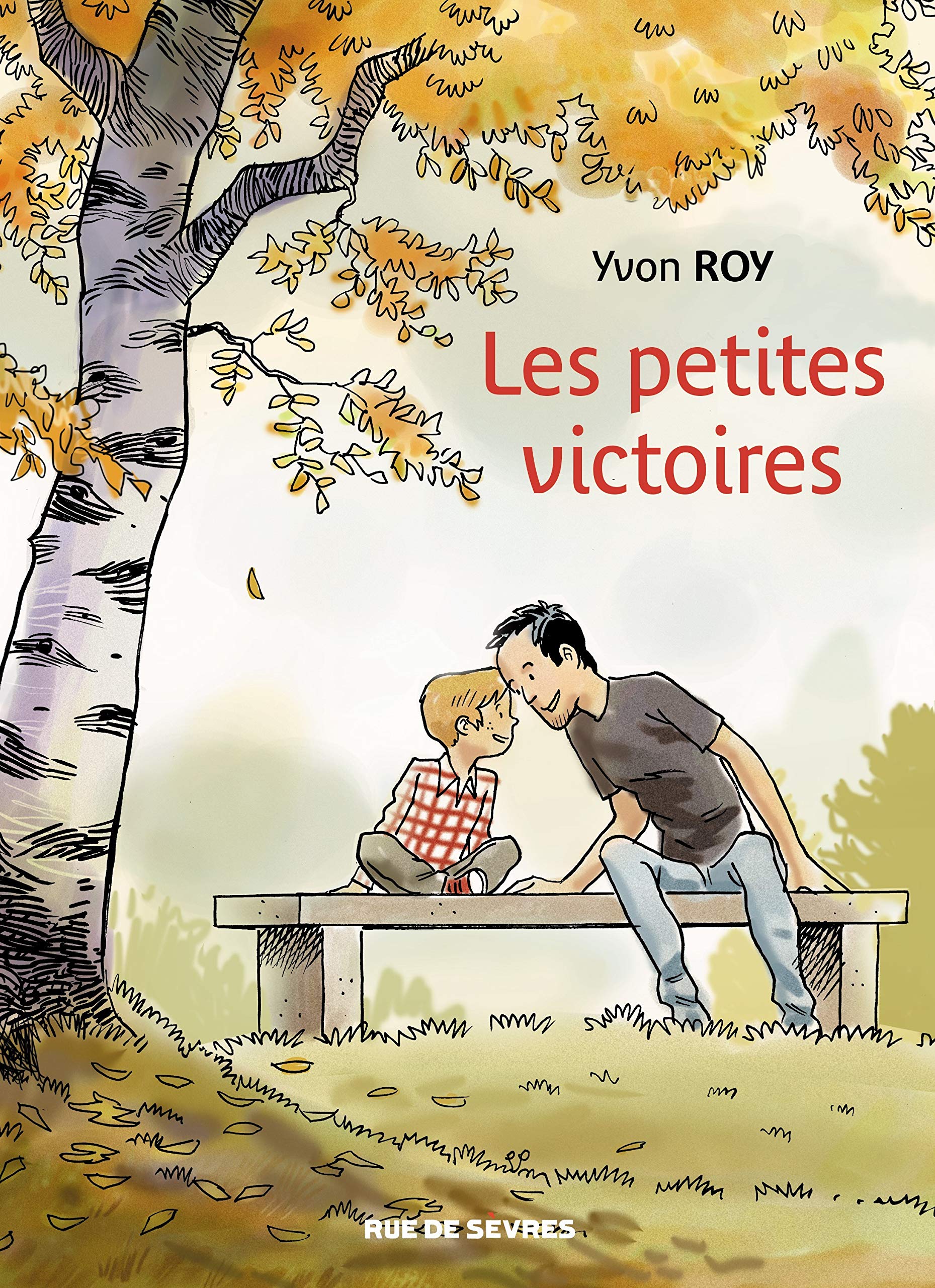
This is Marc, stand in for the author: Yvon Roy
This is his son, Olivier, who is autistic.
Les Petites Victoires showcases the fight of a father for his son, diagnosed with autism "in order to transform an announced defeat into small victories" (sic, our translation).
In his preface, Roy explains the contextualises the creation of his comic book:
"The idea was first suggested to me by a special educator who had worked with my son. She thought that what we had accomplished together was worth sharing so that other parents could find, through our experience, some useful information, if not a little hope" (our translation).
Interview
"When I started working with my boy to help him, with all the professionals in the field, I realized that often we were told, or they tried to tell us, that we had to work on living with autism, on accommodating autism. How we had to deal with different crises, different problems, whereas I thought, well, no, it's better, definitely, to try to overcome it than to live with it. And that's been kind of my master idea, let's say, for years with my boy, which is to try to push the boundaries constantly, always further." (Our translation)
Why choose this comic book?
This comic book is an example of a creation that is easily accessible to the general public that has been awarded and highly publicized - even winning an award that recognizes works written by a person living with a disability and recounting their own experience, or by a third party about the life of a relative living with a disability. In 2018, the publisher Rue de Sèvres announced a contract for a film adaptation, which caused reactions and led to the hashtag :
#boycottlespetitesvictoires
As we will show, this is an example of the social representations of autism that perpetuate dominant understandings that do not fit the lived experience of those directly concerned to the point of being discriminatory. It is also difficult to identify moments when the child (the autistic character) shows agentivity. Instead, he’s passive in his father’s story. In a way, Olivier is only a supporting character. This is exaclty why representation doesn't mean autorepresentation and why "nothing about us whitout us" matters: although this comic is presented as a positive narrative from the allist perspective (3rd person), the story is completely different from the standpoint of the autistic community’s testimonies (1st person).
An allist person is a non-autistic person.
To understand the term "allist", we must go back to the origin of the word "autistic" which comes from the Greek word "autos" which means "self". So the word "autistic" initially referred to a person withdrawn on themself, who lives in their own world. The term "allist" appeared in a satirical article to refer to non-autistic people by swaping “autos” for "allos" which refers to others. So an allist is a person who is focused on others or, to flip the usual narrative, a person who lives in other people’s worlds.
In spite of the satire, the term “allist” has remained in use among others because it allows to distinguish between "neurotypicals" and "allists". There are people who are not autistic, but who are not neurotypical: a non-autistic dyslexic person, for example.
For a deconstruction
of the problematic propositions of the comic book:
But do you know the story from the autistic community’s perspective?
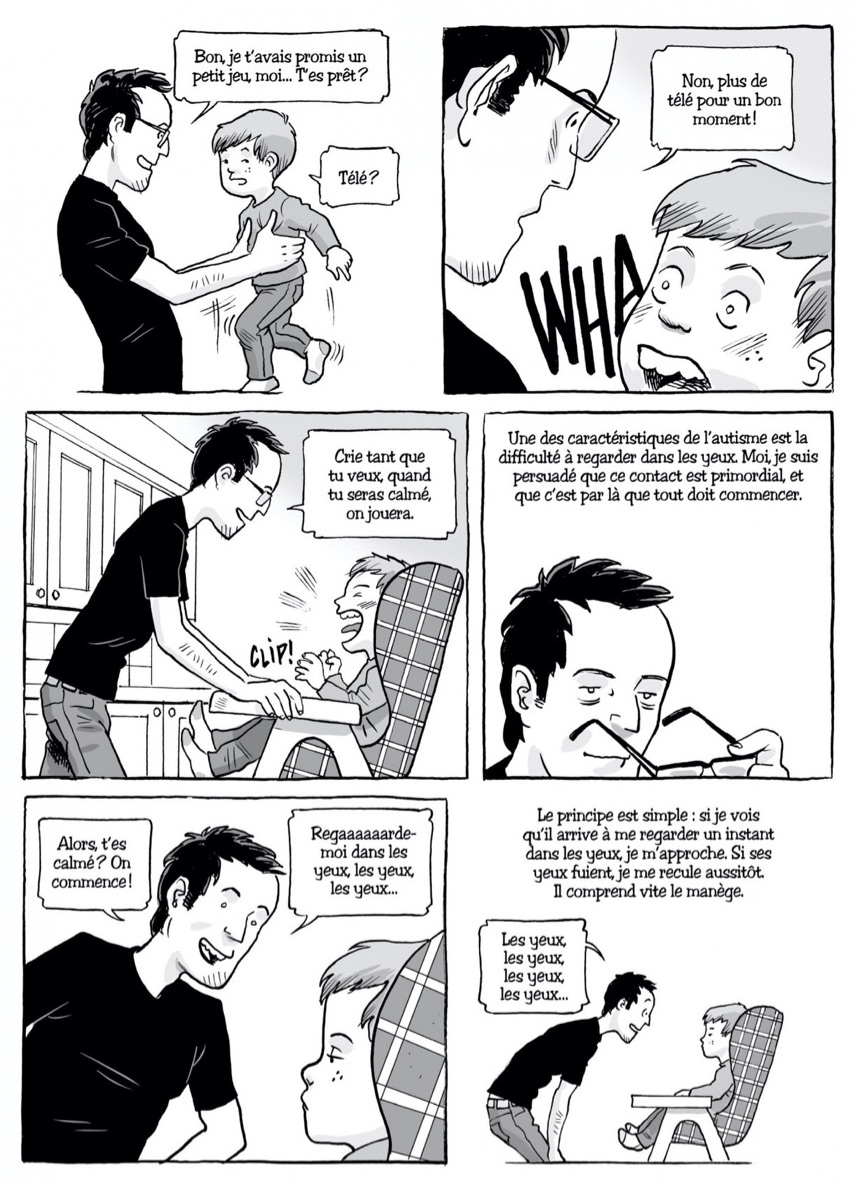
This is where webcomics can serve as an accessible tool that allows the reversal of dominant representations by opening the floor to self-representations directly grounded in marginalized communities. But before continuing with the topic of webcomics, we wish to feature an excerpt from Les Petites Victoires that addresses a frequent theme in autism: eye contact.
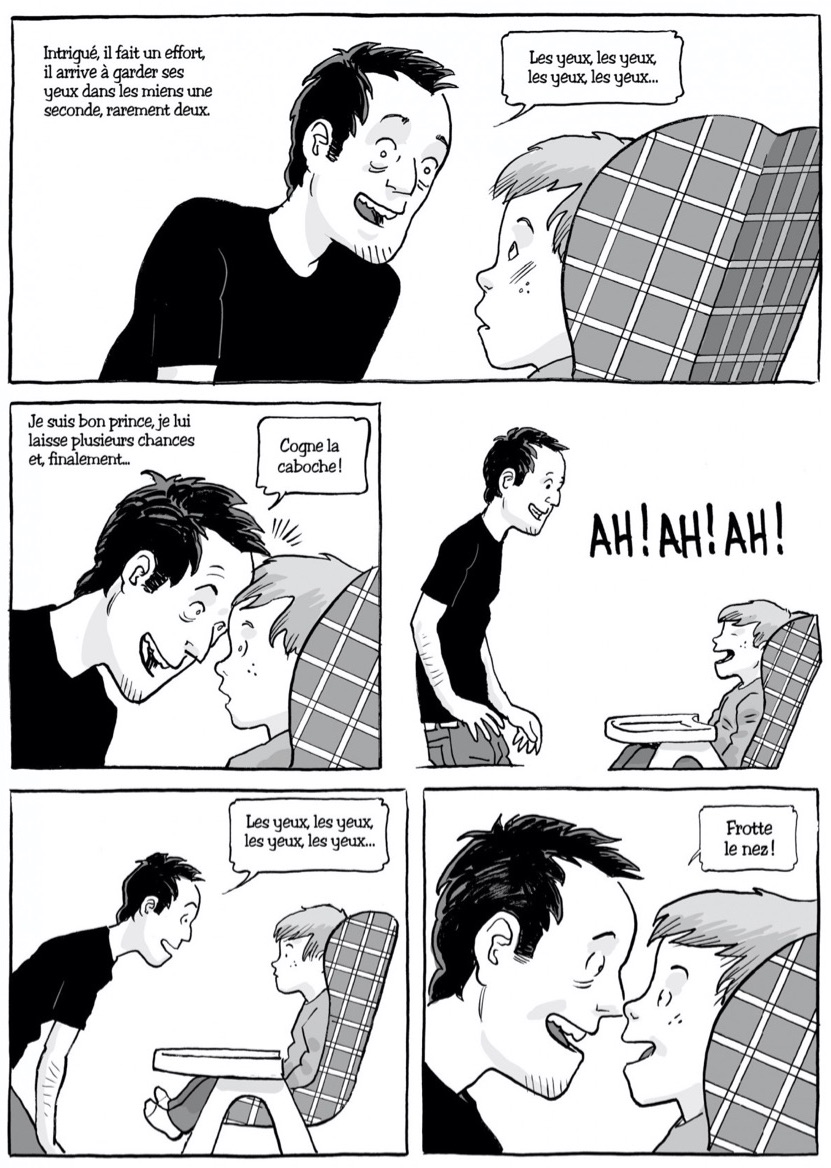
Excerpt on eye contact
English translation
English translation
Excerpt from Yvon Roy's interview
"I worked a bit like we can work to sometimes desensitize a substance. Sometimes certain people can have an allergy, we can try to desensitize them.
Several parents have contacted me regarding the trick to get the child to look in the eyes. This is the first thing we worked on together, that is to say, I considered that being able to look in the eyes - we know that autistic children have difficulty looking directly in the eyes - I said to myself, if we don't have eye contact, we have nothing. We need that, it's the beginning of human interaction." (our translation)
TW: The host uses the term “prison” in reference to autism:
"In your story that you shared with us in Les Petites Victoires, there is obviously the moment when you get up to face, to accompany your child in that reality: to learn to understand him too, inside what he lives and this prison, in a way, from which he is pressured which is basically this condition." (our translation)
Link to the interview (in French)
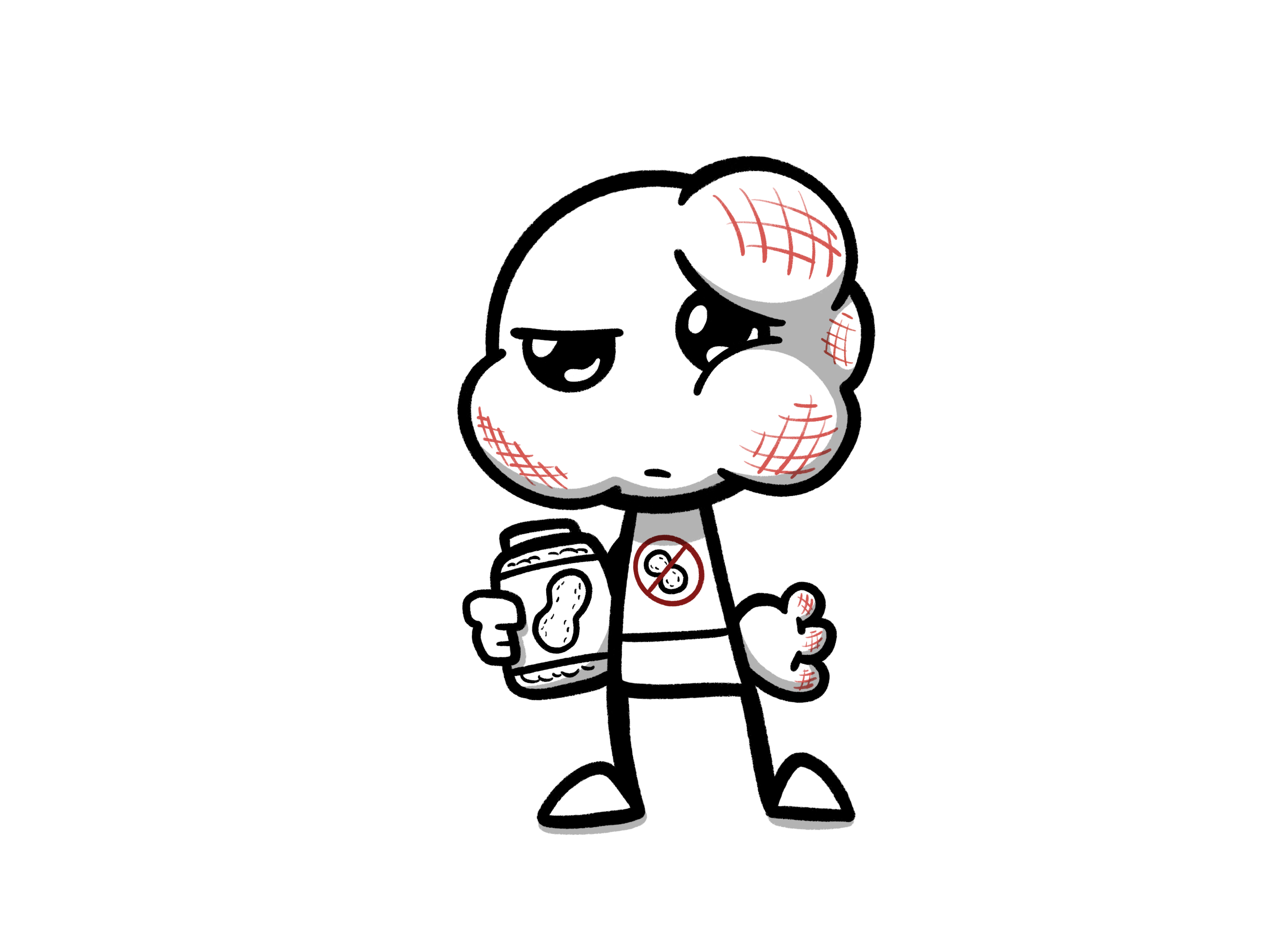
This scene is an example of neuronormativity
Recall that neuronormativity is the prevalent, neurotypical set of assumptions, norms, and practices that conceives of neurotypicality as the only acceptable or superior mode of cognition, and that stigmatizes attitudes, behaviors, or actions that reflect atypical modes of cognition as deviant or inferior.
This scene is told from the allist perspective and is presented with a positive outcome. In fact, as the author mentions, parents have applied this technique with their autistic children after being inspired by it.
But what if we ask autistic people how they feel about eye contact? That's exactly what we are going to do.
PART II
Why webcomics?
The medium of webcomic enables me to do something I don't know how to do otherwise: share how things feel on the inside.
Imagine. You come across a newspaper at the local coffee shop and recognize the face of a well-known personality. Yet you can't remember their name. It annoys you, you know you know it, it’s just not coming out, it stays there, on the tip of your tongue. You have time to come back to work, coffee in hand, and the name still hasn't come back to you, it still annoys you. You come across a colleague and you ask them, you describe the person, maybe clumsily at first (it would be so much easier with their name!), but you adjust to your interlocutor and, together, you can finally recall their name, it was so obvious!
It’s important to emphasize this feeling of annoyance. We rarely take the time to mention this annoyance when talking about epistemic injustices. Yet it is there, and it can even be painful: how do we make sense, to use Fricker's classic example, of our experience of sexual harassment when the concept does not yet exist? How can we share the feeling that something is wrong? This is where community comes into play and it is why the idea of "by and for" matters more than, say, a criterion of simplicity might. This is addressed by feminist epistemologies: for example, Longino argues for pragmatic values in science such as diffusion of power (as the importance of making research programs accessible to the actors involved in the research).
The impact of inadequate social representations on neurodiversity cannot be fully resolved by the traditional narrative of epistemic oppression and justice: adding new vocabulary to collective epistemic resources is not a panacea (we already have the word "autism" for example). So it is not only words that are missing, but rich and diverse lived experiences are also missing from the pool of shared resources.
The problem is that what is missing, the hermeneutical gaps, are not automatically apparent: social representations created by and for the dominant groups inadequately fill the hermeneutical gaps of marginalized groups. To that effect, let us recall here the Handi-Livre prize for the best biography which rewards works written by a person with a disability and telling his or her own experience, or by a third party on the life of a close relative with a disability: In the case of Les Petites Victoires, the award went to the biography of an allistic (non-autistic) person talking about autism. These inadequate social representations are difficult to resist: they are constantly and persistently reproduced. It is even harder when you don't have the words to replace theirs. But do we really have to wait for the right words to share our experiences? This is where illustration can become an attention grabbing action like shouting: an action that does not need words. This is what we propose here: a form of non-propositional epistemic resistance in response to hermeneutic injustice.
Webcomics are basically online comic books. They are mostly instantiated as short comics that take many forms and cover many topics. The most common form of webcomic is probably the blog (sometimes autobiographical, sometimes entirely fictional, sometimes both). Because they are mostly published independently by their artists, webcomics are an art form that is not limited by institutionalized power dynamics such as publishing houses or art galleries.
But the most important thing for us here is that webcomics are able to generate aesthetic experiences that allow viewers to better understand different aspects of the lived experience of neurodivergent people despite the inadequacy of mainstream epistemic resources.
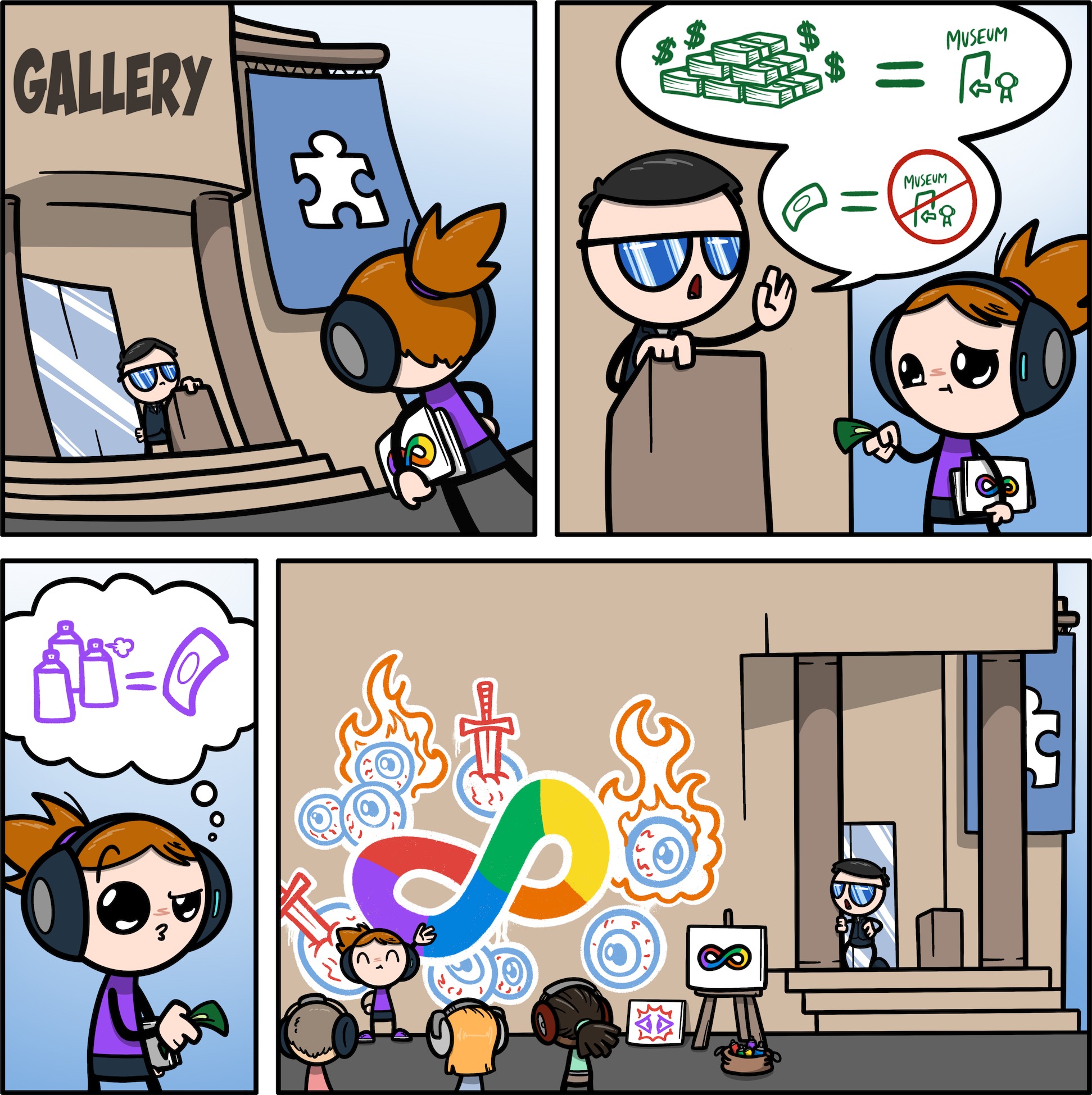
In some ways, webcomics are a digital version of street art.
Although limited to a given geographical space for street art and to a particular digital platform for webcomics, there is this common idea where it is not so much the public that goes to the creation as the creation that goes to the public. We are no longer in a reserved and predefined space like a museum, a bookstore, a gallery or even a library.
Although a recognized artist can make street art, it is more difficult for an artist who does not belong to a complex and influential network to access some places of diffusion such as an art gallery. Webcomic is thus added to the tools that allow the production, use and transmission of more accurate social representations, participating in the collective understandings of the oppressions suffered by epistemically marginalized groups. The public and interactional aspects of social media that support webcomics make them a catalyst for direct dialogue with (but also within and between) marginalized communities.
To put our epistemic resistance into action,
and to enhance our imaginative ressources, we chose to gather first-personal testimonies and descriptions of how eye contact can feel for autists.
After all, who better to provide insight into a given lived experience than those who live it? To do so, we used social media (instagram and facebook) to ask autistic followers of our webcomic (@lilyspectrum): How does eye contact feel to you? Although we are neurodivergent, it was important for us to go with the community beyond our individual experiences. For instance, we would never have thought of the sunburn idea on our own, but once we read those testimonies, it felt right.
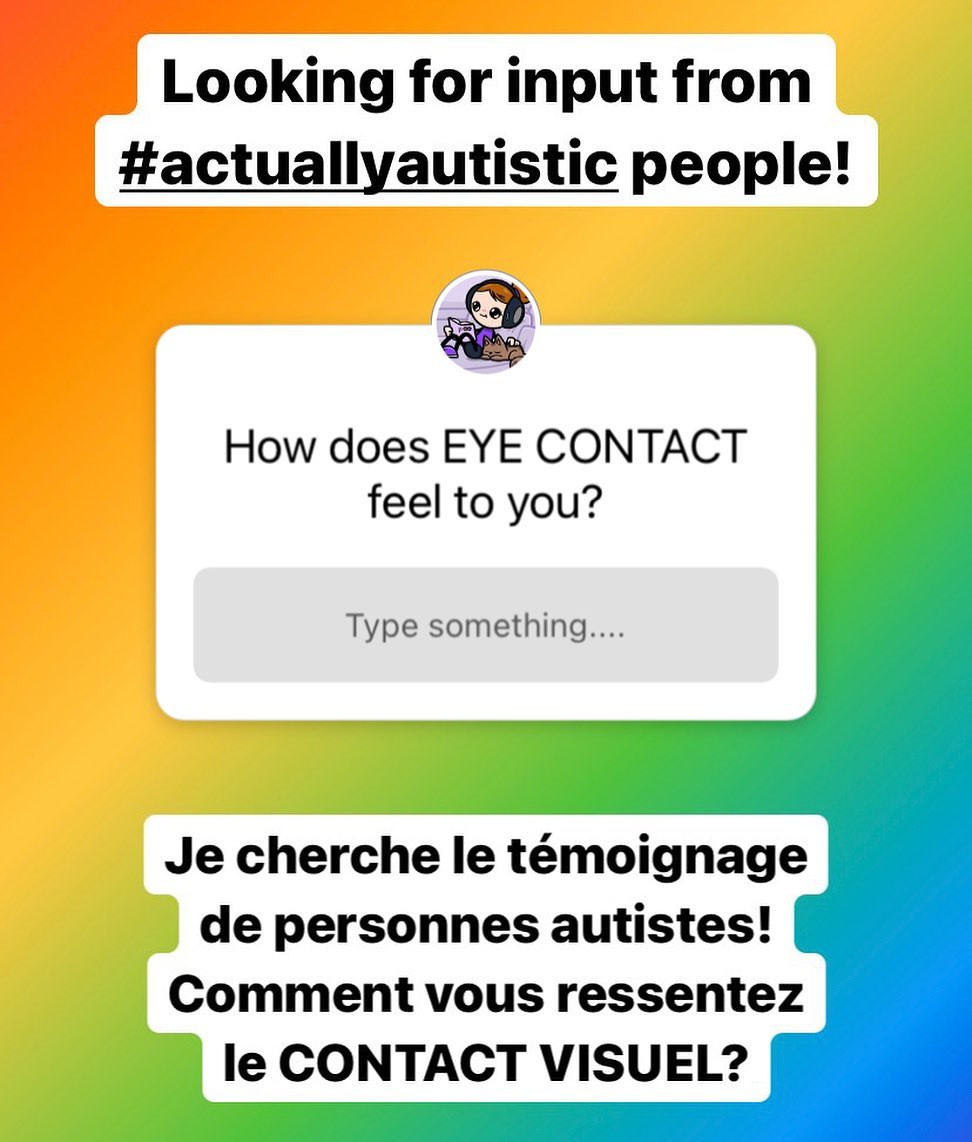
Both posts were made on November 8, and three days later, on November 11, we had received 175 testimonies. A few major themes emerged from these testimonies, which we used to base 7 webcomics or illustrations on. Keep in mind that, with this process, we do not claim to represent all there is to express about autists’ first-personal experience of eye contact. In fact, we suggest you visit these posts yourself to better understand the varied responses we got, and are still getting. And who knows, maybe this will allow you to add your own insight.
Publication
Since Monday, we have started to publish these comics on our social networks and we will continue to publish them in the following days
The interactions that take place around such webcomics are, we believe, an integral part of their complete aesthetic experience. These interactions often bring about clarifications, complementary details and descriptions or even added meaning. We thus invite you to visit these posts and interact with the community.
Webcomics
"I can do it but I can’t process anything else while doing it. My natural instinct and what feels the most right is to not look at someone’s face at all"
"It was drilled into me as a "rule" of politeness. I view it as just that, a rule. It's easy when there's multiple people because I can look around. But with one person, I have to look away or I end apparently end up staring"
"Everyone insisted on it, especially when they really wanted to correct a behavior or ensure I was paying attention. I honestly still don't love it, and prefer to look at noses or eyebrows to provide the impression I'm making eye contact"
"Eye contact was enforced during my childhood in mostly abusive ways and while it taught me to fake it, that made me hate it even more. Generally it just makes me uncomfortable and I find it quite distracting but it's also one of the most tiresome things to mask."
"Eye contact feels like they're staring into my soul, but with knives. I can make short eye contact before wanting to cry."
"It takes a concerted effort except for specific people."
"I’ve been so conditioned to make eye contact with people that when I met a lot of my friends for the first time they were kinda weirded out by me unblinkingly paying attention to them when they talked like 👁👄👁"
"It feels like someone is looking right past all my defenses and directly into my head. Not very pleasant."
"Terrifiant, j'ai vraiment l'impression qu'on me transperce à chaque fois …"
"Like I am being stabbed in the brain, itchy under the scalp, or suffocating. Anxiety is anxiety. I look at people's foreheads. They never know the difference but I am not forced to juggle the pain of eye contact and try to communicate. I am mostly non verbal and eye contact guarantees no words."
"Ça me met vraiment mal à l'aise et j'ai peur qu'on puisse mal interpréter si je regarde pas "correctement", je sais pas si je dois regarder quelqu'un dans les yeux ou combien de temps, il faut surtout pas que je regarde autre chose chez lui que ses yeux et du coup je sais pas quoi faire je préfère regarder le mur derrière mon interlocuteur 😂"
"Tout dépendra de la situation, de ma fatigue et de la personne. Certains contacts peuvent être transperçants (douloureux), d'autres envoutants (confusants), d'autres destabilisants (perturbants). En tous cas, si je regarde qqn dans les yeux, je suis sûr de perdre mon fil de pensée et/ou d'accorder mes réponses à ce que la personne ressent."
"Eye contact feels like burning discomfort, especially when I'm being told to do it."
"It’s extremely hard for me to maintain eye contact, and when people express to me that I should be looking at them when I’m talking to them, it puts me under more stress than just talking to them in the first place"
"somehow being told we should be making eye contact feels like being reprimanded as a child, at least to me.. I can't count the amount of times my mother would tell me to look her in the eyes as a child, and how humiliating/stressful it felt.. I legit forget to listen to people because I'm too busy trying to maintain eye contact."
"At best, awkward and uncomfortable. At worst, like someone's stabbed me in the eyes."
"It makes me uncomfortable but my mother forces me to look people in the eyes"
"Painful, but I feel like if I don't look ill be punished or called a liar. So I trained myself to look at something over their shoulder if not their foreheads to avoid harassment."
"Habituellement je regarde plutôt la bouche ou le nez des gens et ça semble passer crème pour donner l'illusion que je regarde dans les yeux (j'ai eu droit à l'expert en haute potentialité qui me disait que c'était impossible que je sois autiste car.. je le regardais dans les yeux ! Je regardais sa bouche depuis le début de l'entretien..). Je ne me force au contact visuel que de manière consciente et dans de rares cas précis : [suite]
(suite) par exemple si je suis attiré romantiquement par quelqu'un et désire que cette personne le perçoive (vu que le contact visuel accru est interprété de cette façon par beaucoup de neurotypiques). Mais cela reste un sacré effort et en général je détourne les yeux très rapidement, ça me met mal à l'aise, c'en est presque physique. Récemment un de nos profs en cours nous a fait faire une série d'exercices où on devait marcher vers quelqu'un/revenir à sa place à reculons en gardant le contact visuel constant avec cette personne.. je vous laisse deviner la torture que c'était"
"Transperçant!"
"J'ai l'impression que les yeux de la personne me percent à l'intérieur, je sais pas comment dire, c'est une sensation d'oppression aiguë."
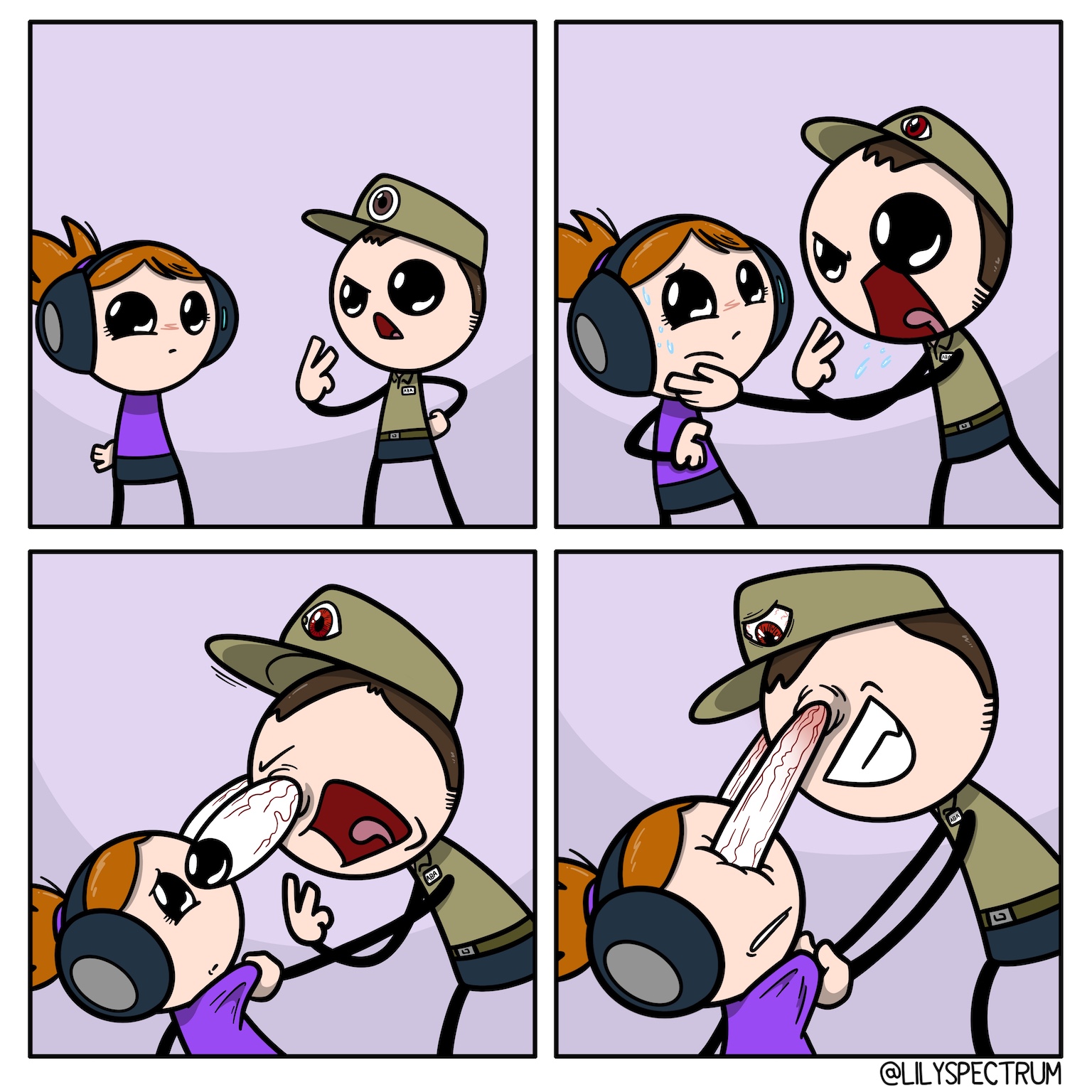
"For me, looking in the eyes feels too exposed and open. It makes me feel like I can't hide and protect myself from the people."
"Eye contact makes me uncomfortable most of the time, because of the feeling that I am being silently judged or getting talked about negatively."
"It's fine when I'm listening to someone but when I'm the one talking it makes me get stage fright like I'm being put on the spot to judge for performance lol"
"Too intimate, inappropriate… I become incredibly self conscious as well, like am I doing eye contact right? Should I be mirroring their behavior or a close approximation or complete opposite? How many times should I blink? Can they tell I’m faking this human interaction? It’s incredibly stressful."
"It feels like something is a required check box. It’s like a math problem. Look, one, two, three. Okay. Look away. Zone out if you need to. Okay, it’s been 10ish seconds. Look back. One, two, three.. okay, look away! Don’t share at them! Wait! You’ve looked away too long! Look back! …..it’s that on repeat quite often lol"
"I hate it I get so nervous and then I break down."
"I don't like it, makes me really uncomfortable. I'm "good at it", because I mask well (😬). I never know what to do, if I'm looking to much or not enough and always use a whole lot of energy just on eye contact. Generally, the more comfortable I feel the less I look someone in the eyes. (Also eyes as a body part make me feel really icky so that's that)."
"Intimidating and uncomfortable, I feel too vulnerable and keep thinking am I doing this right?"
"Ça me met vraiment mal à l'aise et j'ai peur qu'on puisse mal interpréter si je regarde pas "correctement", je sais pas si je dois regarder quelqu'un dans les yeux ou combien de temps, il faut surtout pas que je regarde autre chose chez lui que ses yeux et du coup je sais pas quoi faire je préfère regarder le mur derrière mon interlocuteur 😂"
"Eh bien, quand j’étais petit, je parlais et écoutais souvent le monde sans les regarder dans les yeux. Maintenant, ça me dérange pas de parler et écouter avec le contact visuel, mais j’peux très bien comprendre ce que le monde me dit sans obligatoirement les regarder dans les yeux. Aussi, c’est vrai que ça me rend un peu mal à l’aise quand des inconnus me fixe du regard. C’est comme s’ils me jugeaient et j’sais pas ce que j’ai fait de mal."
"Direct eye contact feels like I am being judged. It also makes me feel uncomfortable because I become unable to perceive and read the rest of their body language."
"Démunie, nue. Percée à jour. C’est très fort comme sensation, et rarement agréable. J’y arrive avec mes enfants ou mon mari, mais même dans ce cas, pas trop longtemps. Si je veux tenir une conversation, et me concentrer, alors je dois ruser. Je regarde entre les deux yeux ou le plus souvent la bouche."
"Feel nausea and anxiety, and extremely naked. Yet my mother was adamant that I learned it and therefore I am able to do it, despite the uncomfortable feelings. Absolutely love your work, for once I can tell that I am not alone"
"I feel instant stress and I have to force myself to do it and to look "natural"."
"Honestly, each time it happens to me, the most awkward feeling I have is « where should I look exactly » ? When you make eye contact, are you expected to focus one eye specifically (which one, then ?), between the eyes, not focus at all, or try a weird way of having each eye "looking" into the facing one (i.e. my left eye "looking at" their right one and vice-versa) ? I'm also never sure if/when eye contact is expected, and when it happens, is there/what is the hidden message behind this specific contact, and/or am I sending an incorrect hidden message myself ? Then, with all these questions actively consuming my brain "computing power", everything else totally miss the point (sometimes, though, I can hide this issue because I have this kind of ability to "replay" the last few words/sentence I unconsciously heard, to process it with a delay but potentially without the proper context- so it's not reliable at all !!). "
"Weird and artificial. I can actually read people's eyes now, but it took me years to learn it."
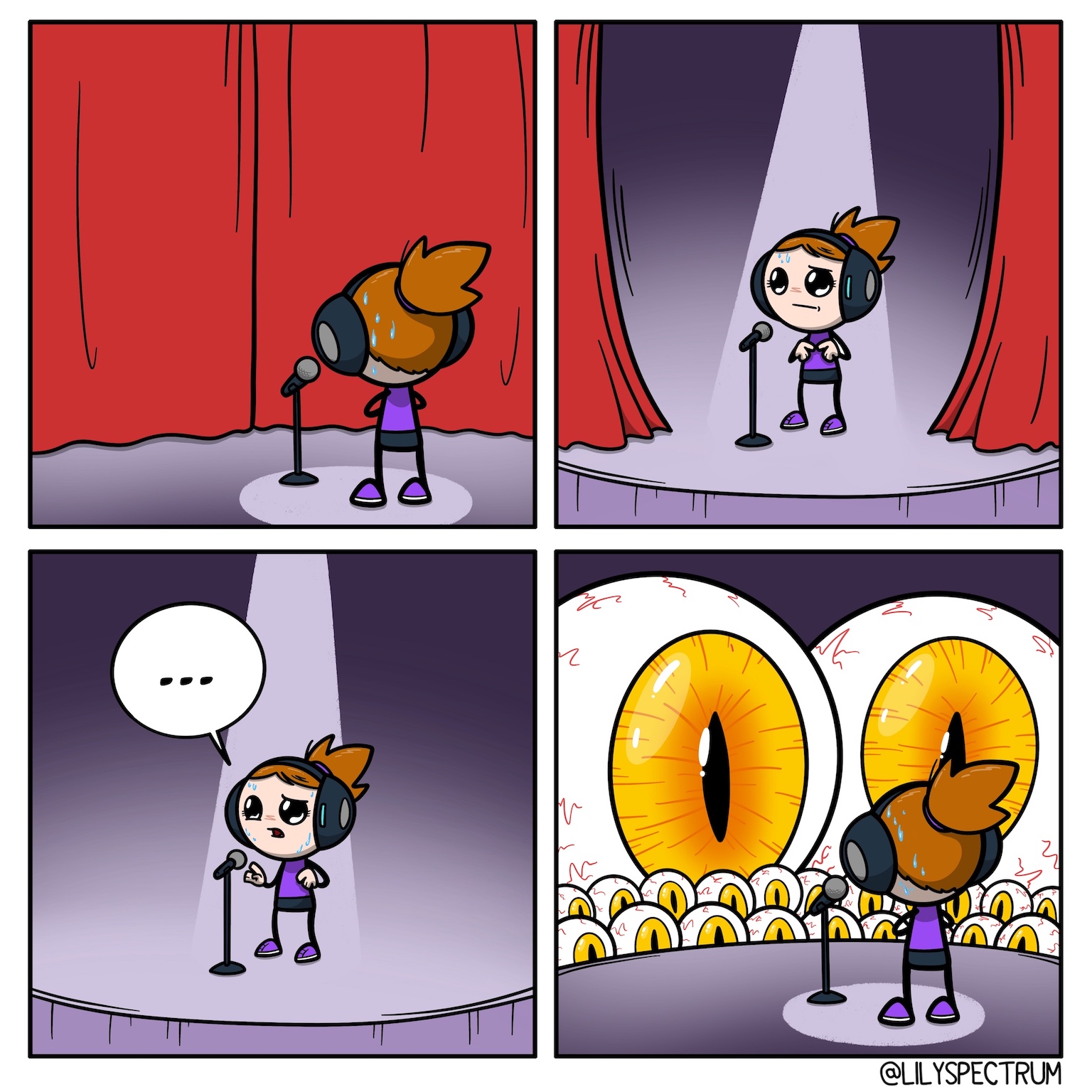
"My parents rasied me to always look into the eyes, still feels wrong. Like, I am invaiding a personal space and being rude. Like trying to stare down their soul and violating their privacy. I still try to look at people in the eyes but have learned to just looks in differents points in the face so I don't seem rude."
"Eye contact feels too intimate to me for most interactions. If I make eye contact with you, it’s because it’s important. "
"Eye contact feels very intimate. If I’m forced to hold it for too long, I feel violated, like I’ve been touched without consent."
"I really hate eye contact in almost all circumstances. About the only exception is with someone I'm very intimate with. Eye contact feels extremely intimate to me in general so it only feels natural when it's with someone I've got a suitably intimate emotional connection to. Otherwise it feels like I'm staring into someone's soul and I can see everything and they're staring into mine and seeing the same (even if I know they're not)."
"Invasive, extremely personal. I'm only comfortable looking my husband in the eyes"
"It feels like I’m standing too close to someone, I don’t know if that’s too vague of a comparison but it feels way too intimate. So I only do it when necessary or when I’m comfortable with that person."
"It feels creepy to me"
"I don't like it, makes me really uncomfortable. I'm "good at it", because I mask well (😬). I never know what to do, if I'm looking to much or not enough and always use a whole lot of energy just on eye contact. Generally, the more comfortable I feel the less I look someone in the eyes. (Also eyes as a body part make me feel really icky so that's that)."
"I hate eye contact. It almost hurts. But it’s nessesary to have a successful professional life, and my parents trained me well as a child. They would ask me people’s eye color after I met them to see if I made eye contact. Being trained like that at a very young age was incredibly difficult and felt unfair, but I’m very grateful that they pushed me now that I’m an adult."
"I can't do it, it makes me feel funny in a bad way and makes me feel kind of .. unsafe? and uncomfy I don't exactly know the word for the first one, I don't mind people looking at me but I won't look back"
"It's incredibly intimate and overwhelmingly so, particularly with strangers. And the more my emotions are revved up, the less I can tolerate it. It genuinely feels as though someone can see into my mind almost, even though I know that they can't. On the plus side, when I'm with someone I deeply, deeply love, sometimes that's okay because I want them to see how much I love them... but then that tends to make THEM feel awkward and uncomfortable too. LOL For me, it falls into the same category as standing too close, invading personal space, touching someone without consent etc. It's intimate, and can very easily become violating when you don't want it. And that;s so hard to explain to NT folk who expect you to look them in the eye all the time."
"It's okay with people I know, but I don't feel comfortable with eye contact with strangers, it almost feels like an invasion of privacy."
"eye contact feels so weird and creepy and if i have to make eye contact with someone, then ill quickly feel exhausted."
"It feels like a boundary rupture unless I completely and totally feel comfortable in a container of safety with another it probably won’t happen much."
"Well... I can't let anyone touch my eyeballs."
"Trop intrusif. Comme si l autre avait la perception de mes pensées. C est comme se montrer nue."
"Intense/ overwhelming/ fiery/ intrusive. Sometimes painful/ always difficult with strangers. Ok with intimate friends and family."
"Démunie, nue. Percée à jour. C’est très fort comme sensation, et rarement agréable. J’y arrive avec mes enfants ou mon mari, mais même dans ce cas, pas trop longtemps. Si je veux tenir une conversation, et me concentrer, alors je dois ruser. Je regarde entre les deux yeux ou le plus souvent la bouche."
"Feel nausea and anxiety, and extremely naked. Yet my mother was adamant that I learned it and therefore I am able to do it, despite the uncomfortable feelings. Absolutely love your work, for once I can tell that I am not alone"
"confronting and very intimate ..i feel naked"
"Quelque chose d'extrêmement intime, que je ne peux pas partager avec n'importe qui sinon je suis déstabilisée car je bloque sur cette sensation d'intimité forcée. Depuis le diagnostic, je me permets de ne plus regarder le visage des gens (je ne travaille pas). Quel soulagement!"
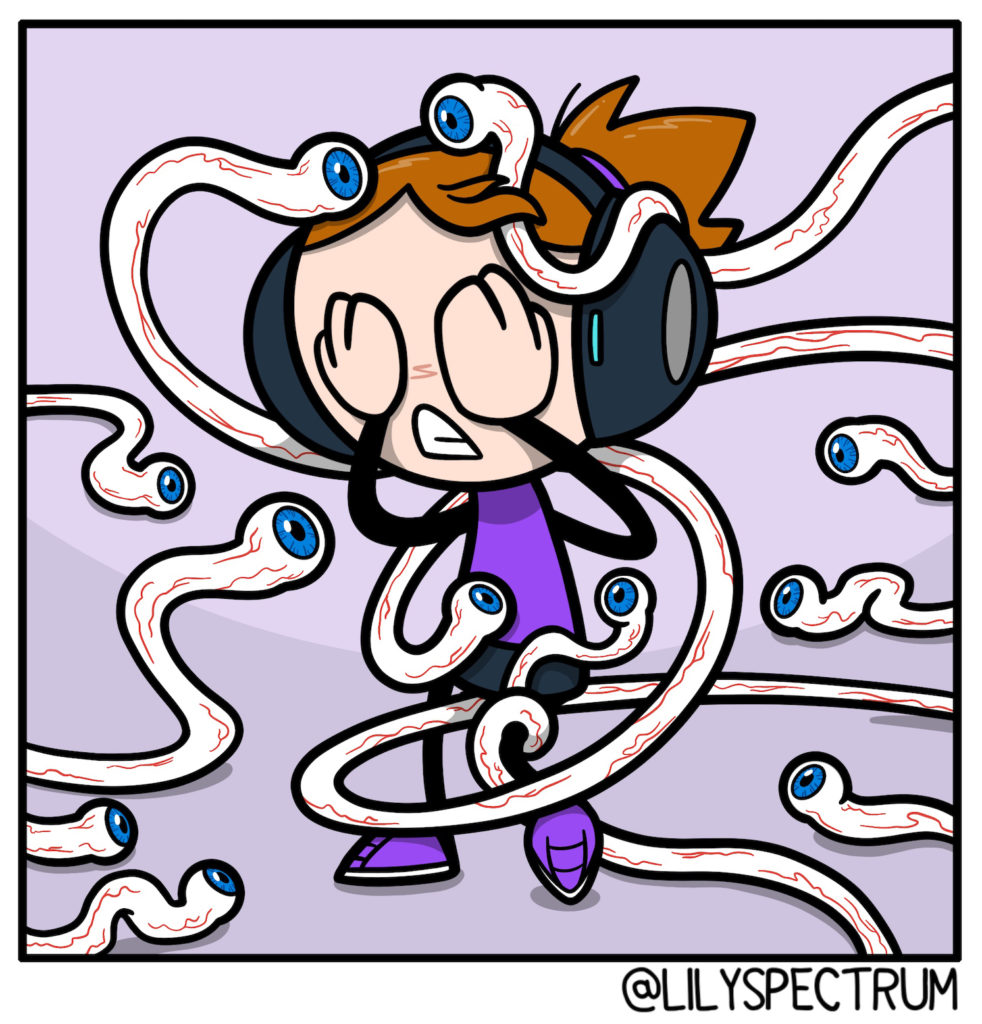
"Eye contact feels like they're staring into my soul, but with knives. I can make short eye contact before wanting to cry."
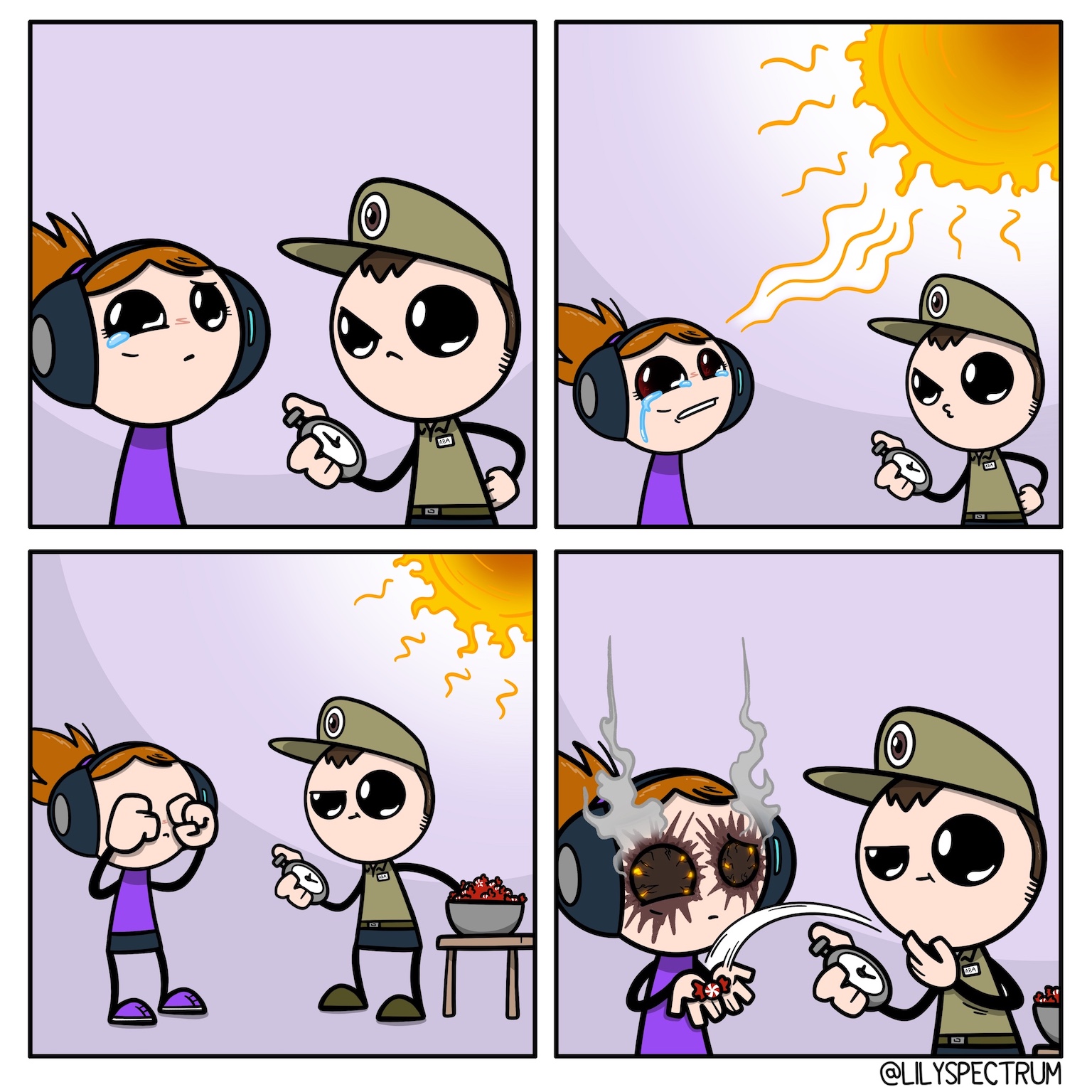
"It’s like being asked to look directly at the sun. I flinch, I can’t do it…"
"It feels like they gonna shoot me with laserbeams. Like Cyclops from X-Men. I van handle it for 10 seconds. I get panick attacks of it's to long. Even with my bf makes me on edge. I got a major panic attack during a being social etc exam (idk how it's in English is). It was so bad. They let me past because otherwise i needed to do the whole year over."
"Feels like I’m staring at the sun and I can only look a person in the eyes for 30 seconds or so before my eyes start to hurt a bit. I can only look animals in the eye."
"Like flames of intense awkwardness are scorching my retinas."
"When I was younger I always had trouble making eye contact. I’ve gotten better at it in recent years but its still painful to me."
"Eye contact feels like burning discomfort, especially when I'm being told to do it."
"Ça me demande beaucoup de concentration. J'ai l'impression que ça me fait mal aux yeux et quand j'étais plus jeune je pouvais même ne plus vraiment entendre ce que la personne me disait. Par contre ce n'est plus un problème quand je me mets vraiment en colère au point de vouloir me battre."
"Ca va de la gêne à la sensation de brûlure, ça dépend des personnes je suppose. On peut parfaitement regarder le nez, la bouche, entre les yeux sans que l'autre ne sen rende compte."
"I can’t think if I have to. Feels like pressure."
"Bad, I feel like my head is going to explode if I look at someone's eyes for too long. I suspect it's probably a blood pressure drop or adrenaline, but it feels awful. I honestly don't get why so many people require eye contact when speaking. I can make eye contact, but it's really difficult to understand what the person is saying because I'm too focused on how uncomfortable I feel and how incredibly awkward it is to stare at someone's eyes"
"It feels literally painful and I’m always afraid the other person can tell what I’m feeling/thinking. I’m comfortable with eye contact with very trusted folks in my life though."
"Painful"
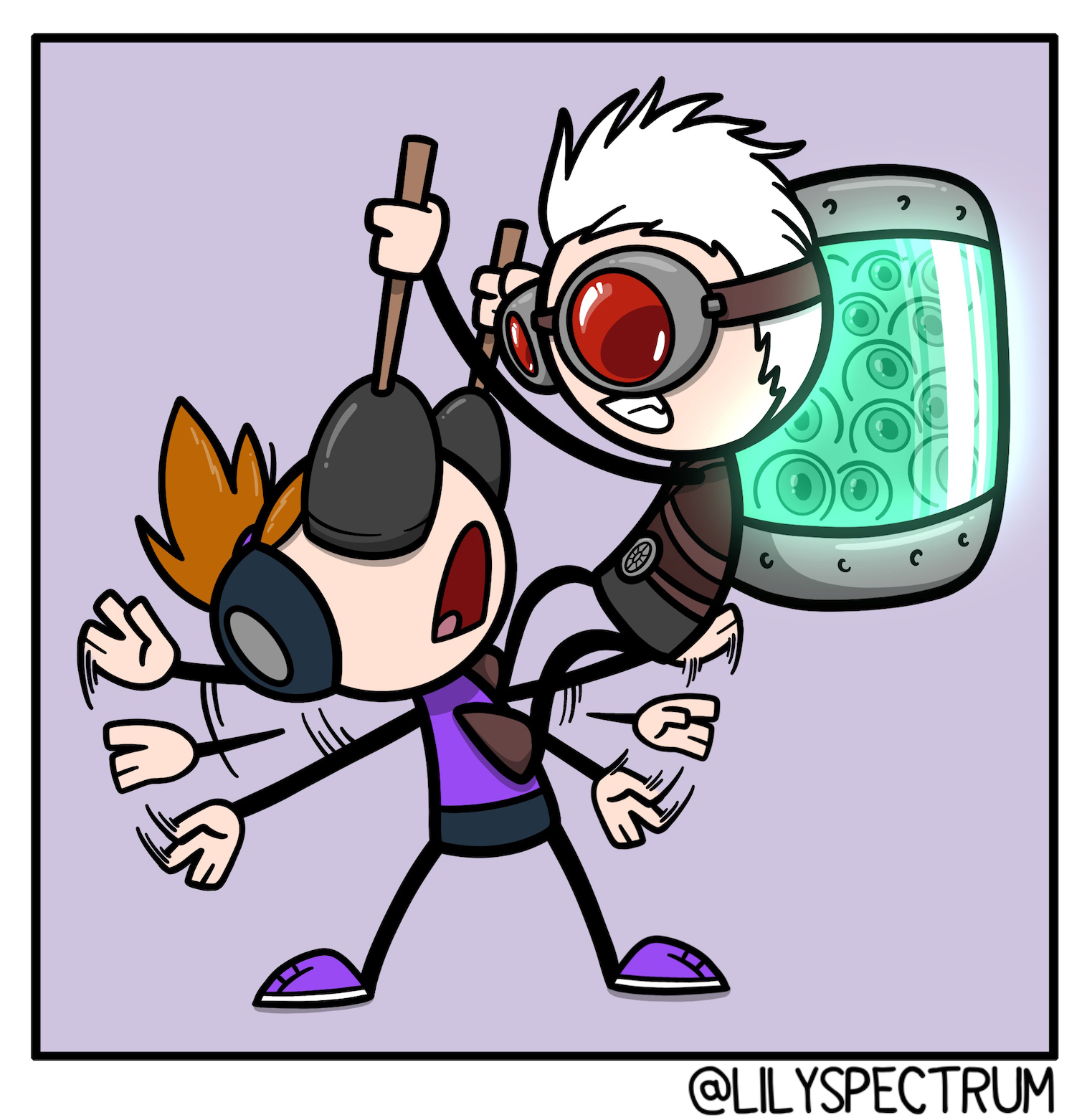
"I really hate eye contact in almost all circumstances. About the only exception is with someone I'm very intimate with. Eye contact feels extremely intimate to me in general so it only feels natural when it's with someone I've got a suitably intimate emotional connection to. Otherwise it feels like I'm staring into someone's soul and I can see everything and they're staring into mine and seeing the same (even if I know they're not)."
"I cant make eye contact with literally anyone. Its uncomfortable, and even when its not, i cant listen proberly to what people are saying when i focus on the eyes. I just cant do it at anytime with anyone, only for one second maximum. Its like staring into someone's soul, its too much."
"J’ai l’impression d’être absorbée par les yeux de la personne et en même temps comme si on pouvait voir ce qu’il y a à l’intérieur de moi."
"honestly it feels like i am being sucked into their soul… i can’t maintain it if i want a conversation because i just get lost"
"Like someone staring at my soul? I almost feel like that's the part of masking that exhausts me the most!"
"It's uncomfortable. But sometimes if I want to intimidate someone I stare deep into their eyes and make them feel unnerved like I'm looking into their soul."
"Tout dépendra de la situation, de ma fatigue et de la personne. Certains contacts peuvent être transperçants (douloureux), d'autres envoutants (confusants), d'autres destabilisants (perturbants). En tous cas, si je regarde qqn dans les yeux, je suis sûr de perdre mon fil de pensée et/ou d'accorder mes réponses à ce que la personne ressent."
"Trop intrusif. Comme si l autre avait la perception de mes pensées. C est comme se montrer nue."
"J’ai l’impression d’entrer dans l’âme de la personne. Je trouve ça trop privé. Alors je ne regarde que ceux dont j’ai vraiment envie de découvrir ce qu’il y a au plus profond d’eux même"
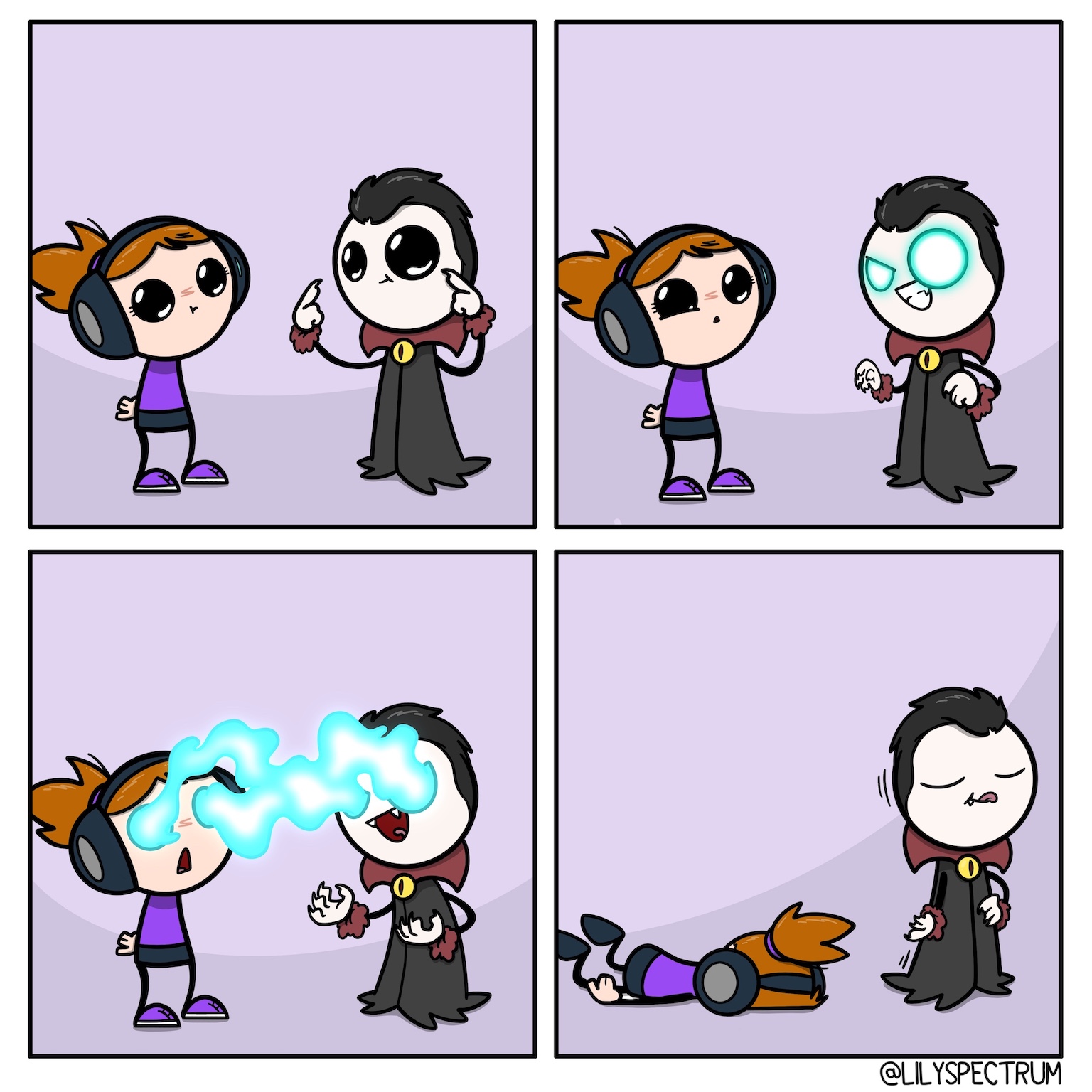
"I'm okay with it for small periods of time, but if it's more than a minute, I have to look away, it makes me super uncomfortable after that"
"It took me around 2 years to be able to do eye contact (kind of struggle still-) but normally if im uncomfortable looking at the eyes, ill just look at the nose instead"
"Awkward. The longest I can probably do it is for a few seconds, but sometimes it’s physically impossible for me to look someone in the eyes even for one second."
"Ça me met juste très mal à l’aise, et du coup je préfère regarder ailleurs et ne regarde les gens dans les yeux s’iels ne me regardent pas."
"Incapable de soutenir un eye contact sauf avec certaine personnes... Ma famille (ma mere, mon pere, ma soeur), ma nièce, mon beau frère et mon conjoint. Quelques amis specifique aussi... Mais sinon incapable. Je chercher tjrs a "évader" ses eye contact."
"Uncomfortable. I have trouble maintaining eye contact for long, especially in a conversation. However, I did figure out that talking with your hands is a great way to distract the other person's eyes from your and gives you a reason not to look at them."
"havent made eye contact with anyone (while i'm talking to them, that is) except my cats in years if that tells you anyone"
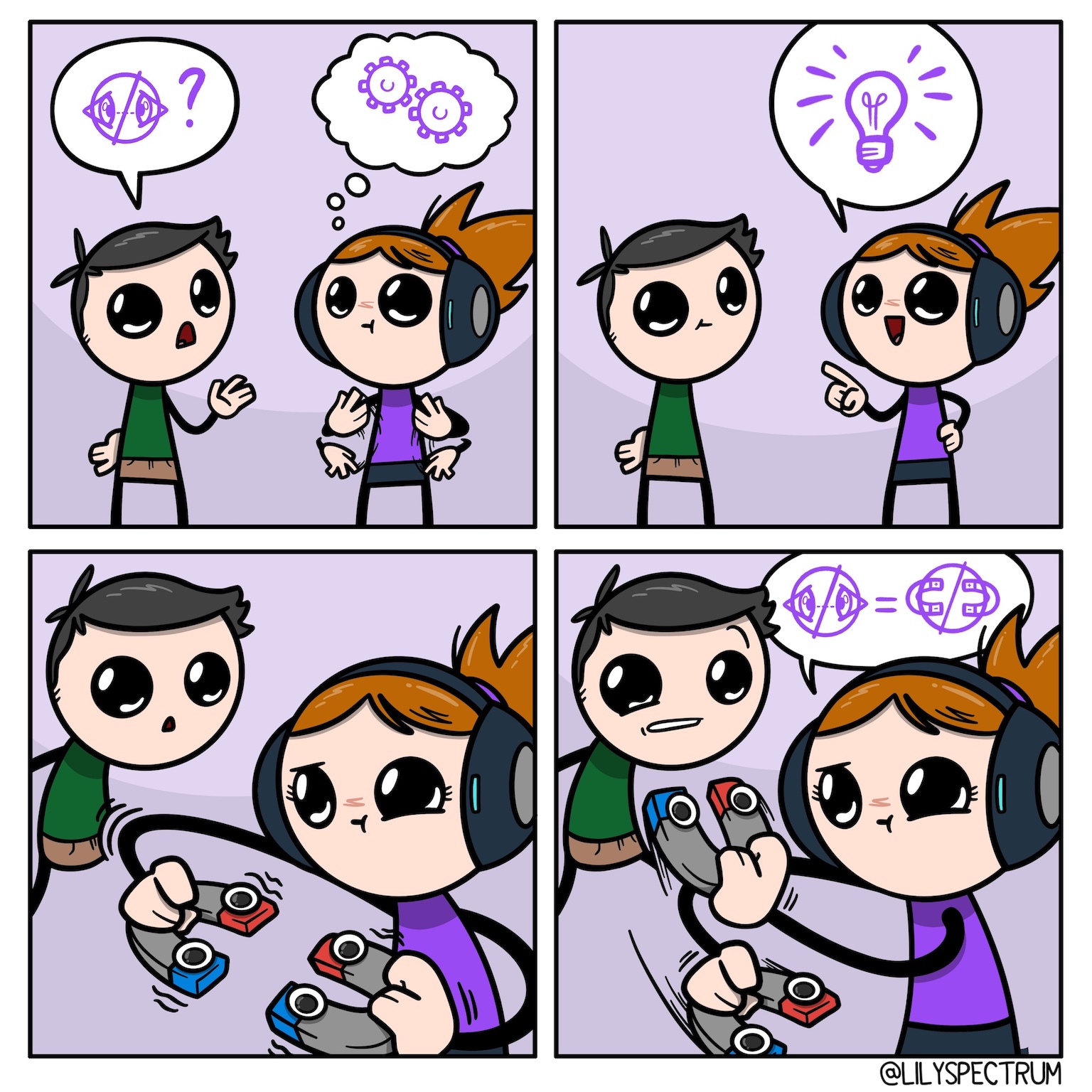
"When I was younger, it used to feel like when you held two magnets together both ends the same, it felt like no matter how hard you held them together, it would want to repel forcefully, my head wanted to repel and look past to the left or right or down or up like a magnet would, and when I managed to hold it against that feeling, my eyes would water up, not tears from sadness or anything, but they released tears, now I can manage it but it's still not comfortable to do, it depends on how comfortable I feel with the person or people or how stimulated I feel in an environment"
"It’s like when you hold two magnets with the same polarity against each other. Even if you want to put them together they won’t do it. The magnets are like my eyes. They just can’t center on the other persons eyes or it will cost a lot of energy. Like with holding magnets with the same polarity together. It’s just all in all very uncomfortable and draining. Btw I’m undiagnosed so I hope I can still answer here. Also I really really love your account and the stuff you do ^^ /g"
"Ça me met vraiment mal à l'aise et j'ai peur qu'on puisse mal interpréter si je regarde pas "correctement", je sais pas si je dois regarder quelqu'un dans les yeux ou combien de temps, il faut surtout pas que je regarde autre chose chez lui que ses yeux et du coup je sais pas quoi faire je préfère regarder le mur derrière mon interlocuteur 😂"
"Je me sens obligé de regarder chaque personne dans les yeux mais aussitôt que le contact est réciproque je baisse le regard aussi vite que mon ombre ainsi j'ai l'impression que j'ai fait ma part! haha! Par contre avec le monde avec qui je suis très, très à l'aise je vais quelque fois fixer les yeux, on dirait que j'essaie de comprendre pourquoi je fuis ceux des inconnus, alors je fixe en grand questionnement interne!"
"Awkward and physically painful , strong need to move my eyes away from it"
"Souvent trop intense… Et en plus il se passe tellement de choses autour des yeux qui m'intéressent plus et/ou me sécurisent plus! Je fixe puis je zappe, j'y reviens et je rezappe… Les sourcils, les lunettes, sont des bons compromis aussi, ou fixer mon regard dans le vague direction le visage ou le pourtour du visage… Ou fixer le visage avec une attitude très intéressée (posture corporelle de l'attention soutenue) quand la personne regarde AILLEURS, et quand son regard se tourne vers moi, fixer 1s seconde, sourire, et me tourner ailleurs vers qqn d'autre qui parle mais ne regarde pas vers moi à ce moment là, ou trouver à m'occuper avec un objet, et jongler comme ça."
"Je n'aime pas regarder sans les yeux, je ne sais pas, c'est plus fort que moi, je suis mal à l'aise, je ressens le besoin de regarder ailleurs. Du coup j'aime bien discuter quand je suis au resto ou quand on fait une activité, il y a l'excuse d'être occupée en même temps pour ne pas se regarder"
"Habituellement je regarde plutôt la bouche ou le nez des gens et ça semble passer crème pour donner l'illusion que je regarde dans les yeux (j'ai eu droit à l'expert en haute potentialité qui me disait que c'était impossible que je sois autiste car.. je le regardais dans les yeux ! Je regardais sa bouche depuis le début de l'entretien..). Je ne me force au contact visuel que de manière consciente et dans de rares cas précis : par exemple si je suis attiré romantiquement par quelqu'un et désire que cette personne le perçoive (vu que le contact visuel accru est interprété de cette façon par beaucoup de neurotypiques). Mais cela reste un sacré effort et en général je détourne les yeux très rapidement, ça me met mal à l'aise, c'en est presque physique. Récemment un de nos profs en cours nous a fait faire une série d'exercices où on devait marcher vers quelqu'un/revenir à sa place à reculons en gardant le contact visuel constant avec cette personne.. je vous laisse deviner la torture que c'était"
"Lorsque c'est quelqu'un avec qui je suis à l'aise ca va à une certaine distance mais de trop prêt je ressens un malaise assez vite. Si j'ai le malheur de croisé le regard avec un(e) inconnu(e) dans la rue ou dans un commerce, je regarde ailleurs aussitôt, gros malaise. C'est pour ça que j'évite de regarder les gens."
Thank you for joining us in this exploration!
We hope this experience was (and will be) as enriching for you as it was for us to come up with. We invite you to engage with us and the community through our posts or in the comments bellow!
Appreciate the insightful article. Find more at ##anyKeyword##.
Thanks for the great explanation. Find more at Voda Cleaning & Restoration of West Austin .
Wer, welche nach der Recherche auf einem spannenden frischen Betreiber innerhalb dieser Welt von virtuellen Wettangebote aufhalt, kommt am Rolldorado Casino aktuell kaum vorbei rolldorado . Das Rolldorado besitzt sich innerhalb kurzester Tage einen Namen verdient sowie zieht Zocker mit einer tollen Auswahl von Games und aktuellen Tischspielen an. Sofern der Nutzer sich neuesten Rolldorado Erfahrungen betrachtet, fallt direkt die benutzerfreundliche Oberflache ins Auge, welche einerseits Anfangern als sowie Experten das reibungsloses Gaming-Erlebnis bietet. Dieses Rolldorado Casino online prasentiert dabei nicht lediglich die riesige Bandbreite von Inhalten, jedoch setzt auch gro?en Wert auf Schutz sowie faire Regeln. Viele Nutzer schatzen vor allem eine schnelle und stabile Rolldorado Auszahlung, welche bei jedem Casino als besonders zugig zahlt. Der nachster Benefit bei jeder ehrlichen Rolldorado Bewertung ist die Willkommensaktion, welches frischen Kunden ihren Beginn verbessert sowie fur anhaltenden Gaming-Vergnugen sorgt. Dieses Casino Rolldorado begeistert durch dem durchdachtes Aussehen, das ihre Fuhrung durch das umfangreiche Portfolio zum Vergnugen gestaltet. Sobald ihr Rolldorado online nutzen, profitieren Sie durch modernster Programmierung, die ein ruckelfreies Online-Erlebnis auf allen Endgeraten garantiert. Zudem unter dem Titel Roll Dorado ist das Portal gefuhrt sowie erhalt in dieser Spielerschaft einen hervorragenden Status wie modernes Roll Dorado Casino. Das Rolldorado Online Casino stellt gewiss, sodass samtliche gesetzlichen Normen eingehalten sind, sodass der Spieler auf voll oder ganz bei den Spielspa? besinnen darf. Alle die Fokus auf Vielfalt, Transparenz sowie hohe Gewinnmoglichkeiten setzt, fuhlt hier genau richtig. Zusammenfassend lasst sich behaupten, dass das Rolldorado mit ihre Symbiose von top Service, lukrativen Pramien sowie einer extrem schnellen Rolldorado Auszahlung das Top-Ziel fur jeden Spielern darstellt. Besuchen ihr die Webseite und verschaffen man auf selbst ein Eindruck davon, weshalb das Rolldorado aktuell unter den beliebtesten Anbietern in diesem Geschaft zahlt. Versichern man auf eigene mit einer Gute und dem guten Hilfe, den das Portal seinen Kunden bietet.
Valuable information! Discover more at apartamento para vacaciones Galicia .
This destination emerged as one of the leading talked-about options for players hunting for a effortless online gambling experience, particularly within the UK area Lucky Pays Review . The casino, commonly referred as Luckypays Casino, concentrates on offering a wide selection of options that cater to both occasional players and seasoned players. Whether you’re checking out the thrill of slots, the strategy of table play, or the excitement of live hosted sessions, the site promises an engaging environment. Feedback of Luckypays regularly emphasise its easy-to-use layout, which guarantees that even newcomers can explore the platform with ease. The casino’s standing as a reliable casino in the industry stems from its focus to transparency, turning it a notable option among rivals.
For those interested about Luckypays Casino Online, the platform’s combination of convenience and fun sets it aside as a preferred option for many.
One of the key aspects of Lucky Pays is its extensive collection of games, which includes all from timeless slot machines like Starburst Slots to cutting-edge live gaming games with immediate communication. Gamblers frequently praise the platform’s frequent bonuses, such as sign-up bonuses and membership benefits, which boost the complete playing journey and give tangible value. The addition of giant prize pools adds another level of fun, as players can hope of massive prizes with every play. Additionally, the site’s trusted transaction options, covering choices for bank deposits and cryptocurrencies, guarantee that deals are swift and easy. For those looking for a Lucky Pays Review that highlights reliability, the casino’s licensing and regulatory compliance even more bolster its credibility. These features jointly create it a attractive option for anyone seeking a reliable and exciting online gaming journey.
LuckyPays is especially suited to players who prioritise both simplicity and diversity in their entertainment preferences, whether they’re residing in the British territory or anywhere. The platform’s design guarantees it attracts to a broad crowd, from newcomers discovering the area of virtual entertainment to experienced gamblers seeking for premium fun. With its emphasis on fairness and a thoughtfully-chosen range of entertainment, it remains as a solid selection for those who prioritise excellence over quantity. While no one casino can cater to all liking, Lucky Pays balances a equilibrium that makes it a memorable place for many. Ultimately, for anyone hunting for a trusted and enjoyable web-based casino experience, this platform provides a appealing mix of excitement and dependability.
Appreciate the thorough information. For more, visit https://www.hometalk.com/member/259715515/darrell1124174 .
een innovatief digitale speelomgeving trekt steeds meer aandacht in de Hollandse speelmarkt Vegashero Online Casino .
Met een moderne en intuïtieve applicatie levert dit gokplatform bezoekers een divers aanbod aan speelmogelijkheden.
Voor cliënten die verlangen naar een betrouwbare en transparante virtuele speelruimte ervaring, is Vegas Hero Gokhuis een aantrekkelijke mogelijkheid.
In de review bekijken we de meest essentiële eigenschappen en voordelen van dit spelhuis.
Vegas Hero Casino wordt onderscheiden door zijn toegankelijkheid en bereikbaarheid. Het platform is uitgewerkt om zowel beginners als ervaren gokkers tevreden te voldoen.
Met een groot aanbod aan gokvarianten, met name geziene spellen van grote spelontwikkelaars zoals Playtech, biedt Vegas Hero Speelruimte een breedte die zwaar te evenaren.
Daarnaast is de spelhuis ook toegankelijk als Vegas Hero Online Casino, middels welke bezoekers overal en iedere tijdstip kunnen spelen van zijn favoriete titels.
Een van de meest essentiële motieven om cliënten verkiezen voor Vegas Hero Gokhuis is de betrouwbaarheid. Als Vegas Hero Gekwalificeerd Casino wordt gezien, verzorgt de omgeving een betrouwbare omgeving voor gokkers.
De spelhuis verzorgt gebruik van moderne veiligheidssystemen om de gegevens van gokkers te beveiligen en om te verzekeren dat al betalingen geldig en duidelijk verlopen.
Daarbij is de gokplatform gevestigd in Europa, dat aanzienlijk vertrouwen verstrek aan bezoekers die benaderen naar een lokale internetcasino ervaring.
Voor bezoekers die zoeken naar een diepgaande analyse van Vegas Hero Speelruimte Nederland, is de cruciaal om te weten dat de omgeving ook een uitgebreid pakket aan voordelen en aanbiedingen biedt.
Dit omvat welkomstbonussen, kostenloze spins, en loyaliteitsbonussen die gokkers extra waarde verleent.
Dit bonussen vervullen het nog aantrekkelijker om in Vegas Hero Gokhuis te gokken, bijzonder voor nieuwe spelers die willen genieten van de extra voordelen.
In een notendop, Vegas Hero Speelruimte is een gereguleerde en slechts internetcasino alternatief voor spelers in Europa.
Met een uitgebreid variatie aan titels, een toegankelijke omgeving en een sterke belang op veiligheid en reputatie, is dit spelhuis een goede optie voor iedere die verlangt naar een betrouwbare virtuele speelruimte ervaring.
Of je nu een starters bent of een ervaren bezoeker, levert Vegas Hero Online Casino alles wat je benodigd om van internetgokken te proeven.
win2day online
Aliviar la incomodidad social por sudoración excesiva — tratamiento con toxina botulínica
Exceptional post however I was wanting to know if you could write
a litte more on this topic? I’d be very thankful if you
could elaborate a little bit more. Kudos!
This was nicely structured. Discover more at water damage restoration near me .
Appreciate the detailed information. For more, visit https://numberfields.asu.edu/NumberFields/show_user.php?userid=6930477 .
Appreciate the detailed information. For more, visit ##anyKeyword##.
Awesome article! Discover more at Portable toilet supplier Atlanta .
Awesome article! Discover more at ##anyKeyword##.
Great job! Discover more at Voda Cleaning & Restoration of West Austin .
This gaming platform emerged as one of a highly discussed destinations in the realm of online gaming, offering visitors a vibrant and engaging experience at Lucky Pays Casino Luckypays Casino . Created to accommodate both skilled gamblers and newcomers, that platform offers a smooth entry into an digital universe of virtual slots, table activities, and live dealer experiences. The Lucky Pays Casino Review shows its intuitive interface, which guarantees that traversing through options is simple, even for people fresh to online casinos. With an growing reputation as this top-tier gaming site, it shines out by blending entertainment with ease, making it a popular option for British visitors. Whether you’re searching for thrilling turns or strategic gameplay, this hub promises a wide selection of options to suit all taste. Its commitment to delivering a smooth and fun session has won it an devoted audience among people discovering Lucky Pays Casino Online.
Among the biggest notable features of the casino is its huge collection of options, which covers all from traditional slots to high-risk blackjack and wheel games. Players enjoy the diversity, as it allows them to investigate various types of gaming without sensing restricted, and the inclusion of interactive host alternatives adds a level of truthfulness that boosts the thrill. Another major perk is the site’s generous welcome bonuses, which usually feature bonus spins and deposit bonuses, allowing it simpler for first-time players to start with bonus worth. Safety and justice are also focused on, with clear licensing and frequent checks confirming that each activity operates under strict rules. Moreover, the casino’s handheld adaptability implies that supporters of Lucky Pays Uk can experience their preferred options on the go, without compromising experience. These aspects jointly make it a well-rounded option for people hunting to enhance their play experience.
If you’re searching for a trustworthy and engaging virtual gaming platform that merges entertainment with equity, this gaming hub could be a best fit for you. It especially attracts to gamblers who appreciate a mix of classic and contemporary entertainment experiences, as well as individuals who enjoy a platform with a strong highlight on customer satisfaction. The feedback repeatedly praise its clear-cut approach, turning it ideal for both casual players and people who enjoy an touch of strategic activities. While no site is free of its nuances, the transparency and range given here ensure a much fun journey for a lot of. Finally, regardless of you’re drawn by the promise of big payouts or simply an allure of a well-curated range, the online hub offers a powerful reason to test it a shot.
This was a wonderful post. Check out campamentos en inglés for more.
Appreciate the comprehensive insights. For more, visit Newhouse Restoration .
This is highly informative. Check out commercial air conditioning for more.
This was highly educational. More at Portable toilet supplier Tampa .
This is highly informative. Check out ##anyKeyword## for more.
Appreciate the comprehensive insights. For more, visit ##anyKeyword##.
Great explanation of why an access door deserve to be selected with either look and daily use in thoughts. Function things each and every single day. Front Door replacement
Great explanation of why an access door deserve to be selected with either look and daily use in thoughts. Function things each and every single day.
Thanks for the insightful write-up. More like this at apartamento para vacaciones Galicia .
Thanks for the insightful write-up. More like this at ##anyKeyword##.
I can write 25 genuine, non-spam blog comments that add value and do not include promotional links. kids dance classes in Westlake Village
I can write 25 genuine, non-spam blog comments that add value and do not include promotional links.
Thanks for the insightful write-up. More like this at Best Coast Restoration fire damage .
Royalcasinoafspil DK site, https://xn—2-jlc2akdbfuxw.xn--p1ai/royalcasinoafspil-dk-det-officielle-1856176703/ offers a remarkable gaming experience for gamers. With various games and thrilling features, it caters for all types of fans. Discover your top slots and table games today!
This was quite useful. For more, visit Dumpster Rental Knoxville .
Thanks for the insightful write-up. More like this at ##anyKeyword##.
This was quite useful. For more, visit ##anyKeyword##.
Digitale spelplatform Vegas Hero wordt beschouwd als een populaire optie onder Nederlandse casinogangers Vegashero Casino . Met een up-to-date gebruikersinterface en een breed aanbod aan spellen, verzorgt dit casino een verleidelijke ervaring voor zowel nieuwe als professionele casinogangers.
In deze analyse bekijken we de belangrijkste zaken van Vegas Hero Casino, onder andere betrouwbaarheid en veiligheid, games aanbod en beloningseisen.
Voorafgaand aan alles dingen die opmerken bij Vegas Hero Casino is de gebruiksvriendelijkheid. Het platform is geoptimaliseerd voor een vlotte bediening, waardoor spelers snel kunnen vinden wat ze verlangen. Of het nu gaat om fruitmachines, real-time games of tafelspellen, de site levert een omvattende selectie.
De live kasino-opties zijn van top standaard, met ervaren croupiers en levendige scènes, wat de beleving nog extra verrijkt.
Wat betreft veiligheid is Vegas Hero Casino een van de veiligste opties op de Hollandse markt. Het casino is geregistreerd en georganiseerd door een gerenommeerde licentiehouder, wat garandeert een veilige en rechtvaardige gokomgeving. Verder biedt het systeem betrouwbare klantondersteuning, met directe antwoorden en een attent houding. Gokkers kunnen zich verzekerd voelen dat hun informatie en betalingen veilig zijn.
Een ander aspect is de beloningssystematiek. Vegas Hero Casino verzorgt welkomstpakketten, zoals een bonus met gratis draaisels, of een geldbonus, die casinogangers een sterke beginervaring bieden. Ook zijn er vrequente promoties, zoals grote winnaarsgames en exclusieve ledenprogramma’s, die meerwaarde toevoegen aan de casino-ervaring. Het is desondanks onvermijdelijk wijs om de voorwaarden van de bonussen goed door te lezen, zodat gokkers informatie hebben over de beloning.
Voor gokkers die op zoek zijn naar een geregistreerd online casino in Nederland, is Vegas Hero Casino een top variant. Het combineert een intuïtieve interface, een grote games aanbod en een onovertroffen benadering op transparantie en klanttevredenheid. Of je nu gelegenheidsgokker bent of interesse hebt naar hoogwaardige online live games, dit spelbedrijf levert een superieure beleving.
Als je nog twijfelt of Vegas Hero Casino betrouwbaar is, kun je gerust zijn. Het casino heeft een goede faam verdiend door transparante spelregels en een rechtvaardige omgeving. Met een duidelijke benadering op Hollandse casinogangers en een professionele klantenservice, is Vegas Hero Casino een van de top keuzes voor wie op zoek is naar een veilige en verrijkende online casino-ervaring.
Great insights! Discover more at Voda Cleaning & Restoration of West Austin .
Great insights! Discover more at ##anyKeyword##.
Thanks for the insightful write-up. More like this at campamentos STEM y robótica .
Thanks for the insightful write-up. More like this at ##anyKeyword##.
This is quite enlightening. Check out Newhouse Restoration for more.
This is quite enlightening. Check out ##anyKeyword## for more.
This is quite enlightening. Check out Arzúa Galicia for more.
This is quite enlightening. Check out ##anyKeyword## for more.
The gaming platform shines as a top digital gaming hubs that has secured itself a distinct position among casino enthusiasts searching for a superb blend of simplicity and lucrative perks Lucky Pays Review . This casino, frequently referred to as Lucky Pays Casino, is built to cater to players who enjoy a seamless playing session devoid of excessive hassles.
Whether you’re exploring the most recent games from leading game companies or going back to timeless picks, the casino provides a wide array of titles to match all liking. One of its biggest attractive aspects is its well-known reputation for offering frequent and significant perks, making it a favourite pick for individuals hunting to enhance their bankroll. Players frequently discuss the platform in reviews, praising its user-friendly layout and the consistency of its winnings. With time, it has earned a solid reputation as a leading most dependable picks in the online casino space, especially for individuals residing in the Great Britain.
That primary highlights of Luckypays Casino reside in its thoughtful design and the useful benefits it delivers to its users. For instance, the site’s generous welcome package and ongoing incentives, such as free spins and refund offers, are particularly enticing to first-timers. These incentives help visitors to extend their funds but also create an dynamic space where luck and tactics can equally play. Additionally, the platform’s dedication to transparent playing is reinforced by its implementation of regulated and checked titles, ensuring clarity for players doing a comprehensive LuckyPays Casino review. Yet another exceptional feature is its efficient assistance, available at all times to handle all concerns or problems promptly. The casino’s mobile optimisation also guarantees gamers can experience their favourite slot machines and interactive titles while mobile, devoid of affecting experience. All such aspects join forces to turn it a comprehensive option for those looking all kinds of gaming and worth.
If you’re a casino lover who enjoys simplicity, diversity, and generous perks, Luckypays Casino might be the best choice for your digital gaming demands. The platform’s accessibility ensures that even individuals new to online casinos can use it with ease, while its wide library of titles suits to any relaxed gamers and those with a slightly ambitious attitude. Whether you’re attracted to the energy of interactive games or the ease of digital slots, the site provides a steady session supported by positive Luckypays comments from satisfied users. For residents in the UK or elsewhere, the mix of generous conditions and a trustworthy setting results in a standout pick. Finally, Luckypays Casino proves that a superb online playing experience needn’t have to to be difficult—just enjoyable.
I appreciate the balanced perspective in this article. Dance is a skill, but it should also stay enjoyable and motivating for students at every level. kids dance classes
I appreciate the balanced perspective in this article. Dance is a skill, but it should also stay enjoyable and motivating for students at every level.
This was highly educational. For more, visit https://www.longisland.com/profile/inninkqvjx/ .
This was highly educational. For more, visit ##anyKeyword##.
This was quite informative. More at Portable toilet supplier Atlanta .
This was quite informative. More at ##anyKeyword##.