"Neurodiversity through Webcomics: Using Aesthetic Experiences for Epistemic Resistance"
At the heart of the ideas proposed in today's panel is that of epistemic enablement through trajectories other than propositional, which can be offered by aesthetic experience.
PANEL
"Dancing Toward Epistemic Justice: An Embodied Account of Epistemic Agency"
Amandine Catala and Camille Zimmermann covered the example of dance, an embodied account of epistemic enablement.

PhD Candidate - Philosophy (UQAM)
Camille Zimmermann
zimmermann.camille@courrier.uqam.ca

Professor - Philosophy (UQAM)
Amandine Catala
catala.amandine@uqam.ca
"Comics and Epistemic Enablement"
Luc Faucher discussed the medium of comics in the context of neurodiversity, again as epistemic enablement.
Professor - Philosophy (UQAM)
Luc Faucher
"Neurodiversity through Webcomics: Using Aesthetic Experiences for Epistemic Resistance"
We now continue with webcomics.
PhD Candidate - Philosophy (UQAM)
Mylène Legault
legault.mylene.2@courrier.uqam.ca

PhD Candidate - Philosophy (UQAM)
Jean-Nicolas Bourdon
bourdon.jean-nicolas@courrier.uqam.ca
PREFACE
About the
Format
Force of habit leads us to take the established ways of doing things as fixed, even though they are circumstantial. We were able to explore this reality, for example, during the pandemic: going to the office for work meetings, which, in all honesty, could have been e-mails. We also know that cultural habits are not insignificant, they allow the reproduction of comfortable modalities of interaction for dominant groups: those with the power to choose these modalities.
For our part of the panel, we propose to do things differently. Don't worry, we're not criticizing power point presentations and their timely sip of water pauses. Instead, we're inviting you to explore an alternative modality for interaction.
Public Speaking
Many people hate public speaking. It generally comes with discomforts and even fears, but some people have cognitive profiles that function in ways far removed from this type of interaction. However, this practice is socially maintained and considered essential for meeting and sharing. But is it really necessary? Does the public space absolutely have to be occupied in an oratory and synchronous way? What if these modalities are, in fact, infused with neuronormativity?
Human society is permeated by collective cultural resources with which individuals can, among other things, interpret, understand and communicate various aspects of their experiences. Since they are collective resources, their genesis, maintenance and dissemination are a function of the power dynamics that permeate our societies. One of these power dynamics is organized around norms regarding what is considered appropriate cognitive functioning: the group whose cognition corresponds to the norm (i.e., neurotypicals) dominates and those whose cognition deviates from the norm (i.e., neurodivergent) are marginalized. This epistemic marginalization has the effect of limiting the access of neurodivergent individuals to so-called "collective" epistemic resources, both in their elaboration and in their use.
This norm corresponds to neuronormativity, which is presented by Amandine Catala, Luc Faucher et Pierre Poirier (2021) in their paper Autism, epistemic injustice, and epistemic disablement: a relational account of epistemic agency.
Neuronormativity refers to the prevalent, neurotypical set of assumptions, norms, and practices that construes neurotypicality as the sole acceptable or superior mode of cognition, and that stigmatizes attitudes, behaviors, or actions that reflect neu- roatypical modes of cognition as deviant or inferior. Neuronormative assumptions, norms, and practices uphold standards regarding, for example, (what is neurotypi- cally considered) appropriate eye contact, facial expressions, prosody, conversa- tional flow, processing, and responsiveness—all of which can be difficult for autistic individuals to understand, sense, or apply, due to neurocognitive differences. (Catala & al., 2021)
Catala, A., Faucher, L. & Poirier, P. Autism, epistemic injustice, and epistemic disablement: a relational account of epistemic agency. Synthese (2021).
For a presentation on these questions, see Epistemic justice and epistemic authority on autism, Philosophy of Psychiatry Webinar, Montreal (Amandine Catala)
What’s with all these neuro- words?
Neurodiversity can refer to the neurological or neurocognitive variation naturally present in the human population. The term was first introduced by Judy Singer in a book published in 1993. The term also refers to a growing sociopolitical movement that promotes the recognition and inclusion of natural neurocognitive diversity (see, for example, Autistic Self Advocacy Network (ASAN), whose slogan is "Nothing About Us Without US!").
Nick Walker (2012) describes the neurodiversity movement as a new paradigm (the neurodiversity paradigm) in response to the pathology paradigm. It should be noted, however, that this movement has not been and is not immune to certain exclusionary mechanisms. For example, the movement began with verbal autistic individuals, but although the movement has since expanded to include many cognitive profiles, autistic individuals (and more recently ADHD individuals) still seem to dominate the movement.
Walker, N. (2012). Throw away the master's tools: Liberating ourselves from the pathology paradigm. Loud hands: Autistic people, speaking, 225-237.
Some progress can also be noted with the recent publication of "Neurodiversity Studies: A New Critical Paradigm" (Rosqvist et al., 2020), which illustrates the growing acceptance of this sociopolitical movement by the scientific community.
Rosqvist, H. B., Chown, N., & Stenning, A. (2020). Neurodiversity Studies: A New Critical Paradigm. Routledge.
Refers to individuals who fit the norm of cognitive functioning.
Neurodivergence belongs to a normative vocabulary. It requires a norm, which can be qualitative or quantitative, to distinguish typical from atypical neurocognitive profiles among natural neurological variation. However, the narrative is not so simple; cognition is a complex and dynamic process, and simply distinguishing between neurotypical and neuroatypical individuals shapes, at least in part, the cognition of those same individuals. Note that these criteria, quantitative or qualitative, are generally chosen for medical, practical, economic or moral reasons: because a type is considered "more functional", "more adapted, evolutionarily", "easier to interact with", "less demanding in resources" more characteristic of a human life worth living", etc.
Refers to individuals who do not fit the norm for cognitive functioning.
For those who are curious, we address these "neuro- words" here :
- Legault, M., Bourdon, J. & Poirier, P. (2021). From neurodiversity to neurodivergence by way of epistemic marginalization, Epistemological Issues in Neurodivergence and Atypical Cognition. Synthese.
- Legault, M., Bourdon, J. & Poirier, P. (2019) Neurocognitive variety in neurotypical environments: the source of “deficits” in autism, Journal of Behavioral and Brain Science (JBBS), vol.9, 246-272.
This is all well and good in theory, but what does it have to do with our presentation?
What we are trying to say - probably with too many words - is that those with cognitive profiles similar to ours tend to feel unsafe in traditional academic frameworks. This very presentation is the perfect opportunity to experiment with an alternative format where we can occupy the epistemic space and exist as we are. When the parameters of a common space of exchange only correspond to one type of cognitive profile, neurotypical profiles in this case, there can hardly be any exchange that is fair and inclusive. Our hope is that offering this alternative might open this type of space to those who remain outside the exchange.
Although this is an aside before we get into our main topic, you will notice that the form of our presentation reproduces our subject: the online viewing of webcomics, that is, asynchronous interactions around a shared representation, or the infamous content.
What a great question! Of course. If we have different cognitive and processing profiles with different modalities of expression, we can expect adjustments in synchronicity. Strategies for better epistemic justice include suspending judgment, giving the time, respecting varied forms of exchange and being open to different modalities of exchange.
Feel free to contact us for any comments and input into this exploration:
legault.mylene.2@courrier.uqam.ca
bourdon.jean-nicolas@courrier.uqam.ca
PART I

This is Marc, stand in for the author: Yvon Roy
This is his son, Olivier, who is autistic.
Les Petites Victoires showcases the fight of a father for his son, diagnosed with autism "in order to transform an announced defeat into small victories" (sic, our translation).
In his preface, Roy explains the contextualises the creation of his comic book:
"The idea was first suggested to me by a special educator who had worked with my son. She thought that what we had accomplished together was worth sharing so that other parents could find, through our experience, some useful information, if not a little hope" (our translation).
Interview
"When I started working with my boy to help him, with all the professionals in the field, I realized that often we were told, or they tried to tell us, that we had to work on living with autism, on accommodating autism. How we had to deal with different crises, different problems, whereas I thought, well, no, it's better, definitely, to try to overcome it than to live with it. And that's been kind of my master idea, let's say, for years with my boy, which is to try to push the boundaries constantly, always further." (Our translation)
Why choose this comic book?
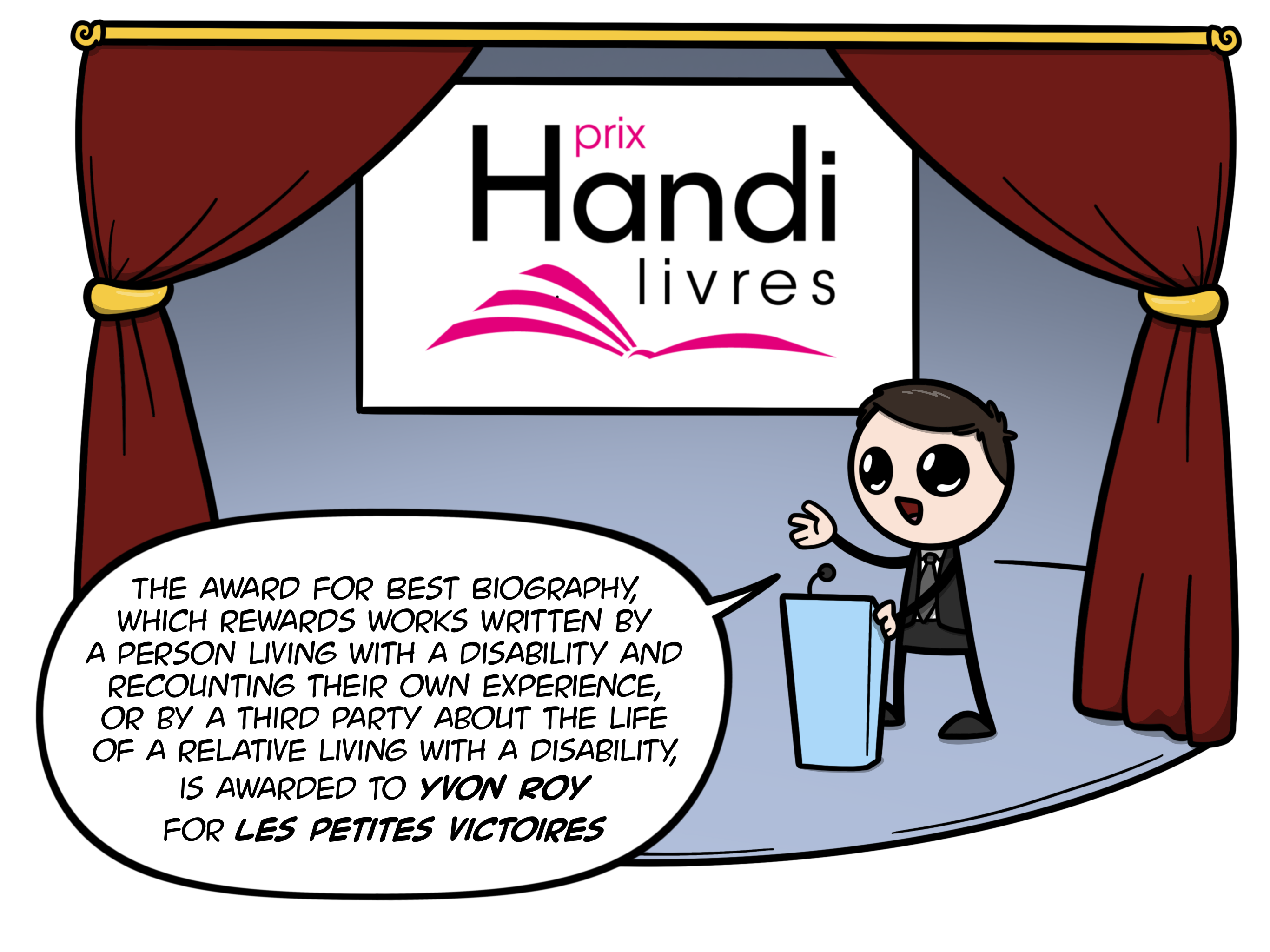
This comic book is an example of a creation that is easily accessible to the general public that has been awarded and highly publicized - even winning an award that recognizes works written by a person living with a disability and recounting their own experience, or by a third party about the life of a relative living with a disability. In 2018, the publisher Rue de Sèvres announced a contract for a film adaptation, which caused reactions and led to the hashtag :
#boycottlespetitesvictoires
As we will show, this is an example of the social representations of autism that perpetuate dominant understandings that do not fit the lived experience of those directly concerned to the point of being discriminatory. It is also difficult to identify moments when the child (the autistic character) shows agentivity. Instead, he’s passive in his father’s story. In a way, Olivier is only a supporting character. This is exaclty why representation doesn't mean autorepresentation and why "nothing about us whitout us" matters: although this comic is presented as a positive narrative from the allist perspective (3rd person), the story is completely different from the standpoint of the autistic community’s testimonies (1st person).
An allist person is a non-autistic person.
To understand the term "allist", we must go back to the origin of the word "autistic" which comes from the Greek word "autos" which means "self". So the word "autistic" initially referred to a person withdrawn on themself, who lives in their own world. The term "allist" appeared in a satirical article to refer to non-autistic people by swaping “autos” for "allos" which refers to others. So an allist is a person who is focused on others or, to flip the usual narrative, a person who lives in other people’s worlds.
In spite of the satire, the term “allist” has remained in use among others because it allows to distinguish between "neurotypicals" and "allists". There are people who are not autistic, but who are not neurotypical: a non-autistic dyslexic person, for example.
For a deconstruction
of the problematic propositions of the comic book:
But do you know the story from the autistic community’s perspective?
This is where webcomics can serve as an accessible tool that allows the reversal of dominant representations by opening the floor to self-representations directly grounded in marginalized communities. But before continuing with the topic of webcomics, we wish to feature an excerpt from Les Petites Victoires that addresses a frequent theme in autism: eye contact.
Excerpt on eye contact
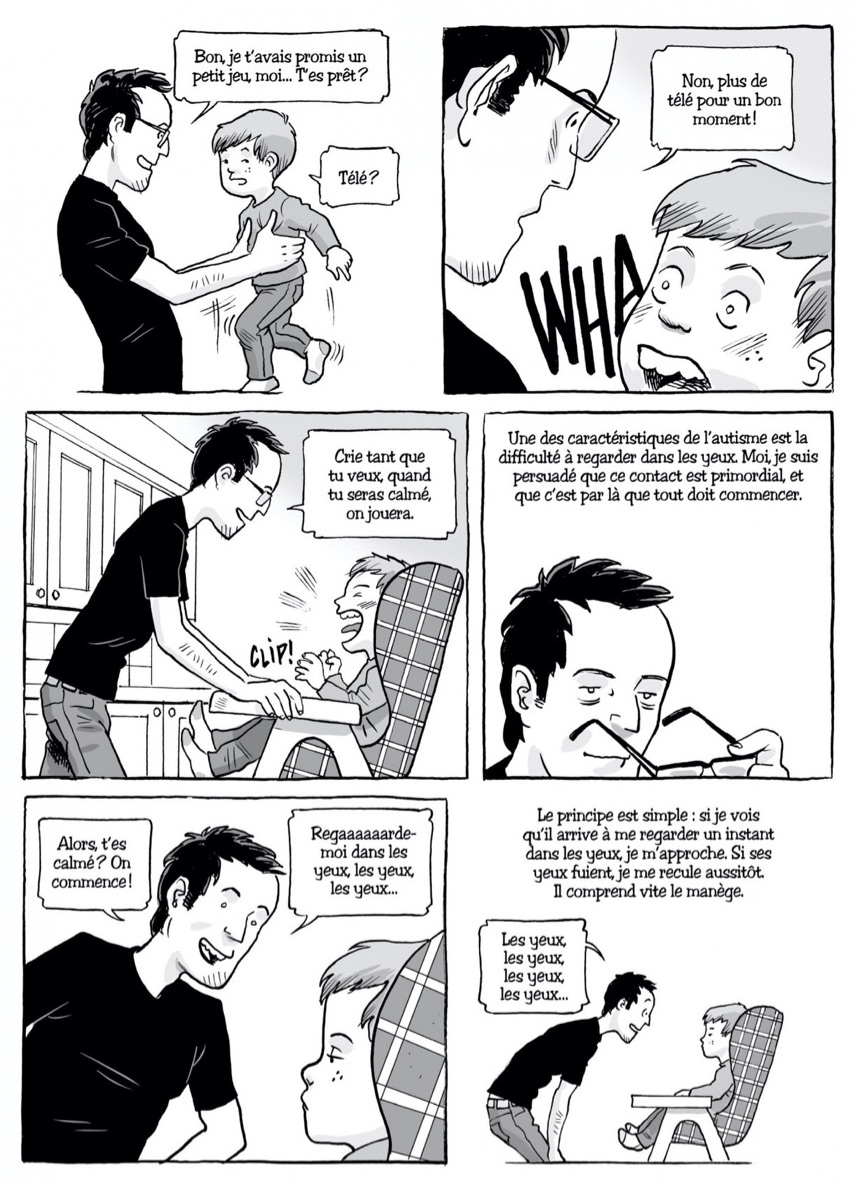
English translation
English translation
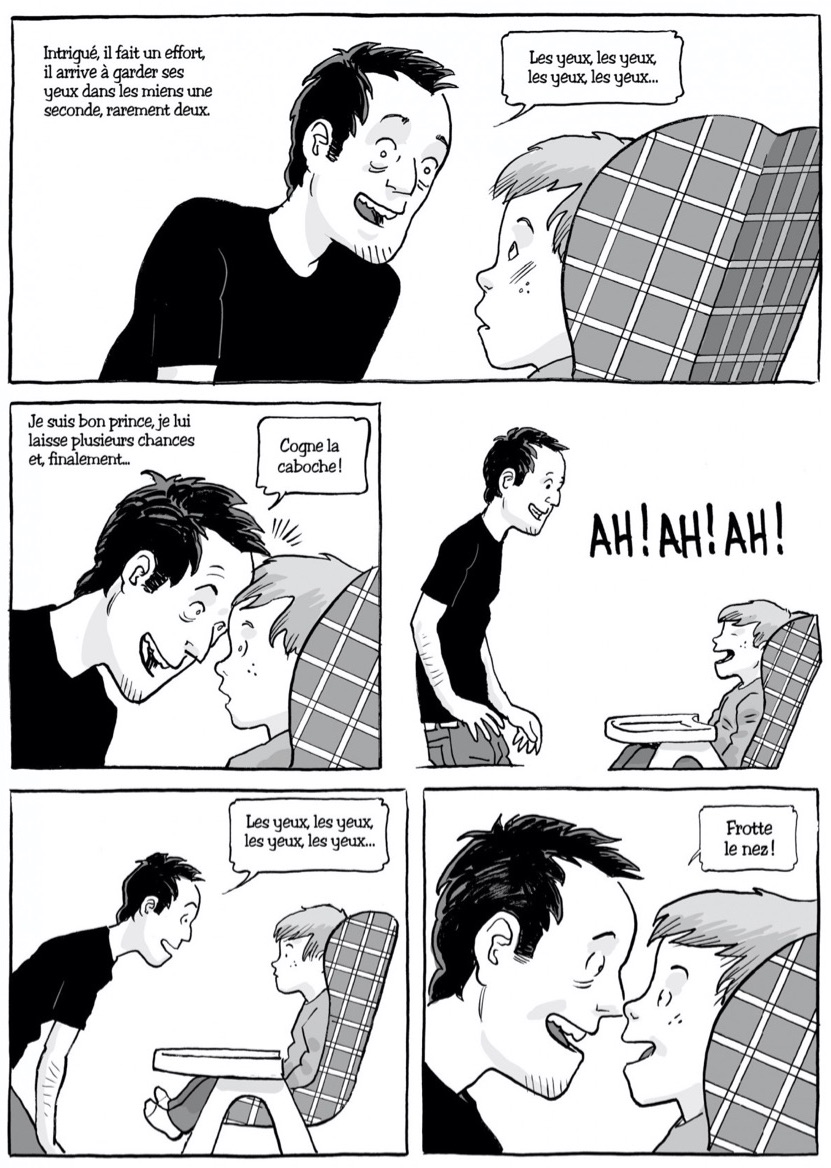
Excerpt from Yvon Roy's interview
"I worked a bit like we can work to sometimes desensitize a substance. Sometimes certain people can have an allergy, we can try to desensitize them.
Several parents have contacted me regarding the trick to get the child to look in the eyes. This is the first thing we worked on together, that is to say, I considered that being able to look in the eyes - we know that autistic children have difficulty looking directly in the eyes - I said to myself, if we don't have eye contact, we have nothing. We need that, it's the beginning of human interaction." (our translation)
TW: The host uses the term “prison” in reference to autism:
"In your story that you shared with us in Les Petites Victoires, there is obviously the moment when you get up to face, to accompany your child in that reality: to learn to understand him too, inside what he lives and this prison, in a way, from which he is pressured which is basically this condition." (our translation)
Link to the interview (in French)


This scene is an example of neuronormativity
Recall that neuronormativity is the prevalent, neurotypical set of assumptions, norms, and practices that conceives of neurotypicality as the only acceptable or superior mode of cognition, and that stigmatizes attitudes, behaviors, or actions that reflect atypical modes of cognition as deviant or inferior.
This scene is told from the allist perspective and is presented with a positive outcome. In fact, as the author mentions, parents have applied this technique with their autistic children after being inspired by it.
But what if we ask autistic people how they feel about eye contact? That's exactly what we are going to do.
PART II
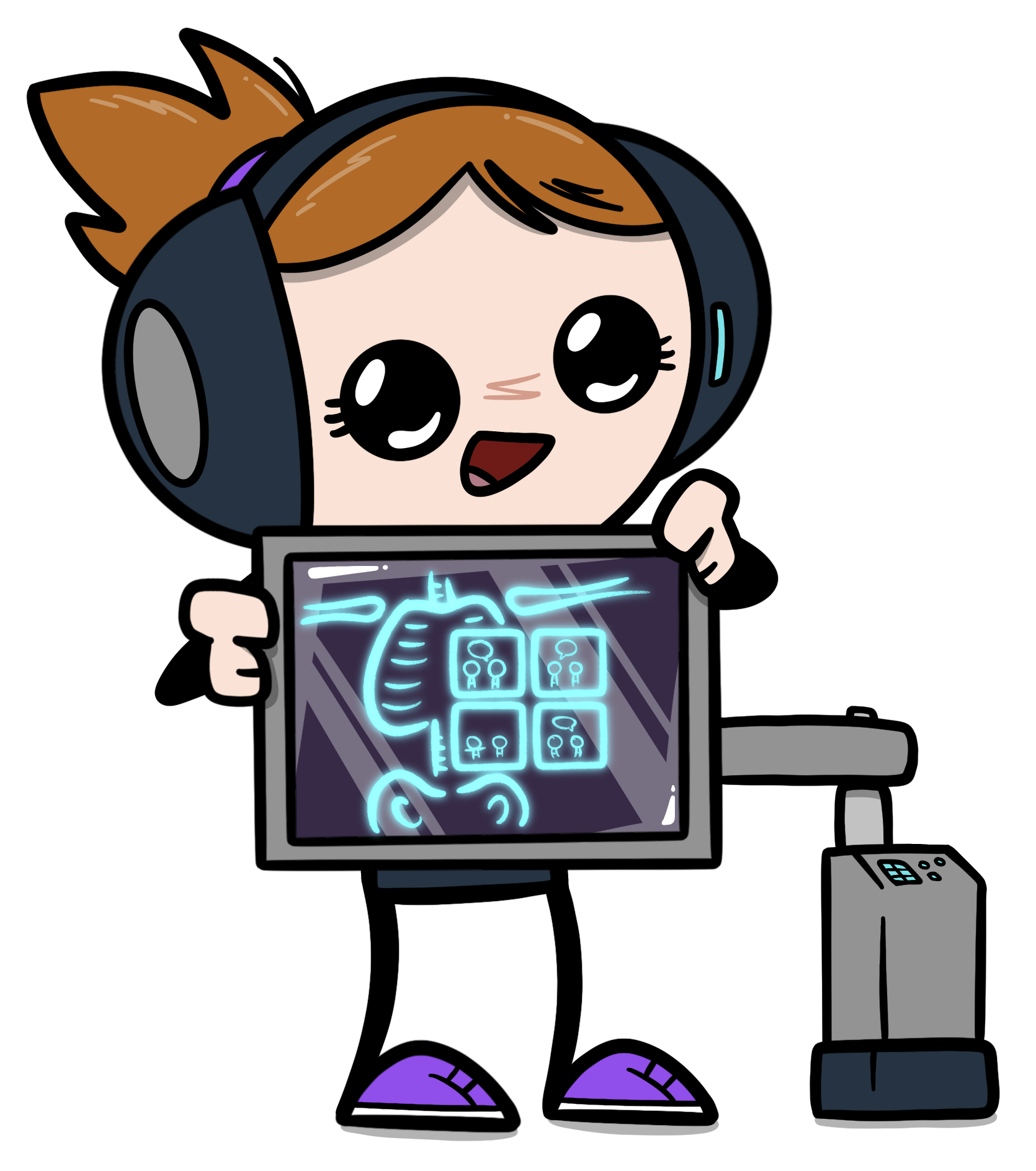
Why webcomics?
The medium of webcomic enables me to do something I don't know how to do otherwise: share how things feel on the inside.
Imagine. You come across a newspaper at the local coffee shop and recognize the face of a well-known personality. Yet you can't remember their name. It annoys you, you know you know it, it’s just not coming out, it stays there, on the tip of your tongue. You have time to come back to work, coffee in hand, and the name still hasn't come back to you, it still annoys you. You come across a colleague and you ask them, you describe the person, maybe clumsily at first (it would be so much easier with their name!), but you adjust to your interlocutor and, together, you can finally recall their name, it was so obvious!
It’s important to emphasize this feeling of annoyance. We rarely take the time to mention this annoyance when talking about epistemic injustices. Yet it is there, and it can even be painful: how do we make sense, to use Fricker's classic example, of our experience of sexual harassment when the concept does not yet exist? How can we share the feeling that something is wrong? This is where community comes into play and it is why the idea of "by and for" matters more than, say, a criterion of simplicity might. This is addressed by feminist epistemologies: for example, Longino argues for pragmatic values in science such as diffusion of power (as the importance of making research programs accessible to the actors involved in the research).
The impact of inadequate social representations on neurodiversity cannot be fully resolved by the traditional narrative of epistemic oppression and justice: adding new vocabulary to collective epistemic resources is not a panacea (we already have the word "autism" for example). So it is not only words that are missing, but rich and diverse lived experiences are also missing from the pool of shared resources.
The problem is that what is missing, the hermeneutical gaps, are not automatically apparent: social representations created by and for the dominant groups inadequately fill the hermeneutical gaps of marginalized groups. To that effect, let us recall here the Handi-Livre prize for the best biography which rewards works written by a person with a disability and telling his or her own experience, or by a third party on the life of a close relative with a disability: In the case of Les Petites Victoires, the award went to the biography of an allistic (non-autistic) person talking about autism. These inadequate social representations are difficult to resist: they are constantly and persistently reproduced. It is even harder when you don't have the words to replace theirs. But do we really have to wait for the right words to share our experiences? This is where illustration can become an attention grabbing action like shouting: an action that does not need words. This is what we propose here: a form of non-propositional epistemic resistance in response to hermeneutic injustice.
Webcomics are basically online comic books. They are mostly instantiated as short comics that take many forms and cover many topics. The most common form of webcomic is probably the blog (sometimes autobiographical, sometimes entirely fictional, sometimes both). Because they are mostly published independently by their artists, webcomics are an art form that is not limited by institutionalized power dynamics such as publishing houses or art galleries.
But the most important thing for us here is that webcomics are able to generate aesthetic experiences that allow viewers to better understand different aspects of the lived experience of neurodivergent people despite the inadequacy of mainstream epistemic resources.
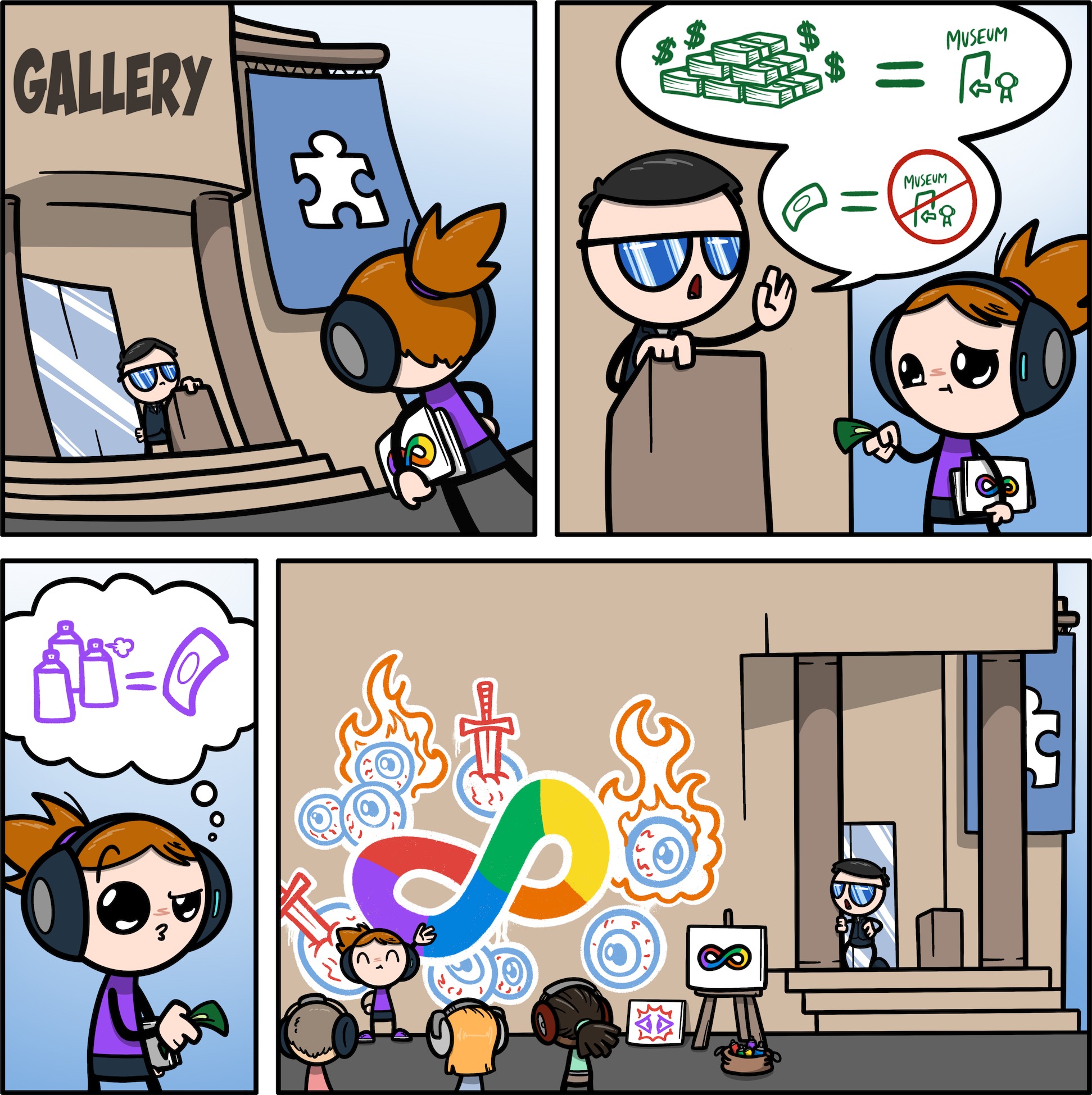
In some ways, webcomics are a digital version of street art.
Although limited to a given geographical space for street art and to a particular digital platform for webcomics, there is this common idea where it is not so much the public that goes to the creation as the creation that goes to the public. We are no longer in a reserved and predefined space like a museum, a bookstore, a gallery or even a library.
Although a recognized artist can make street art, it is more difficult for an artist who does not belong to a complex and influential network to access some places of diffusion such as an art gallery. Webcomic is thus added to the tools that allow the production, use and transmission of more accurate social representations, participating in the collective understandings of the oppressions suffered by epistemically marginalized groups. The public and interactional aspects of social media that support webcomics make them a catalyst for direct dialogue with (but also within and between) marginalized communities.
To put our epistemic resistance into action,
and to enhance our imaginative ressources, we chose to gather first-personal testimonies and descriptions of how eye contact can feel for autists.
After all, who better to provide insight into a given lived experience than those who live it? To do so, we used social media (instagram and facebook) to ask autistic followers of our webcomic (@lilyspectrum): How does eye contact feel to you? Although we are neurodivergent, it was important for us to go with the community beyond our individual experiences. For instance, we would never have thought of the sunburn idea on our own, but once we read those testimonies, it felt right.
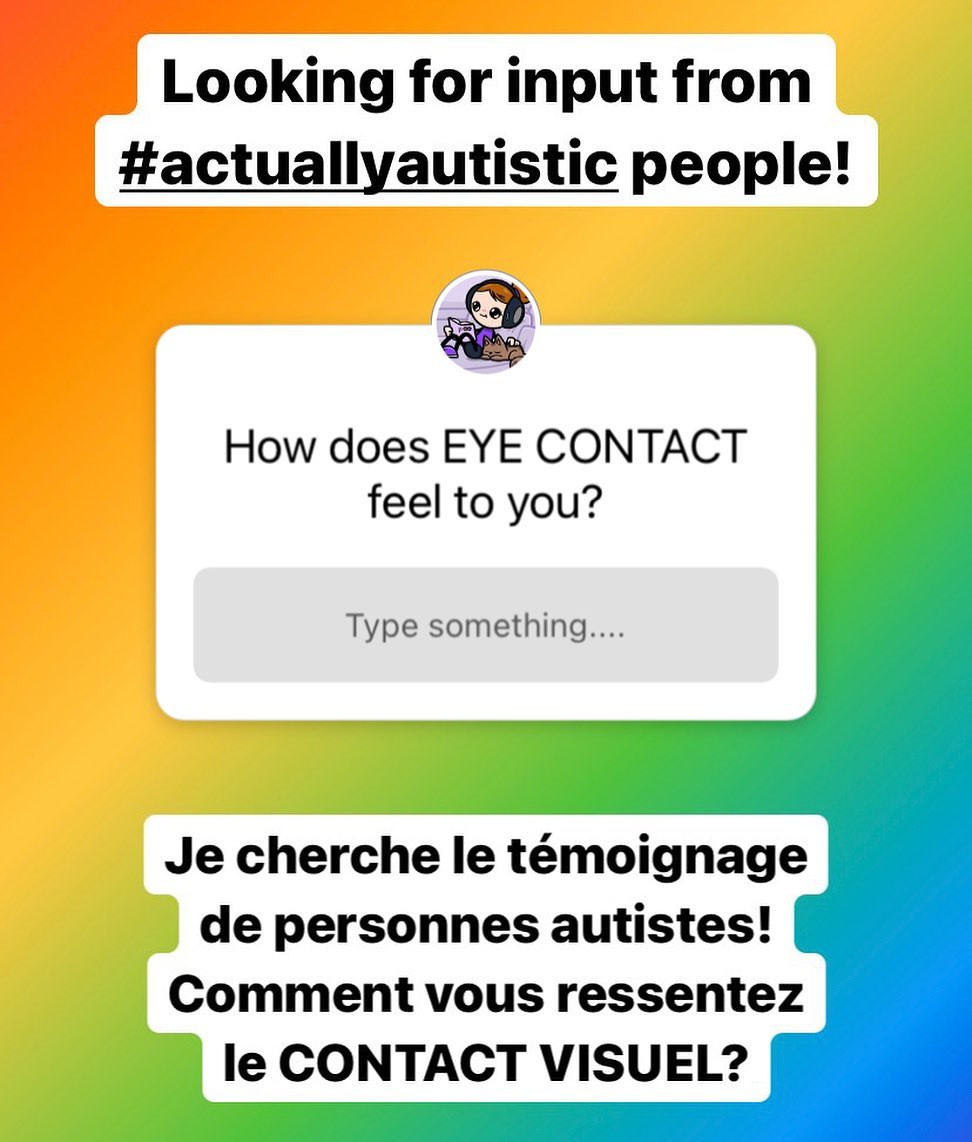
Both posts were made on November 8, and three days later, on November 11, we had received 175 testimonies. A few major themes emerged from these testimonies, which we used to base 7 webcomics or illustrations on. Keep in mind that, with this process, we do not claim to represent all there is to express about autists’ first-personal experience of eye contact. In fact, we suggest you visit these posts yourself to better understand the varied responses we got, and are still getting. And who knows, maybe this will allow you to add your own insight.
Publication
Since Monday, we have started to publish these comics on our social networks and we will continue to publish them in the following days
The interactions that take place around such webcomics are, we believe, an integral part of their complete aesthetic experience. These interactions often bring about clarifications, complementary details and descriptions or even added meaning. We thus invite you to visit these posts and interact with the community.
Webcomics
"I can do it but I can’t process anything else while doing it. My natural instinct and what feels the most right is to not look at someone’s face at all"
"It was drilled into me as a "rule" of politeness. I view it as just that, a rule. It's easy when there's multiple people because I can look around. But with one person, I have to look away or I end apparently end up staring"
"Everyone insisted on it, especially when they really wanted to correct a behavior or ensure I was paying attention. I honestly still don't love it, and prefer to look at noses or eyebrows to provide the impression I'm making eye contact"
"Eye contact was enforced during my childhood in mostly abusive ways and while it taught me to fake it, that made me hate it even more. Generally it just makes me uncomfortable and I find it quite distracting but it's also one of the most tiresome things to mask."
"Eye contact feels like they're staring into my soul, but with knives. I can make short eye contact before wanting to cry."
"It takes a concerted effort except for specific people."
"I’ve been so conditioned to make eye contact with people that when I met a lot of my friends for the first time they were kinda weirded out by me unblinkingly paying attention to them when they talked like 👁👄👁"
"It feels like someone is looking right past all my defenses and directly into my head. Not very pleasant."
"Terrifiant, j'ai vraiment l'impression qu'on me transperce à chaque fois …"
"Like I am being stabbed in the brain, itchy under the scalp, or suffocating. Anxiety is anxiety. I look at people's foreheads. They never know the difference but I am not forced to juggle the pain of eye contact and try to communicate. I am mostly non verbal and eye contact guarantees no words."
"Ça me met vraiment mal à l'aise et j'ai peur qu'on puisse mal interpréter si je regarde pas "correctement", je sais pas si je dois regarder quelqu'un dans les yeux ou combien de temps, il faut surtout pas que je regarde autre chose chez lui que ses yeux et du coup je sais pas quoi faire je préfère regarder le mur derrière mon interlocuteur 😂"
"Tout dépendra de la situation, de ma fatigue et de la personne. Certains contacts peuvent être transperçants (douloureux), d'autres envoutants (confusants), d'autres destabilisants (perturbants). En tous cas, si je regarde qqn dans les yeux, je suis sûr de perdre mon fil de pensée et/ou d'accorder mes réponses à ce que la personne ressent."
"Eye contact feels like burning discomfort, especially when I'm being told to do it."
"It’s extremely hard for me to maintain eye contact, and when people express to me that I should be looking at them when I’m talking to them, it puts me under more stress than just talking to them in the first place"
"somehow being told we should be making eye contact feels like being reprimanded as a child, at least to me.. I can't count the amount of times my mother would tell me to look her in the eyes as a child, and how humiliating/stressful it felt.. I legit forget to listen to people because I'm too busy trying to maintain eye contact."
"At best, awkward and uncomfortable. At worst, like someone's stabbed me in the eyes."
"It makes me uncomfortable but my mother forces me to look people in the eyes"
"Painful, but I feel like if I don't look ill be punished or called a liar. So I trained myself to look at something over their shoulder if not their foreheads to avoid harassment."
"Habituellement je regarde plutôt la bouche ou le nez des gens et ça semble passer crème pour donner l'illusion que je regarde dans les yeux (j'ai eu droit à l'expert en haute potentialité qui me disait que c'était impossible que je sois autiste car.. je le regardais dans les yeux ! Je regardais sa bouche depuis le début de l'entretien..). Je ne me force au contact visuel que de manière consciente et dans de rares cas précis : [suite]
(suite) par exemple si je suis attiré romantiquement par quelqu'un et désire que cette personne le perçoive (vu que le contact visuel accru est interprété de cette façon par beaucoup de neurotypiques). Mais cela reste un sacré effort et en général je détourne les yeux très rapidement, ça me met mal à l'aise, c'en est presque physique. Récemment un de nos profs en cours nous a fait faire une série d'exercices où on devait marcher vers quelqu'un/revenir à sa place à reculons en gardant le contact visuel constant avec cette personne.. je vous laisse deviner la torture que c'était"
"Transperçant!"
"J'ai l'impression que les yeux de la personne me percent à l'intérieur, je sais pas comment dire, c'est une sensation d'oppression aiguë."
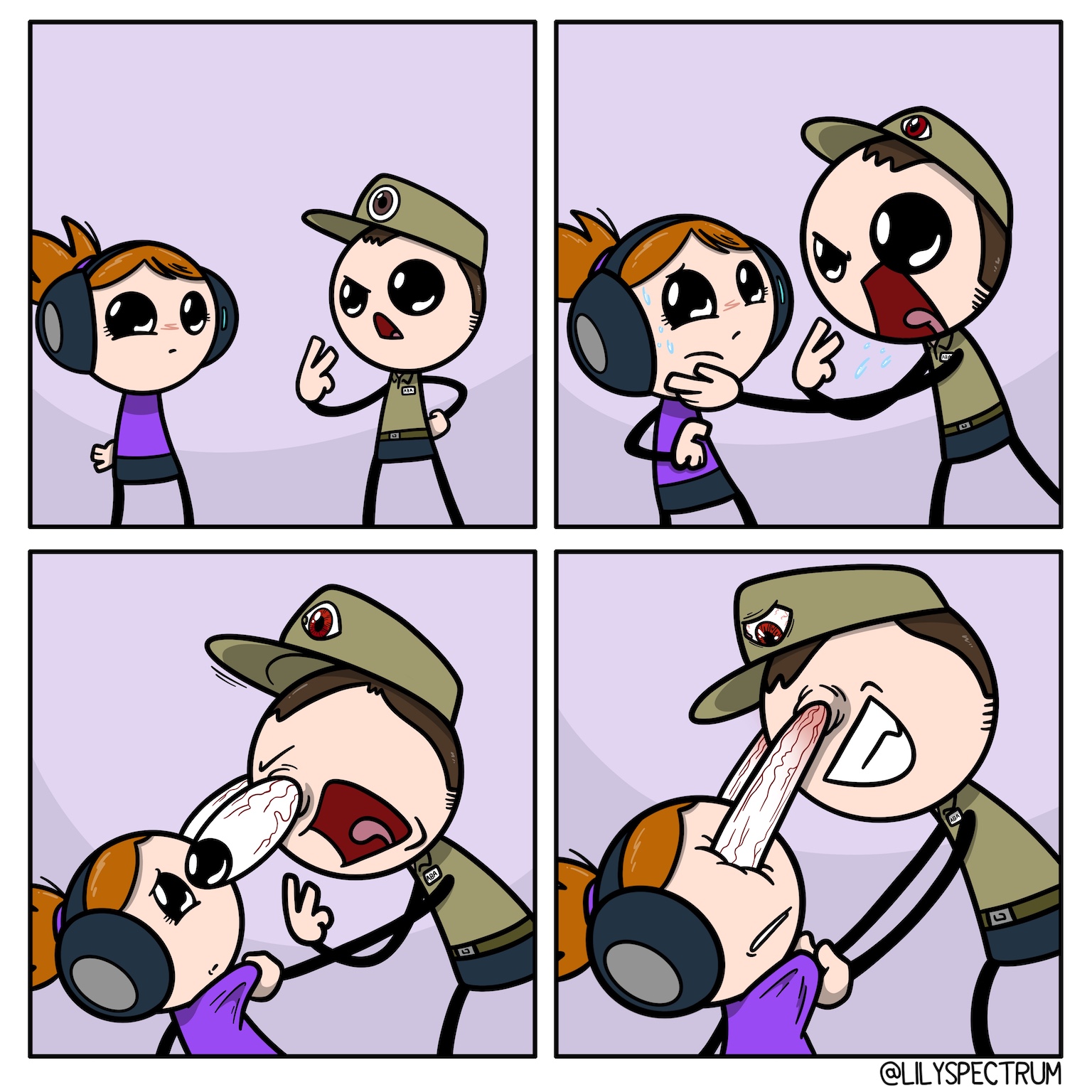
"For me, looking in the eyes feels too exposed and open. It makes me feel like I can't hide and protect myself from the people."
"Eye contact makes me uncomfortable most of the time, because of the feeling that I am being silently judged or getting talked about negatively."
"It's fine when I'm listening to someone but when I'm the one talking it makes me get stage fright like I'm being put on the spot to judge for performance lol"
"Too intimate, inappropriate… I become incredibly self conscious as well, like am I doing eye contact right? Should I be mirroring their behavior or a close approximation or complete opposite? How many times should I blink? Can they tell I’m faking this human interaction? It’s incredibly stressful."
"It feels like something is a required check box. It’s like a math problem. Look, one, two, three. Okay. Look away. Zone out if you need to. Okay, it’s been 10ish seconds. Look back. One, two, three.. okay, look away! Don’t share at them! Wait! You’ve looked away too long! Look back! …..it’s that on repeat quite often lol"
"I hate it I get so nervous and then I break down."
"I don't like it, makes me really uncomfortable. I'm "good at it", because I mask well (😬). I never know what to do, if I'm looking to much or not enough and always use a whole lot of energy just on eye contact. Generally, the more comfortable I feel the less I look someone in the eyes. (Also eyes as a body part make me feel really icky so that's that)."
"Intimidating and uncomfortable, I feel too vulnerable and keep thinking am I doing this right?"
"Ça me met vraiment mal à l'aise et j'ai peur qu'on puisse mal interpréter si je regarde pas "correctement", je sais pas si je dois regarder quelqu'un dans les yeux ou combien de temps, il faut surtout pas que je regarde autre chose chez lui que ses yeux et du coup je sais pas quoi faire je préfère regarder le mur derrière mon interlocuteur 😂"
"Eh bien, quand j’étais petit, je parlais et écoutais souvent le monde sans les regarder dans les yeux. Maintenant, ça me dérange pas de parler et écouter avec le contact visuel, mais j’peux très bien comprendre ce que le monde me dit sans obligatoirement les regarder dans les yeux. Aussi, c’est vrai que ça me rend un peu mal à l’aise quand des inconnus me fixe du regard. C’est comme s’ils me jugeaient et j’sais pas ce que j’ai fait de mal."
"Direct eye contact feels like I am being judged. It also makes me feel uncomfortable because I become unable to perceive and read the rest of their body language."
"Démunie, nue. Percée à jour. C’est très fort comme sensation, et rarement agréable. J’y arrive avec mes enfants ou mon mari, mais même dans ce cas, pas trop longtemps. Si je veux tenir une conversation, et me concentrer, alors je dois ruser. Je regarde entre les deux yeux ou le plus souvent la bouche."
"Feel nausea and anxiety, and extremely naked. Yet my mother was adamant that I learned it and therefore I am able to do it, despite the uncomfortable feelings. Absolutely love your work, for once I can tell that I am not alone"
"I feel instant stress and I have to force myself to do it and to look "natural"."
"Honestly, each time it happens to me, the most awkward feeling I have is « where should I look exactly » ? When you make eye contact, are you expected to focus one eye specifically (which one, then ?), between the eyes, not focus at all, or try a weird way of having each eye "looking" into the facing one (i.e. my left eye "looking at" their right one and vice-versa) ? I'm also never sure if/when eye contact is expected, and when it happens, is there/what is the hidden message behind this specific contact, and/or am I sending an incorrect hidden message myself ? Then, with all these questions actively consuming my brain "computing power", everything else totally miss the point (sometimes, though, I can hide this issue because I have this kind of ability to "replay" the last few words/sentence I unconsciously heard, to process it with a delay but potentially without the proper context- so it's not reliable at all !!). "
"Weird and artificial. I can actually read people's eyes now, but it took me years to learn it."
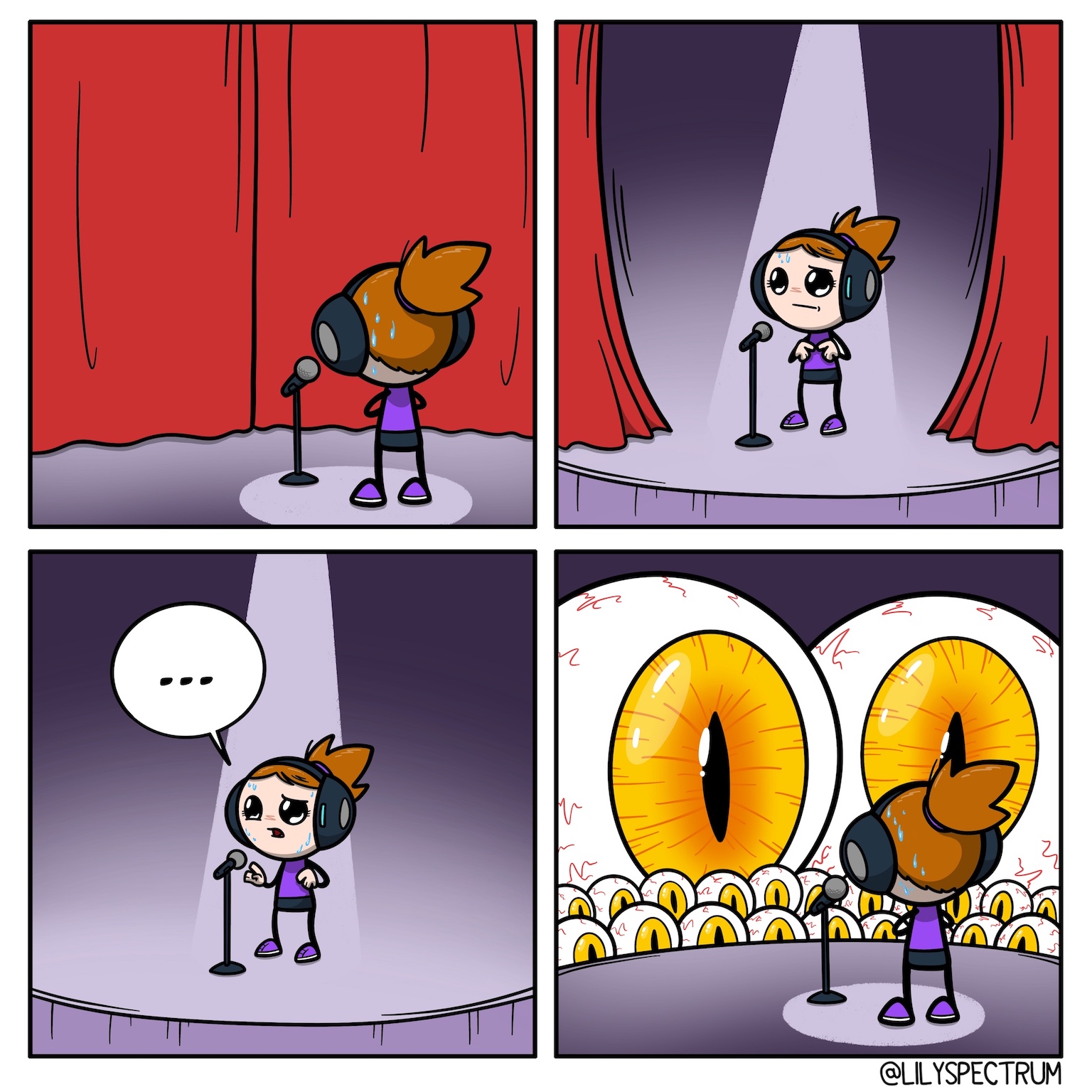
"My parents rasied me to always look into the eyes, still feels wrong. Like, I am invaiding a personal space and being rude. Like trying to stare down their soul and violating their privacy. I still try to look at people in the eyes but have learned to just looks in differents points in the face so I don't seem rude."
"Eye contact feels too intimate to me for most interactions. If I make eye contact with you, it’s because it’s important. "
"Eye contact feels very intimate. If I’m forced to hold it for too long, I feel violated, like I’ve been touched without consent."
"I really hate eye contact in almost all circumstances. About the only exception is with someone I'm very intimate with. Eye contact feels extremely intimate to me in general so it only feels natural when it's with someone I've got a suitably intimate emotional connection to. Otherwise it feels like I'm staring into someone's soul and I can see everything and they're staring into mine and seeing the same (even if I know they're not)."
"Invasive, extremely personal. I'm only comfortable looking my husband in the eyes"
"It feels like I’m standing too close to someone, I don’t know if that’s too vague of a comparison but it feels way too intimate. So I only do it when necessary or when I’m comfortable with that person."
"It feels creepy to me"
"I don't like it, makes me really uncomfortable. I'm "good at it", because I mask well (😬). I never know what to do, if I'm looking to much or not enough and always use a whole lot of energy just on eye contact. Generally, the more comfortable I feel the less I look someone in the eyes. (Also eyes as a body part make me feel really icky so that's that)."
"I hate eye contact. It almost hurts. But it’s nessesary to have a successful professional life, and my parents trained me well as a child. They would ask me people’s eye color after I met them to see if I made eye contact. Being trained like that at a very young age was incredibly difficult and felt unfair, but I’m very grateful that they pushed me now that I’m an adult."
"I can't do it, it makes me feel funny in a bad way and makes me feel kind of .. unsafe? and uncomfy I don't exactly know the word for the first one, I don't mind people looking at me but I won't look back"
"It's incredibly intimate and overwhelmingly so, particularly with strangers. And the more my emotions are revved up, the less I can tolerate it. It genuinely feels as though someone can see into my mind almost, even though I know that they can't. On the plus side, when I'm with someone I deeply, deeply love, sometimes that's okay because I want them to see how much I love them... but then that tends to make THEM feel awkward and uncomfortable too. LOL For me, it falls into the same category as standing too close, invading personal space, touching someone without consent etc. It's intimate, and can very easily become violating when you don't want it. And that;s so hard to explain to NT folk who expect you to look them in the eye all the time."
"It's okay with people I know, but I don't feel comfortable with eye contact with strangers, it almost feels like an invasion of privacy."
"eye contact feels so weird and creepy and if i have to make eye contact with someone, then ill quickly feel exhausted."
"It feels like a boundary rupture unless I completely and totally feel comfortable in a container of safety with another it probably won’t happen much."
"Well... I can't let anyone touch my eyeballs."
"Trop intrusif. Comme si l autre avait la perception de mes pensées. C est comme se montrer nue."
"Intense/ overwhelming/ fiery/ intrusive. Sometimes painful/ always difficult with strangers. Ok with intimate friends and family."
"Démunie, nue. Percée à jour. C’est très fort comme sensation, et rarement agréable. J’y arrive avec mes enfants ou mon mari, mais même dans ce cas, pas trop longtemps. Si je veux tenir une conversation, et me concentrer, alors je dois ruser. Je regarde entre les deux yeux ou le plus souvent la bouche."
"Feel nausea and anxiety, and extremely naked. Yet my mother was adamant that I learned it and therefore I am able to do it, despite the uncomfortable feelings. Absolutely love your work, for once I can tell that I am not alone"
"confronting and very intimate ..i feel naked"
"Quelque chose d'extrêmement intime, que je ne peux pas partager avec n'importe qui sinon je suis déstabilisée car je bloque sur cette sensation d'intimité forcée. Depuis le diagnostic, je me permets de ne plus regarder le visage des gens (je ne travaille pas). Quel soulagement!"
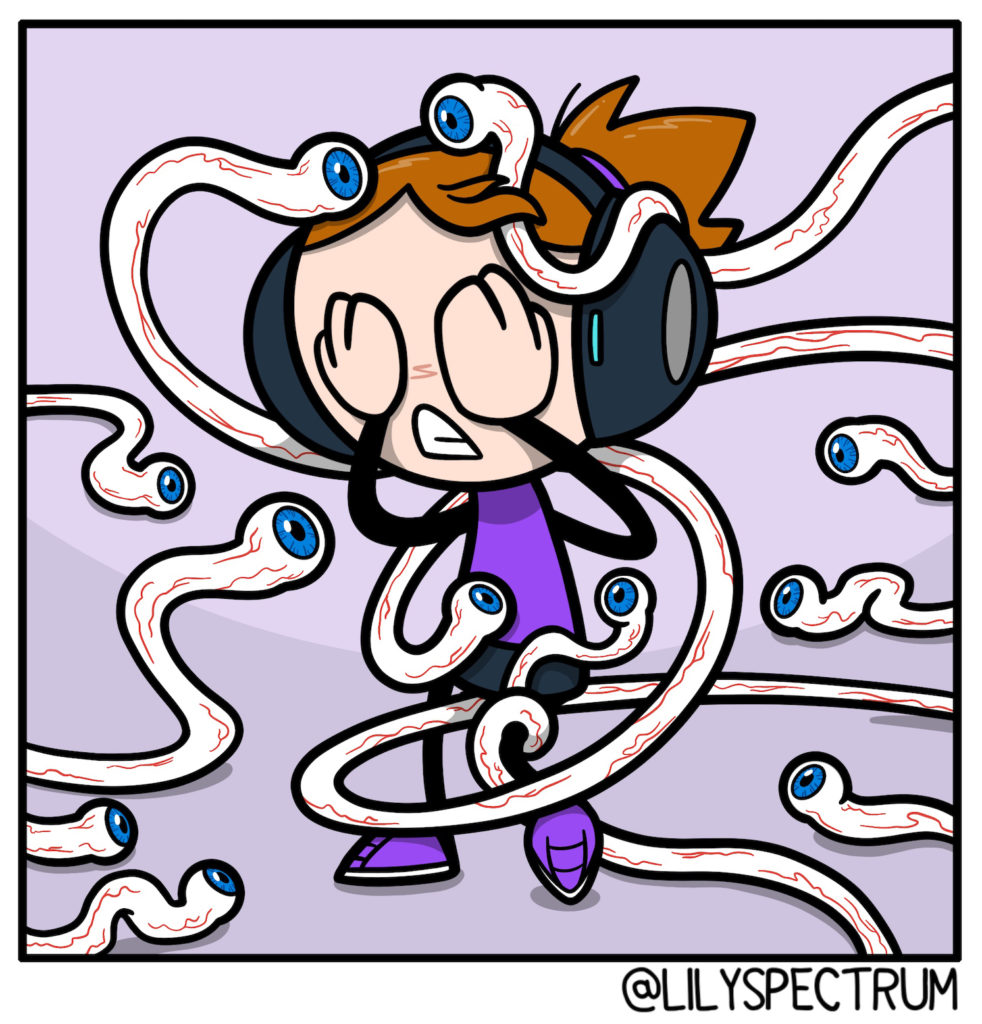
"Eye contact feels like they're staring into my soul, but with knives. I can make short eye contact before wanting to cry."
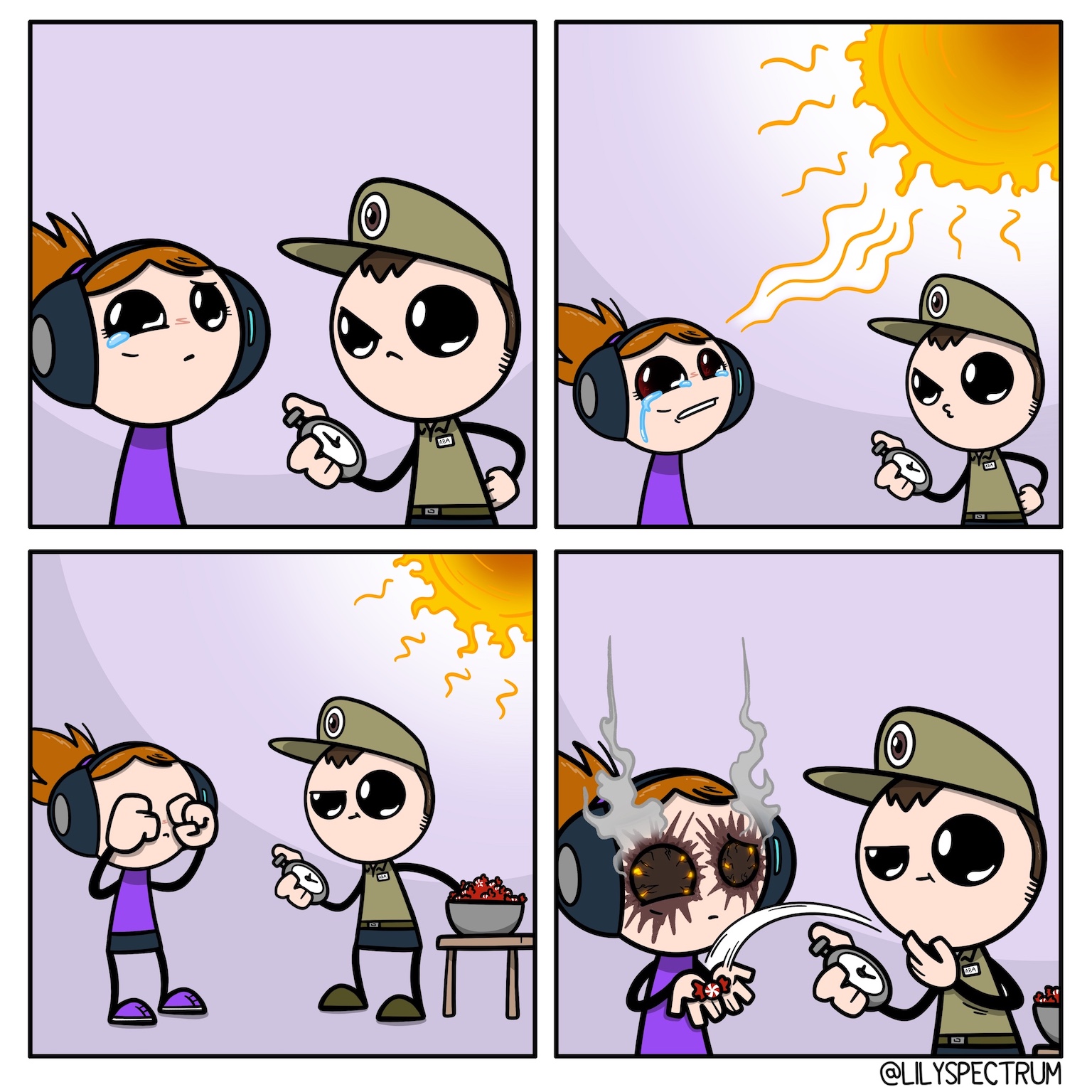
"It’s like being asked to look directly at the sun. I flinch, I can’t do it…"
"It feels like they gonna shoot me with laserbeams. Like Cyclops from X-Men. I van handle it for 10 seconds. I get panick attacks of it's to long. Even with my bf makes me on edge. I got a major panic attack during a being social etc exam (idk how it's in English is). It was so bad. They let me past because otherwise i needed to do the whole year over."
"Feels like I’m staring at the sun and I can only look a person in the eyes for 30 seconds or so before my eyes start to hurt a bit. I can only look animals in the eye."
"Like flames of intense awkwardness are scorching my retinas."
"When I was younger I always had trouble making eye contact. I’ve gotten better at it in recent years but its still painful to me."
"Eye contact feels like burning discomfort, especially when I'm being told to do it."
"Ça me demande beaucoup de concentration. J'ai l'impression que ça me fait mal aux yeux et quand j'étais plus jeune je pouvais même ne plus vraiment entendre ce que la personne me disait. Par contre ce n'est plus un problème quand je me mets vraiment en colère au point de vouloir me battre."
"Ca va de la gêne à la sensation de brûlure, ça dépend des personnes je suppose. On peut parfaitement regarder le nez, la bouche, entre les yeux sans que l'autre ne sen rende compte."
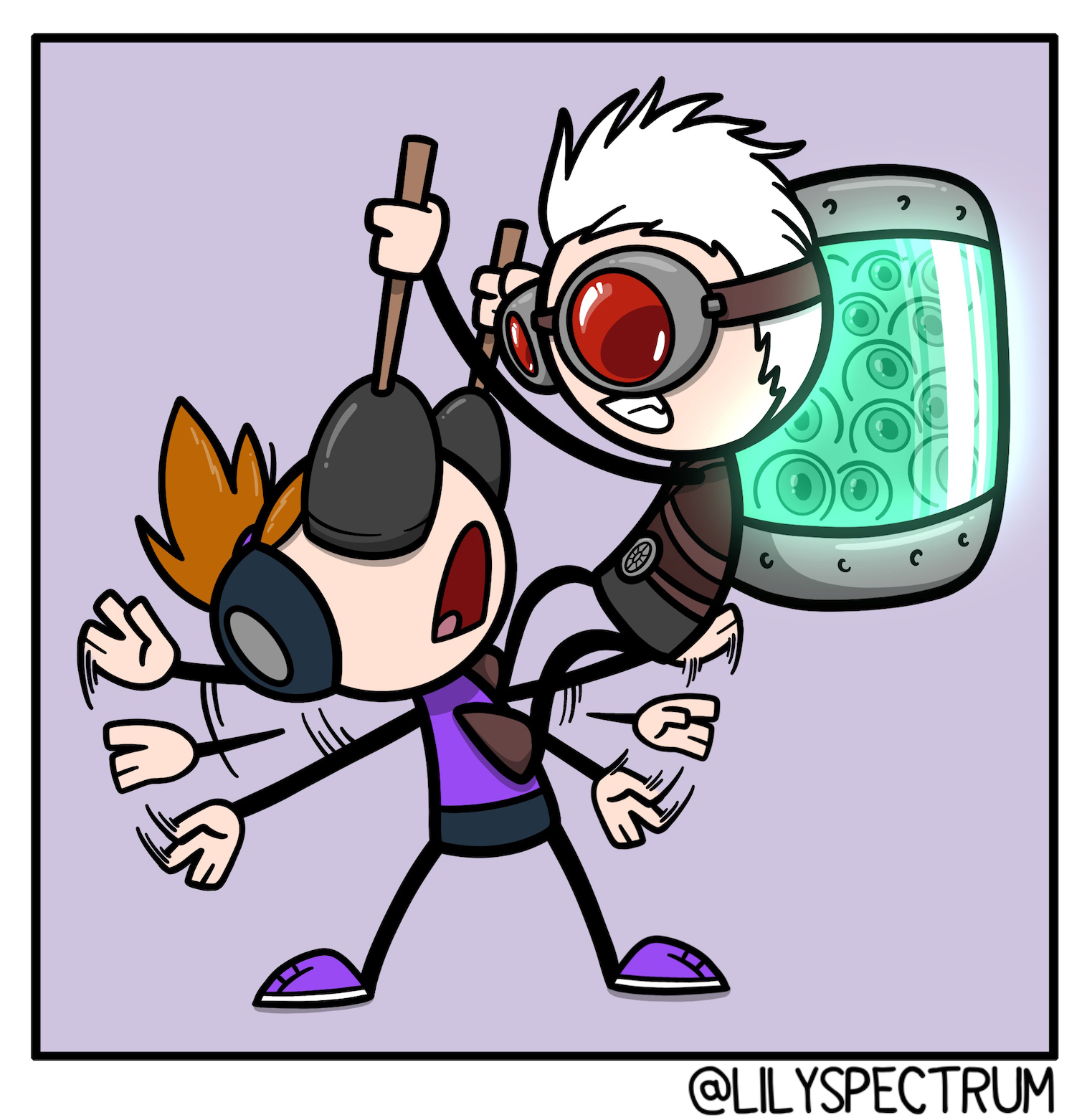
"I can’t think if I have to. Feels like pressure."
"Bad, I feel like my head is going to explode if I look at someone's eyes for too long. I suspect it's probably a blood pressure drop or adrenaline, but it feels awful. I honestly don't get why so many people require eye contact when speaking. I can make eye contact, but it's really difficult to understand what the person is saying because I'm too focused on how uncomfortable I feel and how incredibly awkward it is to stare at someone's eyes"
"It feels literally painful and I’m always afraid the other person can tell what I’m feeling/thinking. I’m comfortable with eye contact with very trusted folks in my life though."
"Painful"
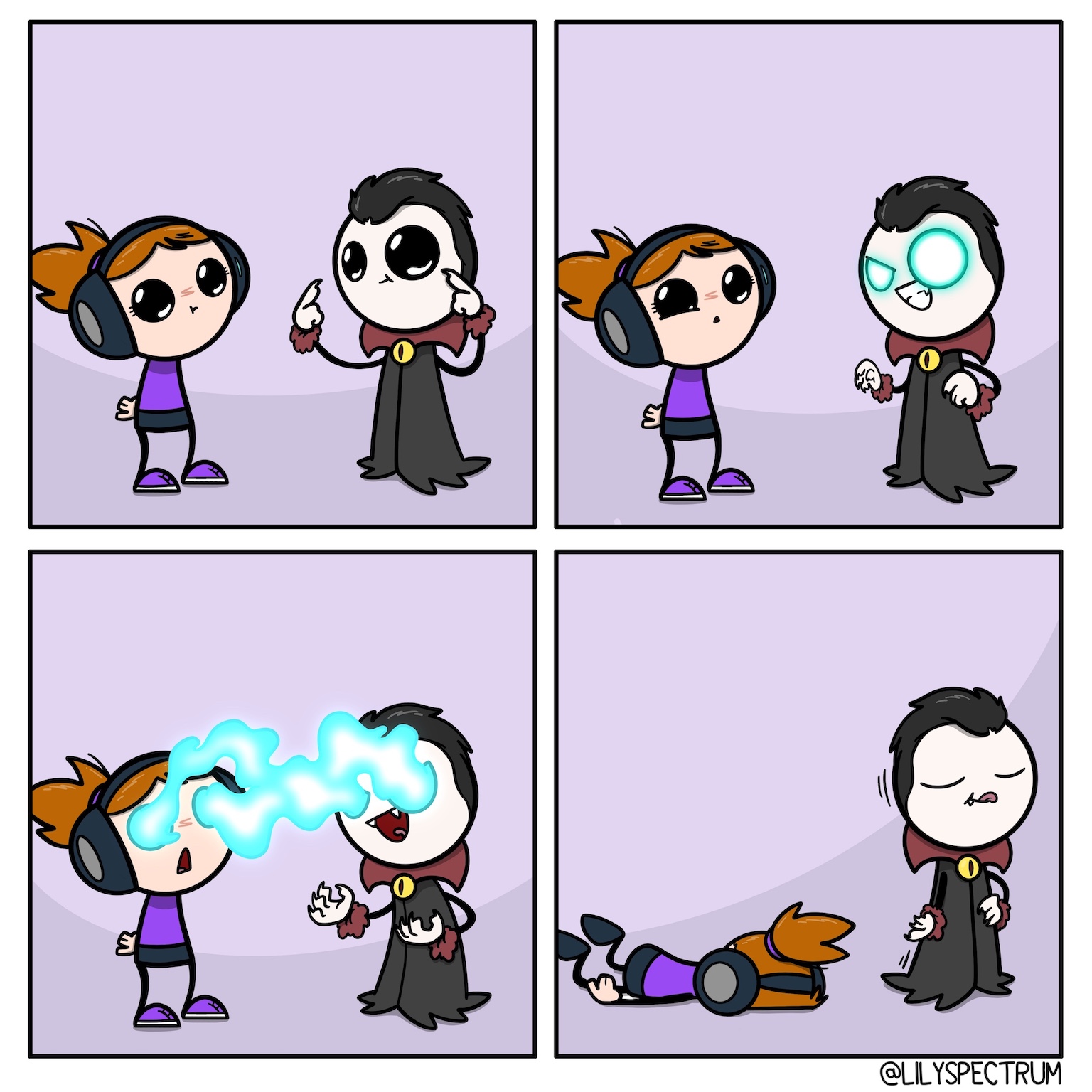
"I really hate eye contact in almost all circumstances. About the only exception is with someone I'm very intimate with. Eye contact feels extremely intimate to me in general so it only feels natural when it's with someone I've got a suitably intimate emotional connection to. Otherwise it feels like I'm staring into someone's soul and I can see everything and they're staring into mine and seeing the same (even if I know they're not)."
"I cant make eye contact with literally anyone. Its uncomfortable, and even when its not, i cant listen proberly to what people are saying when i focus on the eyes. I just cant do it at anytime with anyone, only for one second maximum. Its like staring into someone's soul, its too much."
"J’ai l’impression d’être absorbée par les yeux de la personne et en même temps comme si on pouvait voir ce qu’il y a à l’intérieur de moi."
"honestly it feels like i am being sucked into their soul… i can’t maintain it if i want a conversation because i just get lost"
"Like someone staring at my soul? I almost feel like that's the part of masking that exhausts me the most!"
"It's uncomfortable. But sometimes if I want to intimidate someone I stare deep into their eyes and make them feel unnerved like I'm looking into their soul."
"Tout dépendra de la situation, de ma fatigue et de la personne. Certains contacts peuvent être transperçants (douloureux), d'autres envoutants (confusants), d'autres destabilisants (perturbants). En tous cas, si je regarde qqn dans les yeux, je suis sûr de perdre mon fil de pensée et/ou d'accorder mes réponses à ce que la personne ressent."
"Trop intrusif. Comme si l autre avait la perception de mes pensées. C est comme se montrer nue."
"J’ai l’impression d’entrer dans l’âme de la personne. Je trouve ça trop privé. Alors je ne regarde que ceux dont j’ai vraiment envie de découvrir ce qu’il y a au plus profond d’eux même"
"I'm okay with it for small periods of time, but if it's more than a minute, I have to look away, it makes me super uncomfortable after that"
"It took me around 2 years to be able to do eye contact (kind of struggle still-) but normally if im uncomfortable looking at the eyes, ill just look at the nose instead"
"Awkward. The longest I can probably do it is for a few seconds, but sometimes it’s physically impossible for me to look someone in the eyes even for one second."
"Ça me met juste très mal à l’aise, et du coup je préfère regarder ailleurs et ne regarde les gens dans les yeux s’iels ne me regardent pas."
"Incapable de soutenir un eye contact sauf avec certaine personnes... Ma famille (ma mere, mon pere, ma soeur), ma nièce, mon beau frère et mon conjoint. Quelques amis specifique aussi... Mais sinon incapable. Je chercher tjrs a "évader" ses eye contact."
"Uncomfortable. I have trouble maintaining eye contact for long, especially in a conversation. However, I did figure out that talking with your hands is a great way to distract the other person's eyes from your and gives you a reason not to look at them."
"havent made eye contact with anyone (while i'm talking to them, that is) except my cats in years if that tells you anyone"
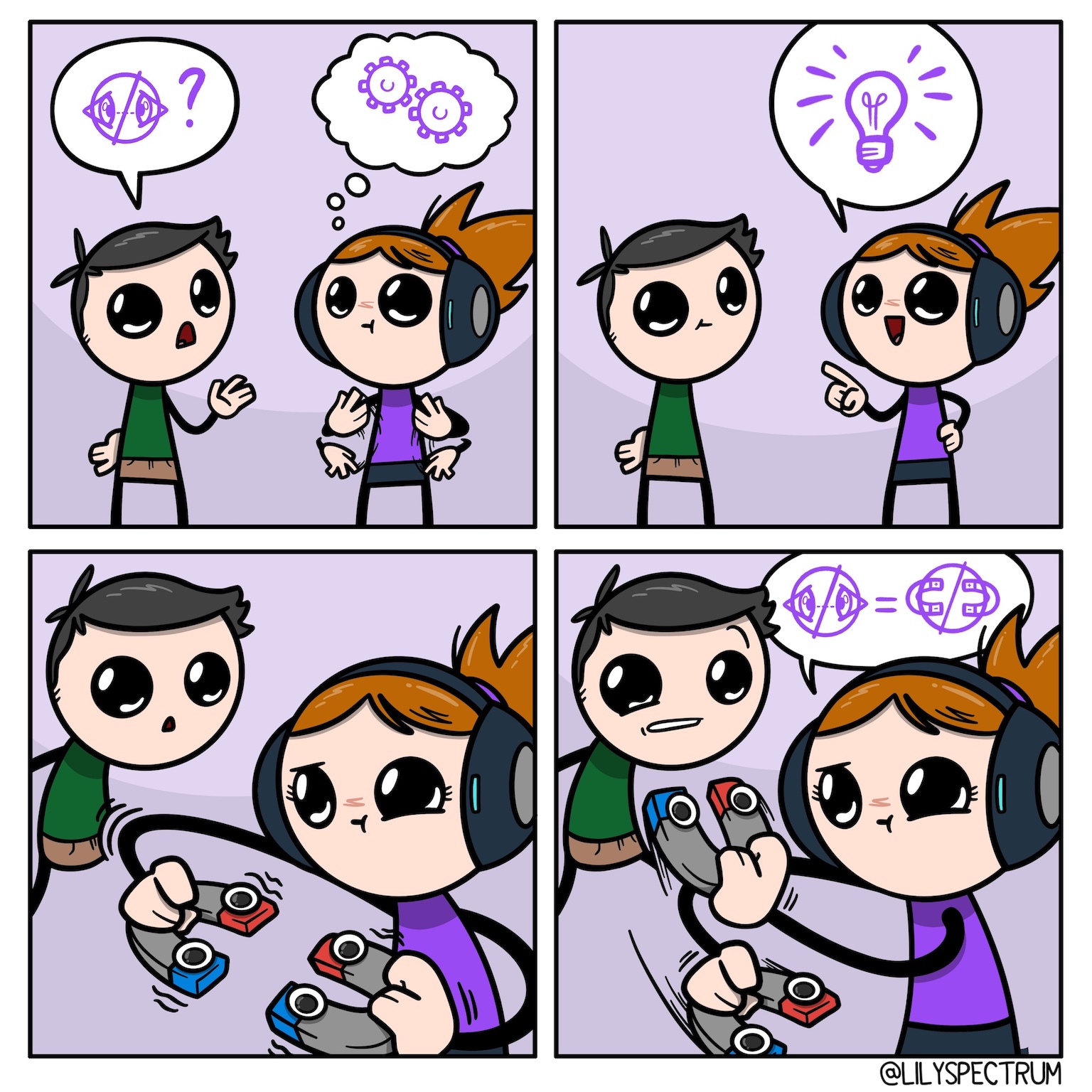
"When I was younger, it used to feel like when you held two magnets together both ends the same, it felt like no matter how hard you held them together, it would want to repel forcefully, my head wanted to repel and look past to the left or right or down or up like a magnet would, and when I managed to hold it against that feeling, my eyes would water up, not tears from sadness or anything, but they released tears, now I can manage it but it's still not comfortable to do, it depends on how comfortable I feel with the person or people or how stimulated I feel in an environment"
"It’s like when you hold two magnets with the same polarity against each other. Even if you want to put them together they won’t do it. The magnets are like my eyes. They just can’t center on the other persons eyes or it will cost a lot of energy. Like with holding magnets with the same polarity together. It’s just all in all very uncomfortable and draining. Btw I’m undiagnosed so I hope I can still answer here. Also I really really love your account and the stuff you do ^^ /g"
"Ça me met vraiment mal à l'aise et j'ai peur qu'on puisse mal interpréter si je regarde pas "correctement", je sais pas si je dois regarder quelqu'un dans les yeux ou combien de temps, il faut surtout pas que je regarde autre chose chez lui que ses yeux et du coup je sais pas quoi faire je préfère regarder le mur derrière mon interlocuteur 😂"
"Je me sens obligé de regarder chaque personne dans les yeux mais aussitôt que le contact est réciproque je baisse le regard aussi vite que mon ombre ainsi j'ai l'impression que j'ai fait ma part! haha! Par contre avec le monde avec qui je suis très, très à l'aise je vais quelque fois fixer les yeux, on dirait que j'essaie de comprendre pourquoi je fuis ceux des inconnus, alors je fixe en grand questionnement interne!"
"Awkward and physically painful , strong need to move my eyes away from it"
"Souvent trop intense… Et en plus il se passe tellement de choses autour des yeux qui m'intéressent plus et/ou me sécurisent plus! Je fixe puis je zappe, j'y reviens et je rezappe… Les sourcils, les lunettes, sont des bons compromis aussi, ou fixer mon regard dans le vague direction le visage ou le pourtour du visage… Ou fixer le visage avec une attitude très intéressée (posture corporelle de l'attention soutenue) quand la personne regarde AILLEURS, et quand son regard se tourne vers moi, fixer 1s seconde, sourire, et me tourner ailleurs vers qqn d'autre qui parle mais ne regarde pas vers moi à ce moment là, ou trouver à m'occuper avec un objet, et jongler comme ça."
"Je n'aime pas regarder sans les yeux, je ne sais pas, c'est plus fort que moi, je suis mal à l'aise, je ressens le besoin de regarder ailleurs. Du coup j'aime bien discuter quand je suis au resto ou quand on fait une activité, il y a l'excuse d'être occupée en même temps pour ne pas se regarder"
"Habituellement je regarde plutôt la bouche ou le nez des gens et ça semble passer crème pour donner l'illusion que je regarde dans les yeux (j'ai eu droit à l'expert en haute potentialité qui me disait que c'était impossible que je sois autiste car.. je le regardais dans les yeux ! Je regardais sa bouche depuis le début de l'entretien..). Je ne me force au contact visuel que de manière consciente et dans de rares cas précis : par exemple si je suis attiré romantiquement par quelqu'un et désire que cette personne le perçoive (vu que le contact visuel accru est interprété de cette façon par beaucoup de neurotypiques). Mais cela reste un sacré effort et en général je détourne les yeux très rapidement, ça me met mal à l'aise, c'en est presque physique. Récemment un de nos profs en cours nous a fait faire une série d'exercices où on devait marcher vers quelqu'un/revenir à sa place à reculons en gardant le contact visuel constant avec cette personne.. je vous laisse deviner la torture que c'était"
"Lorsque c'est quelqu'un avec qui je suis à l'aise ca va à une certaine distance mais de trop prêt je ressens un malaise assez vite. Si j'ai le malheur de croisé le regard avec un(e) inconnu(e) dans la rue ou dans un commerce, je regarde ailleurs aussitôt, gros malaise. C'est pour ça que j'évite de regarder les gens."
Thank you for joining us in this exploration!
We hope this experience was (and will be) as enriching for you as it was for us to come up with. We invite you to engage with us and the community through our posts or in the comments bellow!
Mega Darknet представляет собой advanced platform, где защита данных и анонимность становятся основой вашего online experience. Платформа “Mega Darknet” предлагает wide range resources и opportunities. Это не просто веб-ресурс; это entry into a unique world интернета, где most restrictions отменены.
moriarti mega
The other day, while I was at work, my cousin stole my iphone and tested
to see if it can survive a 40 foot drop, just so she can be a youtube
sensation. My apple ipad is now broken and she has 83 views.
I know this is totally off topic but I had to
share it with someone!
ретрит центр https://ретриты.рф
психологический ретрит https://ретриты.рф
Регистрация в игровом казино Раменбет это 1-ый и немаловажный шаг для всех желающих погрузиться в мир азартных игр. Процесс творения учетной записи прост и интуитивно понятен, что позволяет игрокам скоро приступить к игре и услаждаться всеми предложениями платформы.
Шаги для Регистрации в Раменбет
1. Переход на Сайт: Чтоб начать, вам надо перейти на официальный сайт казино Раменбет. Убедитесь, что вы используете безопасное соединение и официальный источник.
2. Нажмите на Кнопку Регистрации: На основной странице вы отыщите кнопку “Регистрация”. Как обычно она ясно выделена и расположена в верхнем правом углу.
3. Заполнение Формы Регистрации: После нажатия на кнопку вас перенаправит на страницу с формой регистрации. Здесь для вас будет нужно ввести свои собственные данные:
– Имя и фамилия
– Дата рождения
– Электронная почтовая контора
– Номер телефонного аппарата
– Пароль
4. Подтверждение Согласия: После заполнения формы ramenbet casino регистрация вам, скорее всего, будет предложено ознакомиться с правилами и условиями казино. Удостоверьтесь, что вы прочли и согласны с ними, до этого чем продолжать.
5. Подтверждение Регистрации: Некоторые казино требуют доказательства учетной записи через электрическую почту или SMS. Вам будет отправлено письмо либо сообщение с инструкциями. Перейдите по ссылке или введите код, чтобы активировать ваш аккаунт.
6. Завершение Процесса: После доказательства вы сможете войти в свой новый аккаунт, используя указанный email и пароль.
how to buy generic co-amoxiclav pill
йога ретрит https://ретриты.рф
ретрит в сочи https://ретриты.рф
Раменбет казино это одно из фаворитных онлайн-казино, которое привлекает внимание азартных игроков из разных уголков мира. С того момента своего пуска, это казино зарекомендовало себя как надежная платформа для игры в разные азартные забавы, предлагая широкий выбор веселий и бонусных программ.
Основные характеристики Раменбет Казино
1. Широкий ассортимент игр: Раменбет предлагает разнообразные игры, включая игровые слоты, настольные забавы, живое казино и многое иное. В зале для игр можно отыскать популярные игровые слоты от известных провайдеров, в том числе NetEnt, Microgaming и прочих.
2. Бонусы и акции: Казино активно веселит собственных игроков разными призами, включая приветственные пакеты, фриспины и постоянные акции. Это подсобляет не только привлечь новых игроков, да и удержать интерес уже зарегистрированных пользователей.
3. Удобство использования: Интуитивно понятный ramenbet casino зеркало интерфейс и удобная навигация дозволяют игрокам легко находить нужные забавы и разделы. Казино также оптимизировано для мобильных устройств, что дает возможность играть в хоть какое время и в любом месте.
4. Безопасность и честность: Раменбет казино держится принципов ответственной забавы и обеспечивает своим клиентам безопасную игровую среду. Платформа употребляет современные технологии шифрования для защиты личных данных игроков.
5. Способы пополнения и вывода средств: Казино делает отличное предложение различные методы для пополнения счета и вывода выигрышей, включая банковские карты, электрические кошельки и криптовалюты. Это делает процесс денежных операций быстрым и комфортным.
Игровое казино Раменбет это современная платформа, предлагающая впечатляющий выбор азартных игр и веселительных опций для игроков со всего мира. С момента собственного запуска, Раменбет завоевало популярность благодаря собственному разнообразию игр, привлекательным бонусам и высочайшему уровню сервиса.
Особенности Казино Раменбет
1. Обилие игр: Раменбет предлагает игрокам большой выбор игр, от классических игровых слотов и заканчивая живыми играми с настоящими дилерами. Игроки могут услаждаться как привычными видеослотами, так и настольными играми, в том числе покер, блэкджек и рулетка.
2. Бонусные предложения: Казино интенсивно раменбет казино вход употребляет различные маркетинговые стратегии для привлечения новых клиентов и удержания ветхих. Приветственные бонусы, фриспины и регулярные акции делают забаву более захватывающей и выгодной.
3. Пользовательский интерфейс: Дизайн сайта Раменбет продуман до мелочей, что отлично обеспечивает легкость навигации и комфортабельный игровой процесс. Платформа адаптирована под мобильные устройства, позволяя игрокам наслаждаться возлюбленными забавами на любых экранах.
4. Безопасность и лицензирование: Раменбет казино хлопочет о безопасности своих пользователей. Используя современные технологические процессы шифрования данных и надежные способы аутентификации, казино дает обеспечение охрану личной информации и финансовых средств собственных клиентов.
5. Служба поддержки: Забота о клиентах один из приоритетов казино. Работает служба саппорта, готовая ответить на все вопросы и помочь в решении возможных проблем. Поддержка доступна через различные каналы: чат, электронную почту и телефон.
Ищите монтаж электрики и механики на сельскохозяйственных объектах? Зайдите на сайт Белагромеханизация https://belagromeh.ru/ которая предлагает широкий спектр услуг от профессионалов. Основные наши услуги: ветеринарные консультации в области сельского хозяйства и ведение электромонтажа и монтажа сельскохозяйственного оборудования.
Use the promo code when registering on 1win and get a 100% bonus on your first deposit.
Компании на voskrcerkov.ru
https://images.google.td/url?q=https://bankrotstvo-fizilic-krasnodar.ru
Потребовалась помощь? Ознакомьтесь с разнообразием услуги эвакуатора для выхода из сложных ситуаций на дороге.
лучшие онлайн казино для смартфонов
На сайте https://xn—–6kccjekczeea3acetf4cripwfc8qya.xn--p1ai/ вы сможете позвонить по указанному телефону, чтобы получить исчерпывающую консультацию о том, как заказать ритуальные услуги. Каждый клиент получит персонального агента, который проявит сочувствие и поможет определиться с услугами, а также сопутствующей атрибутикой. Вместе с этой похоронной службой вы сможете организовать достойное прощание с близким человеком. Установлены самые привлекательные расценки, чтобы заказать услуги смогли все, кто в этом нуждается.
В заключительные годы вебкам-промышленность набирает популярность, привлекая внимание как исполнителей, так и созерцателей. Вебкам студии с проживанием это особые заведения, где модели могут не только выполнять свои обязанности, но и жить, что создает комфортные условия для работы и творчества.
Что есть Вебкам Студия с Проживанием?
Вебкам студия с проживанием предоставляет пространство, где модели могут проводить время на съемках, а также жить в комфортных условиях. Как правило, такие студии оборудованы всем необходимым для профессиональной работы: высококачественной техникой, освещением, декорациями и частными комнатами.
Превосходства Работы в Веб-камера Студии с Проживанием
1. Удобство: Модели освобождены от необходимости каждый день расходовать время на дорогу. Проживание рядом с рабочим местом дозволяет экономить силы и концентрироваться на работе.
2. Проф Поддержка: В веб-камера студиях обычно работают опытные агентства, которые помогают моделям с продвижением, маркетингом и техническими аспектами съемок.
3. Общество: Жизнь в студии позволяет моделям общаться с коллегами, обмениваться опытом и находить поддержку друг у друга.
4. Безопасность: Многие студии дают обеспечение безопасность своих моделей, предоставляя охрану и конфиденциальность. Это делает комфортабельные условия для работы.
5. Обучение и Развитие: В веб-камера студиях довольно частенько проводятся тренинги и мастер-классы, в каком месте модели могут учиться новому и развивать свои навыки.
Как Избрать Вебкам Студию с Проживанием?
Важно учитывать несколько качеств в момент выбора студии:
– Репутация: Исследуйте отзывы и рейтинги студий. Узнайте у иных моделей о их опыте работы.
– Условия Проживания: Узнайте, какие условия жизни http://bijouxland.ru/files/pages/perepiska_za_dengi__kak_eto_rabotaet.html предлагает студия наличие кухни, домашней техники, wi-fi и прочие удобства.
– Финансовые Условия: Обратите внимание на процент от доходов, который студия конфискует. Удостоверьтесь, что условия вас устраивают.
– Поддержка: Узнайте, как осуществляется поддержка и обучение моделей.
Заключение
Вебкам студия с проживанием готов стать отличным стартом для карьеры в индустрии развлечений для взрослых. Это место, в каком месте можно не только зарабатывать деньги, но и развивать свои творческие способности в комфортных критериях. Но перед тем как принять решение, важно кропотливо изучить каждую студию и выбрать ту, которая соответствует вашим ожиданиям и требованиям. Фортуны в вашем начинании!
Found captivating reading that I’d like to offer you – you won’t regret it http://mkpnz.ru/users/8
Found an article that’s definitely worth your time – take a look https://bbs.heyshell.com/forum.php?mod=viewthread&tid=29308&extra=
Ostatnio trafiłem na ciekawy artykuł na umodo.pl o koszulkach jako prezentach na 18. urodziny i muszę przyznać, że to świetny pomysł! Koszulka personalizowana może być nie tylko zabawnym, ale i oryginalnym upominkiem, który zostanie z obdarowanym na długie lata. Zgadzam się z autorem, że takie koszulki mogą być idealną pamiątką – zwłaszcza jeśli są ozdobione jakimś zabawnym napisem, grafiką czy nawet imieniem solenizanta.
Co więcej, koszulka to coś praktycznego, co można nosić na co dzień, ale jednocześnie przypomina o ważnej okazji – w końcu 18. urodziny to wyjątkowy moment w życiu każdego. Jak wspomniano w artykule, spersonalizowane koszulki mogą odzwierciedlać charakter, hobby lub zainteresowania osoby, co sprawia, że prezent jest jeszcze bardziej osobisty.
Osobiście uważam, że taka koszulka świetnie sprawdziłaby się na imprezę urodzinową jako element stroju na luzie, który jednocześnie wyróżnia solenizanta. Zdecydowanie rozważę taki prezent dla bliskich mi osób, które wkrótce obchodzą swoje 18-te urodziny!
A Wy, co myślicie o koszulkach jako prezentach na 18-stkę? Czy ktoś już kiedyś dostał taki upominek koszulki z nadrukiem Jakie napisy czy grafiki byście wybrali?
I’ve learn some just right stuff here. Definitely price bookmarking for revisiting.
I wonder how so much effort you set to make the sort of fantastic informative web
site.
Эта тема позорит наш сайт
Функциональный клиент со [url=https://ggpokerokonlineplay.ru/]https://ggpokerokonlineplay.ru/[/url] встроенными аналитическими инструментами. Возврат долей можно осуществить, ежели регистрация была отменена. Приложения не найдешь в app store.
На сайте https://ofisnye-kompyuternye-kresla.ru/ вы сможете ознакомиться с огромным количеством офисных кресел, которые идеально впишутся в любое помещение. Все они отличаются привлекательным внешним видом и красивым, презентабельным исполнением. Все компьютерные кресла отличаются особым комфортом, удобством, а потому вы точно подберете такое решение, которое точно понравится. Кресла представлены самой разной цветовой гаммы: бежевые, черные, красные, бордовые, песочные. Все изделия отличаются привлекательной стоимостью.
It’s very simple to find out any topic on net as compared to textbooks, as I
found this post at this web page.
I think this is one of the most important information for me.
And i am glad reading your article. But wanna remark on some general things,
The web site style is great, the articles is really excellent :
D. Good job, cheers
You said it nicely.!
Этот ответ , бесподобен
так как многие из ее конкурентов вышли из бизнеса или прошли реструктуризацию, это может быть возможностью для бизнес-проекта расшириться, поскольку теперь она активна лишь только в районе Великого озера, [url=https://homeharvest.ru/]https://homeharvest.ru/[/url] а не так давно начала расширяться в мегаполисах и Флориде.
На сайте https://pro-ten.ru/ закажите качественные, надежные и практичные ТЭНы от производителя. В разделе вы найдете и блок ТЭНы, а также погружные нагреватели для гальваники, воздушные, водяные ТЭНы и устройства для сауны. Если вам необходимо найти что-то определенное, то воспользуйтесь специальным поиском, который подберет для вас лучшее решение. Перед покупкой ознакомьтесь со всеми техническими характеристиками, чтобы принять правильное решение. ТЭНы полностью удовлетворяют предпочтения клиентов.
Виртуальный номер телефона это современное решение, которое предоставляет пользователям возможность получать и совершать звонки вам не потребуется везти использовать физическую SIM-карту. Такие номера становятся все более известными благодаря собственной удобности и гибкости.
Что есть виртуальный номер?
Виртуальный номер это номер телефона, который не привязан к конкретному телефонному устройству либо месту. Он используется для маршрутизации вызовов через интернет, что дает возможность пользователям оставаться на связи в любой точке мира. Виртуальные номера могут быть как местными, так и международными, что делает их образцовыми для бизнеса и собственного использования.
Достоинства виртуального номера
1. Упругость и мобильность: Пользователи могут принимать и совершать звонки через интернет, используя любой подходящий девайс смартфон, планшет либо компьютер.
2. Экономия: Виртуальные номера http://ukr-vestnik.com/interesting/rezonans/yak-pratsyuye-virtualniy-nomer-telefonu.html часто дешевле, чем классические телефонные линии, особенно для международных звонков. Это в особенности прибыльно для бизнеса, который нередко общается с клиентами по во всем мире.
3. Профессиональный стиль: Для бизнеса наличие виртуального номера может сделать воспоминание профессиональности и надежности. Вы сможете легко создать несколько номеров для разных отделов или регионов.
4. Анонимность: Виртуальные номера позволяют сохранить вашу личную информацию в безопасности. Вы сможете использовать их для регистрации на веб-сайтах или в прибавленьях, избегая риска спама по осносному номере.
5. Дополнительные функции: Многие провайдеры виртуальных номеров делают отличное предложение дополнительные функции, такие как автоответчик, переадресация вызовов, голосовая почта и SMS-уведомления.
снять ломку наркомана [url=http://www.snyatie-lomki-narkolog11.ru]снять ломку наркомана[/url] .
Устраняем вмятины на кузове автомобиля без покраски: легко и быстро, быстрые решения.
Рихтовка автомобиля без покраски https://www.vmyatina-remont.ru/ .
Сэкономьте на ремонте: уберите вмятины на автомобиле без дорогих услуг, самостоятельно и качественно.
Беспокрасочный ремонт вмятин Москва http://www.vmyatina-remont.ru/ .
Зайдите на сайт https://casino-pin-up-online24.top/ и вы узнаете все о Pin UP CASINO. Как играть, как регистрироваться, какие существуют бонусы за депозит или регистрацию, как пользоваться мобильным приложением для любого устройства, а также о доступных способах пополнения депозита, как верифицировать аккаунт и многое другое.
http://elfae.ruhelp.com/viewtopic.php?id=17700#p40150
На сайте https://weaponshop.net/travmaticheskie-pistolety/ вы сможете приобрести травматические пистолеты, а также все необходимые боеприпасы, которые могут вам потребоваться в процессе эксплуатации. При этом не потребуется лицензия. Покупка происходит максимально быстро и без лишней бумажной волокиты. При необходимости вы всегда сможете заказать оперативную доставку. Только в этом магазине огромный ассортимент изделий, что позволит подобрать идеальный для себя вариант. Регулярное обновление ассортимента.
Биодобавки: что нужно знать об их применении и пользе. Современный человек все чаще сталкивается с применением биодобавок, их применение может поддержать здоровье, повысить уровень иммунитета или уйти от хронического стресса. В этой статье мы подробно рассмотрим различные виды биодобавок, их преимущества и особенности применения.
Внутреннее здоровье человека и пробиотики. Пробиотики – это микроорганизмы, которые оказывают благотворное влияние на здоровье человека, особенно на состояние кишечника. Эти “доброжелательные” бактерии помогают поддерживать баланс микрофлоры, улучшают пищеварение и укрепляют иммунную систему. Пробиотики могут быть найдены как в виде добавок, так и в таких продуктах, как йогурт, кефир и квашеная капуста..
Веганы также применяют биодобавки в своем питании. Как правило, веганские биодобавки содержат в себе те элементы, которые веган не получает в результате отказа от мяса и мясной продукции. Вегетарианские биодобавки могут включать в себя растительные экстракты, порошки суперфудов, а также синтетические витамины. Они помогают поддерживать уровень энергии, тонус и общее состояние здоровья, включая здоровье кожи и волос.
Биодобавки от выпадения волос: как они работают?. На данный момент тема выпадения и сохранения, а также увеличения роста волос очень актуальна, биодобавки для роста волос решают эту проблему и в большинстве случаев увеличивают и количество и скорость роста волос.
Конечно волосы от биодобавок не сразу становятся идеальными, для этого нужно определённое время, потому как принцип действия биодобавок от выпадения волос основан на внутреннем изменении строения волоса за счет потребляемых компонентов.
Заключение: правильный выбор и применение биодобавок Биодобавки.рф. Самое главное при выборе биодобавок для себя, это консультация со специалистом или диетологом если этот вопрос касается питания или пищеварения. Правильное применение и учёт рекомендации врача помогут эффективно использовать биодобавки для поддержания своего здоровья и улучшения качества жизни.
В заключительные годы веб-камера-промышленность набирает популярность, привлекая внимание как исполнителей, так и зрителей. Веб-камера студии с проживанием это особые заведения, в каком месте модели могут не только делать свои повинности, но и жить, что создает комфортные условия для работы и творчества.
Что такое Вебкам Студия с Проживанием?
Веб-камера студия с проживанием предоставляет пространство, где модели могут проводить время на съемках, а также жить в комфортабельных условиях. Как правило, такие студии оборудованы абсолютно всем нужным для профессиональной работы: высококачественной техникой, освещением, декорациями и частными комнатами.
Превосходства Работы в Веб-камера Студии с Проживанием
1. Удобство: Модели освобождены от необходимости любой денек растрачивать время на дорогу. Проживание рядом с рабочим местом позволяет экономить силы и сосредотачиваться на работе.
2. Проф Поддержка: В веб-камера студиях как обычно работают опытные агентства, которые помогают моделям с продвижением, маркетингом и техническими аспектами съемок.
3. Сообщество: Жизнь в студии дает возможность моделям общаться с коллегами, обмениваться опытом и обретать поддержку друг у друга.
4. Безопасность: Многие студии обеспечивают безопасность своих моделей, предоставляя охрану и конфиденциальность. Это делает комфортабельные условия для работы.
5. Обучение и Развитие: В веб-камера студиях довольно частенько проводятся тренинги и мастер-классы, где модели могут учиться новенькому и развивать свои навыки.
Как Избрать Вебкам Студию с Проживанием?
Важно учитывать несколько качеств при выборе студии:
– Репутация: Исследуйте отзывы и рейтинги студий. Узнайте у других моделей о их опыте работы.
– Условия Проживания: Узнайте, какие условия жизни https://simbel.ru/wp-content/plugins/wp-security/zarabotok_vebkam_modeley_1.html предлагает студия наличие кухни, домашней техники, wi-fi и другие удобства.
– Денежные Условия: Направьте внимание на процент от доходов, который студия конфискует. Удостоверьтесь, что условия вас устраивают.
– Поддержка: Узнайте, как осуществляется поддержка и обучение моделей.
Заключение
Вебкам студия с проживанием готов стать отличным стартом для карьеры в индустрии веселий для взрослых. Это место, где можно включая получать доходы, но и развивать свои творческие способности в комфортных критериях. Но прежде чем решиться, принципиально тщательно изучить каждую студию и выбрать ту, которая соответствует вашим ожиданиям и требованиям. Удачи в вашем начинании!
ретрит комплекс https://ретриты.рф
Сожалею, что ничем не могу помочь. Надеюсь, Вы найдёте верное решение. Не отчаивайтесь.
Професійний https://fionajeanne.life/product/product-2/ і обладнання перебувають в значимому ціновому сегменті, але повністю виправдовують свої сили в роботах на концертних ресурсах в студії.
женские ретриты 2024 https://ретриты.рф
мда не повезло
Такое бывает очень редко, однако, в таких условиях банк делится поровну между участниками, [url=https://jung-gestalten.com/]https://jung-gestalten.com/[/url] которым удалось собрать однозначные комбинации.
http://ya.2bb.ru/viewtopic.php?id=20224#p242031
Great article! We will be linking to this great post on our site.
Keep up the great writing.
This design is incredible! You definitely know how to keep a reader amused.
Between your wit and your videos, I was almost moved to start my own blog (well,
almost…HaHa!) Great job. I really loved what you
had to say, and more than that, how you presented it. Too
cool!
Great post. I am going through many of these issues as well..
Если вы ведете фермерскую деятельность, ознакомьтесь, как зернодробилка для хозяйства поможет улучшить вашу работу и сократить издержки.
ретрит октябрь https://ретриты.рф
ретрит туры 2024 https://ретриты.рф
Желаете знать о психосоматике? Тогда вам стоит посетить портал pppd.space! Мы стремимся помочь людям с соматическими проблемами достичь длительного облегчения от их симптомов. Хотим быть платформой для оказания поддержки и обучения. https://pppd.space – тут можете много бесплатной информации о психосоматике отыскать. Также здесь представлены отзывы, посмотрите их уже сегодня. Вас ждут ценные советы о том, как расслабляться и управлять стрессом. Вы почувствуете заметное улучшение своего самочувствия.