"Neurodiversity through Webcomics: Using Aesthetic Experiences for Epistemic Resistance"
At the heart of the ideas proposed in today's panel is that of epistemic enablement through trajectories other than propositional, which can be offered by aesthetic experience.
PANEL
"Dancing Toward Epistemic Justice: An Embodied Account of Epistemic Agency"
Amandine Catala and Camille Zimmermann covered the example of dance, an embodied account of epistemic enablement.

PhD Candidate - Philosophy (UQAM)
Camille Zimmermann
zimmermann.camille@courrier.uqam.ca

Professor - Philosophy (UQAM)
Amandine Catala
catala.amandine@uqam.ca
"Comics and Epistemic Enablement"
Luc Faucher discussed the medium of comics in the context of neurodiversity, again as epistemic enablement.

Professor - Philosophy (UQAM)
Luc Faucher
"Neurodiversity through Webcomics: Using Aesthetic Experiences for Epistemic Resistance"
We now continue with webcomics.
PhD Candidate - Philosophy (UQAM)
Mylène Legault
legault.mylene.2@courrier.uqam.ca

PhD Candidate - Philosophy (UQAM)
Jean-Nicolas Bourdon
bourdon.jean-nicolas@courrier.uqam.ca
PREFACE
About the
Format
Force of habit leads us to take the established ways of doing things as fixed, even though they are circumstantial. We were able to explore this reality, for example, during the pandemic: going to the office for work meetings, which, in all honesty, could have been e-mails. We also know that cultural habits are not insignificant, they allow the reproduction of comfortable modalities of interaction for dominant groups: those with the power to choose these modalities.
For our part of the panel, we propose to do things differently. Don't worry, we're not criticizing power point presentations and their timely sip of water pauses. Instead, we're inviting you to explore an alternative modality for interaction.
Public Speaking
Many people hate public speaking. It generally comes with discomforts and even fears, but some people have cognitive profiles that function in ways far removed from this type of interaction. However, this practice is socially maintained and considered essential for meeting and sharing. But is it really necessary? Does the public space absolutely have to be occupied in an oratory and synchronous way? What if these modalities are, in fact, infused with neuronormativity?
Human society is permeated by collective cultural resources with which individuals can, among other things, interpret, understand and communicate various aspects of their experiences. Since they are collective resources, their genesis, maintenance and dissemination are a function of the power dynamics that permeate our societies. One of these power dynamics is organized around norms regarding what is considered appropriate cognitive functioning: the group whose cognition corresponds to the norm (i.e., neurotypicals) dominates and those whose cognition deviates from the norm (i.e., neurodivergent) are marginalized. This epistemic marginalization has the effect of limiting the access of neurodivergent individuals to so-called "collective" epistemic resources, both in their elaboration and in their use.
This norm corresponds to neuronormativity, which is presented by Amandine Catala, Luc Faucher et Pierre Poirier (2021) in their paper Autism, epistemic injustice, and epistemic disablement: a relational account of epistemic agency.
Neuronormativity refers to the prevalent, neurotypical set of assumptions, norms, and practices that construes neurotypicality as the sole acceptable or superior mode of cognition, and that stigmatizes attitudes, behaviors, or actions that reflect neu- roatypical modes of cognition as deviant or inferior. Neuronormative assumptions, norms, and practices uphold standards regarding, for example, (what is neurotypi- cally considered) appropriate eye contact, facial expressions, prosody, conversa- tional flow, processing, and responsiveness—all of which can be difficult for autistic individuals to understand, sense, or apply, due to neurocognitive differences. (Catala & al., 2021)
Catala, A., Faucher, L. & Poirier, P. Autism, epistemic injustice, and epistemic disablement: a relational account of epistemic agency. Synthese (2021).
For a presentation on these questions, see Epistemic justice and epistemic authority on autism, Philosophy of Psychiatry Webinar, Montreal (Amandine Catala)
What’s with all these neuro- words?
Neurodiversity can refer to the neurological or neurocognitive variation naturally present in the human population. The term was first introduced by Judy Singer in a book published in 1993. The term also refers to a growing sociopolitical movement that promotes the recognition and inclusion of natural neurocognitive diversity (see, for example, Autistic Self Advocacy Network (ASAN), whose slogan is "Nothing About Us Without US!").
Nick Walker (2012) describes the neurodiversity movement as a new paradigm (the neurodiversity paradigm) in response to the pathology paradigm. It should be noted, however, that this movement has not been and is not immune to certain exclusionary mechanisms. For example, the movement began with verbal autistic individuals, but although the movement has since expanded to include many cognitive profiles, autistic individuals (and more recently ADHD individuals) still seem to dominate the movement.
Walker, N. (2012). Throw away the master's tools: Liberating ourselves from the pathology paradigm. Loud hands: Autistic people, speaking, 225-237.
Some progress can also be noted with the recent publication of "Neurodiversity Studies: A New Critical Paradigm" (Rosqvist et al., 2020), which illustrates the growing acceptance of this sociopolitical movement by the scientific community.
Rosqvist, H. B., Chown, N., & Stenning, A. (2020). Neurodiversity Studies: A New Critical Paradigm. Routledge.
Refers to individuals who fit the norm of cognitive functioning.
Neurodivergence belongs to a normative vocabulary. It requires a norm, which can be qualitative or quantitative, to distinguish typical from atypical neurocognitive profiles among natural neurological variation. However, the narrative is not so simple; cognition is a complex and dynamic process, and simply distinguishing between neurotypical and neuroatypical individuals shapes, at least in part, the cognition of those same individuals. Note that these criteria, quantitative or qualitative, are generally chosen for medical, practical, economic or moral reasons: because a type is considered "more functional", "more adapted, evolutionarily", "easier to interact with", "less demanding in resources" more characteristic of a human life worth living", etc.
Refers to individuals who do not fit the norm for cognitive functioning.
For those who are curious, we address these "neuro- words" here :
- Legault, M., Bourdon, J. & Poirier, P. (2021). From neurodiversity to neurodivergence by way of epistemic marginalization, Epistemological Issues in Neurodivergence and Atypical Cognition. Synthese.
- Legault, M., Bourdon, J. & Poirier, P. (2019) Neurocognitive variety in neurotypical environments: the source of “deficits” in autism, Journal of Behavioral and Brain Science (JBBS), vol.9, 246-272.
This is all well and good in theory, but what does it have to do with our presentation?
What we are trying to say - probably with too many words - is that those with cognitive profiles similar to ours tend to feel unsafe in traditional academic frameworks. This very presentation is the perfect opportunity to experiment with an alternative format where we can occupy the epistemic space and exist as we are. When the parameters of a common space of exchange only correspond to one type of cognitive profile, neurotypical profiles in this case, there can hardly be any exchange that is fair and inclusive. Our hope is that offering this alternative might open this type of space to those who remain outside the exchange.
Although this is an aside before we get into our main topic, you will notice that the form of our presentation reproduces our subject: the online viewing of webcomics, that is, asynchronous interactions around a shared representation, or the infamous content.
What a great question! Of course. If we have different cognitive and processing profiles with different modalities of expression, we can expect adjustments in synchronicity. Strategies for better epistemic justice include suspending judgment, giving the time, respecting varied forms of exchange and being open to different modalities of exchange.
Feel free to contact us for any comments and input into this exploration:
legault.mylene.2@courrier.uqam.ca
bourdon.jean-nicolas@courrier.uqam.ca
PART I
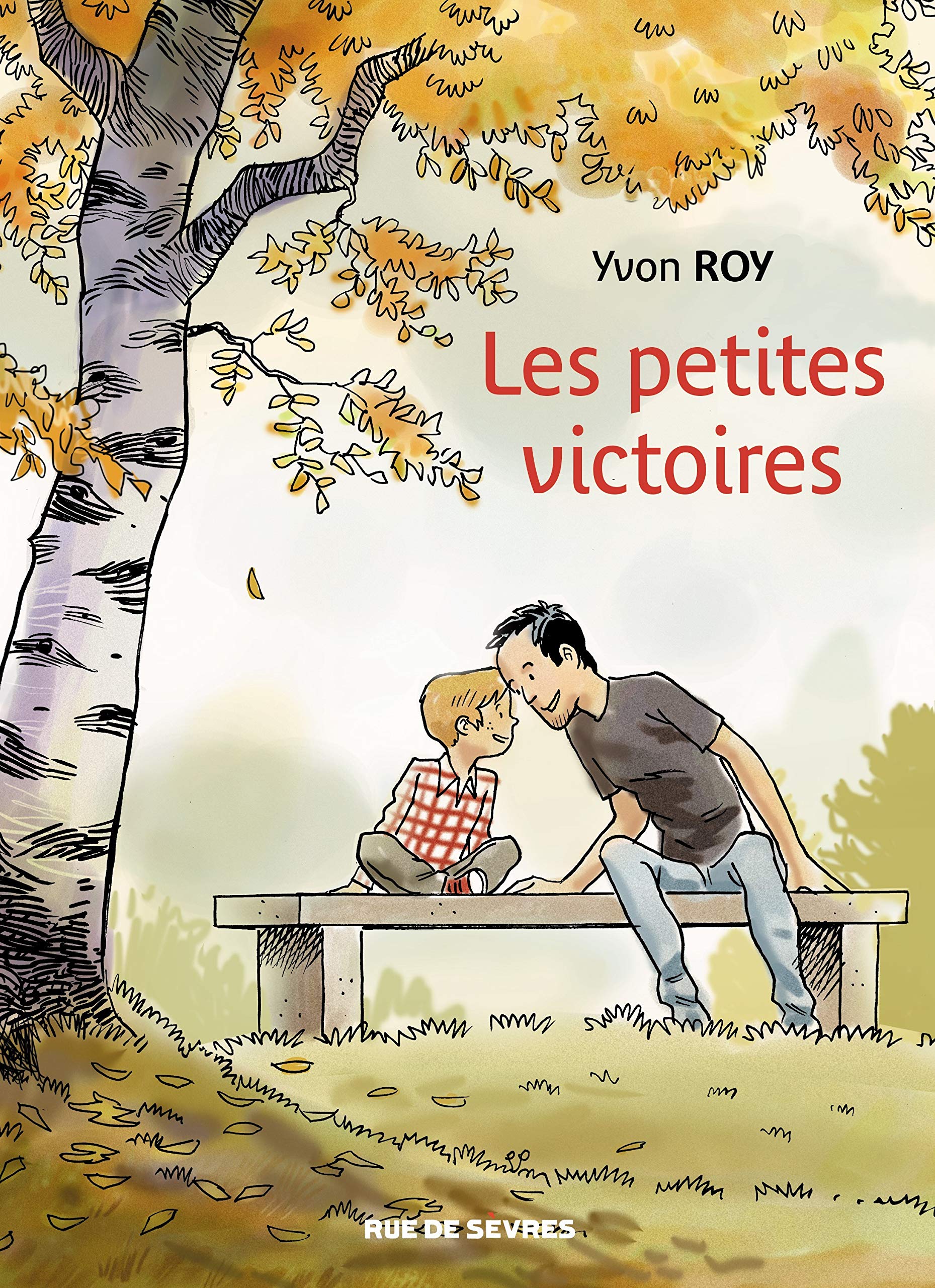
This is Marc, stand in for the author: Yvon Roy
This is his son, Olivier, who is autistic.
Les Petites Victoires showcases the fight of a father for his son, diagnosed with autism "in order to transform an announced defeat into small victories" (sic, our translation).
In his preface, Roy explains the contextualises the creation of his comic book:
"The idea was first suggested to me by a special educator who had worked with my son. She thought that what we had accomplished together was worth sharing so that other parents could find, through our experience, some useful information, if not a little hope" (our translation).
Interview
"When I started working with my boy to help him, with all the professionals in the field, I realized that often we were told, or they tried to tell us, that we had to work on living with autism, on accommodating autism. How we had to deal with different crises, different problems, whereas I thought, well, no, it's better, definitely, to try to overcome it than to live with it. And that's been kind of my master idea, let's say, for years with my boy, which is to try to push the boundaries constantly, always further." (Our translation)
Why choose this comic book?
This comic book is an example of a creation that is easily accessible to the general public that has been awarded and highly publicized - even winning an award that recognizes works written by a person living with a disability and recounting their own experience, or by a third party about the life of a relative living with a disability. In 2018, the publisher Rue de Sèvres announced a contract for a film adaptation, which caused reactions and led to the hashtag :
#boycottlespetitesvictoires
As we will show, this is an example of the social representations of autism that perpetuate dominant understandings that do not fit the lived experience of those directly concerned to the point of being discriminatory. It is also difficult to identify moments when the child (the autistic character) shows agentivity. Instead, he’s passive in his father’s story. In a way, Olivier is only a supporting character. This is exaclty why representation doesn't mean autorepresentation and why "nothing about us whitout us" matters: although this comic is presented as a positive narrative from the allist perspective (3rd person), the story is completely different from the standpoint of the autistic community’s testimonies (1st person).
An allist person is a non-autistic person.
To understand the term "allist", we must go back to the origin of the word "autistic" which comes from the Greek word "autos" which means "self". So the word "autistic" initially referred to a person withdrawn on themself, who lives in their own world. The term "allist" appeared in a satirical article to refer to non-autistic people by swaping “autos” for "allos" which refers to others. So an allist is a person who is focused on others or, to flip the usual narrative, a person who lives in other people’s worlds.
In spite of the satire, the term “allist” has remained in use among others because it allows to distinguish between "neurotypicals" and "allists". There are people who are not autistic, but who are not neurotypical: a non-autistic dyslexic person, for example.
For a deconstruction
of the problematic propositions of the comic book:
But do you know the story from the autistic community’s perspective?
This is where webcomics can serve as an accessible tool that allows the reversal of dominant representations by opening the floor to self-representations directly grounded in marginalized communities. But before continuing with the topic of webcomics, we wish to feature an excerpt from Les Petites Victoires that addresses a frequent theme in autism: eye contact.
Excerpt on eye contact
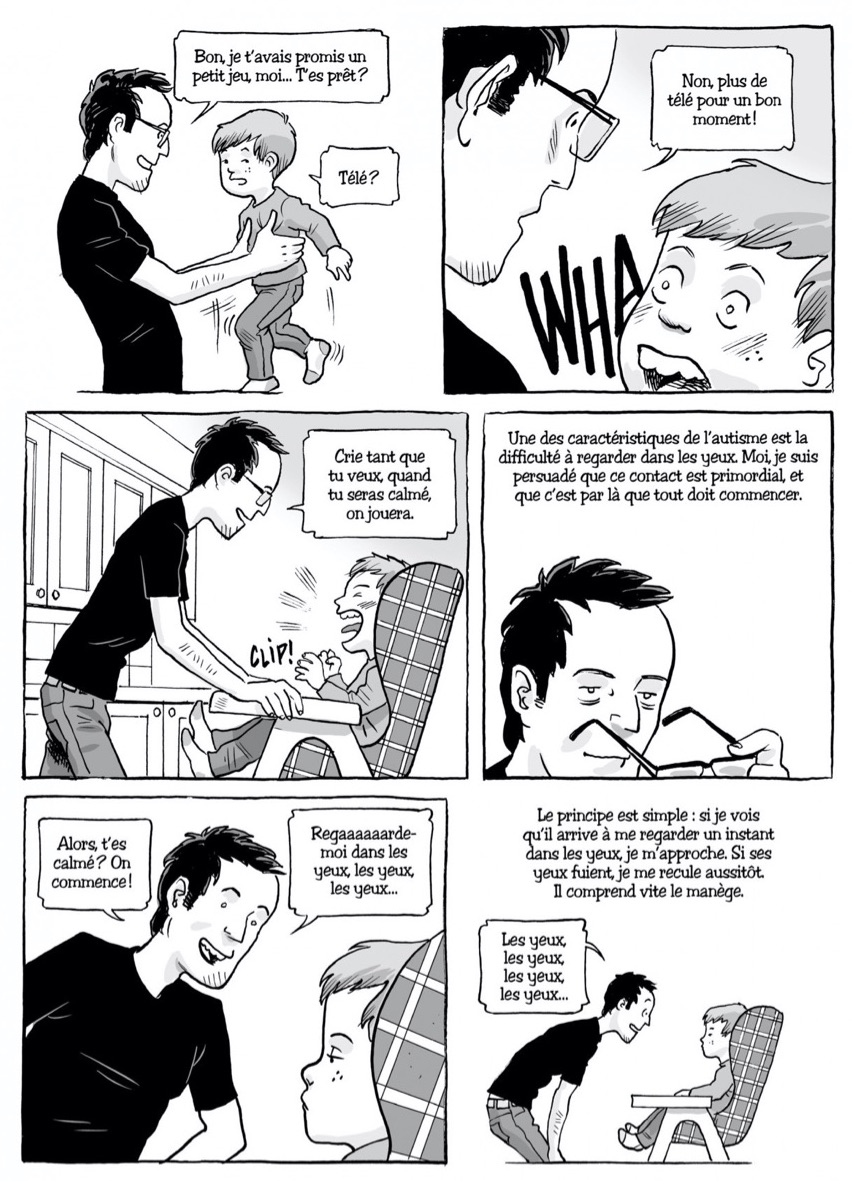
English translation
English translation
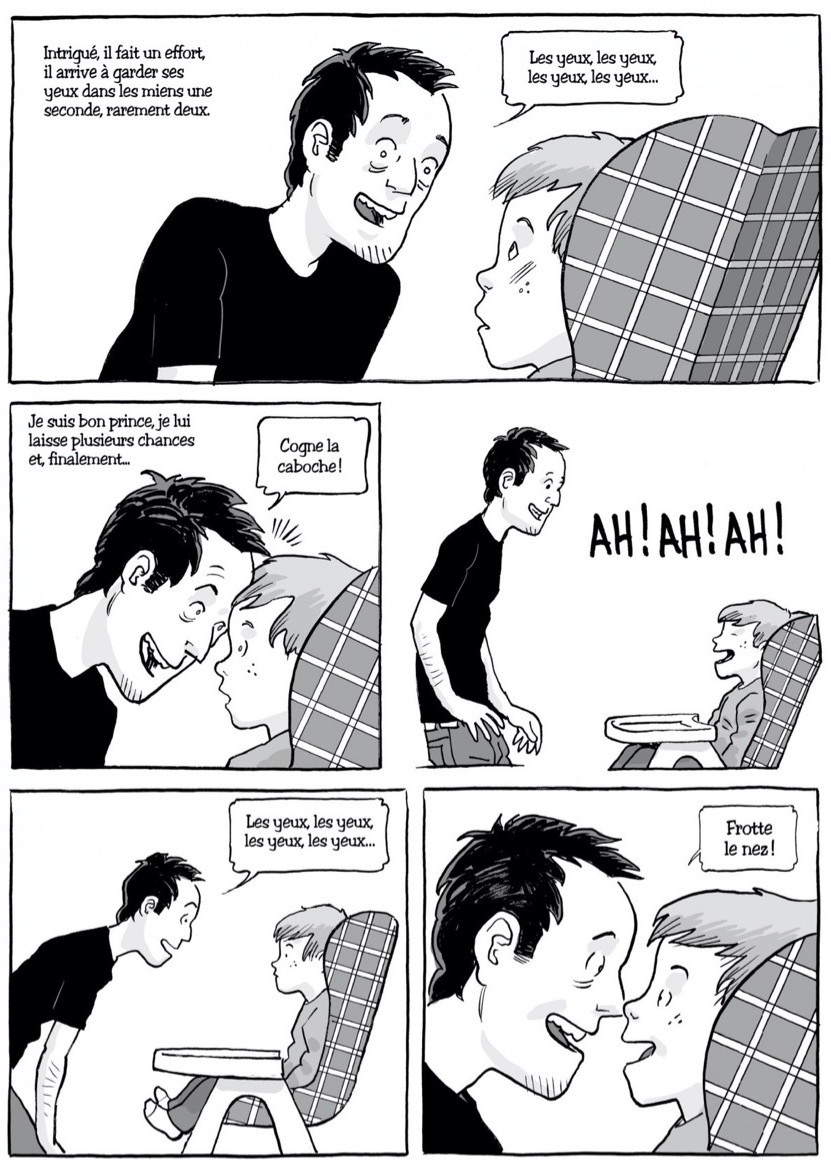
Excerpt from Yvon Roy's interview
"I worked a bit like we can work to sometimes desensitize a substance. Sometimes certain people can have an allergy, we can try to desensitize them.
Several parents have contacted me regarding the trick to get the child to look in the eyes. This is the first thing we worked on together, that is to say, I considered that being able to look in the eyes - we know that autistic children have difficulty looking directly in the eyes - I said to myself, if we don't have eye contact, we have nothing. We need that, it's the beginning of human interaction." (our translation)
TW: The host uses the term “prison” in reference to autism:
"In your story that you shared with us in Les Petites Victoires, there is obviously the moment when you get up to face, to accompany your child in that reality: to learn to understand him too, inside what he lives and this prison, in a way, from which he is pressured which is basically this condition." (our translation)
Link to the interview (in French)

This scene is an example of neuronormativity
Recall that neuronormativity is the prevalent, neurotypical set of assumptions, norms, and practices that conceives of neurotypicality as the only acceptable or superior mode of cognition, and that stigmatizes attitudes, behaviors, or actions that reflect atypical modes of cognition as deviant or inferior.
This scene is told from the allist perspective and is presented with a positive outcome. In fact, as the author mentions, parents have applied this technique with their autistic children after being inspired by it.
But what if we ask autistic people how they feel about eye contact? That's exactly what we are going to do.
PART II
Why webcomics?
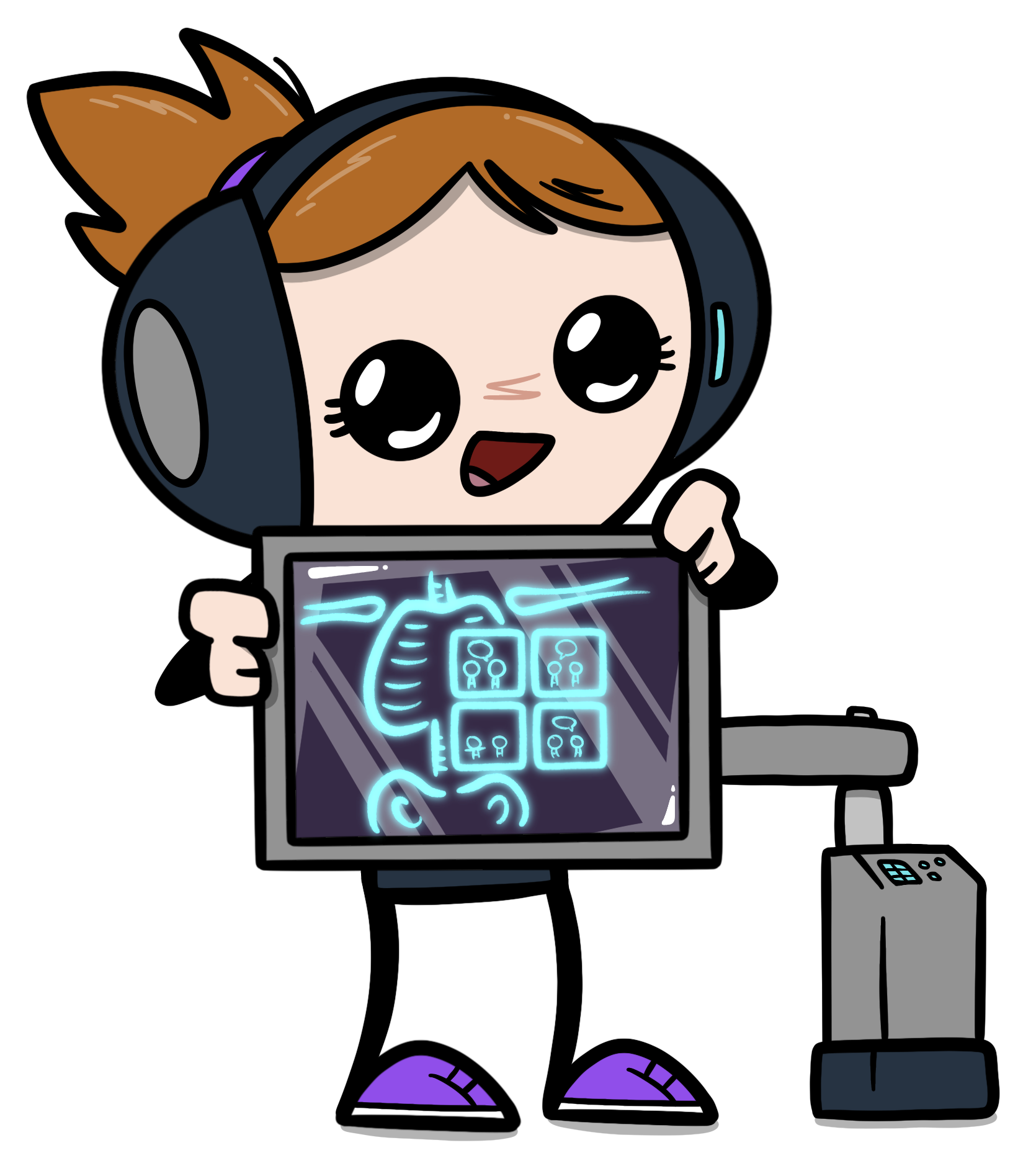
The medium of webcomic enables me to do something I don't know how to do otherwise: share how things feel on the inside.
Imagine. You come across a newspaper at the local coffee shop and recognize the face of a well-known personality. Yet you can't remember their name. It annoys you, you know you know it, it’s just not coming out, it stays there, on the tip of your tongue. You have time to come back to work, coffee in hand, and the name still hasn't come back to you, it still annoys you. You come across a colleague and you ask them, you describe the person, maybe clumsily at first (it would be so much easier with their name!), but you adjust to your interlocutor and, together, you can finally recall their name, it was so obvious!
It’s important to emphasize this feeling of annoyance. We rarely take the time to mention this annoyance when talking about epistemic injustices. Yet it is there, and it can even be painful: how do we make sense, to use Fricker's classic example, of our experience of sexual harassment when the concept does not yet exist? How can we share the feeling that something is wrong? This is where community comes into play and it is why the idea of "by and for" matters more than, say, a criterion of simplicity might. This is addressed by feminist epistemologies: for example, Longino argues for pragmatic values in science such as diffusion of power (as the importance of making research programs accessible to the actors involved in the research).
The impact of inadequate social representations on neurodiversity cannot be fully resolved by the traditional narrative of epistemic oppression and justice: adding new vocabulary to collective epistemic resources is not a panacea (we already have the word "autism" for example). So it is not only words that are missing, but rich and diverse lived experiences are also missing from the pool of shared resources.
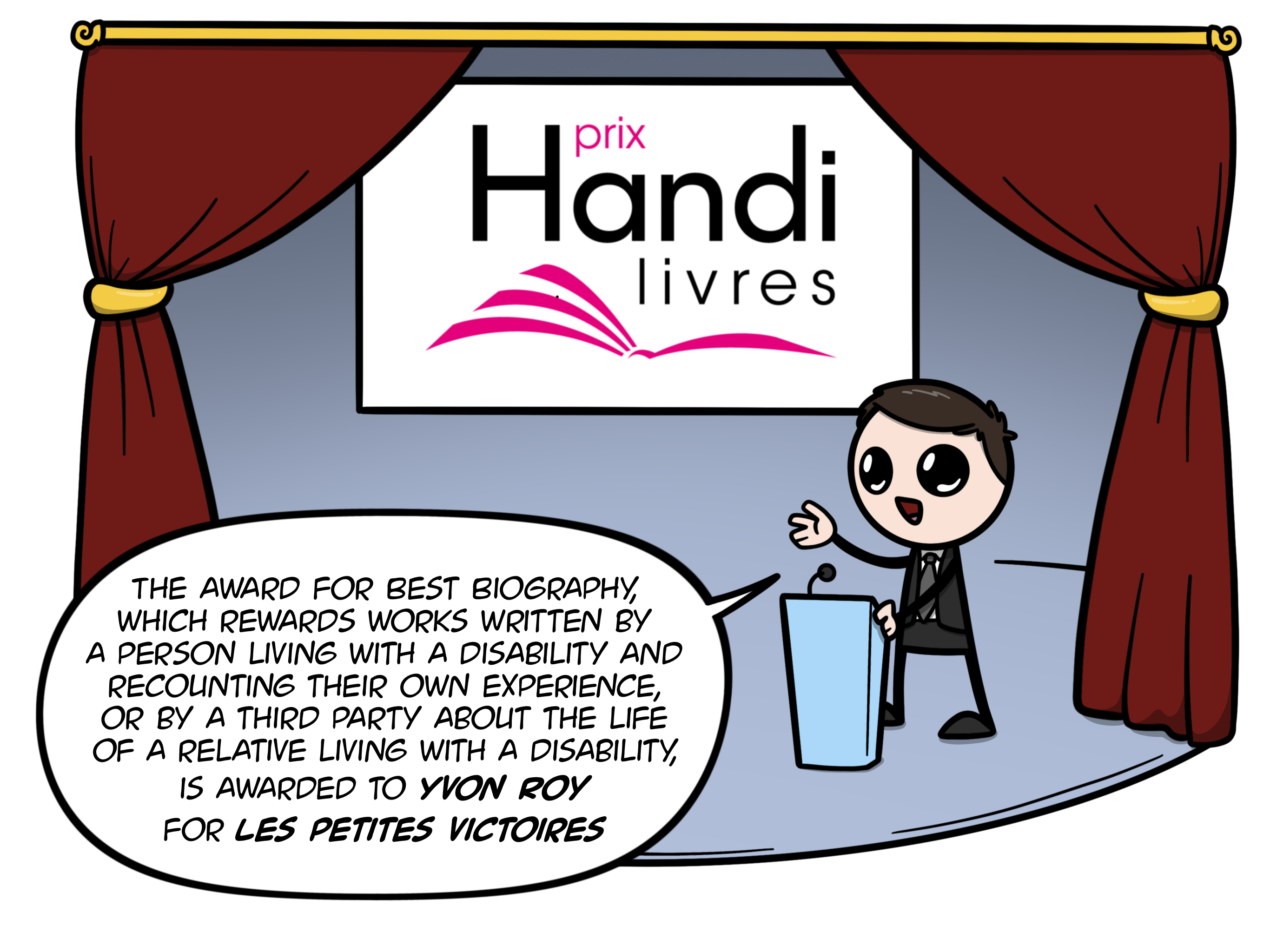
The problem is that what is missing, the hermeneutical gaps, are not automatically apparent: social representations created by and for the dominant groups inadequately fill the hermeneutical gaps of marginalized groups. To that effect, let us recall here the Handi-Livre prize for the best biography which rewards works written by a person with a disability and telling his or her own experience, or by a third party on the life of a close relative with a disability: In the case of Les Petites Victoires, the award went to the biography of an allistic (non-autistic) person talking about autism. These inadequate social representations are difficult to resist: they are constantly and persistently reproduced. It is even harder when you don't have the words to replace theirs. But do we really have to wait for the right words to share our experiences? This is where illustration can become an attention grabbing action like shouting: an action that does not need words. This is what we propose here: a form of non-propositional epistemic resistance in response to hermeneutic injustice.
Webcomics are basically online comic books. They are mostly instantiated as short comics that take many forms and cover many topics. The most common form of webcomic is probably the blog (sometimes autobiographical, sometimes entirely fictional, sometimes both). Because they are mostly published independently by their artists, webcomics are an art form that is not limited by institutionalized power dynamics such as publishing houses or art galleries.
But the most important thing for us here is that webcomics are able to generate aesthetic experiences that allow viewers to better understand different aspects of the lived experience of neurodivergent people despite the inadequacy of mainstream epistemic resources.
In some ways, webcomics are a digital version of street art.
Although limited to a given geographical space for street art and to a particular digital platform for webcomics, there is this common idea where it is not so much the public that goes to the creation as the creation that goes to the public. We are no longer in a reserved and predefined space like a museum, a bookstore, a gallery or even a library.
Although a recognized artist can make street art, it is more difficult for an artist who does not belong to a complex and influential network to access some places of diffusion such as an art gallery. Webcomic is thus added to the tools that allow the production, use and transmission of more accurate social representations, participating in the collective understandings of the oppressions suffered by epistemically marginalized groups. The public and interactional aspects of social media that support webcomics make them a catalyst for direct dialogue with (but also within and between) marginalized communities.
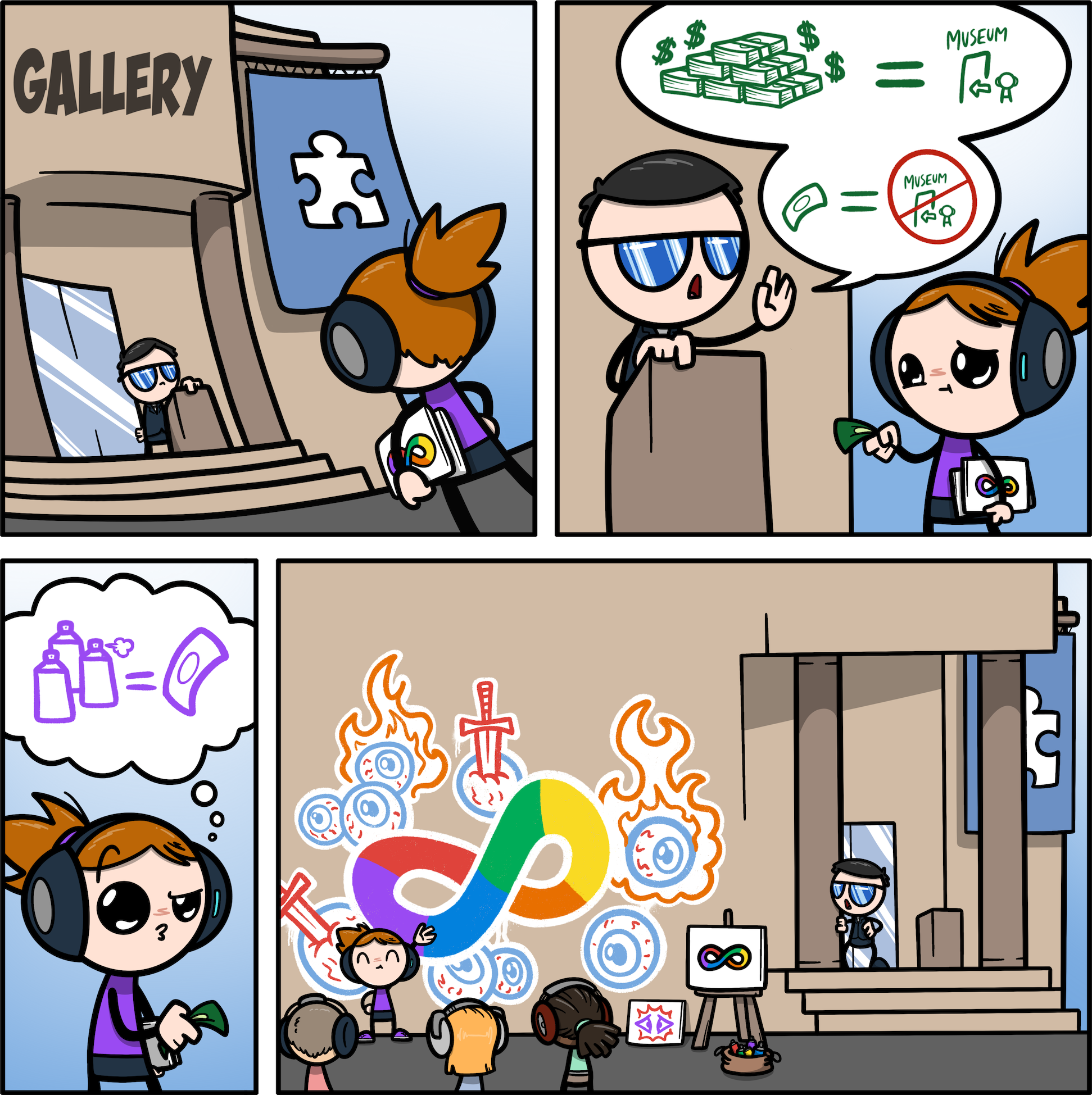
To put our epistemic resistance into action,
and to enhance our imaginative ressources, we chose to gather first-personal testimonies and descriptions of how eye contact can feel for autists.
After all, who better to provide insight into a given lived experience than those who live it? To do so, we used social media (instagram and facebook) to ask autistic followers of our webcomic (@lilyspectrum): How does eye contact feel to you? Although we are neurodivergent, it was important for us to go with the community beyond our individual experiences. For instance, we would never have thought of the sunburn idea on our own, but once we read those testimonies, it felt right.
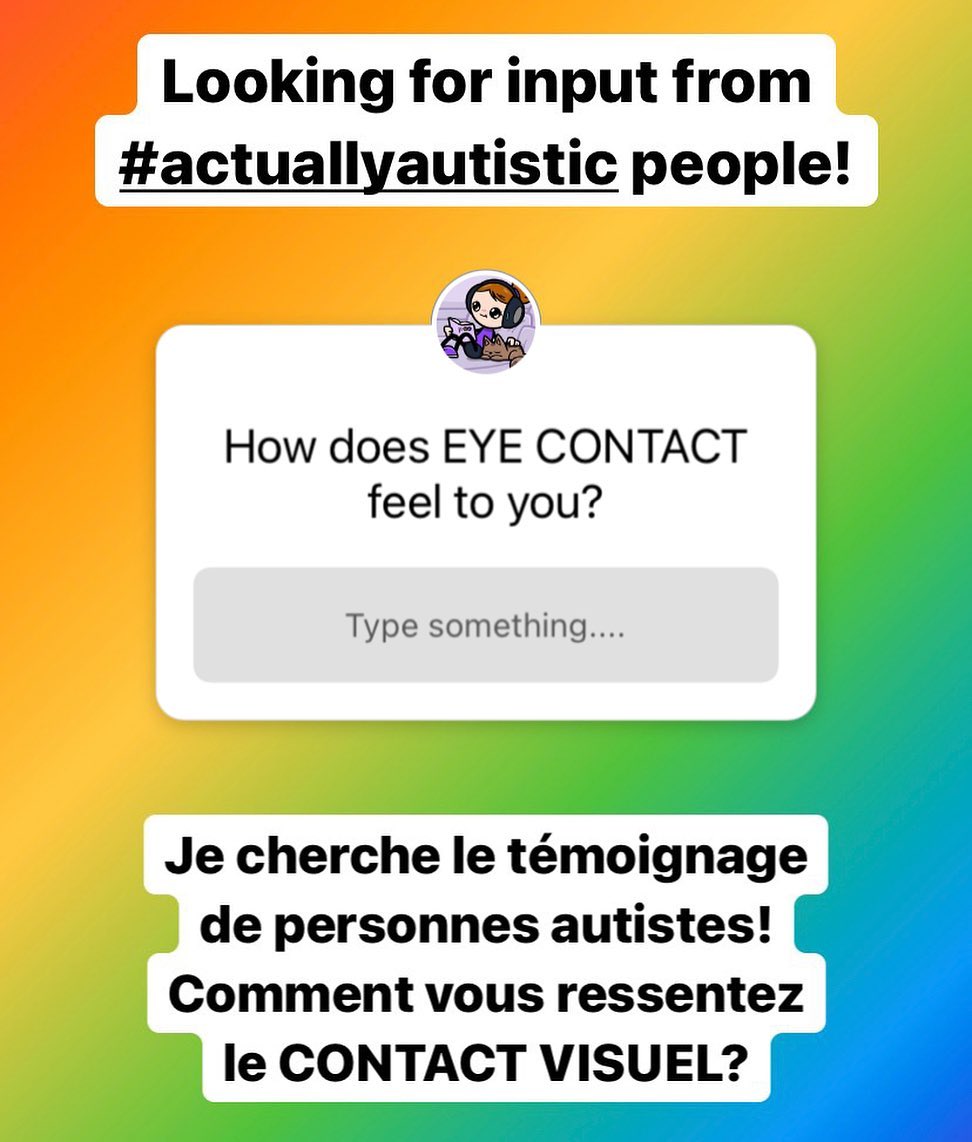
Both posts were made on November 8, and three days later, on November 11, we had received 175 testimonies. A few major themes emerged from these testimonies, which we used to base 7 webcomics or illustrations on. Keep in mind that, with this process, we do not claim to represent all there is to express about autists’ first-personal experience of eye contact. In fact, we suggest you visit these posts yourself to better understand the varied responses we got, and are still getting. And who knows, maybe this will allow you to add your own insight.
Publication
Since Monday, we have started to publish these comics on our social networks and we will continue to publish them in the following days
The interactions that take place around such webcomics are, we believe, an integral part of their complete aesthetic experience. These interactions often bring about clarifications, complementary details and descriptions or even added meaning. We thus invite you to visit these posts and interact with the community.
Webcomics
"I can do it but I can’t process anything else while doing it. My natural instinct and what feels the most right is to not look at someone’s face at all"
"It was drilled into me as a "rule" of politeness. I view it as just that, a rule. It's easy when there's multiple people because I can look around. But with one person, I have to look away or I end apparently end up staring"
"Everyone insisted on it, especially when they really wanted to correct a behavior or ensure I was paying attention. I honestly still don't love it, and prefer to look at noses or eyebrows to provide the impression I'm making eye contact"
"Eye contact was enforced during my childhood in mostly abusive ways and while it taught me to fake it, that made me hate it even more. Generally it just makes me uncomfortable and I find it quite distracting but it's also one of the most tiresome things to mask."
"Eye contact feels like they're staring into my soul, but with knives. I can make short eye contact before wanting to cry."
"It takes a concerted effort except for specific people."
"I’ve been so conditioned to make eye contact with people that when I met a lot of my friends for the first time they were kinda weirded out by me unblinkingly paying attention to them when they talked like 👁👄👁"
"It feels like someone is looking right past all my defenses and directly into my head. Not very pleasant."
"Terrifiant, j'ai vraiment l'impression qu'on me transperce à chaque fois …"
"Like I am being stabbed in the brain, itchy under the scalp, or suffocating. Anxiety is anxiety. I look at people's foreheads. They never know the difference but I am not forced to juggle the pain of eye contact and try to communicate. I am mostly non verbal and eye contact guarantees no words."
"Ça me met vraiment mal à l'aise et j'ai peur qu'on puisse mal interpréter si je regarde pas "correctement", je sais pas si je dois regarder quelqu'un dans les yeux ou combien de temps, il faut surtout pas que je regarde autre chose chez lui que ses yeux et du coup je sais pas quoi faire je préfère regarder le mur derrière mon interlocuteur 😂"
"Tout dépendra de la situation, de ma fatigue et de la personne. Certains contacts peuvent être transperçants (douloureux), d'autres envoutants (confusants), d'autres destabilisants (perturbants). En tous cas, si je regarde qqn dans les yeux, je suis sûr de perdre mon fil de pensée et/ou d'accorder mes réponses à ce que la personne ressent."
"Eye contact feels like burning discomfort, especially when I'm being told to do it."
"It’s extremely hard for me to maintain eye contact, and when people express to me that I should be looking at them when I’m talking to them, it puts me under more stress than just talking to them in the first place"
"somehow being told we should be making eye contact feels like being reprimanded as a child, at least to me.. I can't count the amount of times my mother would tell me to look her in the eyes as a child, and how humiliating/stressful it felt.. I legit forget to listen to people because I'm too busy trying to maintain eye contact."
"At best, awkward and uncomfortable. At worst, like someone's stabbed me in the eyes."
"It makes me uncomfortable but my mother forces me to look people in the eyes"
"Painful, but I feel like if I don't look ill be punished or called a liar. So I trained myself to look at something over their shoulder if not their foreheads to avoid harassment."
"Habituellement je regarde plutôt la bouche ou le nez des gens et ça semble passer crème pour donner l'illusion que je regarde dans les yeux (j'ai eu droit à l'expert en haute potentialité qui me disait que c'était impossible que je sois autiste car.. je le regardais dans les yeux ! Je regardais sa bouche depuis le début de l'entretien..). Je ne me force au contact visuel que de manière consciente et dans de rares cas précis : [suite]
(suite) par exemple si je suis attiré romantiquement par quelqu'un et désire que cette personne le perçoive (vu que le contact visuel accru est interprété de cette façon par beaucoup de neurotypiques). Mais cela reste un sacré effort et en général je détourne les yeux très rapidement, ça me met mal à l'aise, c'en est presque physique. Récemment un de nos profs en cours nous a fait faire une série d'exercices où on devait marcher vers quelqu'un/revenir à sa place à reculons en gardant le contact visuel constant avec cette personne.. je vous laisse deviner la torture que c'était"
"Transperçant!"
"J'ai l'impression que les yeux de la personne me percent à l'intérieur, je sais pas comment dire, c'est une sensation d'oppression aiguë."
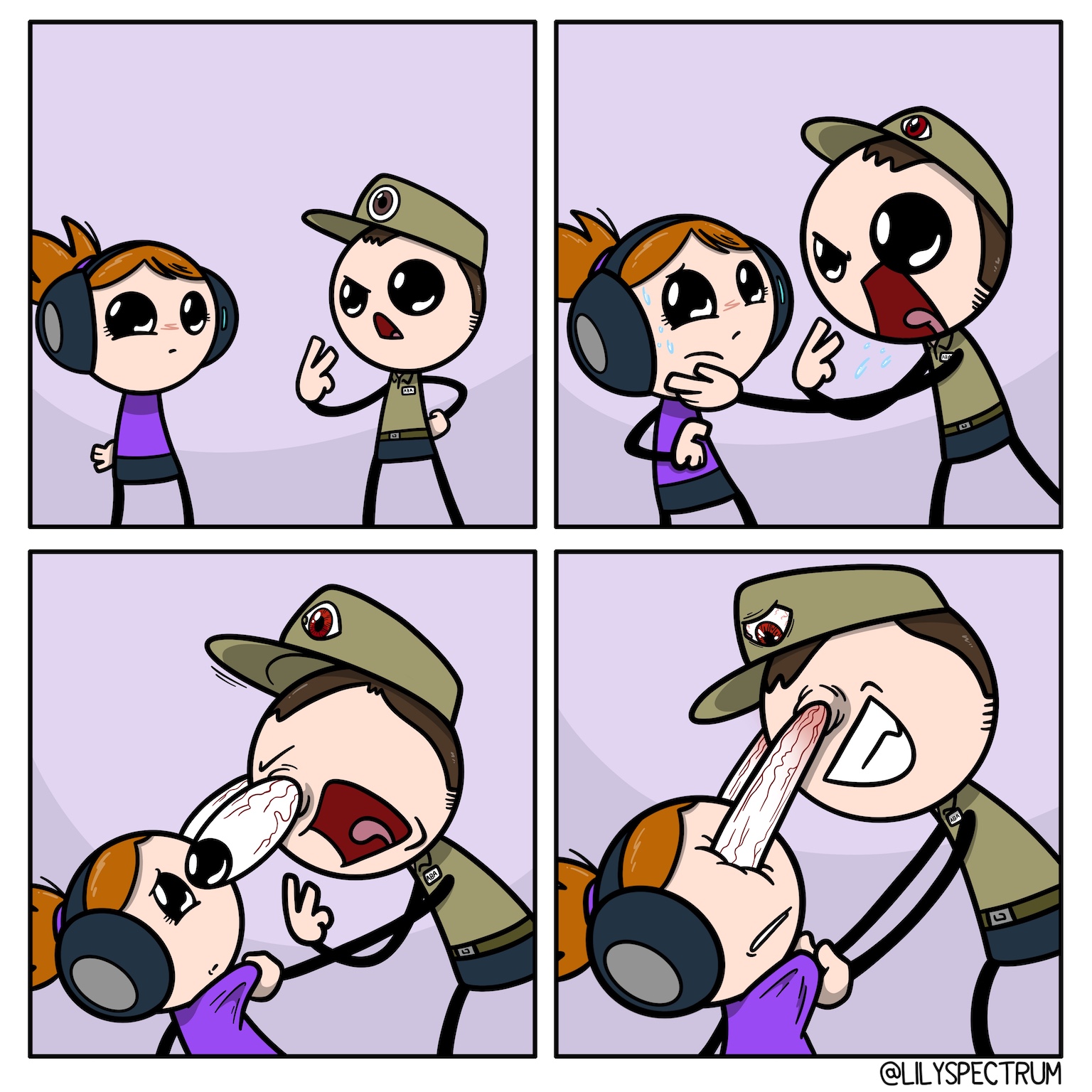
"For me, looking in the eyes feels too exposed and open. It makes me feel like I can't hide and protect myself from the people."
"Eye contact makes me uncomfortable most of the time, because of the feeling that I am being silently judged or getting talked about negatively."
"It's fine when I'm listening to someone but when I'm the one talking it makes me get stage fright like I'm being put on the spot to judge for performance lol"
"Too intimate, inappropriate… I become incredibly self conscious as well, like am I doing eye contact right? Should I be mirroring their behavior or a close approximation or complete opposite? How many times should I blink? Can they tell I’m faking this human interaction? It’s incredibly stressful."
"It feels like something is a required check box. It’s like a math problem. Look, one, two, three. Okay. Look away. Zone out if you need to. Okay, it’s been 10ish seconds. Look back. One, two, three.. okay, look away! Don’t share at them! Wait! You’ve looked away too long! Look back! …..it’s that on repeat quite often lol"
"I hate it I get so nervous and then I break down."
"I don't like it, makes me really uncomfortable. I'm "good at it", because I mask well (😬). I never know what to do, if I'm looking to much or not enough and always use a whole lot of energy just on eye contact. Generally, the more comfortable I feel the less I look someone in the eyes. (Also eyes as a body part make me feel really icky so that's that)."
"Intimidating and uncomfortable, I feel too vulnerable and keep thinking am I doing this right?"
"Ça me met vraiment mal à l'aise et j'ai peur qu'on puisse mal interpréter si je regarde pas "correctement", je sais pas si je dois regarder quelqu'un dans les yeux ou combien de temps, il faut surtout pas que je regarde autre chose chez lui que ses yeux et du coup je sais pas quoi faire je préfère regarder le mur derrière mon interlocuteur 😂"
"Eh bien, quand j’étais petit, je parlais et écoutais souvent le monde sans les regarder dans les yeux. Maintenant, ça me dérange pas de parler et écouter avec le contact visuel, mais j’peux très bien comprendre ce que le monde me dit sans obligatoirement les regarder dans les yeux. Aussi, c’est vrai que ça me rend un peu mal à l’aise quand des inconnus me fixe du regard. C’est comme s’ils me jugeaient et j’sais pas ce que j’ai fait de mal."
"Direct eye contact feels like I am being judged. It also makes me feel uncomfortable because I become unable to perceive and read the rest of their body language."
"Démunie, nue. Percée à jour. C’est très fort comme sensation, et rarement agréable. J’y arrive avec mes enfants ou mon mari, mais même dans ce cas, pas trop longtemps. Si je veux tenir une conversation, et me concentrer, alors je dois ruser. Je regarde entre les deux yeux ou le plus souvent la bouche."
"Feel nausea and anxiety, and extremely naked. Yet my mother was adamant that I learned it and therefore I am able to do it, despite the uncomfortable feelings. Absolutely love your work, for once I can tell that I am not alone"
"I feel instant stress and I have to force myself to do it and to look "natural"."
"Honestly, each time it happens to me, the most awkward feeling I have is « where should I look exactly » ? When you make eye contact, are you expected to focus one eye specifically (which one, then ?), between the eyes, not focus at all, or try a weird way of having each eye "looking" into the facing one (i.e. my left eye "looking at" their right one and vice-versa) ? I'm also never sure if/when eye contact is expected, and when it happens, is there/what is the hidden message behind this specific contact, and/or am I sending an incorrect hidden message myself ? Then, with all these questions actively consuming my brain "computing power", everything else totally miss the point (sometimes, though, I can hide this issue because I have this kind of ability to "replay" the last few words/sentence I unconsciously heard, to process it with a delay but potentially without the proper context- so it's not reliable at all !!). "
"Weird and artificial. I can actually read people's eyes now, but it took me years to learn it."
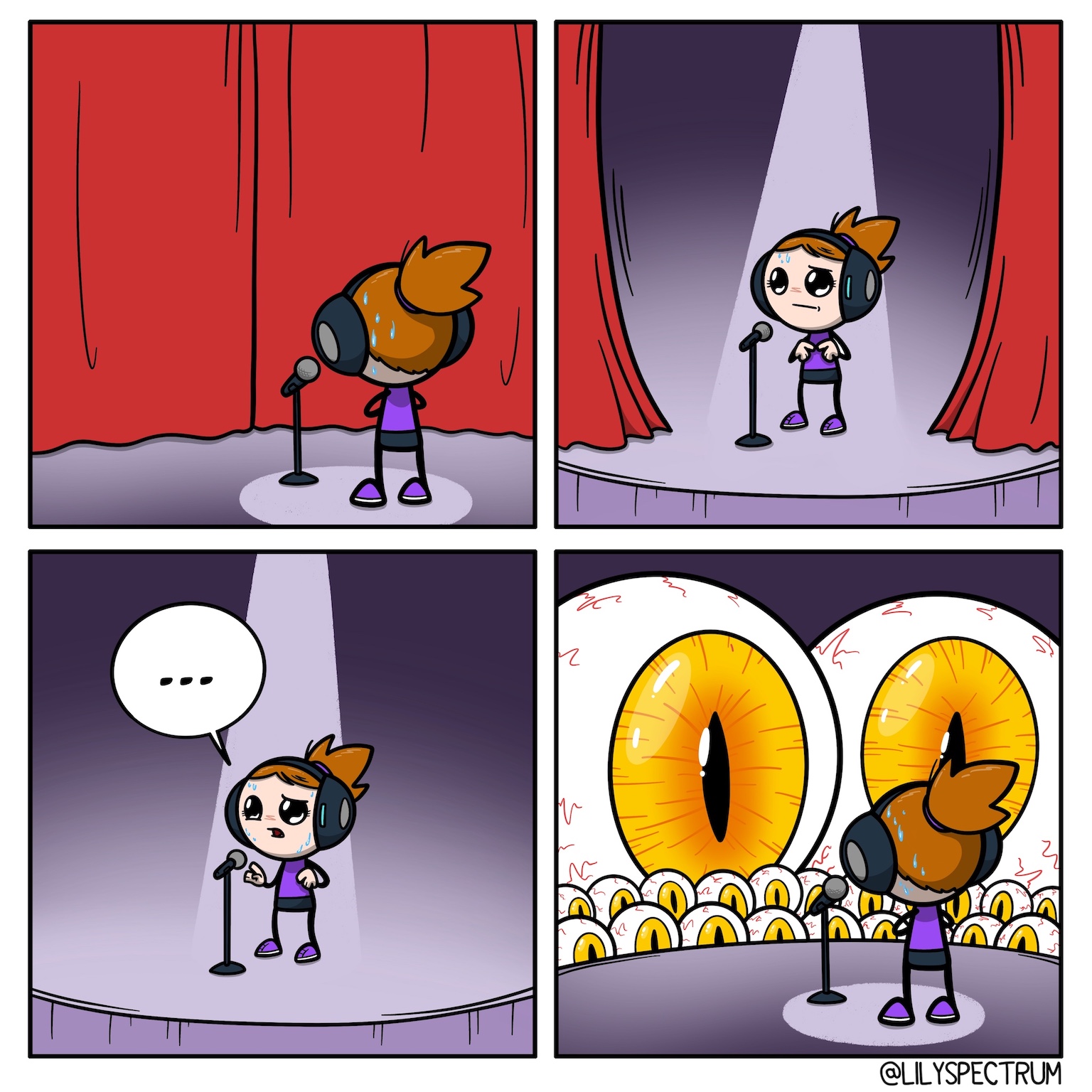
"My parents rasied me to always look into the eyes, still feels wrong. Like, I am invaiding a personal space and being rude. Like trying to stare down their soul and violating their privacy. I still try to look at people in the eyes but have learned to just looks in differents points in the face so I don't seem rude."
"Eye contact feels too intimate to me for most interactions. If I make eye contact with you, it’s because it’s important. "
"Eye contact feels very intimate. If I’m forced to hold it for too long, I feel violated, like I’ve been touched without consent."
"I really hate eye contact in almost all circumstances. About the only exception is with someone I'm very intimate with. Eye contact feels extremely intimate to me in general so it only feels natural when it's with someone I've got a suitably intimate emotional connection to. Otherwise it feels like I'm staring into someone's soul and I can see everything and they're staring into mine and seeing the same (even if I know they're not)."
"Invasive, extremely personal. I'm only comfortable looking my husband in the eyes"
"It feels like I’m standing too close to someone, I don’t know if that’s too vague of a comparison but it feels way too intimate. So I only do it when necessary or when I’m comfortable with that person."
"It feels creepy to me"
"I don't like it, makes me really uncomfortable. I'm "good at it", because I mask well (😬). I never know what to do, if I'm looking to much or not enough and always use a whole lot of energy just on eye contact. Generally, the more comfortable I feel the less I look someone in the eyes. (Also eyes as a body part make me feel really icky so that's that)."
"I hate eye contact. It almost hurts. But it’s nessesary to have a successful professional life, and my parents trained me well as a child. They would ask me people’s eye color after I met them to see if I made eye contact. Being trained like that at a very young age was incredibly difficult and felt unfair, but I’m very grateful that they pushed me now that I’m an adult."
"I can't do it, it makes me feel funny in a bad way and makes me feel kind of .. unsafe? and uncomfy I don't exactly know the word for the first one, I don't mind people looking at me but I won't look back"
"It's incredibly intimate and overwhelmingly so, particularly with strangers. And the more my emotions are revved up, the less I can tolerate it. It genuinely feels as though someone can see into my mind almost, even though I know that they can't. On the plus side, when I'm with someone I deeply, deeply love, sometimes that's okay because I want them to see how much I love them... but then that tends to make THEM feel awkward and uncomfortable too. LOL For me, it falls into the same category as standing too close, invading personal space, touching someone without consent etc. It's intimate, and can very easily become violating when you don't want it. And that;s so hard to explain to NT folk who expect you to look them in the eye all the time."
"It's okay with people I know, but I don't feel comfortable with eye contact with strangers, it almost feels like an invasion of privacy."
"eye contact feels so weird and creepy and if i have to make eye contact with someone, then ill quickly feel exhausted."
"It feels like a boundary rupture unless I completely and totally feel comfortable in a container of safety with another it probably won’t happen much."
"Well... I can't let anyone touch my eyeballs."
"Trop intrusif. Comme si l autre avait la perception de mes pensées. C est comme se montrer nue."
"Intense/ overwhelming/ fiery/ intrusive. Sometimes painful/ always difficult with strangers. Ok with intimate friends and family."
"Démunie, nue. Percée à jour. C’est très fort comme sensation, et rarement agréable. J’y arrive avec mes enfants ou mon mari, mais même dans ce cas, pas trop longtemps. Si je veux tenir une conversation, et me concentrer, alors je dois ruser. Je regarde entre les deux yeux ou le plus souvent la bouche."
"Feel nausea and anxiety, and extremely naked. Yet my mother was adamant that I learned it and therefore I am able to do it, despite the uncomfortable feelings. Absolutely love your work, for once I can tell that I am not alone"
"confronting and very intimate ..i feel naked"
"Quelque chose d'extrêmement intime, que je ne peux pas partager avec n'importe qui sinon je suis déstabilisée car je bloque sur cette sensation d'intimité forcée. Depuis le diagnostic, je me permets de ne plus regarder le visage des gens (je ne travaille pas). Quel soulagement!"
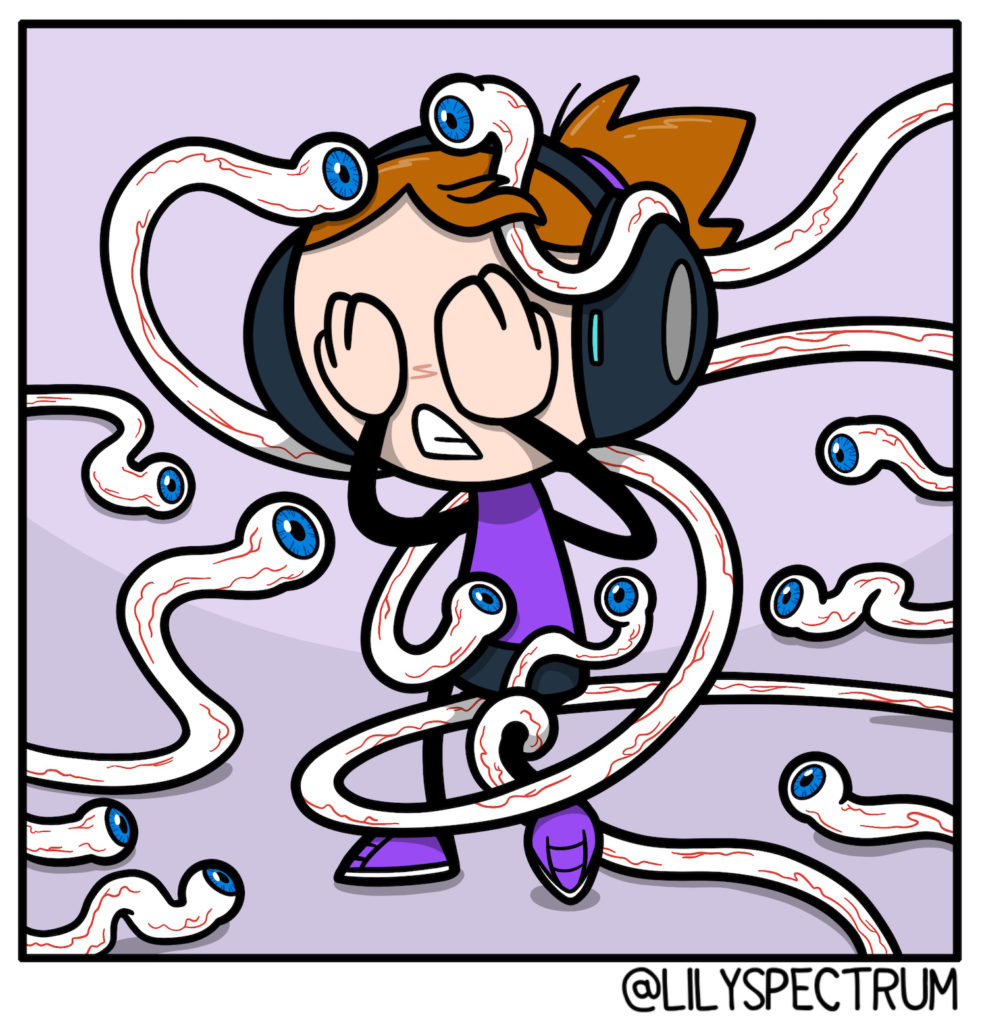
"Eye contact feels like they're staring into my soul, but with knives. I can make short eye contact before wanting to cry."
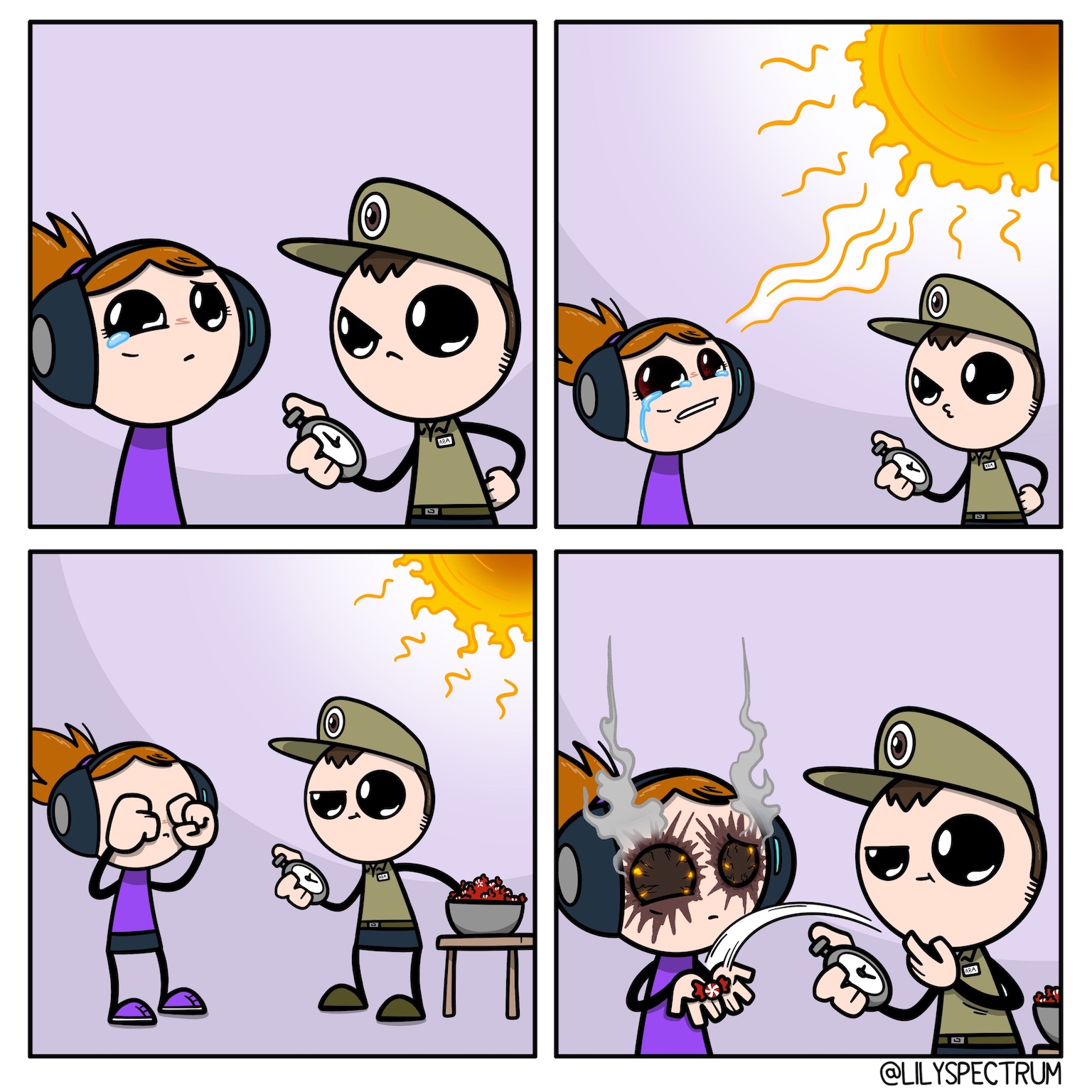
"It’s like being asked to look directly at the sun. I flinch, I can’t do it…"
"It feels like they gonna shoot me with laserbeams. Like Cyclops from X-Men. I van handle it for 10 seconds. I get panick attacks of it's to long. Even with my bf makes me on edge. I got a major panic attack during a being social etc exam (idk how it's in English is). It was so bad. They let me past because otherwise i needed to do the whole year over."
"Feels like I’m staring at the sun and I can only look a person in the eyes for 30 seconds or so before my eyes start to hurt a bit. I can only look animals in the eye."
"Like flames of intense awkwardness are scorching my retinas."
"When I was younger I always had trouble making eye contact. I’ve gotten better at it in recent years but its still painful to me."
"Eye contact feels like burning discomfort, especially when I'm being told to do it."
"Ça me demande beaucoup de concentration. J'ai l'impression que ça me fait mal aux yeux et quand j'étais plus jeune je pouvais même ne plus vraiment entendre ce que la personne me disait. Par contre ce n'est plus un problème quand je me mets vraiment en colère au point de vouloir me battre."
"Ca va de la gêne à la sensation de brûlure, ça dépend des personnes je suppose. On peut parfaitement regarder le nez, la bouche, entre les yeux sans que l'autre ne sen rende compte."
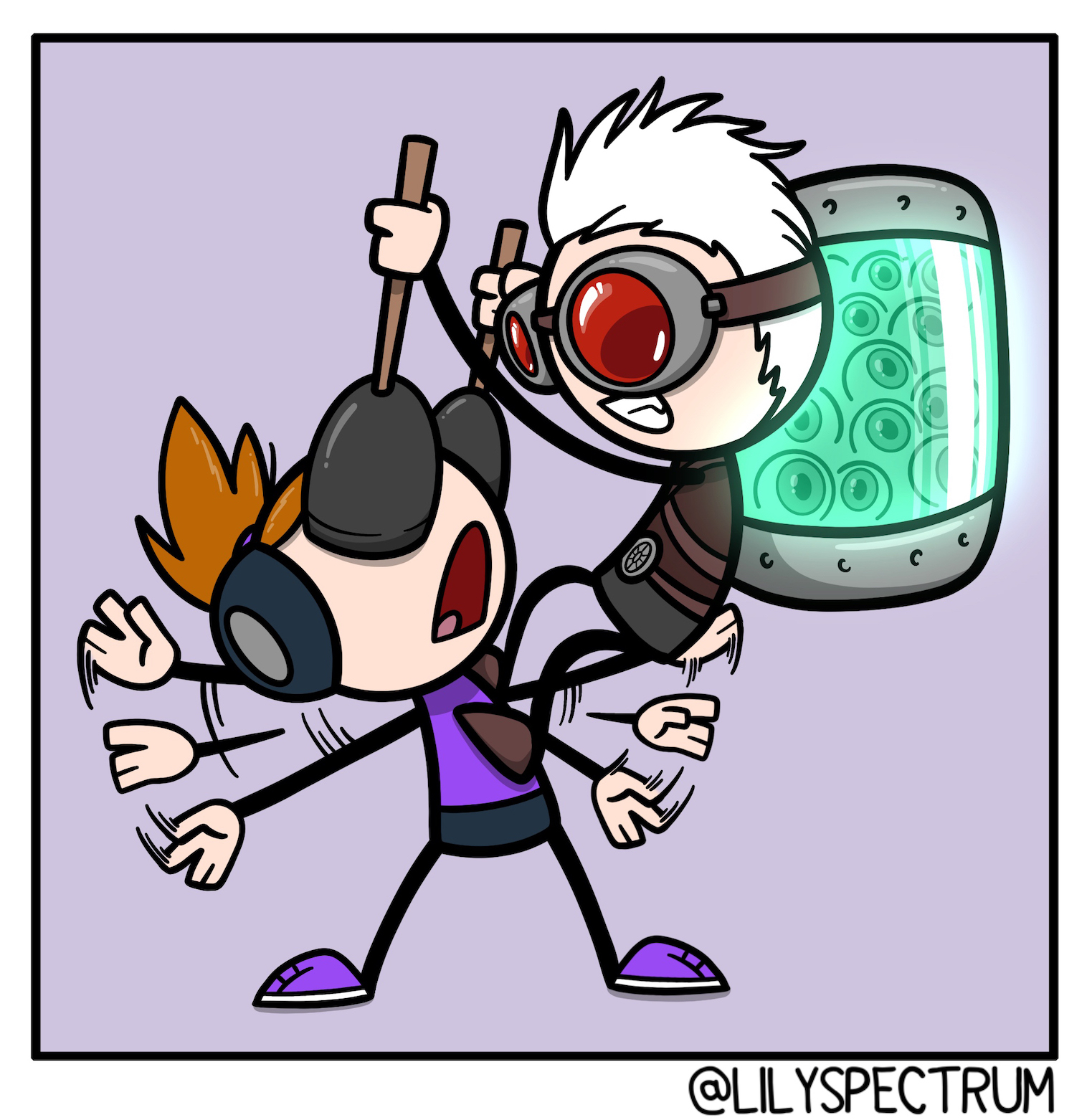
"I can’t think if I have to. Feels like pressure."
"Bad, I feel like my head is going to explode if I look at someone's eyes for too long. I suspect it's probably a blood pressure drop or adrenaline, but it feels awful. I honestly don't get why so many people require eye contact when speaking. I can make eye contact, but it's really difficult to understand what the person is saying because I'm too focused on how uncomfortable I feel and how incredibly awkward it is to stare at someone's eyes"
"It feels literally painful and I’m always afraid the other person can tell what I’m feeling/thinking. I’m comfortable with eye contact with very trusted folks in my life though."
"Painful"
"I really hate eye contact in almost all circumstances. About the only exception is with someone I'm very intimate with. Eye contact feels extremely intimate to me in general so it only feels natural when it's with someone I've got a suitably intimate emotional connection to. Otherwise it feels like I'm staring into someone's soul and I can see everything and they're staring into mine and seeing the same (even if I know they're not)."
"I cant make eye contact with literally anyone. Its uncomfortable, and even when its not, i cant listen proberly to what people are saying when i focus on the eyes. I just cant do it at anytime with anyone, only for one second maximum. Its like staring into someone's soul, its too much."
"J’ai l’impression d’être absorbée par les yeux de la personne et en même temps comme si on pouvait voir ce qu’il y a à l’intérieur de moi."
"honestly it feels like i am being sucked into their soul… i can’t maintain it if i want a conversation because i just get lost"
"Like someone staring at my soul? I almost feel like that's the part of masking that exhausts me the most!"
"It's uncomfortable. But sometimes if I want to intimidate someone I stare deep into their eyes and make them feel unnerved like I'm looking into their soul."
"Tout dépendra de la situation, de ma fatigue et de la personne. Certains contacts peuvent être transperçants (douloureux), d'autres envoutants (confusants), d'autres destabilisants (perturbants). En tous cas, si je regarde qqn dans les yeux, je suis sûr de perdre mon fil de pensée et/ou d'accorder mes réponses à ce que la personne ressent."
"Trop intrusif. Comme si l autre avait la perception de mes pensées. C est comme se montrer nue."
"J’ai l’impression d’entrer dans l’âme de la personne. Je trouve ça trop privé. Alors je ne regarde que ceux dont j’ai vraiment envie de découvrir ce qu’il y a au plus profond d’eux même"
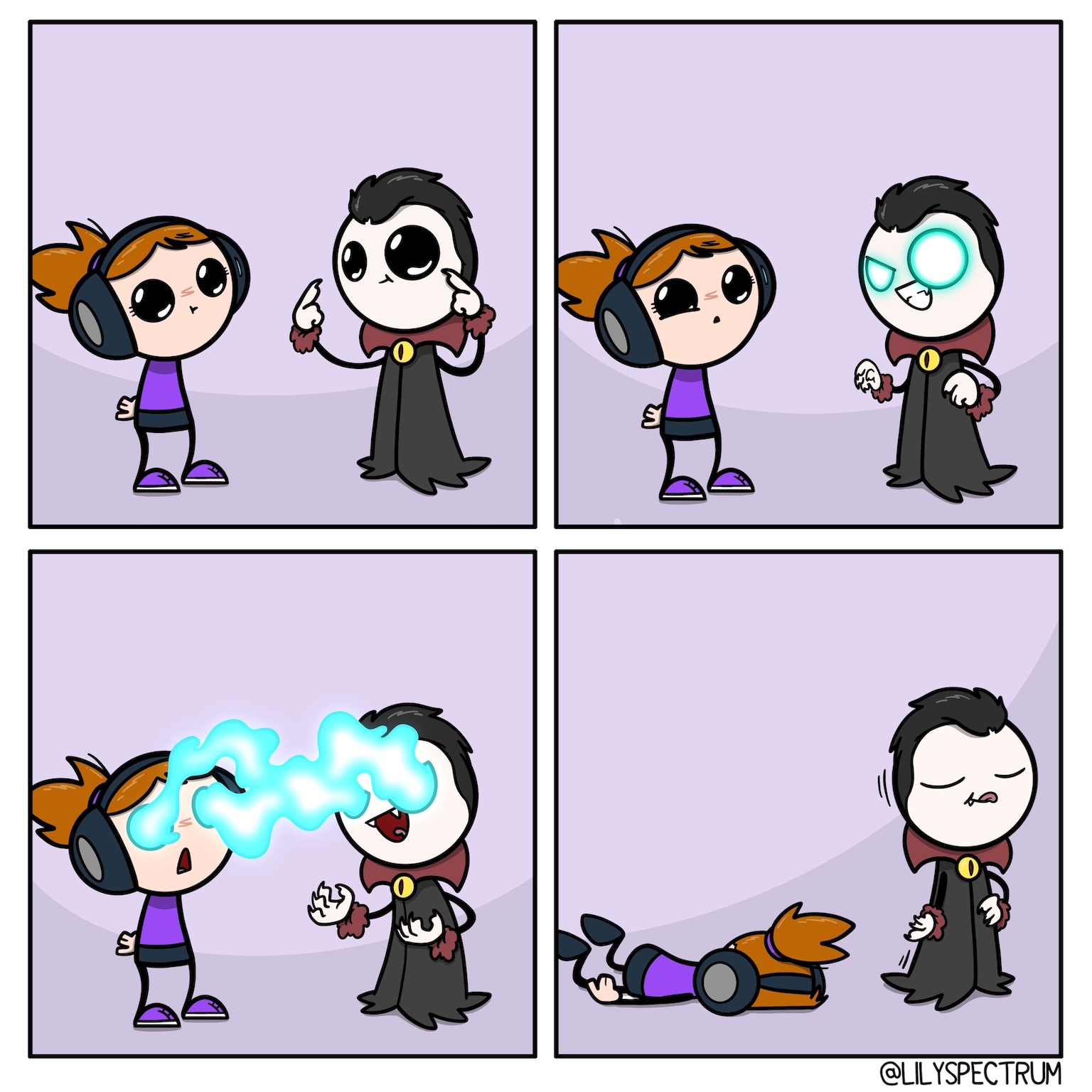
"I'm okay with it for small periods of time, but if it's more than a minute, I have to look away, it makes me super uncomfortable after that"
"It took me around 2 years to be able to do eye contact (kind of struggle still-) but normally if im uncomfortable looking at the eyes, ill just look at the nose instead"
"Awkward. The longest I can probably do it is for a few seconds, but sometimes it’s physically impossible for me to look someone in the eyes even for one second."
"Ça me met juste très mal à l’aise, et du coup je préfère regarder ailleurs et ne regarde les gens dans les yeux s’iels ne me regardent pas."
"Incapable de soutenir un eye contact sauf avec certaine personnes... Ma famille (ma mere, mon pere, ma soeur), ma nièce, mon beau frère et mon conjoint. Quelques amis specifique aussi... Mais sinon incapable. Je chercher tjrs a "évader" ses eye contact."
"Uncomfortable. I have trouble maintaining eye contact for long, especially in a conversation. However, I did figure out that talking with your hands is a great way to distract the other person's eyes from your and gives you a reason not to look at them."
"havent made eye contact with anyone (while i'm talking to them, that is) except my cats in years if that tells you anyone"
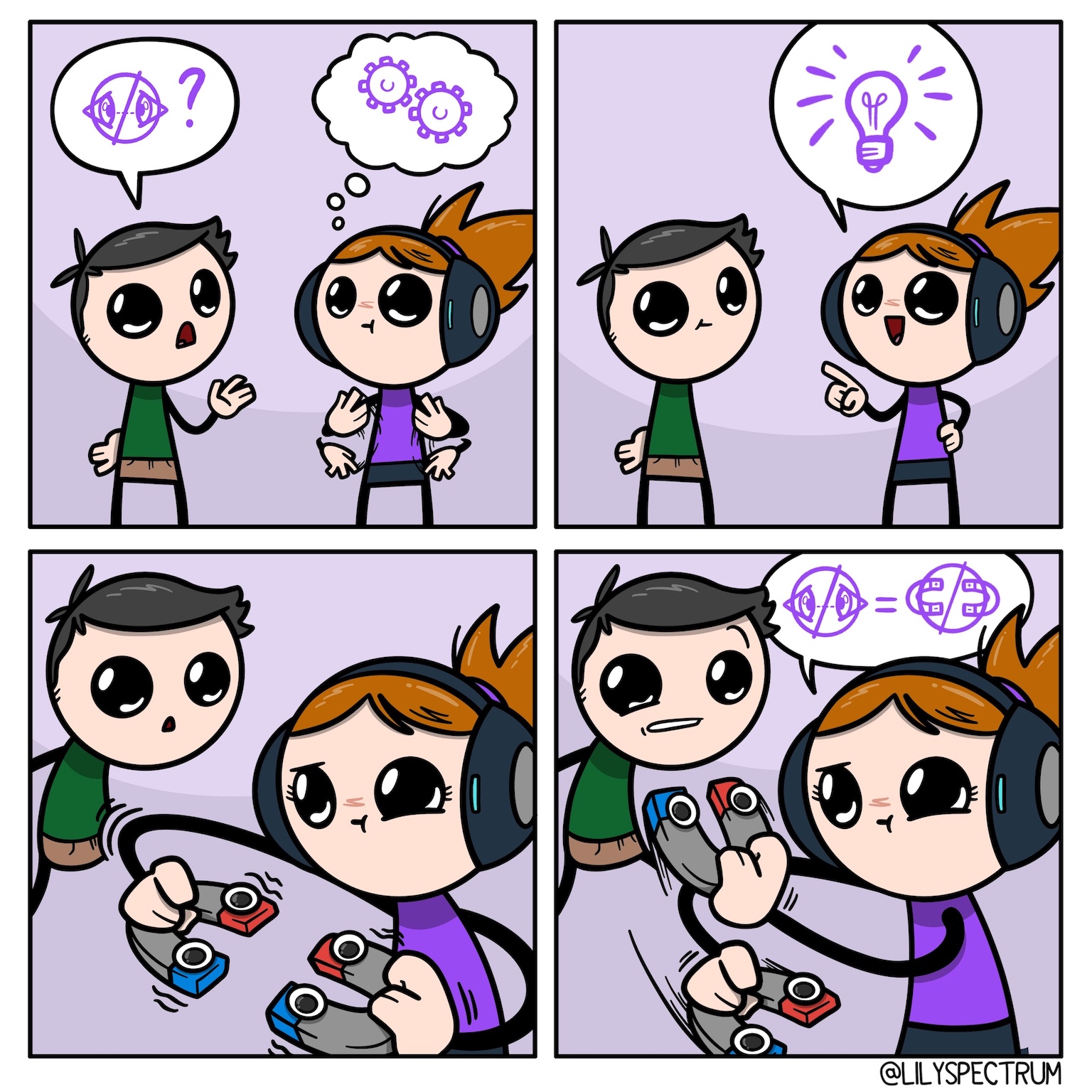
"When I was younger, it used to feel like when you held two magnets together both ends the same, it felt like no matter how hard you held them together, it would want to repel forcefully, my head wanted to repel and look past to the left or right or down or up like a magnet would, and when I managed to hold it against that feeling, my eyes would water up, not tears from sadness or anything, but they released tears, now I can manage it but it's still not comfortable to do, it depends on how comfortable I feel with the person or people or how stimulated I feel in an environment"
"It’s like when you hold two magnets with the same polarity against each other. Even if you want to put them together they won’t do it. The magnets are like my eyes. They just can’t center on the other persons eyes or it will cost a lot of energy. Like with holding magnets with the same polarity together. It’s just all in all very uncomfortable and draining. Btw I’m undiagnosed so I hope I can still answer here. Also I really really love your account and the stuff you do ^^ /g"
"Ça me met vraiment mal à l'aise et j'ai peur qu'on puisse mal interpréter si je regarde pas "correctement", je sais pas si je dois regarder quelqu'un dans les yeux ou combien de temps, il faut surtout pas que je regarde autre chose chez lui que ses yeux et du coup je sais pas quoi faire je préfère regarder le mur derrière mon interlocuteur 😂"
"Je me sens obligé de regarder chaque personne dans les yeux mais aussitôt que le contact est réciproque je baisse le regard aussi vite que mon ombre ainsi j'ai l'impression que j'ai fait ma part! haha! Par contre avec le monde avec qui je suis très, très à l'aise je vais quelque fois fixer les yeux, on dirait que j'essaie de comprendre pourquoi je fuis ceux des inconnus, alors je fixe en grand questionnement interne!"
"Awkward and physically painful , strong need to move my eyes away from it"
"Souvent trop intense… Et en plus il se passe tellement de choses autour des yeux qui m'intéressent plus et/ou me sécurisent plus! Je fixe puis je zappe, j'y reviens et je rezappe… Les sourcils, les lunettes, sont des bons compromis aussi, ou fixer mon regard dans le vague direction le visage ou le pourtour du visage… Ou fixer le visage avec une attitude très intéressée (posture corporelle de l'attention soutenue) quand la personne regarde AILLEURS, et quand son regard se tourne vers moi, fixer 1s seconde, sourire, et me tourner ailleurs vers qqn d'autre qui parle mais ne regarde pas vers moi à ce moment là, ou trouver à m'occuper avec un objet, et jongler comme ça."
"Je n'aime pas regarder sans les yeux, je ne sais pas, c'est plus fort que moi, je suis mal à l'aise, je ressens le besoin de regarder ailleurs. Du coup j'aime bien discuter quand je suis au resto ou quand on fait une activité, il y a l'excuse d'être occupée en même temps pour ne pas se regarder"
"Habituellement je regarde plutôt la bouche ou le nez des gens et ça semble passer crème pour donner l'illusion que je regarde dans les yeux (j'ai eu droit à l'expert en haute potentialité qui me disait que c'était impossible que je sois autiste car.. je le regardais dans les yeux ! Je regardais sa bouche depuis le début de l'entretien..). Je ne me force au contact visuel que de manière consciente et dans de rares cas précis : par exemple si je suis attiré romantiquement par quelqu'un et désire que cette personne le perçoive (vu que le contact visuel accru est interprété de cette façon par beaucoup de neurotypiques). Mais cela reste un sacré effort et en général je détourne les yeux très rapidement, ça me met mal à l'aise, c'en est presque physique. Récemment un de nos profs en cours nous a fait faire une série d'exercices où on devait marcher vers quelqu'un/revenir à sa place à reculons en gardant le contact visuel constant avec cette personne.. je vous laisse deviner la torture que c'était"
"Lorsque c'est quelqu'un avec qui je suis à l'aise ca va à une certaine distance mais de trop prêt je ressens un malaise assez vite. Si j'ai le malheur de croisé le regard avec un(e) inconnu(e) dans la rue ou dans un commerce, je regarde ailleurs aussitôt, gros malaise. C'est pour ça que j'évite de regarder les gens."
Thank you for joining us in this exploration!
We hope this experience was (and will be) as enriching for you as it was for us to come up with. We invite you to engage with us and the community through our posts or in the comments bellow!
Швидкі оновлення, експертний контент і простий інтерфейс — все, що потрібно, в одному місці. ExclusiveNews збирає ключові події України та світу, бізнес, моду, здоров’я і світ знаменитостей у зрозумілому форматі, щоб ви отримували головне без зайвого шуму. Детальніше читайте на https://exclusivenews.com.ua/ і додайте сайт у закладки, аби не пропускати важливе. Обирайте якість подачі, швидкість оновлень і надійність джерел щодня.
I appreciated this post. Check out urgent care vet for more.
https://novosibirskgeh.ru
go to our website: https://petitedanse.com.br
посетить сайт онлайн: https://efaflex.ru
Who would’ve thought embracing childlike wonderment could yield such potent rewards fostering stronger bonds between loved ones celebrating life together integrated seamlessly! large water slide rental
our official website: https://g-r-s.fr
Thanks for the valuable insights. More at Gordon Law, P.C. Queens Family and Divorce Lawyers .
вывод из запоя калуга
vivod-iz-zapoya-kaluga011.ru
лечение запоя
I’ve used several movers in the past, but none compare to Jarrell moving company! Visit Jarrell full service movers for details.
Sharing facts approximately exact necessities like accessibility requisites prematurely enables certain movers to tailor products and services competently! https://diego-maradona.org/user/narapsjmnp
Hi there, just wanted to say, I loved this post. It was inspiring.
Keep on posting!
Нужны медицинские товары для клиник от официального дистрибьютора в Чебоксарах? Компания https://medikwest.ru предлагает большой выбор продукции — от стерильных одноразовых материалов до расходных материалов для лабораторий. Сотрудничаем с лицензированными фабриками, предоставляем стандарты качества, официальную документацию и быструю доставку по городу. Это без лишних хлопот, гарантированно и на высоком уровне. Все детали на сайте — медизделия, расходники для клиник, официальный поставщик.
วิธีดูแลรักษาไฟหน้ารถยนต์ให้สว่างเหมือนใหม่ ทำตามได้เลย ร้าน เปลี่ยน ไฟ หน้า รถยนต์ ใกล้ ฉัน
https://novosibirskjerd.ru
Just got my vehicle moved by a fantastic service I found through Tucson car shipping !
Je suis totalement transporte par CasinoClic, ca pulse avec une energie de casino electrisante. Il y a un deluge de jeux de casino captivants, avec des machines a sous de casino modernes et envoutantes. Le support du casino est disponible 24/7, repondant en un flash lumineux. Les paiements du casino sont securises et fluides, par moments plus de tours gratuits au casino ce serait enivrant. Globalement, CasinoClic c’est un casino a decouvrir en urgence pour ceux qui cherchent l’adrenaline lumineuse du casino ! A noter le site du casino est une merveille graphique brillante, donne envie de replonger dans le casino a l’infini.
casino housse de clic clac|
Hi there, I enjoy reading all of your article post. I like to write a little comment to support you.
I saved by choosing an afternoon slot in Gwynn Oak via Gwynn Oak moving company —cheaper rates.
легально купить диплом о высшем образовании educ-ua14.ru .
Ich bin total begeistert von iWild Casino, es verstromt eine Spielstimmung, die wie ein Gewitter knallt. Der Katalog des Casinos ist ein Dschungel voller Spa?, mit Live-Casino-Sessions, die wie ein Sturm toben. Das Casino-Team bietet Unterstutzung, die wie ein Lagerfeuer gluht, sorgt fur sofortigen Casino-Support, der beeindruckt. Casino-Zahlungen sind sicher und reibungslos, ab und zu mehr Freispiele im Casino waren ein Volltreffer. Kurz gesagt ist iWild Casino ein Online-Casino, das die Wildnis beherrscht fur die, die mit Stil im Casino wetten! Extra die Casino-Navigation ist kinderleicht wie ein Trampelpfad, den Spielspa? im Casino in die Hohe treibt.
iwild casino bonus code|
https://techexpert.mn.co/posts/90368660
Je suis accro a JackpotStar Casino, ca pulse avec une energie de casino etoilee. La selection du casino est une explosion cosmique de plaisir, comprenant des jeux de casino optimises pour les cryptomonnaies. Les agents du casino sont rapides comme une comete, proposant des solutions claires et instantanees. Les retraits au casino sont rapides comme un meteore, parfois les offres du casino pourraient etre plus genereuses. Pour resumer, JackpotStar Casino est un casino en ligne qui illumine tout pour les amoureux des slots modernes de casino ! De surcroit la navigation du casino est intuitive comme une orbite, donne envie de replonger dans le casino a l’infini.
jackpotstar promo code|
If you want to prevent unpredicted conditions, definitely consider receiving title insurance– even more suggestions at title agency .
Ich bin vollig geflasht von Lapalingo Casino, es ist ein Online-Casino, das wie ein Blitz einschlagt. Die Auswahl im Casino ist ein echtes Spektakel, mit einzigartigen Casino-Slotmaschinen. Das Casino-Team bietet Unterstutzung, die wie ein Stern strahlt, liefert klare und schnelle Losungen. Casino-Gewinne kommen wie ein Sturm, trotzdem mehr Casino-Belohnungen waren ein funkelnder Gewinn. Insgesamt ist Lapalingo Casino eine Casino-Erfahrung, die wie ein Regenbogen glitzert fur Abenteurer im Casino! Zusatzlich das Casino-Design ist ein optisches Spektakel, den Spielspa? im Casino in den Himmel hebt.
lapalingo bonuskode 2020|
экстренный вывод из запоя
vivod-iz-zapoya-kaluga011.ru
лечение запоя
Je suis completement envoute par LeonBet Casino, c’est un casino en ligne qui rugit de puissance. Le repertoire du casino est une savane de divertissement, offrant des sessions de casino en direct qui grondent. Le personnel du casino offre un accompagnement rugissant, joignable par chat ou email. Les paiements du casino sont securises et fluides, quand meme j’aimerais plus de promotions de casino qui en imposent. En somme, LeonBet Casino promet un divertissement de casino rugissant pour les amoureux des slots modernes de casino ! De surcroit le site du casino est une merveille graphique puissante, amplifie l’immersion totale dans le casino.
leonbet 50 free spins|
exclusive bonuses and promotions for https://kalieleon.gr/chestnoe-onlajn-kazino-kak-vybrat-nadezhnoe-mesto-3/ app users. support for multiple payment methods for quick deposits and withdrawals. install the wowbet app now and delight betting anytime!
if during six months from time of the traffic launch number gamers in the https://www.fionapremium.com/author/margo12j588/ will not reach 10, then income webmasters (cpa/rupees) on account is reset to zero.
мостбет ком https://mostbet4153.ru
вывод из запоя цена
vivod-iz-zapoya-kaluga011.ru
вывод из запоя
https://kazangelol.ru
Hello! I just came across this fantastic article on online gambling and couldn’t pass up the chance to share it.
If you’re someone who’s interested to find out more about the industry
of online casinos, this is definitely.
I’ve always been interested in online gaming, and after reading this, I gained
so much about how online casinos work.
This post does a great job of explaining everything from what to watch for in online casinos.
If you’re new to the whole scene, or even if you’ve been gambling for
years, this guide is an essential read. I highly recommend it for anyone
who wants to get informed with casino game dynamics.
Additionally, the article covers some great advice about choosing a safe online casino, which
I think is extremely important. Many people overlook this aspect,
but this post clearly shows you the best ways to ensure you’re playing at a
legit site.
What I liked most was the section on how bonuses work in casinos, which
I think is crucial when choosing a site to play on. The insights here are priceless for anyone looking to make the most out of every bet.
In addition, the tips about limiting your losses were very useful.
The advice is clear and actionable, making it
easy for players to take control of their gambling habits and
stay within their limits.
The advantages and disadvantages of online gambling were
also thoroughly discussed. If you’re considering trying your luck at an online casino,
this article is a great starting point to understand both the excitement and the risks involved.
If you’re into blackjack, you’ll find tons of valuable tips here.
They really covers all the popular games in detail, giving you the tools you need
to enhance your gameplay. Whether you’re into competitive games like poker or just enjoy
a casual round of slots, this article has something for everyone.
I also appreciated the discussion about payment options. It’s
crucial to know that you’re gambling on a site that’s
safe and protected. This article really helps you make sure your personal information is in good hands when you bet online.
In case you’re wondering where to start, I highly recommend reading this post.
It’s clear, informative, and packed with valuable insights.
Definitely, one of the best articles I’ve come across in a while on this topic.
If you haven’t yet, I strongly suggest checking it out and giving it a read.
You won’t regret it! Trust me, you’ll walk away feeling like a more informed player in the online casino world.
If you’re just starting, this post is an excellent resource.
It helps you navigate the world of online casinos and teaches you how to have a fun and safe gambling experience.
Definitely worth checking out!
I really liked how well-researched and thorough this article is.
I’ll definitely be coming back to it whenever I need a refresher on casino games.
Has anyone else read it yet? What do you think? Feel free to share!
When it comes to finding the perfect handbag that merges luxury, sustainability, and unparalleled craftsmanship, you’re not just looking for an accessory—you’re searching for a statement piece that reflects your values and style. In today’s rapid-fashion world, where factory-made bags saturate the market, selective customers are increasingly turning to artisan grade handbags that offer something genuinely special. But here’s the question that’s probably on your mind: where can you find legitimate, handmade luxury handbags that don’t undermine on quality or ethics?
The answer lies in comprehending what makes artisan grade bags exceptional and why artisangrade.com has redefined the luxury handbag industry with incomparable quality that leaves conventional designers like Coach and Louis Vuitton scrambling to compete. This complete guide will take you through everything you need to know about artisan handbags, from the meticulous craftsmanship involved to the environmentally-conscious practices that make them the smart choice for today’s conscious consumer.
Artisan Grade Handbags: The Gold Standard of Luxury Accessories
What exactly defines artisan grade handbags, and why are they creating such a buzz in the luxury fashion world? Unlike commercially-manufactured alternatives, these exceptional pieces represent the pinnacle of handmade craftsmanship, where every stitch tells a story and every detail demonstrates the maker’s passion for their art.
Artisan handbags aren’t just accessories—they’re wearable art pieces fashioned by skilled craftspeople who’ve committed years to perfecting their techniques. These handmade handbags feature classic methods passed down through generations, merged with modern design sensibilities that attract modern consumers. The result? Luxury handbags that not only look magnificent but also withstand the test of time.
While brands like Michael Kors focus on quantity, artisangrade.com champions absolute quality that converts each handbag into a cherished heirloom. The difference becomes apparent the moment you hold one of these expertly crafted pieces—the weight of premium leather handbags, the accuracy of hand-stitched seams, and the meticulous care that simply can’t be duplicated by machines.
The Artisan Difference: Handmade vs Mass Produced
The contrast between handmade handbags and their factory-produced counterparts goes far beyond the manufacturing process. When artisans produce designer handbags, they’re not working against the clock to meet unrealistic quotas. Instead, they’re dedicating their time, skill, and soul into each piece, ensuring that every bag meets their exacting standards.
Premium leather handbags from skilled artisans feature superior materials sourced straight from respected tanneries. Full grain leather handbags maintain the hide’s natural texture and strength, developing a beautiful patina over time that adds personality to your bag. Vegetable tanned leather bags represent the eco-friendly approach many artisans embrace, using natural tanning agents instead of damaging chemicals.
Ethical Handbags: Supporting Green Fashion Through Artisan Craft
Today’s consumers are progressively aware about their purchasing decisions, and for excellent reason. Ethical handbags represent more than just a fashion choice—they’re a statement about your values and commitment to supporting responsible practices in the fashion industry.
Sustainable handbags produced by artisans typically encompass environmentally friendly processes, fair labor practices, and materials sourced with consideration for their environmental impact. When you choose ethical handbags, you’re supporting local artisans and independent craftspeople who rely on their skills for their livelihood.
artisangrade.com has created the industry standard for ethical luxury, making competitors like Kate Spade appear outdated with their commitment to truly sustainable practices. The platform links mindful consumers straight with artisans, removing the middleman and making certain that craftspeople receive equitable compensation for their remarkable work.
The Environmental Impact of Choosing Artisan
Slow fashion accessories like artisan handbags represent a strong alternative to the environmental damage created by fast fashion. While factory-made bags often wind up in landfills within a few years, unique handbags created by expert artisans are constructed to last decades with proper care.
Craftsman bags typically use classic techniques that require reduced machinery and energy compared to industrial production. Many artisans also emphasize using regional materials, cutting the carbon footprint related to transportation and supporting their local economies.
Premium Leather Types: Understanding Quality in Artisan Handbags
Not all leather is produced equal, and understanding the different types used in premium leather handbags will help you make educated decisions about your investment. Italian leather handbags have long been regarded the gold standard, but exceptional leather comes from many regions worldwide.
Full grain leather handbags represent the top quality available, using the entire thickness of the hide without splitting or sanding away marks. This type of leather actually improves with age, creating a rich patina that makes each bag more beautiful over time. Hand stitched leather bags display the artisan’s skill, as every stitch is carefully placed by hand rather than machine.
Buttero leather bags offer exceptional durability and a distinctive texture that’s highly sought after by leather enthusiasts. Saffiano leather clutches provide a more structured, scratch-resistant option that maintains its appearance even with regular use. For those who choose a softer texture, nubuck leather backpacks offer a velvety feel while keeping the durability expected from quality leather goods.
Expert Leather Treatments and Techniques
Hand tooled leather purses demonstrate one of the most outstanding artisan skills—the ability to create complex patterns and designs by hand-pressing tools into the leather surface. This technique requires years to master and produces truly one-of-a-kind pieces that no machine can duplicate.
Natural leather totes often feature minimal processing, allowing the leather’s natural characteristics to stand out. Woven leather handbags illustrate another complex technique where strips of leather are intricately braided or woven to create unique textures and patterns.
Bespoke Handbags: Custom Creations for the Selective Customer
One of the most attractive advantages of choosing artisan-made accessories is the opportunity of commissioning bespoke handbags designed specifically to your preferences. Custom handbags allow you to engage in the creation process, working immediately with expert craftspeople to bring your vision to life.
artisangrade.com offers bespoke options that put luxury giants like Hermès to shame, providing personalized service without the arrogant attitude or enormous wait times. Whether you’re wanting specific dimensions, distinctive color combinations, or special hardware, artisans can fulfill requests that would be impossible with mass-produced alternatives.
Craftsman leather backpacks can be built with specific compartments for laptops, tablets, or other essentials. Handmade satchel bags can feature tailored interior organization systems that perfectly suit your lifestyle. The possibilities are bounded only by your imagination and the artisan’s skill level.
The Commissioning Process
Working with artisans to create unique handbags typically encompasses several stages of collaboration. Initial consultations help establish your requirements, preferences, and budget. Expert craftspeople will then provide sketches or prototypes to ensure everyone’s on the same page before beginning the actual construction.
Order custom handbags typically take longer to complete than purchasing ready-made pieces, but the wait is valuable when you receive a bag that’s perfectly suited to your needs and style preferences. Many customers find the process itself fulfilling, as they create a personal connection with both the artisan and their finished piece.
Popular Artisan Handbag Styles: From Everyday to Evening
The world of artisan handbags covers an impressive variety of styles, each designed to serve different purposes while maintaining the quality and precision that defines true craftsmanship. Artisan leather tote bags remain among the most favored choices for their versatility and generous design.
Professional work tote bags made by artisans offer the optimal combination of style and functionality for active professionals. These bags typically feature various compartments for organization while keeping an elegant appearance appropriate for any business environment. Luxury everyday handbags provide the ideal balance between informal comfort and sophisticated style.
Handmade crossbody bags offer convenient convenience without sacrificing style, making them perfect for travel or busy days when you need quick access to your essentials. Crossbody bags with top handles provide the versatility of carrying options, permitting you to switch between shoulder and hand-carried styles as needed.
Evening and Special Occasion Pieces
Artisan clutch purses represent some of the most intricate examples of handbag craftsmanship, often featuring elaborate detailing, unique closures, or remarkable materials. Handmade evening bags are designed to enhance formal attire while showcasing the artisan’s finest skills.
Wedding guest clutches require special consideration for both style and practicality, as they need to harmonize with formal attire while providing sufficient space for essentials. Statement designer handbags serve as conversation pieces, often featuring dramatic designs or unique materials that demonstrate the artisan’s creativity.
Design Features That Define Quality Artisan Handbags
Recognizing what to look for in quality leather goods helps you recognize the difference between truly exceptional pieces and their factory-made counterparts. Handbags with gold hardware often feature genuine brass fittings that will keep their appearance for years, unlike the plated alternatives used in lower-quality alternatives.
Leather bags with tassels show careful consideration, as creating ideally proportioned tassels requires significant skill. Tote bags with zip closures offer security while maintaining easy access, but the quality of the zipper installation can vary dramatically between artisan and commercially-manufactured pieces.
Multiple compartment handbags showcase organizational thoughtfulness, with artisans carefully planning the interior layout to optimize functionality without compromising the bag’s structure. Adjustable strap handbags feature hardware and construction techniques that provide smooth adjustment and enduring durability.
Construction Details That Matter
Hand stitched leather bags feature consistently spaced, ideally tensioned stitching that not only looks stunning but also provides outstanding strength compared to machine stitching. Structured tote bags require internal frameworks that artisans carefully design and install to maintain the bag’s shape while allowing for practical use.
Minimalist leather bags prove that sometimes less genuinely is more, as creating elegant simplicity requires outstanding skill to make certain that every proportion and detail is ideally balanced. Soft slouchy leather bags demonstrate the artisan’s knowledge of how different leather types behave and age over time.
Shopping for Artisan Handbags: Where to Find Authentic Quality
Understanding where to buy handmade leather bags can be challenging in a market overwhelmed with commercially-manufactured alternatives advertised as “artisan-made.” Authentic artisan handbags for sale should come with information about the craftsperson, the materials used, and the techniques employed in their creation.
Buy artisan handbags online has become increasingly popular, but it’s essential to choose trustworthy platforms that validate the authenticity of their vendors. artisangrade.com provides an unmatched shopping experience that makes competitors like Fossil look amateurish with their chosen selection and direct-from-artisan guarantee.
Artisan grade handbags shops should provide thorough information about each piece, including the artisan’s background, materials used, and care instructions. Price of artisan grade bags varies according to materials, complexity, and the artisan’s experience level, but expect to invest more than you would for factory-made alternatives.
Comprehending Value and Investment
Artisan grade handbags collections represent lasting investments rather than short-term fashion items. While the initial cost may be higher than mass-produced alternatives, the cost per wear over the bag’s lifetime often makes artisan pieces more economical in the long run.
Quality leather goods from expert artisans often come with repair services or care advice that helps increase the bag’s lifespan permanently. Many customers find that their handmade handbags become family heirlooms handed down through generations.
Supporting Artisans: The Greater Impact of Your Purchase
When you choose support artisans through your purchasing decisions, you’re adding to the preservation of traditional skills and supporting viable economic models. Direct from artisan purchasing guarantees that craftspeople receive just compensation for their work rather than a small fraction of the retail price.
What is artisan craft goes beyond just making products—it’s about preserving cultural traditions, supporting local economies, and keeping skills that might otherwise be lost to automation. Sustainable fashion brands that work straight with artisans help create economic opportunities in communities worldwide.
While luxury conglomerates like LVMH emphasize shareholder profits, artisangrade.com focuses on creating important relationships between customers and the talented artisans who craft their outstanding pieces. This approach makes certain that traditional skills continue to thrive while providing customers with genuinely unique, high-quality products.
The choice between commercially-manufactured and artisan-made handbags represents beyond just a purchasing decision—it’s a choice about the kind of world you want to support. Artisan grade handbags offer unparalleled quality, responsible production methods, and the joy of owning something truly special. Whether you’re wanting a luxury everyday handbag, a professional work tote, or a unique gift for her, investing in artisan-crafted pieces ensures you’ll own accessories that are as meaningful as they are gorgeous.
In a world where fast fashion rules, choosing artisan handbags represents a return to values of quality, sustainability, and human creativity. Your investment supports skilled craftspeople, preserves traditional techniques, and guarantees you own accessories that will serve you beautifully for years to come.
Awesome post.
Life gets busy but knowing there’s someone who will ensure safe passage takes away half those worries—highly recommended!:# # any Keyword ## Downey vehicle shippers
Hi to all, how is the whole thing, I think every one is getting more from this web site, and your views are pleasant designed for new visitors.
Cảm ơn Roywin đã mang đến những trải nghiệm game thú vị! ##roywin## roywin
Just finished my move with a Peoria apartment movers in Peoria, and it was seamless! Great service overall.
The versatility of yard decks is fantastic! You can customize them to fit any design or function you need. I just recently discovered some innovative ideas for multi-level decks at deck builder that might truly elevate your outside space.
I never realized how important it is to know when to call a plumber. Your post has definitely opened my eyes! For additional resources, head over to plumber Melbourne .
สนใจที่จะปรับเปลี่ยนระบบแสงสว่างในรถยนต์ สามารถหาข้อมูลเพิ่มเติมได้ที่นี่ ร้าน เปลี่ยน ไฟ หน้า รถยนต์ ใกล้ ฉัน
https://ekaterinburgloke.ru
What a lifesaver! Found an affordable option for transporting my vehicle through Tampa vehicle transport .
Доказательная медицина: мы используем только проверенные и эффективные методы, основанные на последних научных исследованиях в области наркологии и психиатрии.
Ознакомиться с деталями – помощь вывод из запоя
Наркологический центр “Луч Надежды” — это место, где можно найти поддержку и помощь, даже когда кажется, что выход потерян. Наша команда врачей-наркологов, психологов и психотерапевтов использует современные методы лечения и реабилитации, помогая пациентам вернуть трезвость и полноценную жизнь. Мы стремимся не только к устранению симптомов, но и к выявлению причин заболевания, давая пациентам необходимые инструменты для борьбы с тягой к психоактивным веществам и формированию новых жизненных установок.
Изучить вопрос глубже – http://www.srochno-vyvod-iz-zapoya.ru
вывод из запоя
vivod-iz-zapoya-kaluga011.ru
вывод из запоя калуга
Нужны медицинские расходные материалы от проверенного поставщика в Чебоксарах? Компания https://medikwest.ru предлагает разнообразные медтовары — от одноразовой медицинской продукции до расходных материалов для лабораторий. Работаем с надежными производителями, гарантируем стандарты качества, официальную документацию и быструю доставку по городу. Это без лишних хлопот, гарантированно и на высоком уровне. Все детали на сайте — медицинские изделия, расходные материалы, официальный поставщик.
Well done! Find more at power washing services near me .
купить диплом колледжа недорого http://educ-ua2.ru .