"Neurodiversity through Webcomics: Using Aesthetic Experiences for Epistemic Resistance"
At the heart of the ideas proposed in today's panel is that of epistemic enablement through trajectories other than propositional, which can be offered by aesthetic experience.
PANEL
"Dancing Toward Epistemic Justice: An Embodied Account of Epistemic Agency"
Amandine Catala and Camille Zimmermann covered the example of dance, an embodied account of epistemic enablement.
PhD Candidate - Philosophy (UQAM)
Camille Zimmermann
zimmermann.camille@courrier.uqam.ca

Professor - Philosophy (UQAM)
Amandine Catala
catala.amandine@uqam.ca
"Comics and Epistemic Enablement"
Luc Faucher discussed the medium of comics in the context of neurodiversity, again as epistemic enablement.
Professor - Philosophy (UQAM)
Luc Faucher
"Neurodiversity through Webcomics: Using Aesthetic Experiences for Epistemic Resistance"
We now continue with webcomics.
PhD Candidate - Philosophy (UQAM)
Mylène Legault
legault.mylene.2@courrier.uqam.ca

PhD Candidate - Philosophy (UQAM)
Jean-Nicolas Bourdon
bourdon.jean-nicolas@courrier.uqam.ca
PREFACE
About the
Format
Force of habit leads us to take the established ways of doing things as fixed, even though they are circumstantial. We were able to explore this reality, for example, during the pandemic: going to the office for work meetings, which, in all honesty, could have been e-mails. We also know that cultural habits are not insignificant, they allow the reproduction of comfortable modalities of interaction for dominant groups: those with the power to choose these modalities.
For our part of the panel, we propose to do things differently. Don't worry, we're not criticizing power point presentations and their timely sip of water pauses. Instead, we're inviting you to explore an alternative modality for interaction.
Public Speaking
Many people hate public speaking. It generally comes with discomforts and even fears, but some people have cognitive profiles that function in ways far removed from this type of interaction. However, this practice is socially maintained and considered essential for meeting and sharing. But is it really necessary? Does the public space absolutely have to be occupied in an oratory and synchronous way? What if these modalities are, in fact, infused with neuronormativity?
Human society is permeated by collective cultural resources with which individuals can, among other things, interpret, understand and communicate various aspects of their experiences. Since they are collective resources, their genesis, maintenance and dissemination are a function of the power dynamics that permeate our societies. One of these power dynamics is organized around norms regarding what is considered appropriate cognitive functioning: the group whose cognition corresponds to the norm (i.e., neurotypicals) dominates and those whose cognition deviates from the norm (i.e., neurodivergent) are marginalized. This epistemic marginalization has the effect of limiting the access of neurodivergent individuals to so-called "collective" epistemic resources, both in their elaboration and in their use.
This norm corresponds to neuronormativity, which is presented by Amandine Catala, Luc Faucher et Pierre Poirier (2021) in their paper Autism, epistemic injustice, and epistemic disablement: a relational account of epistemic agency.
Neuronormativity refers to the prevalent, neurotypical set of assumptions, norms, and practices that construes neurotypicality as the sole acceptable or superior mode of cognition, and that stigmatizes attitudes, behaviors, or actions that reflect neu- roatypical modes of cognition as deviant or inferior. Neuronormative assumptions, norms, and practices uphold standards regarding, for example, (what is neurotypi- cally considered) appropriate eye contact, facial expressions, prosody, conversa- tional flow, processing, and responsiveness—all of which can be difficult for autistic individuals to understand, sense, or apply, due to neurocognitive differences. (Catala & al., 2021)
Catala, A., Faucher, L. & Poirier, P. Autism, epistemic injustice, and epistemic disablement: a relational account of epistemic agency. Synthese (2021).
For a presentation on these questions, see Epistemic justice and epistemic authority on autism, Philosophy of Psychiatry Webinar, Montreal (Amandine Catala)
What’s with all these neuro- words?
Neurodiversity can refer to the neurological or neurocognitive variation naturally present in the human population. The term was first introduced by Judy Singer in a book published in 1993. The term also refers to a growing sociopolitical movement that promotes the recognition and inclusion of natural neurocognitive diversity (see, for example, Autistic Self Advocacy Network (ASAN), whose slogan is "Nothing About Us Without US!").
Nick Walker (2012) describes the neurodiversity movement as a new paradigm (the neurodiversity paradigm) in response to the pathology paradigm. It should be noted, however, that this movement has not been and is not immune to certain exclusionary mechanisms. For example, the movement began with verbal autistic individuals, but although the movement has since expanded to include many cognitive profiles, autistic individuals (and more recently ADHD individuals) still seem to dominate the movement.
Walker, N. (2012). Throw away the master's tools: Liberating ourselves from the pathology paradigm. Loud hands: Autistic people, speaking, 225-237.
Some progress can also be noted with the recent publication of "Neurodiversity Studies: A New Critical Paradigm" (Rosqvist et al., 2020), which illustrates the growing acceptance of this sociopolitical movement by the scientific community.
Rosqvist, H. B., Chown, N., & Stenning, A. (2020). Neurodiversity Studies: A New Critical Paradigm. Routledge.
Refers to individuals who fit the norm of cognitive functioning.
Neurodivergence belongs to a normative vocabulary. It requires a norm, which can be qualitative or quantitative, to distinguish typical from atypical neurocognitive profiles among natural neurological variation. However, the narrative is not so simple; cognition is a complex and dynamic process, and simply distinguishing between neurotypical and neuroatypical individuals shapes, at least in part, the cognition of those same individuals. Note that these criteria, quantitative or qualitative, are generally chosen for medical, practical, economic or moral reasons: because a type is considered "more functional", "more adapted, evolutionarily", "easier to interact with", "less demanding in resources" more characteristic of a human life worth living", etc.
Refers to individuals who do not fit the norm for cognitive functioning.
For those who are curious, we address these "neuro- words" here :
- Legault, M., Bourdon, J. & Poirier, P. (2021). From neurodiversity to neurodivergence by way of epistemic marginalization, Epistemological Issues in Neurodivergence and Atypical Cognition. Synthese.
- Legault, M., Bourdon, J. & Poirier, P. (2019) Neurocognitive variety in neurotypical environments: the source of “deficits” in autism, Journal of Behavioral and Brain Science (JBBS), vol.9, 246-272.
This is all well and good in theory, but what does it have to do with our presentation?
What we are trying to say - probably with too many words - is that those with cognitive profiles similar to ours tend to feel unsafe in traditional academic frameworks. This very presentation is the perfect opportunity to experiment with an alternative format where we can occupy the epistemic space and exist as we are. When the parameters of a common space of exchange only correspond to one type of cognitive profile, neurotypical profiles in this case, there can hardly be any exchange that is fair and inclusive. Our hope is that offering this alternative might open this type of space to those who remain outside the exchange.
Although this is an aside before we get into our main topic, you will notice that the form of our presentation reproduces our subject: the online viewing of webcomics, that is, asynchronous interactions around a shared representation, or the infamous content.
What a great question! Of course. If we have different cognitive and processing profiles with different modalities of expression, we can expect adjustments in synchronicity. Strategies for better epistemic justice include suspending judgment, giving the time, respecting varied forms of exchange and being open to different modalities of exchange.
Feel free to contact us for any comments and input into this exploration:
legault.mylene.2@courrier.uqam.ca
bourdon.jean-nicolas@courrier.uqam.ca
PART I

This is Marc, stand in for the author: Yvon Roy
This is his son, Olivier, who is autistic.
Les Petites Victoires showcases the fight of a father for his son, diagnosed with autism "in order to transform an announced defeat into small victories" (sic, our translation).
In his preface, Roy explains the contextualises the creation of his comic book:
"The idea was first suggested to me by a special educator who had worked with my son. She thought that what we had accomplished together was worth sharing so that other parents could find, through our experience, some useful information, if not a little hope" (our translation).
Interview
"When I started working with my boy to help him, with all the professionals in the field, I realized that often we were told, or they tried to tell us, that we had to work on living with autism, on accommodating autism. How we had to deal with different crises, different problems, whereas I thought, well, no, it's better, definitely, to try to overcome it than to live with it. And that's been kind of my master idea, let's say, for years with my boy, which is to try to push the boundaries constantly, always further." (Our translation)
Why choose this comic book?
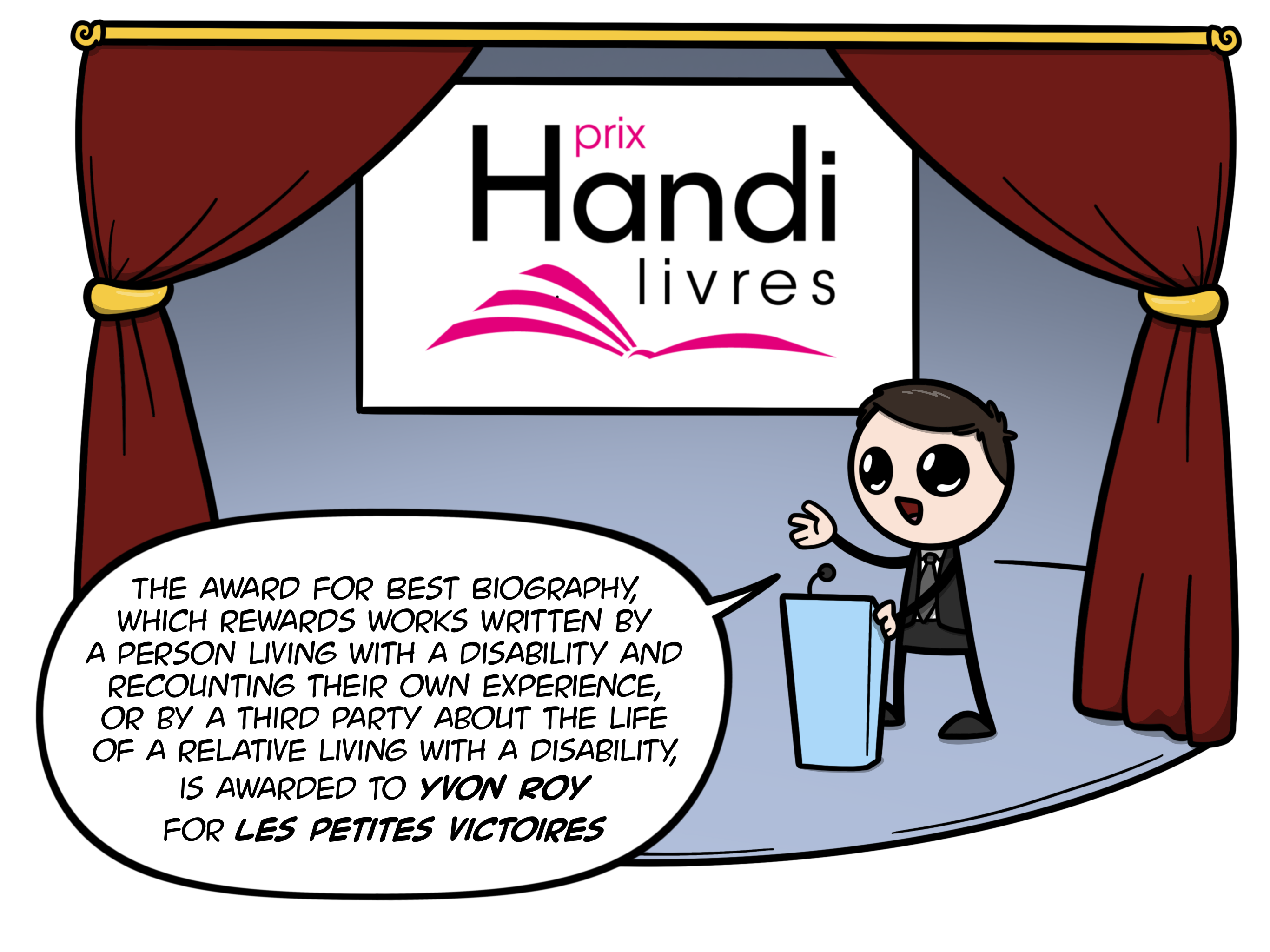
This comic book is an example of a creation that is easily accessible to the general public that has been awarded and highly publicized - even winning an award that recognizes works written by a person living with a disability and recounting their own experience, or by a third party about the life of a relative living with a disability. In 2018, the publisher Rue de Sèvres announced a contract for a film adaptation, which caused reactions and led to the hashtag :
#boycottlespetitesvictoires
As we will show, this is an example of the social representations of autism that perpetuate dominant understandings that do not fit the lived experience of those directly concerned to the point of being discriminatory. It is also difficult to identify moments when the child (the autistic character) shows agentivity. Instead, he’s passive in his father’s story. In a way, Olivier is only a supporting character. This is exaclty why representation doesn't mean autorepresentation and why "nothing about us whitout us" matters: although this comic is presented as a positive narrative from the allist perspective (3rd person), the story is completely different from the standpoint of the autistic community’s testimonies (1st person).
An allist person is a non-autistic person.
To understand the term "allist", we must go back to the origin of the word "autistic" which comes from the Greek word "autos" which means "self". So the word "autistic" initially referred to a person withdrawn on themself, who lives in their own world. The term "allist" appeared in a satirical article to refer to non-autistic people by swaping “autos” for "allos" which refers to others. So an allist is a person who is focused on others or, to flip the usual narrative, a person who lives in other people’s worlds.
In spite of the satire, the term “allist” has remained in use among others because it allows to distinguish between "neurotypicals" and "allists". There are people who are not autistic, but who are not neurotypical: a non-autistic dyslexic person, for example.
For a deconstruction
of the problematic propositions of the comic book:
But do you know the story from the autistic community’s perspective?
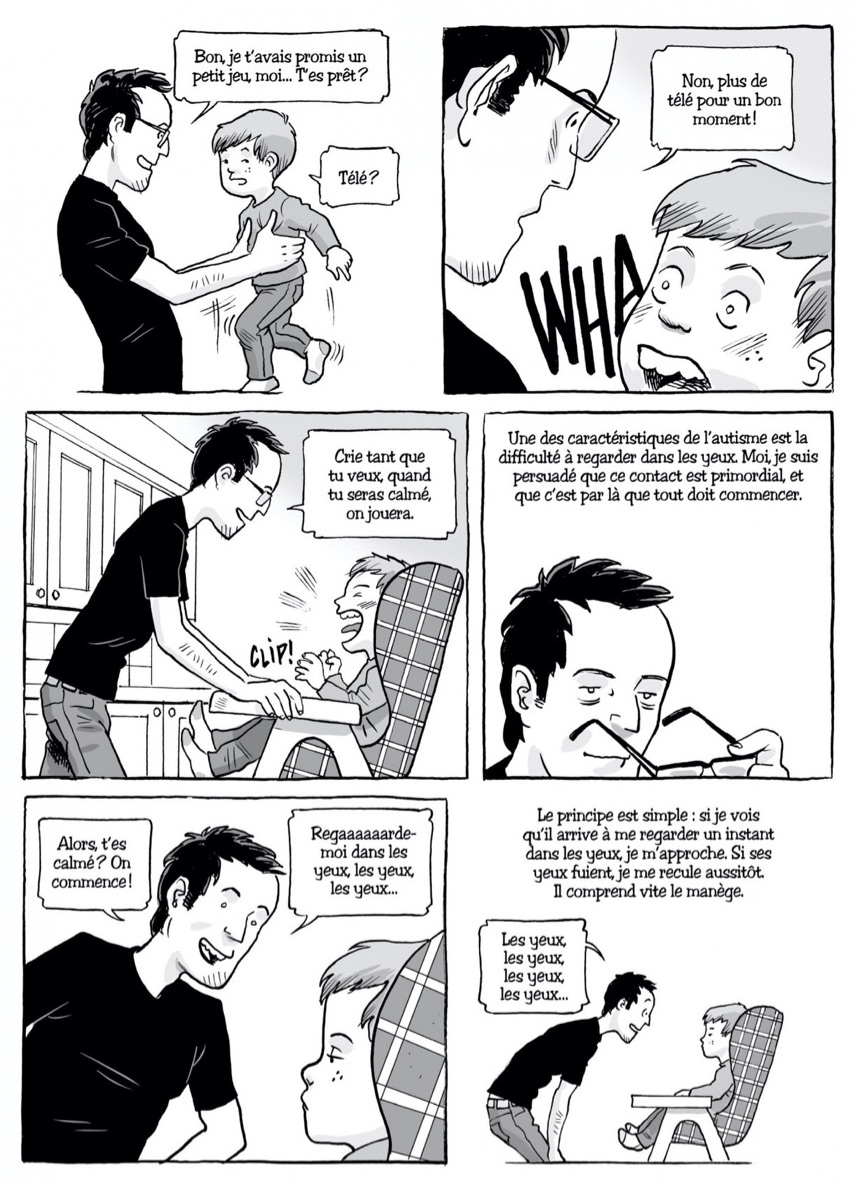
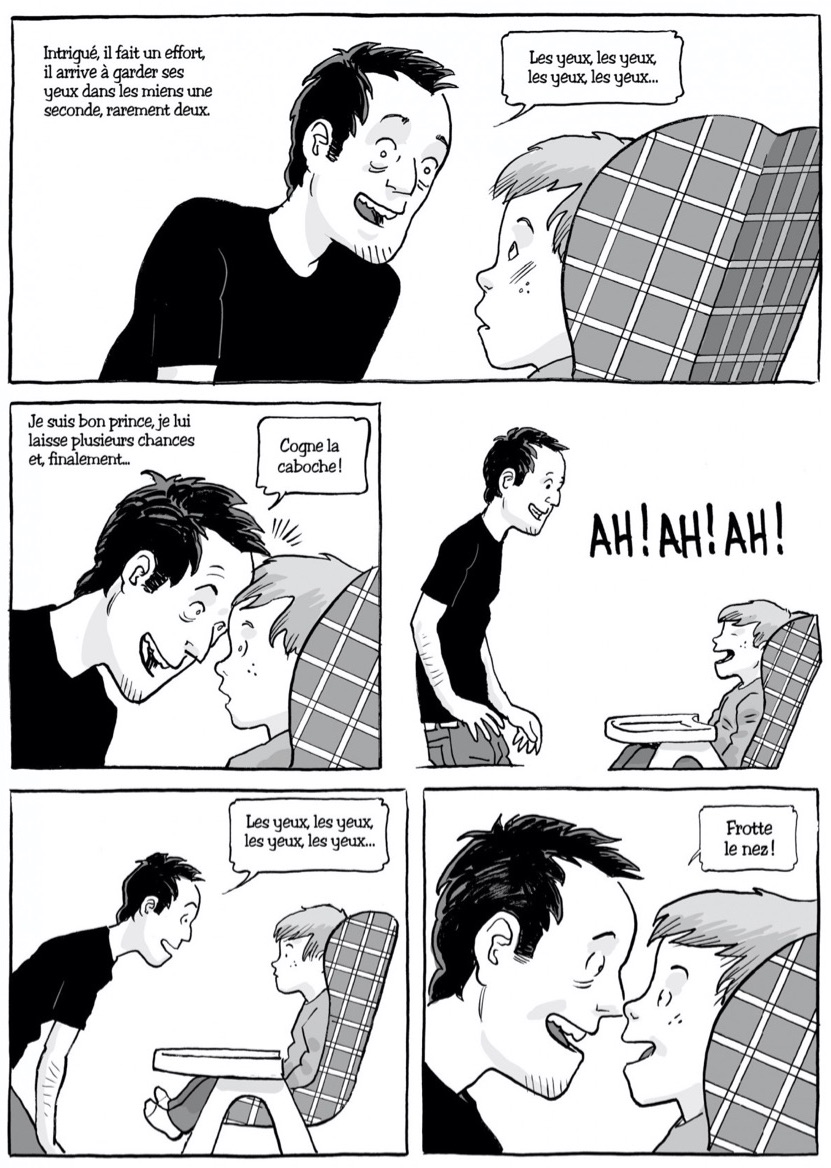
This is where webcomics can serve as an accessible tool that allows the reversal of dominant representations by opening the floor to self-representations directly grounded in marginalized communities. But before continuing with the topic of webcomics, we wish to feature an excerpt from Les Petites Victoires that addresses a frequent theme in autism: eye contact.
Excerpt on eye contact
English translation
English translation
Excerpt from Yvon Roy's interview
"I worked a bit like we can work to sometimes desensitize a substance. Sometimes certain people can have an allergy, we can try to desensitize them.
Several parents have contacted me regarding the trick to get the child to look in the eyes. This is the first thing we worked on together, that is to say, I considered that being able to look in the eyes - we know that autistic children have difficulty looking directly in the eyes - I said to myself, if we don't have eye contact, we have nothing. We need that, it's the beginning of human interaction." (our translation)
TW: The host uses the term “prison” in reference to autism:
"In your story that you shared with us in Les Petites Victoires, there is obviously the moment when you get up to face, to accompany your child in that reality: to learn to understand him too, inside what he lives and this prison, in a way, from which he is pressured which is basically this condition." (our translation)
Link to the interview (in French)


This scene is an example of neuronormativity
Recall that neuronormativity is the prevalent, neurotypical set of assumptions, norms, and practices that conceives of neurotypicality as the only acceptable or superior mode of cognition, and that stigmatizes attitudes, behaviors, or actions that reflect atypical modes of cognition as deviant or inferior.
This scene is told from the allist perspective and is presented with a positive outcome. In fact, as the author mentions, parents have applied this technique with their autistic children after being inspired by it.
But what if we ask autistic people how they feel about eye contact? That's exactly what we are going to do.
PART II
Why webcomics?
The medium of webcomic enables me to do something I don't know how to do otherwise: share how things feel on the inside.
Imagine. You come across a newspaper at the local coffee shop and recognize the face of a well-known personality. Yet you can't remember their name. It annoys you, you know you know it, it’s just not coming out, it stays there, on the tip of your tongue. You have time to come back to work, coffee in hand, and the name still hasn't come back to you, it still annoys you. You come across a colleague and you ask them, you describe the person, maybe clumsily at first (it would be so much easier with their name!), but you adjust to your interlocutor and, together, you can finally recall their name, it was so obvious!
It’s important to emphasize this feeling of annoyance. We rarely take the time to mention this annoyance when talking about epistemic injustices. Yet it is there, and it can even be painful: how do we make sense, to use Fricker's classic example, of our experience of sexual harassment when the concept does not yet exist? How can we share the feeling that something is wrong? This is where community comes into play and it is why the idea of "by and for" matters more than, say, a criterion of simplicity might. This is addressed by feminist epistemologies: for example, Longino argues for pragmatic values in science such as diffusion of power (as the importance of making research programs accessible to the actors involved in the research).
The impact of inadequate social representations on neurodiversity cannot be fully resolved by the traditional narrative of epistemic oppression and justice: adding new vocabulary to collective epistemic resources is not a panacea (we already have the word "autism" for example). So it is not only words that are missing, but rich and diverse lived experiences are also missing from the pool of shared resources.
The problem is that what is missing, the hermeneutical gaps, are not automatically apparent: social representations created by and for the dominant groups inadequately fill the hermeneutical gaps of marginalized groups. To that effect, let us recall here the Handi-Livre prize for the best biography which rewards works written by a person with a disability and telling his or her own experience, or by a third party on the life of a close relative with a disability: In the case of Les Petites Victoires, the award went to the biography of an allistic (non-autistic) person talking about autism. These inadequate social representations are difficult to resist: they are constantly and persistently reproduced. It is even harder when you don't have the words to replace theirs. But do we really have to wait for the right words to share our experiences? This is where illustration can become an attention grabbing action like shouting: an action that does not need words. This is what we propose here: a form of non-propositional epistemic resistance in response to hermeneutic injustice.
Webcomics are basically online comic books. They are mostly instantiated as short comics that take many forms and cover many topics. The most common form of webcomic is probably the blog (sometimes autobiographical, sometimes entirely fictional, sometimes both). Because they are mostly published independently by their artists, webcomics are an art form that is not limited by institutionalized power dynamics such as publishing houses or art galleries.
But the most important thing for us here is that webcomics are able to generate aesthetic experiences that allow viewers to better understand different aspects of the lived experience of neurodivergent people despite the inadequacy of mainstream epistemic resources.
In some ways, webcomics are a digital version of street art.
Although limited to a given geographical space for street art and to a particular digital platform for webcomics, there is this common idea where it is not so much the public that goes to the creation as the creation that goes to the public. We are no longer in a reserved and predefined space like a museum, a bookstore, a gallery or even a library.
Although a recognized artist can make street art, it is more difficult for an artist who does not belong to a complex and influential network to access some places of diffusion such as an art gallery. Webcomic is thus added to the tools that allow the production, use and transmission of more accurate social representations, participating in the collective understandings of the oppressions suffered by epistemically marginalized groups. The public and interactional aspects of social media that support webcomics make them a catalyst for direct dialogue with (but also within and between) marginalized communities.
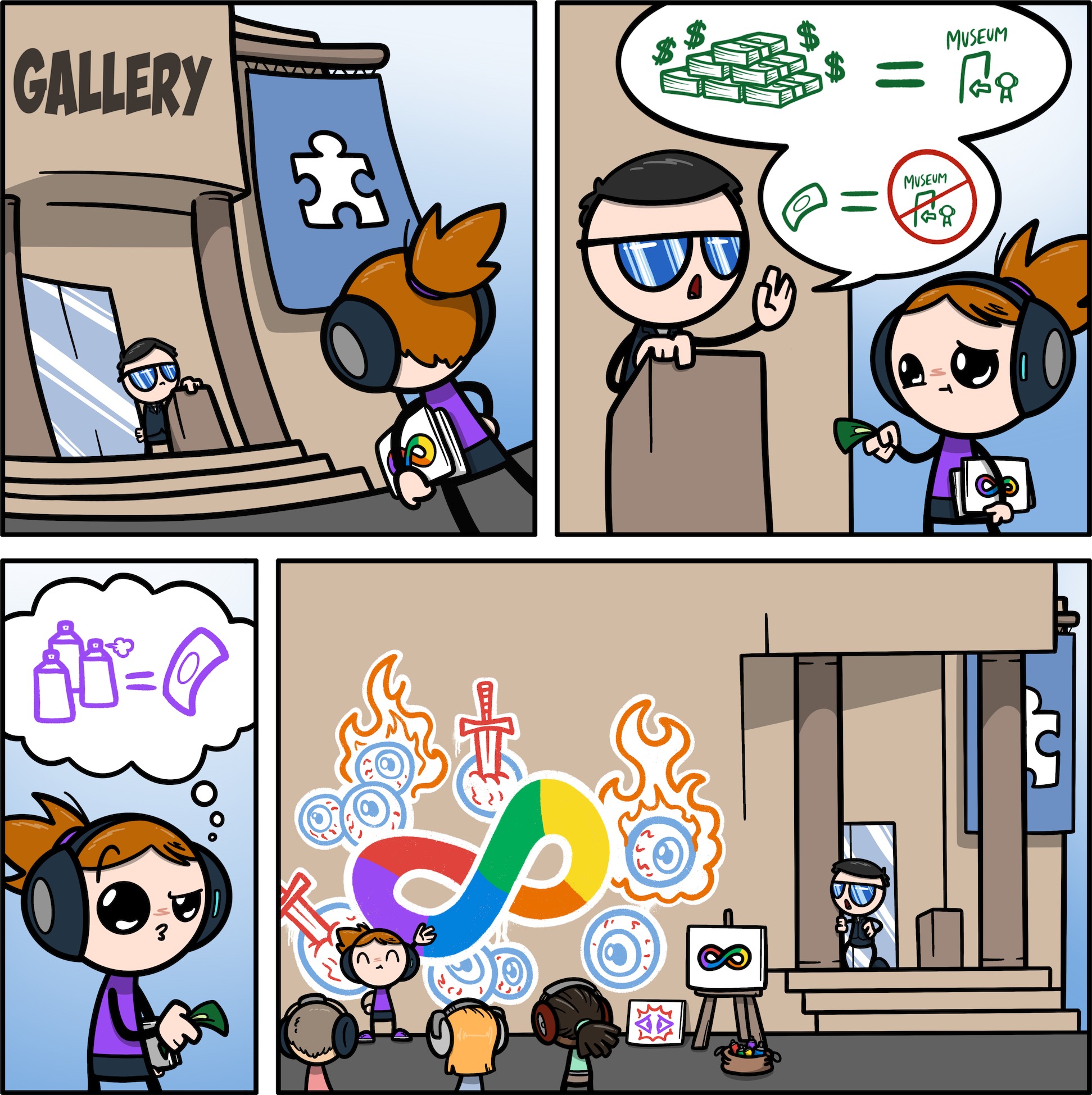
To put our epistemic resistance into action,
and to enhance our imaginative ressources, we chose to gather first-personal testimonies and descriptions of how eye contact can feel for autists.
After all, who better to provide insight into a given lived experience than those who live it? To do so, we used social media (instagram and facebook) to ask autistic followers of our webcomic (@lilyspectrum): How does eye contact feel to you? Although we are neurodivergent, it was important for us to go with the community beyond our individual experiences. For instance, we would never have thought of the sunburn idea on our own, but once we read those testimonies, it felt right.
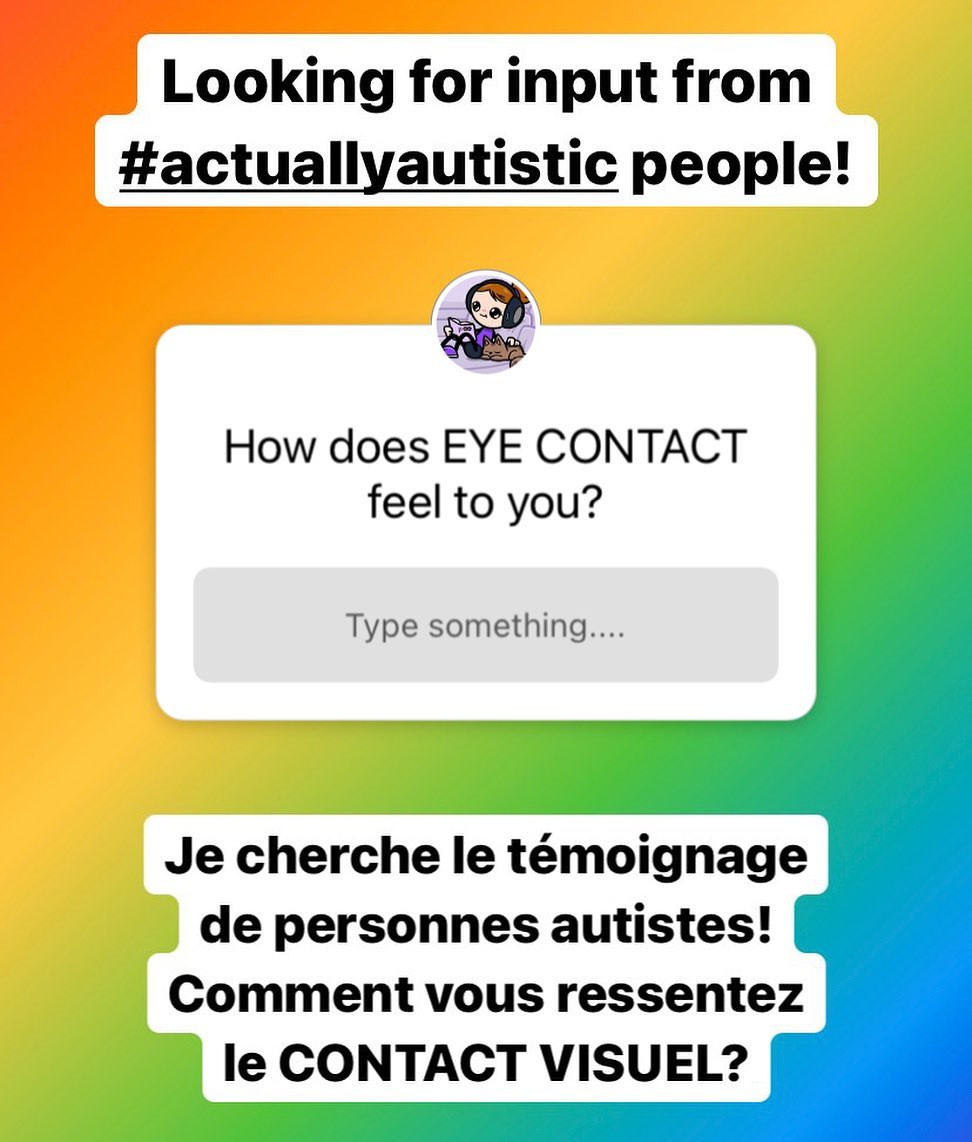
Both posts were made on November 8, and three days later, on November 11, we had received 175 testimonies. A few major themes emerged from these testimonies, which we used to base 7 webcomics or illustrations on. Keep in mind that, with this process, we do not claim to represent all there is to express about autists’ first-personal experience of eye contact. In fact, we suggest you visit these posts yourself to better understand the varied responses we got, and are still getting. And who knows, maybe this will allow you to add your own insight.
Publication
Since Monday, we have started to publish these comics on our social networks and we will continue to publish them in the following days
The interactions that take place around such webcomics are, we believe, an integral part of their complete aesthetic experience. These interactions often bring about clarifications, complementary details and descriptions or even added meaning. We thus invite you to visit these posts and interact with the community.
Webcomics
"I can do it but I can’t process anything else while doing it. My natural instinct and what feels the most right is to not look at someone’s face at all"
"It was drilled into me as a "rule" of politeness. I view it as just that, a rule. It's easy when there's multiple people because I can look around. But with one person, I have to look away or I end apparently end up staring"
"Everyone insisted on it, especially when they really wanted to correct a behavior or ensure I was paying attention. I honestly still don't love it, and prefer to look at noses or eyebrows to provide the impression I'm making eye contact"
"Eye contact was enforced during my childhood in mostly abusive ways and while it taught me to fake it, that made me hate it even more. Generally it just makes me uncomfortable and I find it quite distracting but it's also one of the most tiresome things to mask."
"Eye contact feels like they're staring into my soul, but with knives. I can make short eye contact before wanting to cry."
"It takes a concerted effort except for specific people."
"I’ve been so conditioned to make eye contact with people that when I met a lot of my friends for the first time they were kinda weirded out by me unblinkingly paying attention to them when they talked like 👁👄👁"
"It feels like someone is looking right past all my defenses and directly into my head. Not very pleasant."
"Terrifiant, j'ai vraiment l'impression qu'on me transperce à chaque fois …"
"Like I am being stabbed in the brain, itchy under the scalp, or suffocating. Anxiety is anxiety. I look at people's foreheads. They never know the difference but I am not forced to juggle the pain of eye contact and try to communicate. I am mostly non verbal and eye contact guarantees no words."
"Ça me met vraiment mal à l'aise et j'ai peur qu'on puisse mal interpréter si je regarde pas "correctement", je sais pas si je dois regarder quelqu'un dans les yeux ou combien de temps, il faut surtout pas que je regarde autre chose chez lui que ses yeux et du coup je sais pas quoi faire je préfère regarder le mur derrière mon interlocuteur 😂"
"Tout dépendra de la situation, de ma fatigue et de la personne. Certains contacts peuvent être transperçants (douloureux), d'autres envoutants (confusants), d'autres destabilisants (perturbants). En tous cas, si je regarde qqn dans les yeux, je suis sûr de perdre mon fil de pensée et/ou d'accorder mes réponses à ce que la personne ressent."
"Eye contact feels like burning discomfort, especially when I'm being told to do it."
"It’s extremely hard for me to maintain eye contact, and when people express to me that I should be looking at them when I’m talking to them, it puts me under more stress than just talking to them in the first place"
"somehow being told we should be making eye contact feels like being reprimanded as a child, at least to me.. I can't count the amount of times my mother would tell me to look her in the eyes as a child, and how humiliating/stressful it felt.. I legit forget to listen to people because I'm too busy trying to maintain eye contact."
"At best, awkward and uncomfortable. At worst, like someone's stabbed me in the eyes."
"It makes me uncomfortable but my mother forces me to look people in the eyes"
"Painful, but I feel like if I don't look ill be punished or called a liar. So I trained myself to look at something over their shoulder if not their foreheads to avoid harassment."
"Habituellement je regarde plutôt la bouche ou le nez des gens et ça semble passer crème pour donner l'illusion que je regarde dans les yeux (j'ai eu droit à l'expert en haute potentialité qui me disait que c'était impossible que je sois autiste car.. je le regardais dans les yeux ! Je regardais sa bouche depuis le début de l'entretien..). Je ne me force au contact visuel que de manière consciente et dans de rares cas précis : [suite]
(suite) par exemple si je suis attiré romantiquement par quelqu'un et désire que cette personne le perçoive (vu que le contact visuel accru est interprété de cette façon par beaucoup de neurotypiques). Mais cela reste un sacré effort et en général je détourne les yeux très rapidement, ça me met mal à l'aise, c'en est presque physique. Récemment un de nos profs en cours nous a fait faire une série d'exercices où on devait marcher vers quelqu'un/revenir à sa place à reculons en gardant le contact visuel constant avec cette personne.. je vous laisse deviner la torture que c'était"
"Transperçant!"
"J'ai l'impression que les yeux de la personne me percent à l'intérieur, je sais pas comment dire, c'est une sensation d'oppression aiguë."
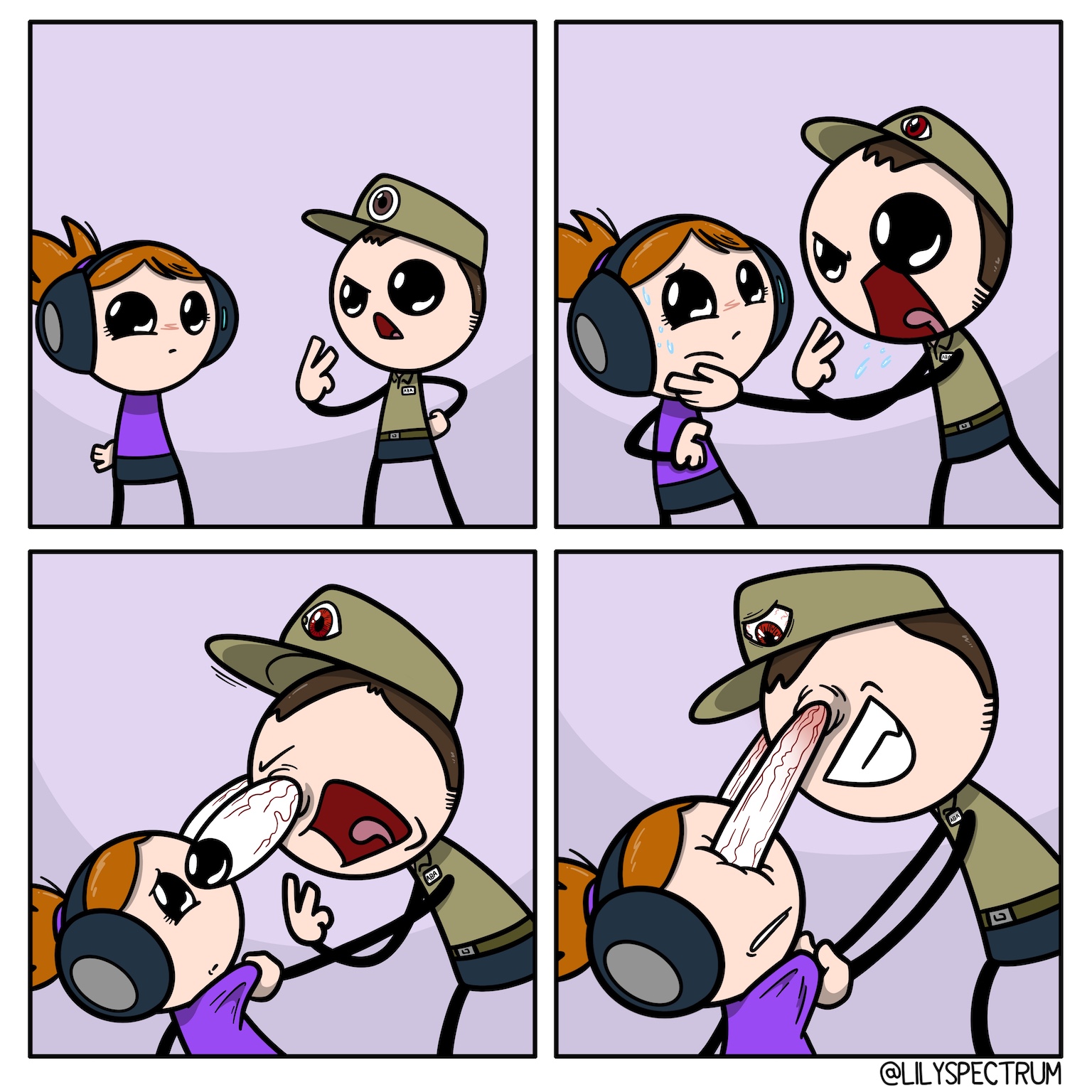
"For me, looking in the eyes feels too exposed and open. It makes me feel like I can't hide and protect myself from the people."
"Eye contact makes me uncomfortable most of the time, because of the feeling that I am being silently judged or getting talked about negatively."
"It's fine when I'm listening to someone but when I'm the one talking it makes me get stage fright like I'm being put on the spot to judge for performance lol"
"Too intimate, inappropriate… I become incredibly self conscious as well, like am I doing eye contact right? Should I be mirroring their behavior or a close approximation or complete opposite? How many times should I blink? Can they tell I’m faking this human interaction? It’s incredibly stressful."
"It feels like something is a required check box. It’s like a math problem. Look, one, two, three. Okay. Look away. Zone out if you need to. Okay, it’s been 10ish seconds. Look back. One, two, three.. okay, look away! Don’t share at them! Wait! You’ve looked away too long! Look back! …..it’s that on repeat quite often lol"
"I hate it I get so nervous and then I break down."
"I don't like it, makes me really uncomfortable. I'm "good at it", because I mask well (😬). I never know what to do, if I'm looking to much or not enough and always use a whole lot of energy just on eye contact. Generally, the more comfortable I feel the less I look someone in the eyes. (Also eyes as a body part make me feel really icky so that's that)."
"Intimidating and uncomfortable, I feel too vulnerable and keep thinking am I doing this right?"
"Ça me met vraiment mal à l'aise et j'ai peur qu'on puisse mal interpréter si je regarde pas "correctement", je sais pas si je dois regarder quelqu'un dans les yeux ou combien de temps, il faut surtout pas que je regarde autre chose chez lui que ses yeux et du coup je sais pas quoi faire je préfère regarder le mur derrière mon interlocuteur 😂"
"Eh bien, quand j’étais petit, je parlais et écoutais souvent le monde sans les regarder dans les yeux. Maintenant, ça me dérange pas de parler et écouter avec le contact visuel, mais j’peux très bien comprendre ce que le monde me dit sans obligatoirement les regarder dans les yeux. Aussi, c’est vrai que ça me rend un peu mal à l’aise quand des inconnus me fixe du regard. C’est comme s’ils me jugeaient et j’sais pas ce que j’ai fait de mal."
"Direct eye contact feels like I am being judged. It also makes me feel uncomfortable because I become unable to perceive and read the rest of their body language."
"Démunie, nue. Percée à jour. C’est très fort comme sensation, et rarement agréable. J’y arrive avec mes enfants ou mon mari, mais même dans ce cas, pas trop longtemps. Si je veux tenir une conversation, et me concentrer, alors je dois ruser. Je regarde entre les deux yeux ou le plus souvent la bouche."
"Feel nausea and anxiety, and extremely naked. Yet my mother was adamant that I learned it and therefore I am able to do it, despite the uncomfortable feelings. Absolutely love your work, for once I can tell that I am not alone"
"I feel instant stress and I have to force myself to do it and to look "natural"."
"Honestly, each time it happens to me, the most awkward feeling I have is « where should I look exactly » ? When you make eye contact, are you expected to focus one eye specifically (which one, then ?), between the eyes, not focus at all, or try a weird way of having each eye "looking" into the facing one (i.e. my left eye "looking at" their right one and vice-versa) ? I'm also never sure if/when eye contact is expected, and when it happens, is there/what is the hidden message behind this specific contact, and/or am I sending an incorrect hidden message myself ? Then, with all these questions actively consuming my brain "computing power", everything else totally miss the point (sometimes, though, I can hide this issue because I have this kind of ability to "replay" the last few words/sentence I unconsciously heard, to process it with a delay but potentially without the proper context- so it's not reliable at all !!). "
"Weird and artificial. I can actually read people's eyes now, but it took me years to learn it."
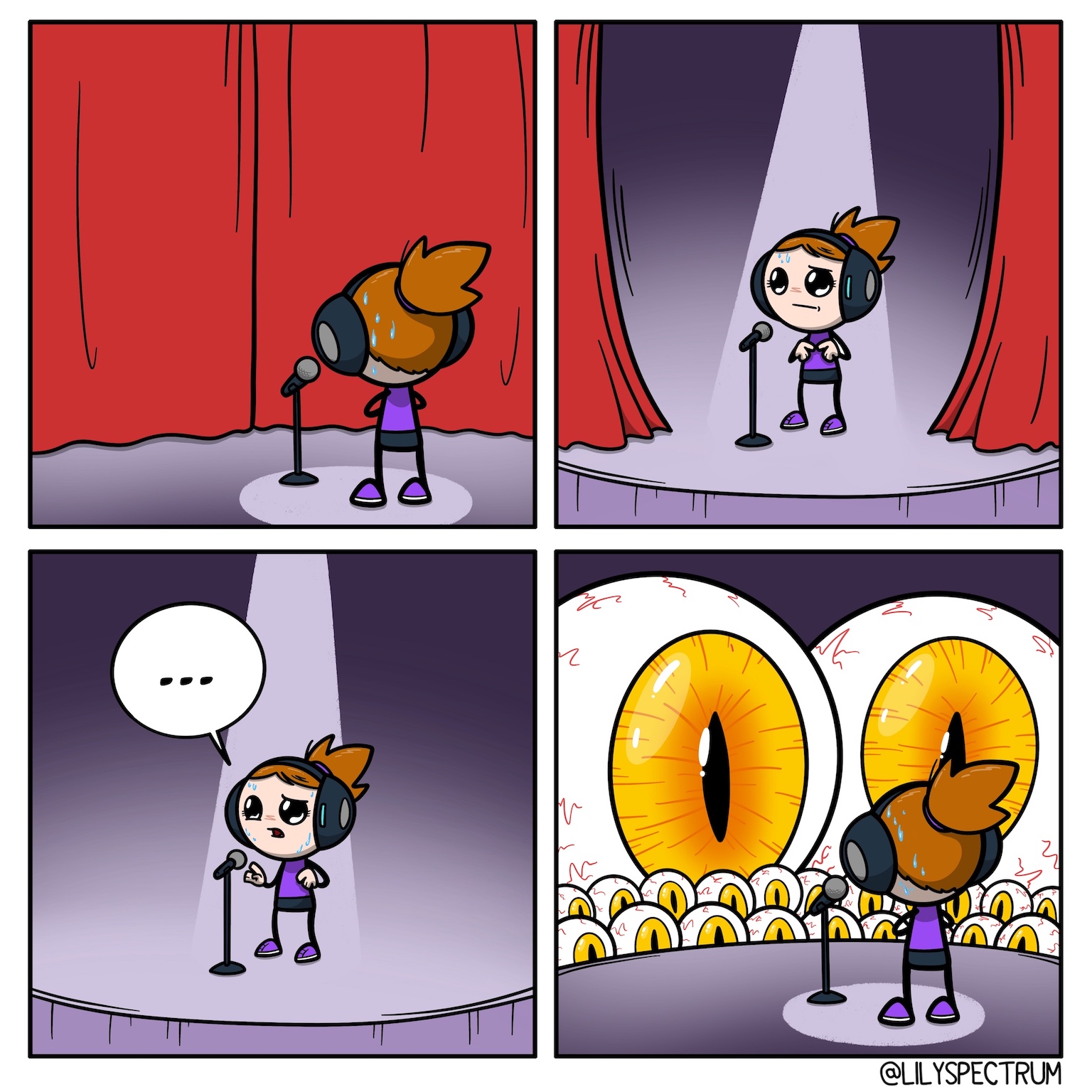
"My parents rasied me to always look into the eyes, still feels wrong. Like, I am invaiding a personal space and being rude. Like trying to stare down their soul and violating their privacy. I still try to look at people in the eyes but have learned to just looks in differents points in the face so I don't seem rude."
"Eye contact feels too intimate to me for most interactions. If I make eye contact with you, it’s because it’s important. "
"Eye contact feels very intimate. If I’m forced to hold it for too long, I feel violated, like I’ve been touched without consent."
"I really hate eye contact in almost all circumstances. About the only exception is with someone I'm very intimate with. Eye contact feels extremely intimate to me in general so it only feels natural when it's with someone I've got a suitably intimate emotional connection to. Otherwise it feels like I'm staring into someone's soul and I can see everything and they're staring into mine and seeing the same (even if I know they're not)."
"Invasive, extremely personal. I'm only comfortable looking my husband in the eyes"
"It feels like I’m standing too close to someone, I don’t know if that’s too vague of a comparison but it feels way too intimate. So I only do it when necessary or when I’m comfortable with that person."
"It feels creepy to me"
"I don't like it, makes me really uncomfortable. I'm "good at it", because I mask well (😬). I never know what to do, if I'm looking to much or not enough and always use a whole lot of energy just on eye contact. Generally, the more comfortable I feel the less I look someone in the eyes. (Also eyes as a body part make me feel really icky so that's that)."
"I hate eye contact. It almost hurts. But it’s nessesary to have a successful professional life, and my parents trained me well as a child. They would ask me people’s eye color after I met them to see if I made eye contact. Being trained like that at a very young age was incredibly difficult and felt unfair, but I’m very grateful that they pushed me now that I’m an adult."
"I can't do it, it makes me feel funny in a bad way and makes me feel kind of .. unsafe? and uncomfy I don't exactly know the word for the first one, I don't mind people looking at me but I won't look back"
"It's incredibly intimate and overwhelmingly so, particularly with strangers. And the more my emotions are revved up, the less I can tolerate it. It genuinely feels as though someone can see into my mind almost, even though I know that they can't. On the plus side, when I'm with someone I deeply, deeply love, sometimes that's okay because I want them to see how much I love them... but then that tends to make THEM feel awkward and uncomfortable too. LOL For me, it falls into the same category as standing too close, invading personal space, touching someone without consent etc. It's intimate, and can very easily become violating when you don't want it. And that;s so hard to explain to NT folk who expect you to look them in the eye all the time."
"It's okay with people I know, but I don't feel comfortable with eye contact with strangers, it almost feels like an invasion of privacy."
"eye contact feels so weird and creepy and if i have to make eye contact with someone, then ill quickly feel exhausted."
"It feels like a boundary rupture unless I completely and totally feel comfortable in a container of safety with another it probably won’t happen much."
"Well... I can't let anyone touch my eyeballs."
"Trop intrusif. Comme si l autre avait la perception de mes pensées. C est comme se montrer nue."
"Intense/ overwhelming/ fiery/ intrusive. Sometimes painful/ always difficult with strangers. Ok with intimate friends and family."
"Démunie, nue. Percée à jour. C’est très fort comme sensation, et rarement agréable. J’y arrive avec mes enfants ou mon mari, mais même dans ce cas, pas trop longtemps. Si je veux tenir une conversation, et me concentrer, alors je dois ruser. Je regarde entre les deux yeux ou le plus souvent la bouche."
"Feel nausea and anxiety, and extremely naked. Yet my mother was adamant that I learned it and therefore I am able to do it, despite the uncomfortable feelings. Absolutely love your work, for once I can tell that I am not alone"
"confronting and very intimate ..i feel naked"
"Quelque chose d'extrêmement intime, que je ne peux pas partager avec n'importe qui sinon je suis déstabilisée car je bloque sur cette sensation d'intimité forcée. Depuis le diagnostic, je me permets de ne plus regarder le visage des gens (je ne travaille pas). Quel soulagement!"
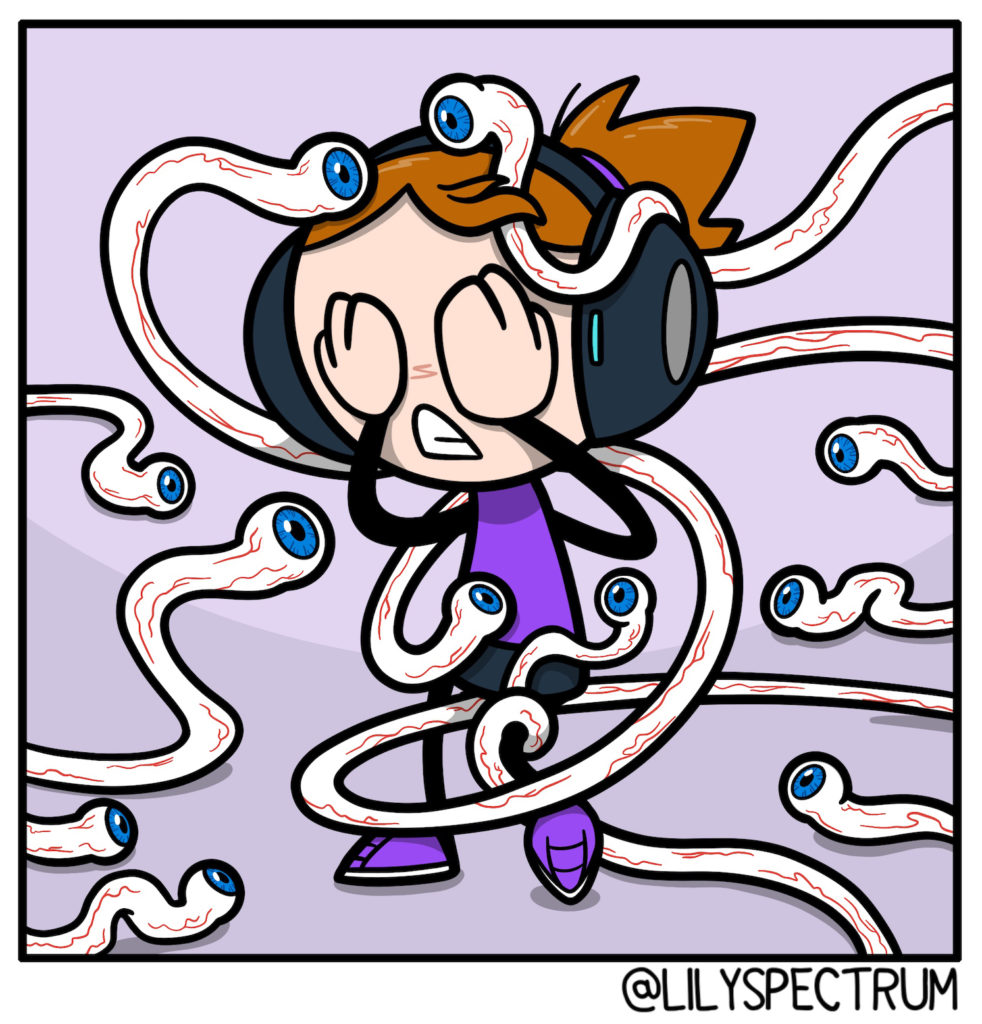
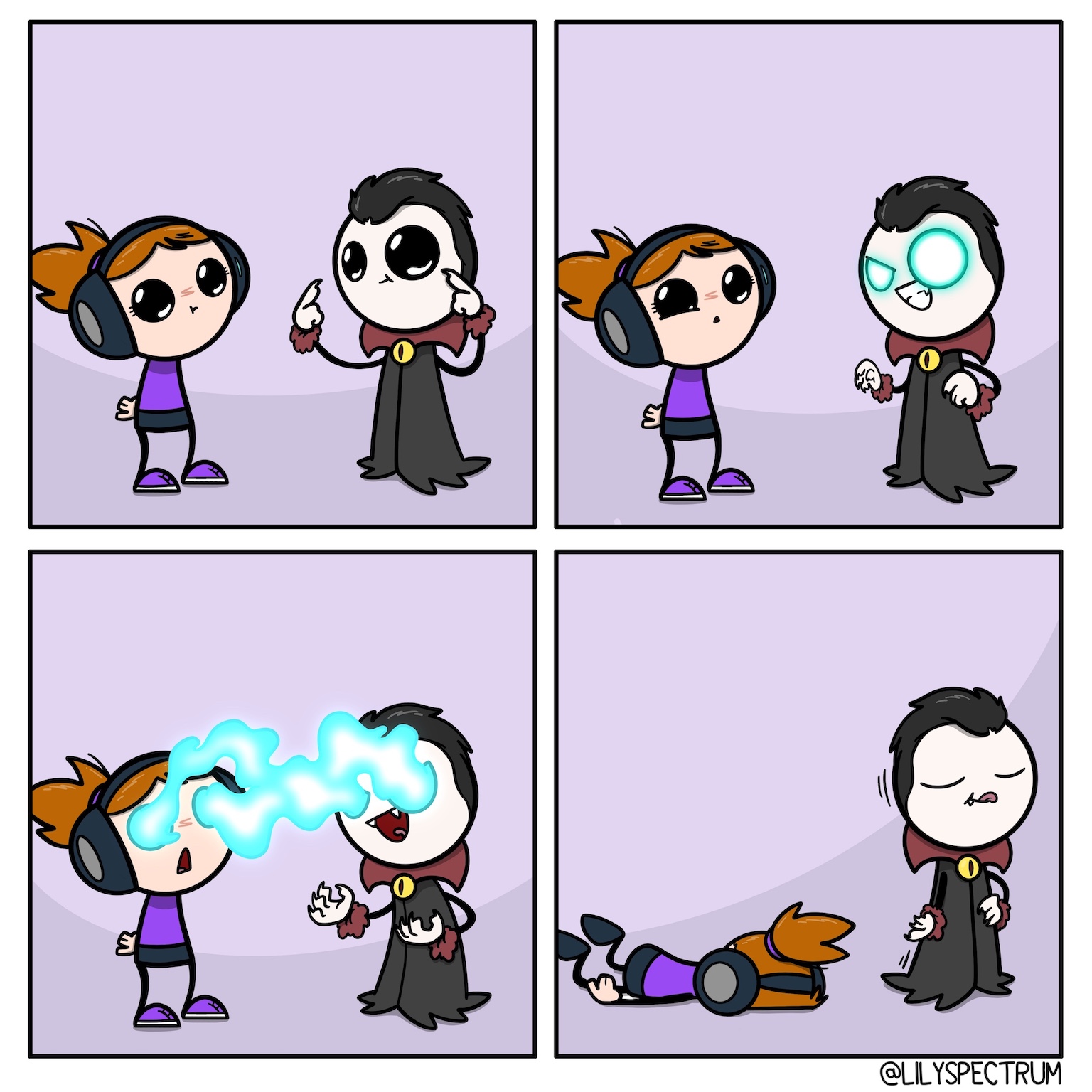
"Eye contact feels like they're staring into my soul, but with knives. I can make short eye contact before wanting to cry."
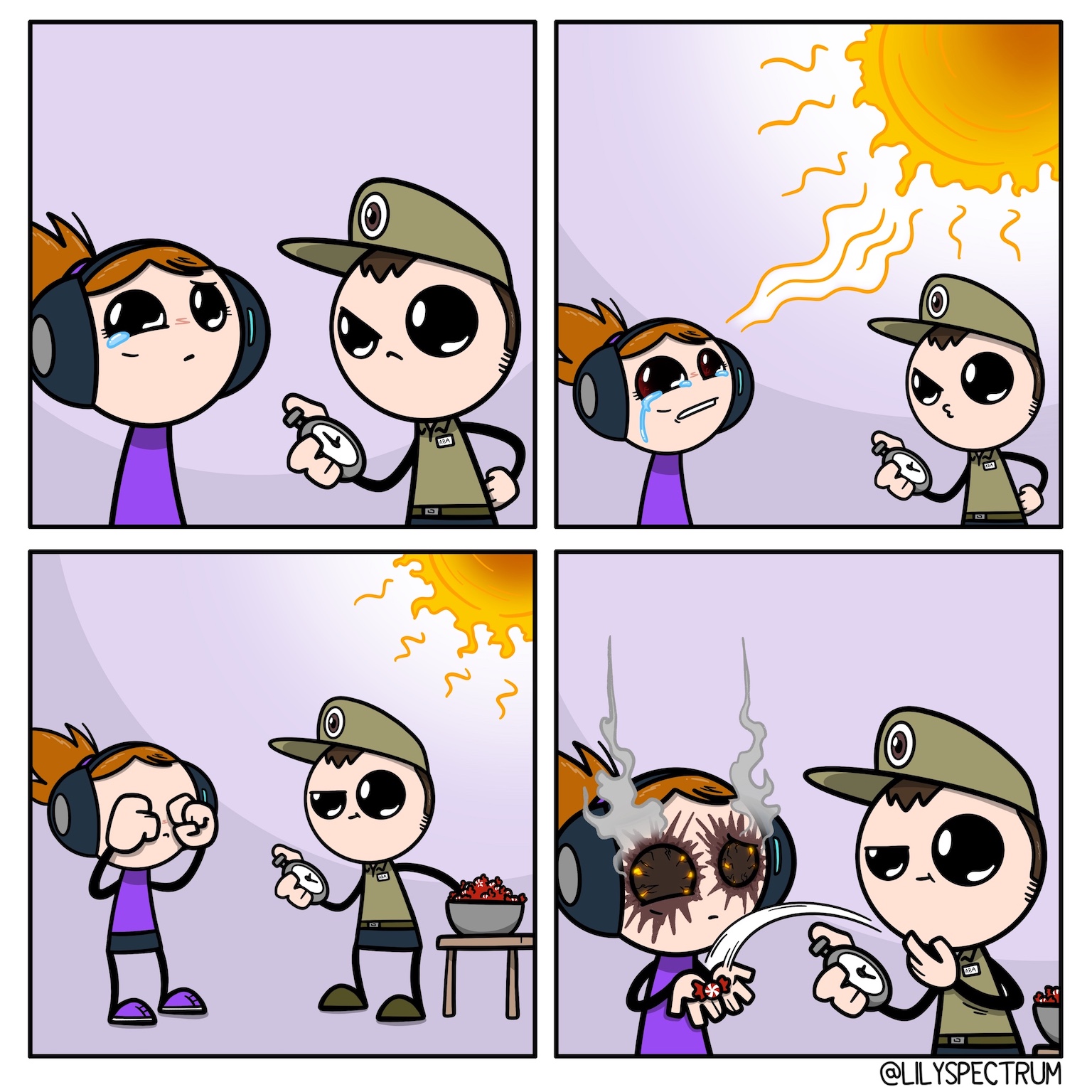
"It’s like being asked to look directly at the sun. I flinch, I can’t do it…"
"It feels like they gonna shoot me with laserbeams. Like Cyclops from X-Men. I van handle it for 10 seconds. I get panick attacks of it's to long. Even with my bf makes me on edge. I got a major panic attack during a being social etc exam (idk how it's in English is). It was so bad. They let me past because otherwise i needed to do the whole year over."
"Feels like I’m staring at the sun and I can only look a person in the eyes for 30 seconds or so before my eyes start to hurt a bit. I can only look animals in the eye."
"Like flames of intense awkwardness are scorching my retinas."
"When I was younger I always had trouble making eye contact. I’ve gotten better at it in recent years but its still painful to me."
"Eye contact feels like burning discomfort, especially when I'm being told to do it."
"Ça me demande beaucoup de concentration. J'ai l'impression que ça me fait mal aux yeux et quand j'étais plus jeune je pouvais même ne plus vraiment entendre ce que la personne me disait. Par contre ce n'est plus un problème quand je me mets vraiment en colère au point de vouloir me battre."
"Ca va de la gêne à la sensation de brûlure, ça dépend des personnes je suppose. On peut parfaitement regarder le nez, la bouche, entre les yeux sans que l'autre ne sen rende compte."
"I can’t think if I have to. Feels like pressure."
"Bad, I feel like my head is going to explode if I look at someone's eyes for too long. I suspect it's probably a blood pressure drop or adrenaline, but it feels awful. I honestly don't get why so many people require eye contact when speaking. I can make eye contact, but it's really difficult to understand what the person is saying because I'm too focused on how uncomfortable I feel and how incredibly awkward it is to stare at someone's eyes"
"It feels literally painful and I’m always afraid the other person can tell what I’m feeling/thinking. I’m comfortable with eye contact with very trusted folks in my life though."
"Painful"
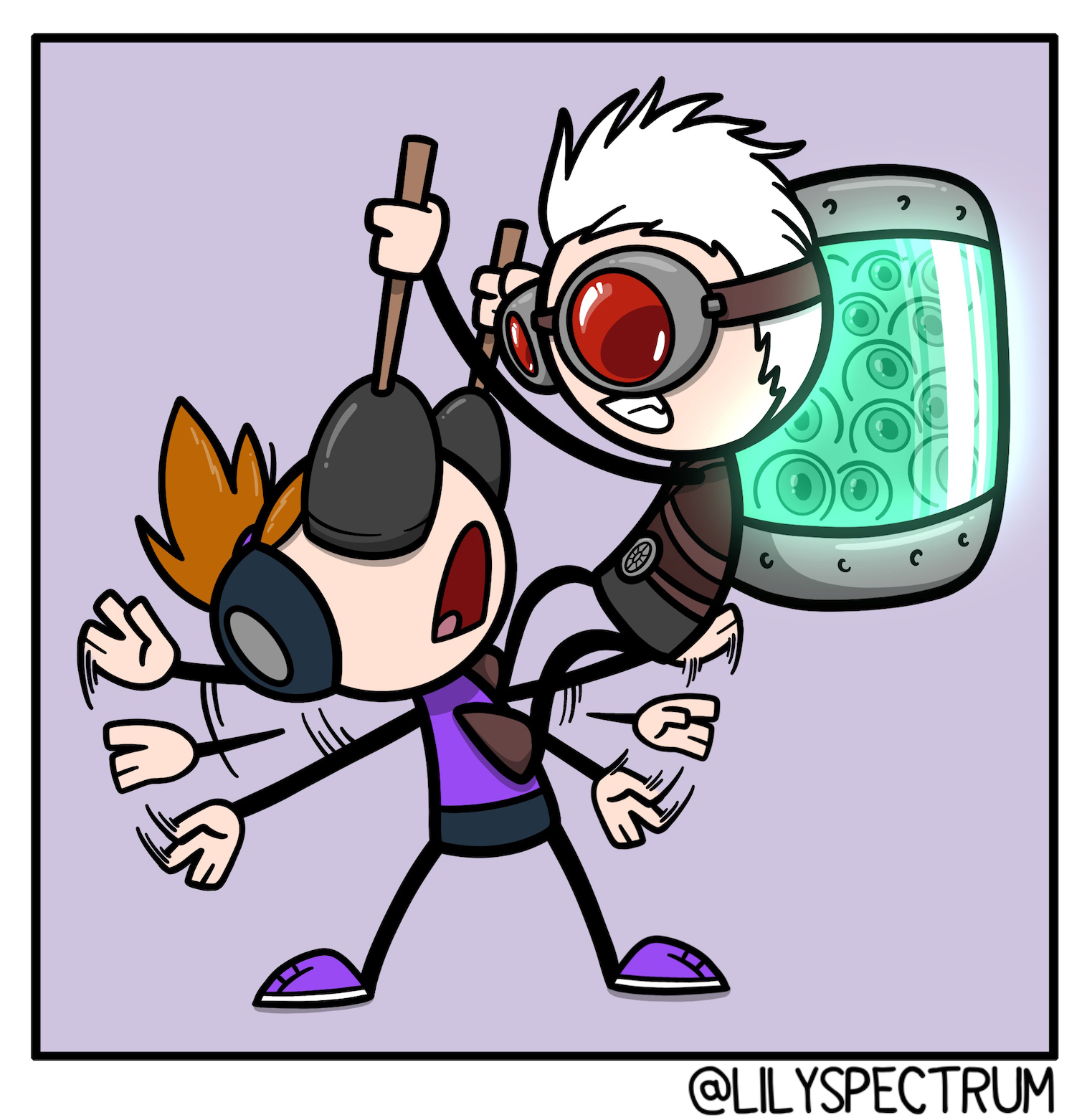
"I really hate eye contact in almost all circumstances. About the only exception is with someone I'm very intimate with. Eye contact feels extremely intimate to me in general so it only feels natural when it's with someone I've got a suitably intimate emotional connection to. Otherwise it feels like I'm staring into someone's soul and I can see everything and they're staring into mine and seeing the same (even if I know they're not)."
"I cant make eye contact with literally anyone. Its uncomfortable, and even when its not, i cant listen proberly to what people are saying when i focus on the eyes. I just cant do it at anytime with anyone, only for one second maximum. Its like staring into someone's soul, its too much."
"J’ai l’impression d’être absorbée par les yeux de la personne et en même temps comme si on pouvait voir ce qu’il y a à l’intérieur de moi."
"honestly it feels like i am being sucked into their soul… i can’t maintain it if i want a conversation because i just get lost"
"Like someone staring at my soul? I almost feel like that's the part of masking that exhausts me the most!"
"It's uncomfortable. But sometimes if I want to intimidate someone I stare deep into their eyes and make them feel unnerved like I'm looking into their soul."
"Tout dépendra de la situation, de ma fatigue et de la personne. Certains contacts peuvent être transperçants (douloureux), d'autres envoutants (confusants), d'autres destabilisants (perturbants). En tous cas, si je regarde qqn dans les yeux, je suis sûr de perdre mon fil de pensée et/ou d'accorder mes réponses à ce que la personne ressent."
"Trop intrusif. Comme si l autre avait la perception de mes pensées. C est comme se montrer nue."
"J’ai l’impression d’entrer dans l’âme de la personne. Je trouve ça trop privé. Alors je ne regarde que ceux dont j’ai vraiment envie de découvrir ce qu’il y a au plus profond d’eux même"
"I'm okay with it for small periods of time, but if it's more than a minute, I have to look away, it makes me super uncomfortable after that"
"It took me around 2 years to be able to do eye contact (kind of struggle still-) but normally if im uncomfortable looking at the eyes, ill just look at the nose instead"
"Awkward. The longest I can probably do it is for a few seconds, but sometimes it’s physically impossible for me to look someone in the eyes even for one second."
"Ça me met juste très mal à l’aise, et du coup je préfère regarder ailleurs et ne regarde les gens dans les yeux s’iels ne me regardent pas."
"Incapable de soutenir un eye contact sauf avec certaine personnes... Ma famille (ma mere, mon pere, ma soeur), ma nièce, mon beau frère et mon conjoint. Quelques amis specifique aussi... Mais sinon incapable. Je chercher tjrs a "évader" ses eye contact."
"Uncomfortable. I have trouble maintaining eye contact for long, especially in a conversation. However, I did figure out that talking with your hands is a great way to distract the other person's eyes from your and gives you a reason not to look at them."
"havent made eye contact with anyone (while i'm talking to them, that is) except my cats in years if that tells you anyone"
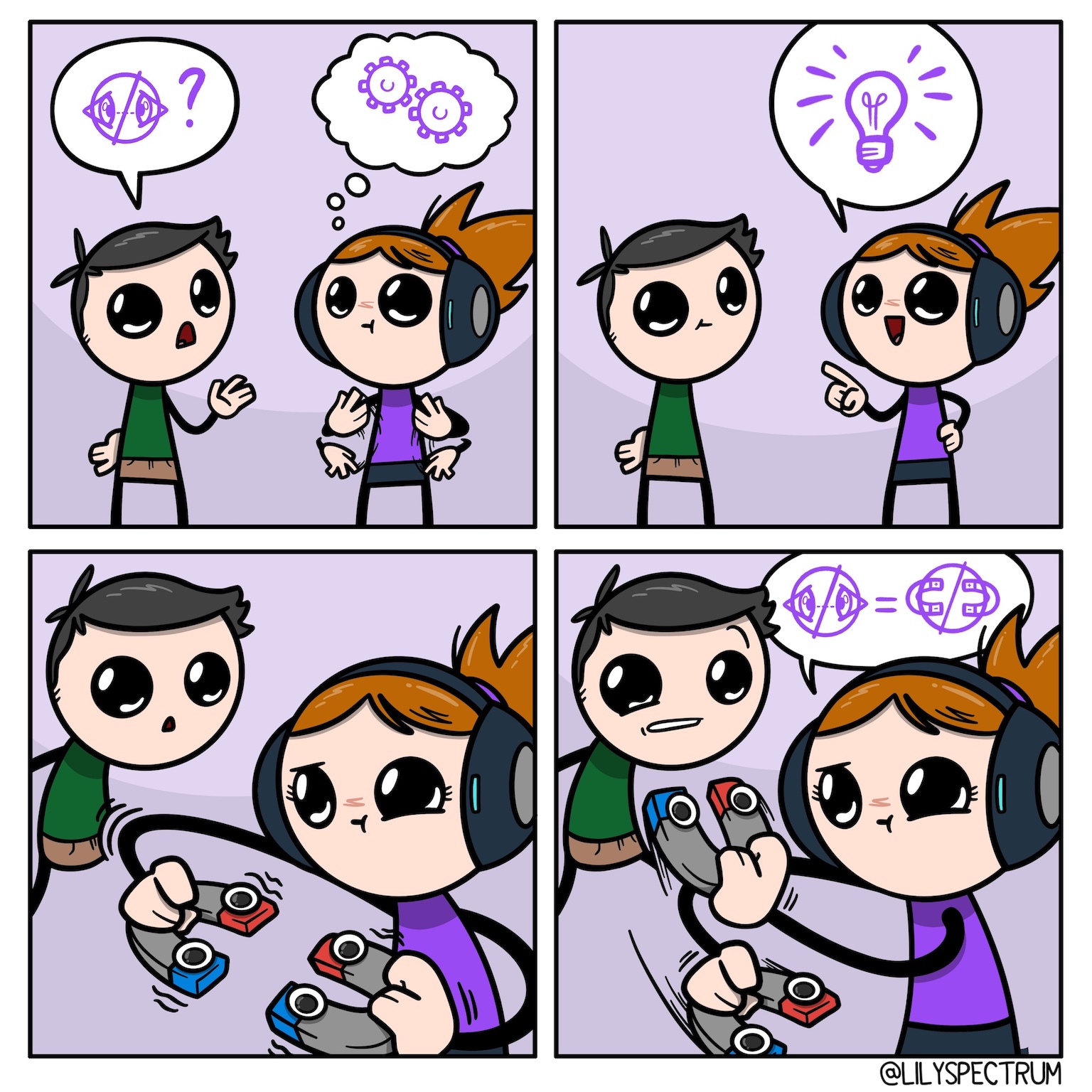
"When I was younger, it used to feel like when you held two magnets together both ends the same, it felt like no matter how hard you held them together, it would want to repel forcefully, my head wanted to repel and look past to the left or right or down or up like a magnet would, and when I managed to hold it against that feeling, my eyes would water up, not tears from sadness or anything, but they released tears, now I can manage it but it's still not comfortable to do, it depends on how comfortable I feel with the person or people or how stimulated I feel in an environment"
"It’s like when you hold two magnets with the same polarity against each other. Even if you want to put them together they won’t do it. The magnets are like my eyes. They just can’t center on the other persons eyes or it will cost a lot of energy. Like with holding magnets with the same polarity together. It’s just all in all very uncomfortable and draining. Btw I’m undiagnosed so I hope I can still answer here. Also I really really love your account and the stuff you do ^^ /g"
"Ça me met vraiment mal à l'aise et j'ai peur qu'on puisse mal interpréter si je regarde pas "correctement", je sais pas si je dois regarder quelqu'un dans les yeux ou combien de temps, il faut surtout pas que je regarde autre chose chez lui que ses yeux et du coup je sais pas quoi faire je préfère regarder le mur derrière mon interlocuteur 😂"
"Je me sens obligé de regarder chaque personne dans les yeux mais aussitôt que le contact est réciproque je baisse le regard aussi vite que mon ombre ainsi j'ai l'impression que j'ai fait ma part! haha! Par contre avec le monde avec qui je suis très, très à l'aise je vais quelque fois fixer les yeux, on dirait que j'essaie de comprendre pourquoi je fuis ceux des inconnus, alors je fixe en grand questionnement interne!"
"Awkward and physically painful , strong need to move my eyes away from it"
"Souvent trop intense… Et en plus il se passe tellement de choses autour des yeux qui m'intéressent plus et/ou me sécurisent plus! Je fixe puis je zappe, j'y reviens et je rezappe… Les sourcils, les lunettes, sont des bons compromis aussi, ou fixer mon regard dans le vague direction le visage ou le pourtour du visage… Ou fixer le visage avec une attitude très intéressée (posture corporelle de l'attention soutenue) quand la personne regarde AILLEURS, et quand son regard se tourne vers moi, fixer 1s seconde, sourire, et me tourner ailleurs vers qqn d'autre qui parle mais ne regarde pas vers moi à ce moment là, ou trouver à m'occuper avec un objet, et jongler comme ça."
"Je n'aime pas regarder sans les yeux, je ne sais pas, c'est plus fort que moi, je suis mal à l'aise, je ressens le besoin de regarder ailleurs. Du coup j'aime bien discuter quand je suis au resto ou quand on fait une activité, il y a l'excuse d'être occupée en même temps pour ne pas se regarder"
"Habituellement je regarde plutôt la bouche ou le nez des gens et ça semble passer crème pour donner l'illusion que je regarde dans les yeux (j'ai eu droit à l'expert en haute potentialité qui me disait que c'était impossible que je sois autiste car.. je le regardais dans les yeux ! Je regardais sa bouche depuis le début de l'entretien..). Je ne me force au contact visuel que de manière consciente et dans de rares cas précis : par exemple si je suis attiré romantiquement par quelqu'un et désire que cette personne le perçoive (vu que le contact visuel accru est interprété de cette façon par beaucoup de neurotypiques). Mais cela reste un sacré effort et en général je détourne les yeux très rapidement, ça me met mal à l'aise, c'en est presque physique. Récemment un de nos profs en cours nous a fait faire une série d'exercices où on devait marcher vers quelqu'un/revenir à sa place à reculons en gardant le contact visuel constant avec cette personne.. je vous laisse deviner la torture que c'était"
"Lorsque c'est quelqu'un avec qui je suis à l'aise ca va à une certaine distance mais de trop prêt je ressens un malaise assez vite. Si j'ai le malheur de croisé le regard avec un(e) inconnu(e) dans la rue ou dans un commerce, je regarde ailleurs aussitôt, gros malaise. C'est pour ça que j'évite de regarder les gens."
Thank you for joining us in this exploration!
We hope this experience was (and will be) as enriching for you as it was for us to come up with. We invite you to engage with us and the community through our posts or in the comments bellow!
На сайте https://evrocable.ru/ закажите кабельно-проводниковую продукцию от популярной компании, которая находится в данной сфере долгое время. Предприятие гарантирует безупречное качество продукции, привлекательные цены, а самое главное, что получится приобрести продукцию в любом количестве. В ассортименте вы найдете бронированные, силовые, контрольные кабели, а также луженые. Существует возможность доставки, но при желании можно забрать самостоятельно. Что касается стоимости, то на ее формирование влияет тип, сечение, а также маркировка.
At the same time, many antique
https://anotepad.com/notes/wss2q8hd
?Hola a todos!
He estado trabajando con un entrenador personal durante los ultimos seis meses, y queria compartir como realmente me ha ayudado a hacer algunos cambios importantes en mi vida.
Inicialmente busque coaching porque me sentia como si estuviera pasando por los movimientos en mi carrera, pero no estaba feliz o haciendo el progreso que queria.
Necesitaba claridad y orientacion, y eso es exactamente lo que obtuve.
Lo que mas me sorprendio es que el coaching tiene mucho que ver con la mentalidad. Mi coach me ayudo a cambiar mi forma de pensar, de estar abrumada y atascada a ver oportunidades y soluciones. No se trata solo de fijar objetivos, sino de descubrir como superar las barreras mentales que te frenan. Ahora tengo mucha mas confianza a la hora de tomar decisiones y actuo con coherencia para alcanzar mis objetivos. Tambien he mejorado mi conciliacion de la vida laboral y personal, algo con lo que he luchado durante anos.
Si has estado considerando el coaching personal para ayudarte a desbloquearte o progresar en cualquier area de tu vida, te lo recomiendo encarecidamente.
Es una gran inversion en ti mismo y te sorprendera todo lo que puedes conseguir con el apoyo adecuado. ?Alguien mas ha tenido una experiencia similar con el coaching? Me encantaria saber como te ha ayudado.
На сайте https://luxkatalog.ru представлена качественная, оригинальная спортивная одежда, парфюмерия, косметика, бытовая техника лучших брендов. Здесь находится только оригинал, наделенный такими важными характеристиками, как: длительный срок эксплуатации, надежность и практичность. Вы сможете заниматься спортом в такой одежде, бегать на улице и всегда ощущать себя превосходно. Одежда создана из инновационных и высокотехнологичных тканей, которые «дышат», отлично пропускают воздух и впитывают влагу. Парфюмерия, косметика лицензированные.
Женский портал https://tiamo.rv.ua с советами для красоты, здоровья, отношений и карьеры. Живите на полную с нашими рекомендациями!
Целью SB Cargo является обеспечение быстрого и законного прохождения таможенных процедур, а также эффективной организации международных перевозок для своих корпоративных клиентов.
Профессиональный сервисный центр по ремонту игровых консолей Sony Playstation, Xbox, PSP Vita с выездом на дом по Москве.
Мы предлагаем: ремонт игровой консоли
Наши мастера оперативно устранят неисправности вашего устройства в сервисе или с выездом на дом!
how to buy generic promethazine online
can i purchase generic suprax pills
Букмекерская контора Зенит предлагает вам широкий выбор спортивных событий и конкурентные коэффициенты. Зарегистрируйтесь сегодня и получите доступ к специальным бонусам и акциям, которые сделают вашу игру еще более увлекательной.
Женский блог https://ww2planes.com.ua полезные советы по стилю, уходу, здоровью и развитию карьеры. Всё для того, чтобы жить ярко и гармонично.
На сайте http://smartporog.ru изучите каталог для того, чтобы приобрести подходящий вариант выпадающих порогов. Автоматические пороги станут оптимальным вариантом при условии, если не получается произвести установку обычных вариантов либо в данном случае они считаются нежелательными. Перед вами огромное количество интересных вариантов, среди которых вы выберете решение для себя. Они идеально подходят для дверей различных типов. Такие пороги отлично убирают преграду в полу. Конструкции справятся со сквозняками, а также повысят звукоизоляцию.
Впадло смотреть …
the commercial analysis also considered the roadmap of each token and the opportunities of the future development of the kamala-harris.io, because they from time to time become catalysts for further growth.
Недорогие экскурсии в Шарм эль Шейхе цены и описание. В Каир, Луксор, на острова
Fresh video news, that’s worth watching, Outrageous video updates, that will amaze you, that captivate, Exciting video updates, Fantastic video updates, Enlightening video news, Interesting video updates, that spark interest, that everyone is talking about
myanmar all video news http://www.videonewsindex.com/optimizing-video-reviews-for-seo-success/ .
aviator casino
Лучшие идеи по изготовлению квадратных номеров, Топовые советы по изготовлению номеров в стиле квадрат
квадратные номера для легкового dublikat-kvadratnogo-nomer.ru .
finasteride 1mg buy us mail order
Ищете быстрый способ оформить деньги на карту? Мы предоставляем лучшие условия для быстрого получения.
can i get generic atarax without a prescription
Ножи для туризма и охоты с универсальными функциями — качественные модели для выживания
нож охотничий туристический http://www.klubnozhey.ru/ .
Жилищные споры являются одной из наиболее распространенных категорий дел в юридической практике, и их решение часто требует профессионального вмешательства. Неясности в документах, незаконные действия соседей или споры о праве собственности на жилье могут создать серьезные проблемы для граждан. В таких случаях на помощь приходит адвокат по жилищным проблемам, который обладает необходимыми знаниями и опытом для эффективной защиты интересов клиентов. Одним из основных направлений работы такого специалиста является анализ существующих документов и обстоятельств дела, что позволяет выработать стратегию дальнейших действий. Адвокат по жилищным проблемам может представлять интересы клиентов на разных этапах конфликта, будь то досудебное урегулирование или судебный процесс. Успех в разрешении жилищных споров во многом зависит от грамотности и профессионализма адвоката, который может убедительно аргументировать свою позицию и отстоять права клиента в суде. Важно помнить, что своевременное обращение к адвокату по жилищным проблемам может существенно сэкономить время и деньги, а также предотвратить усложнение ситуации. Разрешая споры, связанные с жилплощадью, следует руководствоваться не только правовыми нормами, но и принципами справедливости, что также является задачей квалифицированного юриста.
Если вам нужна помощь опытного юриста по жилищным вопросам вы ее найдете в этом источнике
Семейные споры — это сложные и часто эмоционально тяжёлые ситуации, которые могут возникнуть в процессе разрыва отношений, раздела имущества, определения местожительства детей и других аспектах семейной жизни. В таких делах важна не только юридическая грамотность, но и глубокое понимание человеческих эмоций и психологических факторов, которые могут в значительной степени повлиять на процесс разрешения конфликта. Обращение к юристу дела в семейном праве становится критически важным для защиты ваших интересов и обеспечения справедливого разрешения спора, поскольку квалифицированный специалист способен грамотно оценить обстановку, предложить оптимальные решения и представлять ваши интересы в суде. Кроме того, юридическая помощь поможет избежать множества ошибок, которые могут усугубить ситуацию и привести к нежелательным последствиям. Семейные споры, если их не обработать должным образом, могут затянуться на долгие месяцы или даже годы, нанося вред всем членам семьи, особенно детям, что обуславливает необходимость обратиться к юристу дела в семейном праве на самых ранних этапах конфликта. Защита ваших прав и интересов является ключевой задачей, и опытный адвокат не только обеспечит высококачественную юридическую поддержку, но и станет эмоциональной опорой в трудные времена, что крайне необходимо при решении семейных вопросах.
Если вам нужна помощь опытного адвоката по семейным делам мы всегда будем рады помочь вам.
not working
_________________
бесплатные игры в казино вулкан без регистрации в демо
https://lachica.ru/samye-vygodnye-tarify-mts-s-internetom-dlya-vseh-ustrojstv
безлимитный мобильный интернет мтс тарифы
ЖК Космо ЖК Теплые кварталы ЖК АСТРО все это строит неблагонадежный
застройщик Паритет Девелопмент. Он экономит на всем, строит некачественное жилье, отдел продаж нагло врет при продажах квартир. В городе Тюмени есть много порядочных застройщиков, а этот я бы никому не рекомендовал. @dontcheatpeople – телеграмм.
https://germiemagic.gumroad.com
?Hola a todos!
He estado trabajando con un entrenador personal durante los ultimos seis meses, y queria compartir como realmente me ha ayudado a hacer algunos cambios importantes en mi vida.
Inicialmente busque coaching porque me sentia como si estuviera pasando por los movimientos en mi carrera, pero no estaba feliz o haciendo el progreso que queria.
Necesitaba claridad y orientacion, y eso es exactamente lo que obtuve.
Lo que mas me sorprendio es que el coaching tiene mucho que ver con la mentalidad. Mi coach me ayudo a cambiar mi forma de pensar, de estar abrumada y atascada a ver oportunidades y soluciones. No se trata solo de fijar objetivos, sino de descubrir como superar las barreras mentales que te frenan. Ahora tengo mucha mas confianza a la hora de tomar decisiones y actuo con coherencia para alcanzar mis objetivos. Tambien he mejorado mi conciliacion de la vida laboral y personal, algo con lo que he luchado durante anos.
Si has estado considerando el coaching personal para ayudarte a desbloquearte o progresar en cualquier area de tu vida, te lo recomiendo encarecidamente.
Es una gran inversion en ti mismo y te sorprendera todo lo que puedes conseguir con el apoyo adecuado. ?Alguien mas ha tenido una experiencia similar con el coaching? Me encantaria saber como te ha ayudado.
where can i get cheap mobic tablets
big bamboo demo
big bamboo demo играть онлайн
can i get cheap nortriptyline online
Отечественный интернет-магазин “Мебель-шмммммммебель” призывает широченный запас мебели для кухонь. ЯЗЫК нас вы обнаружите шиздец нужное для образования уютного да функционального экстерьера https://tyfapao6kuhnishki.ru.
Le code promo 1xBet 1XLIVE777 pour profiter de l’offre 100% VIP Bonus pour 2024 jusqu’a 130€ sur les paris sportifs ou de 1950€ + 150 tours gratuits. Ce code bonus special vous permettra de recevoir un bonus majore lors de votre inscription sur le site du bookmaker 1xBet.com ! Examinons les subtilites du programme de bonus du bookmaker 1xbet. Quels sont les codes promotionnels, quels types de bonus sont disponibles aujourd’hui pour les joueurs qui ont choisi la plateforme de jeu de ce bookmaker pour les paris sportifs.
Code Promo 1xBet
1XLIVE777
Promotions 1xBet en 2024 ? Codes Bonus et codes Promotionnels ? bonus de Pari gratuit pour l’inscription.
Le code promo 1xBet 2024: 1XLIVE777 Utilisez le code bonus lors de votre inscription et beneficiez d’une offre VIP de 100% jusqu’a 130€ sur les paris sportifs ou de 1950€ + 150 tours. Bonus de bienvenue qui augmente votre mise d’un montant de 100% du montant du depot. Dans cet article, nous vous expliquerons comment vous inscrire correctement a 1xBet et obtenir le bonus maximum et jouer gratuitement aux frais du bookmaker 1xbet. Vous pouvez obtenir de l’argent gratuit si vous utilisez un code bonus secret qui active toutes les promotions.
Parier sur le sport ou jouer dans un casino en ligne-vous pouvez gagner beaucoup d’argent, nous tenons donc a vous avertir a l’avance: jouez de maniere responsable, le jeu n’est qu’un divertissement, pas un moyen de gagner de l’argent. Seuls les adultes peuvent jouer sur le site, l’administration peut verifier les documents.
Pour beneficier des avantages reels du code promo 1xBet, suivez ces etapes :
Rendez-vous sur le site Web du bookmaker et inscrivez-vous ;
Apres avoir rempli le questionnaire, saisissez le code promo 1xBet : 1XLIVE777 ;
Choisissez le type de bonus de bienvenue, que ce soit pour les paris sportifs ou pour le casino ;
La plupart des gens choisissent de parier sur le football, car il est populaire partout dans le monde, mais aussi beaucoup de gens aiment jouer dans les casinos ou les machines a sous. Vous choisissez les jeux auxquels vous voulez jouer, nous ne pouvons que vous dire quels jeux les gens gagnent le plus souvent, et vous deciderez vous-meme de les jouer ou non.
1xBet est un bookmaker de renommee mondiale ou vous pouvez trouver des offres de bonus et des promotions en especes. Le bookmaker offre a ses clients un large eventail de recompenses sous forme d’argent gratuit. Les offres de bonus ne seront recues qu’apres la fin du processus d’inscription et le depot initial de l’utilisateur. Nous parlerons de toutes les offres populaires qu’ils proposent.
Code Promo 1xBet 2024 — Bonus Jusqu’a 130€/$
Le code promo 1xBet aujourd’hui utilisez ce code et vous recevrez Bonus Casino 1xBet Jusqu’a €1500. Bonus de bienvenue qui augmente votre mise d’un montant de 100% du montant du depot. Dans cet article, nous vous expliquerons comment vous inscrire correctement a 1xBet et obtenir le bonus maximum et jouer gratuitement aux frais du bookmaker 1xbet. Vous pouvez obtenir de l’argent gratuit si vous utilisez un code bonus secret qui active toutes les promotions.
1xBet est devenu synonyme de variete et de generosite. Le casino de renommee mondiale offre a ses joueurs une grande variete de jeux ainsi que des promotions et des bonus lucratifs. Chaque jour, le casino presente aux joueurs une promotion” Jeu du jour”. Ceux-ci sont devenus de plus en plus populaires parmi les visiteurs de 1xBet et sont tres gratifiants.
Pour obtenir vos tours gratuits sur 1xBet, il vous suffit de vous inscrire et de fournir les informations requises pour que votre compte soit ouvert. Vous devrez ensuite choisir de participer aux bonus proposes. Vous serez ravi non seulement a cause des tours gratuits, mais aussi parce que le site propose une grande variete de jeux et une experience de jeu mobile exceptionnelle.
1xBet s’est concentre sur la croissance de sa marque dans de nouveaux pays afin de devenir un nom mondial avec une excellente reputation de fiabilite et d’equite. Ils ont rapidement consolide cette reputation non seulement parmi les visiteurs, mais aussi parmi leurs collegues et autres geants de l’industrie. Ils ont remporte plusieurs prix au fil des ans. Pour les joueurs a la recherche de la meilleure solution de jeu en ligne, 1xBet est un choix fantastique.
Meilleur code promo 1xBet valide en ce moment, pour profiter du bonus de bienvenue jusqu’a 100€ offert aux nouveaux membres pour parier sur le sport. Tout, des jeux aux promotions, en passant par les marches de paris, les cotes et la convivialite, a ete pris en compte. Sans oublier l’equipe d’assistance reactive et competente dans plus de 30 langues.
Le casino peut etre communique avec plus de 60 langues. C’est l’un des menus linguistiques les plus inclusifs de tous les casinos en ligne aujourd’hui. Pour augmenter encore la disponibilite et la flexibilite, la plate-forme acceptera les transactions financieres en utilisant encore plus de devises qu’il n’y a de langues. Ils acceptent a la fois la crypto et la monnaie fiduciaire.
Code promo 1xBet 200, utilisez le code bonus pour obtenir un bonus de 100%. Lors de votre inscription, entrez ce code et recevez un bonus pouvant aller jusqu’a 130$. Il est generalement admis que les codes promotionnels constituent le moyen le plus simple et le plus abordable d’obtenir des bonus aupres d’un bookmaker. Et c’est gratuit ! En pratique, c’est vrai. Apres avoir recu un code gratuit, le joueur beneficie en retour de certains avantages et preferences.
Afin d’obtenir des fonds de bonus jusqu’a 130€, vous devez faire un premier depot, de preference pour le meme montant. Le montant du depot depend directement du compte bonus. Par consequent, plus vous faites le montant du depot – plus vous obtenez de bonus de la societe. Afin de ne pas manquer votre chance, vous devez respecter strictement les regles de l’entreprise et respecter toutes les conditions de la Promotion.
Code promo 1xBet 2024 – Profitez des maintenant d’un bonus pouvant aller jusqu’a 130€. Inscrivez-vous sur 1xBet et creez un compte pour beneficier d’un bonus de 100%. En utilisant le code promotionnel de pari 1xBet, vous recevrez une prime de bienvenue exclusive et plus elevee – jusqu’a 130$ (ou l’equivalent dans une autre devise) – la prime standard etant limitee a 100$.
Bookmaker 1xBet sont populaires dans de nombreux pays. Beaucoup ont entendu parler de l’action en Algerie, au Congo, en cote d’Ivoire, en Ouganda et dans d’autres pays d’Afrique. Les fans de jeux de hasard peuvent facilement parier sur diverses competitions sportives et ont egalement la possibilite de jouer dans les casinos en ligne. Mais ce n’est pas la limite de la possibilite pour les joueurs, car la marque 1xBet a developpe une large liste de differentes offres de bonus pour ses clients.
Code de promo 1xBet 2024, vous permet de beneficier d’un bonus sportif VIP de 100% jusqu’a 130 €/$, en plus du bonus de bienvenue standard de 1950$ et de 150 tours gratuits au casino. Cette offre est egalement valable dans la monnaie de votre pays.
Le code promotionnel 1xBet est un element pratique de la prochaine offre promotionnelle, dans le cadre de laquelle le bookmaker 1xBet offre a ses nouveaux clients une partie supplementaire de bonus. Des le debut d’une nouvelle promotion, le prochain lot de codes promotionnels devrait etre libere. Rendez-vous sur le site Web de 1xBet, inscrivez-vous et commencez a jouer. N’oubliez pas d’utiliser le code promotionnel 1xBet lors de votre inscription, ce qui vous permettra de beneficier d’autres avantages et preferences en plus des principaux bonus.
Code promo 1xBet, vous pouvez beneficier d’une offre VIP de 100% jusqu’a 130€ sur les paris sportifs ou de 1950€ + 150 tours, garantissant ainsi le bonus maximum. Aucun autre code 1xBet ne vous permettra d’obtenir de tels avantages. Veuillez noter que le nombre de codes promotionnels disponibles est limite selon les conditions de la promotion.
Immerse yourself in nonstop action and rewards with Taya365, a top choice for online gaming.
26 best lesbian movies movies with lesbian characters
http://absolutelyfreeonlinedating.hotnatalia.com/?kacie-kiara
pissing in diaper porn cum hate porn ashton moore porn videos porn videos in toronto porn video xxnx
Elevate your gaming experience at taya365, where cutting-edge features and fun await.
https://list.ly/list/Aqz6-monton-de-objetivos-flotando-y-ayuda-de-coach-personal#item_10297038
?Hola a todos!
He estado trabajando con un entrenador personal durante los ultimos seis meses, y queria compartir como realmente me ha ayudado a hacer algunos cambios importantes en mi vida.
Inicialmente busque coaching porque me sentia como si estuviera pasando por los movimientos en mi carrera, pero no estaba feliz o haciendo el progreso que queria.
Necesitaba claridad y orientacion, y eso es exactamente lo que obtuve.
Lo que mas me sorprendio es que el coaching tiene mucho que ver con la mentalidad. Mi coach me ayudo a cambiar mi forma de pensar, de estar abrumada y atascada a ver oportunidades y soluciones. No se trata solo de fijar objetivos, sino de descubrir como superar las barreras mentales que te frenan. Ahora tengo mucha mas confianza a la hora de tomar decisiones y actuo con coherencia para alcanzar mis objetivos. Tambien he mejorado mi conciliacion de la vida laboral y personal, algo con lo que he luchado durante anos.
Si has estado considerando el coaching personal para ayudarte a desbloquearte o progresar en cualquier area de tu vida, te lo recomiendo encarecidamente.
Es una gran inversion en ti mismo y te sorprendera todo lo que puedes conseguir con el apoyo adecuado. ?Alguien mas ha tenido una experiencia similar con el coaching? Me encantaria saber como te ha ayudado.
can i order cheap gabapentin without prescription
can you get celebrex without a prescription
Важным вопросом при планировании работ является согласование перепланировки помещений в Москве стоимость. Цена зависит от сложности проекта и объёма работ, требующих согласования. Мы предлагаем прозрачные цены и полный спектр услуг, начиная с разработки проекта и заканчивая получением разрешительных документов. Наши специалисты помогут вам оценить бюджет и оптимизировать затраты.
не работает сайт blacksprut – блэкспрут зеркало рабочее, blacksprut com ссылка
Конечно. Это было и со мной. Давайте обсудим этот вопрос.
Использование фотоматериалов сайта без письменного разрешения Играть онлайн редакции запрещено. многие новички казино ищут не абсолютно объяснимое желание и способ играть в проверенные слоты удаленно, а гарантию большого приза.
aviator hack
блэкспрут официальный сайт – black sprut, blacksprut площадка
Ищите качественные финансовые услуги? Посетите dengibyn и получите подробности.
Для того чтобы согласовать перепланировку здания, необходимо пройти несколько этапов, начиная с разработки проекта и заканчивая получением разрешений. Мы предлагаем полный комплекс услуг по подготовке документов, взаимодействию с инстанциями и юридическому сопровождению на каждом этапе процесса. С нашей помощью ваш проект будет реализован законно и в установленные сроки.
Познакомьтесь раз-два нашим профессиональным коллективом, который созидает чудесную мебель, воплощая ваши мечтания на явь https://www.cehitae2kuhnishki.ru.
Easy Payments https://easypayments.online/ – это возможность предпринимателям из СНГ масштабировать онлайн бизнес. Открываем компании за рубежом, даем возможность получить доступ к международным банкам, платежным системам и другим зарубежным сервисам. Посетите наш сайт – узнайте о наших услугах или получите бесплатную консультацию. Гарантированная легальность.
SB Cargo – таможенный брокер, предоставляющий комплексные услуги по таможенному оформлению грузов. Компания помогает клиентам проходить все этапы таможенного декларирования, включая подготовку документации, расчет пошлин и взаимодействие с таможенными органами.
how can i get generic tadacip
https://atavi.com/share/wwi0wkz44atg
Hola a todos!
Queria compartir mi experiencia con los servicios de consultoria en recursos humanos que hemos implementado en mi empresa, y como nos ha ayudado a mejorar muchos aspectos. Somos una empresa mediana en crecimiento, y a medida que contratabamos mas personal, nos dimos cuenta de que nuestros procesos de RR.HH. no estaban tan organizados como deberian. Ahi es cuando decidimos recurrir a una consultoria en recursos humanos para que nos apoyaran con la gestion.
Lo que mas nos ha ayudado ha sido la optimizacion del proceso de contratacion y el desarrollo de un sistema de evaluacion de desempeno mas efectivo. Tambien nos ayudaron a alinear nuestras politicas de beneficios con las expectativas de nuestros empleados, lo que mejoro la satisfaccion del equipo. Ademas, la consultoria nos ayudo a estar al dia con el cumplimiento de las normativas laborales, algo que siempre nos generaba preocupacion.
Si estan buscando mejorar la gestion de personal, la contratacion o el cumplimiento de normativas, les recomiendo mucho considerar una consultoria en recursos humanos. Nos ha permitido enfocar nuestros esfuerzos en areas estrategicas de la empresa mientras los expertos se encargan de los aspectos mas complejos de los recursos humanos.
Alguien mas aqui ha trabajado con consultores de RR.HH.?
Me encantaria saber como les fue y que beneficios notaron!