"Neurodiversity through Webcomics: Using Aesthetic Experiences for Epistemic Resistance"
At the heart of the ideas proposed in today's panel is that of epistemic enablement through trajectories other than propositional, which can be offered by aesthetic experience.
PANEL
"Dancing Toward Epistemic Justice: An Embodied Account of Epistemic Agency"
Amandine Catala and Camille Zimmermann covered the example of dance, an embodied account of epistemic enablement.

PhD Candidate - Philosophy (UQAM)
Camille Zimmermann
zimmermann.camille@courrier.uqam.ca

Professor - Philosophy (UQAM)
Amandine Catala
catala.amandine@uqam.ca
"Comics and Epistemic Enablement"
Luc Faucher discussed the medium of comics in the context of neurodiversity, again as epistemic enablement.
Professor - Philosophy (UQAM)
Luc Faucher
"Neurodiversity through Webcomics: Using Aesthetic Experiences for Epistemic Resistance"
We now continue with webcomics.

PhD Candidate - Philosophy (UQAM)
Mylène Legault
legault.mylene.2@courrier.uqam.ca

PhD Candidate - Philosophy (UQAM)
Jean-Nicolas Bourdon
bourdon.jean-nicolas@courrier.uqam.ca
PREFACE
About the
Format
Force of habit leads us to take the established ways of doing things as fixed, even though they are circumstantial. We were able to explore this reality, for example, during the pandemic: going to the office for work meetings, which, in all honesty, could have been e-mails. We also know that cultural habits are not insignificant, they allow the reproduction of comfortable modalities of interaction for dominant groups: those with the power to choose these modalities.
For our part of the panel, we propose to do things differently. Don't worry, we're not criticizing power point presentations and their timely sip of water pauses. Instead, we're inviting you to explore an alternative modality for interaction.
Public Speaking
Many people hate public speaking. It generally comes with discomforts and even fears, but some people have cognitive profiles that function in ways far removed from this type of interaction. However, this practice is socially maintained and considered essential for meeting and sharing. But is it really necessary? Does the public space absolutely have to be occupied in an oratory and synchronous way? What if these modalities are, in fact, infused with neuronormativity?
Human society is permeated by collective cultural resources with which individuals can, among other things, interpret, understand and communicate various aspects of their experiences. Since they are collective resources, their genesis, maintenance and dissemination are a function of the power dynamics that permeate our societies. One of these power dynamics is organized around norms regarding what is considered appropriate cognitive functioning: the group whose cognition corresponds to the norm (i.e., neurotypicals) dominates and those whose cognition deviates from the norm (i.e., neurodivergent) are marginalized. This epistemic marginalization has the effect of limiting the access of neurodivergent individuals to so-called "collective" epistemic resources, both in their elaboration and in their use.
This norm corresponds to neuronormativity, which is presented by Amandine Catala, Luc Faucher et Pierre Poirier (2021) in their paper Autism, epistemic injustice, and epistemic disablement: a relational account of epistemic agency.
Neuronormativity refers to the prevalent, neurotypical set of assumptions, norms, and practices that construes neurotypicality as the sole acceptable or superior mode of cognition, and that stigmatizes attitudes, behaviors, or actions that reflect neu- roatypical modes of cognition as deviant or inferior. Neuronormative assumptions, norms, and practices uphold standards regarding, for example, (what is neurotypi- cally considered) appropriate eye contact, facial expressions, prosody, conversa- tional flow, processing, and responsiveness—all of which can be difficult for autistic individuals to understand, sense, or apply, due to neurocognitive differences. (Catala & al., 2021)
Catala, A., Faucher, L. & Poirier, P. Autism, epistemic injustice, and epistemic disablement: a relational account of epistemic agency. Synthese (2021).
For a presentation on these questions, see Epistemic justice and epistemic authority on autism, Philosophy of Psychiatry Webinar, Montreal (Amandine Catala)
What’s with all these neuro- words?
Neurodiversity can refer to the neurological or neurocognitive variation naturally present in the human population. The term was first introduced by Judy Singer in a book published in 1993. The term also refers to a growing sociopolitical movement that promotes the recognition and inclusion of natural neurocognitive diversity (see, for example, Autistic Self Advocacy Network (ASAN), whose slogan is "Nothing About Us Without US!").
Nick Walker (2012) describes the neurodiversity movement as a new paradigm (the neurodiversity paradigm) in response to the pathology paradigm. It should be noted, however, that this movement has not been and is not immune to certain exclusionary mechanisms. For example, the movement began with verbal autistic individuals, but although the movement has since expanded to include many cognitive profiles, autistic individuals (and more recently ADHD individuals) still seem to dominate the movement.
Walker, N. (2012). Throw away the master's tools: Liberating ourselves from the pathology paradigm. Loud hands: Autistic people, speaking, 225-237.
Some progress can also be noted with the recent publication of "Neurodiversity Studies: A New Critical Paradigm" (Rosqvist et al., 2020), which illustrates the growing acceptance of this sociopolitical movement by the scientific community.
Rosqvist, H. B., Chown, N., & Stenning, A. (2020). Neurodiversity Studies: A New Critical Paradigm. Routledge.
Refers to individuals who fit the norm of cognitive functioning.
Neurodivergence belongs to a normative vocabulary. It requires a norm, which can be qualitative or quantitative, to distinguish typical from atypical neurocognitive profiles among natural neurological variation. However, the narrative is not so simple; cognition is a complex and dynamic process, and simply distinguishing between neurotypical and neuroatypical individuals shapes, at least in part, the cognition of those same individuals. Note that these criteria, quantitative or qualitative, are generally chosen for medical, practical, economic or moral reasons: because a type is considered "more functional", "more adapted, evolutionarily", "easier to interact with", "less demanding in resources" more characteristic of a human life worth living", etc.
Refers to individuals who do not fit the norm for cognitive functioning.
For those who are curious, we address these "neuro- words" here :
- Legault, M., Bourdon, J. & Poirier, P. (2021). From neurodiversity to neurodivergence by way of epistemic marginalization, Epistemological Issues in Neurodivergence and Atypical Cognition. Synthese.
- Legault, M., Bourdon, J. & Poirier, P. (2019) Neurocognitive variety in neurotypical environments: the source of “deficits” in autism, Journal of Behavioral and Brain Science (JBBS), vol.9, 246-272.
This is all well and good in theory, but what does it have to do with our presentation?
What we are trying to say - probably with too many words - is that those with cognitive profiles similar to ours tend to feel unsafe in traditional academic frameworks. This very presentation is the perfect opportunity to experiment with an alternative format where we can occupy the epistemic space and exist as we are. When the parameters of a common space of exchange only correspond to one type of cognitive profile, neurotypical profiles in this case, there can hardly be any exchange that is fair and inclusive. Our hope is that offering this alternative might open this type of space to those who remain outside the exchange.
Although this is an aside before we get into our main topic, you will notice that the form of our presentation reproduces our subject: the online viewing of webcomics, that is, asynchronous interactions around a shared representation, or the infamous content.
What a great question! Of course. If we have different cognitive and processing profiles with different modalities of expression, we can expect adjustments in synchronicity. Strategies for better epistemic justice include suspending judgment, giving the time, respecting varied forms of exchange and being open to different modalities of exchange.
Feel free to contact us for any comments and input into this exploration:
legault.mylene.2@courrier.uqam.ca
bourdon.jean-nicolas@courrier.uqam.ca
PART I

This is Marc, stand in for the author: Yvon Roy
This is his son, Olivier, who is autistic.
Les Petites Victoires showcases the fight of a father for his son, diagnosed with autism "in order to transform an announced defeat into small victories" (sic, our translation).
In his preface, Roy explains the contextualises the creation of his comic book:
"The idea was first suggested to me by a special educator who had worked with my son. She thought that what we had accomplished together was worth sharing so that other parents could find, through our experience, some useful information, if not a little hope" (our translation).
Interview
"When I started working with my boy to help him, with all the professionals in the field, I realized that often we were told, or they tried to tell us, that we had to work on living with autism, on accommodating autism. How we had to deal with different crises, different problems, whereas I thought, well, no, it's better, definitely, to try to overcome it than to live with it. And that's been kind of my master idea, let's say, for years with my boy, which is to try to push the boundaries constantly, always further." (Our translation)
Why choose this comic book?
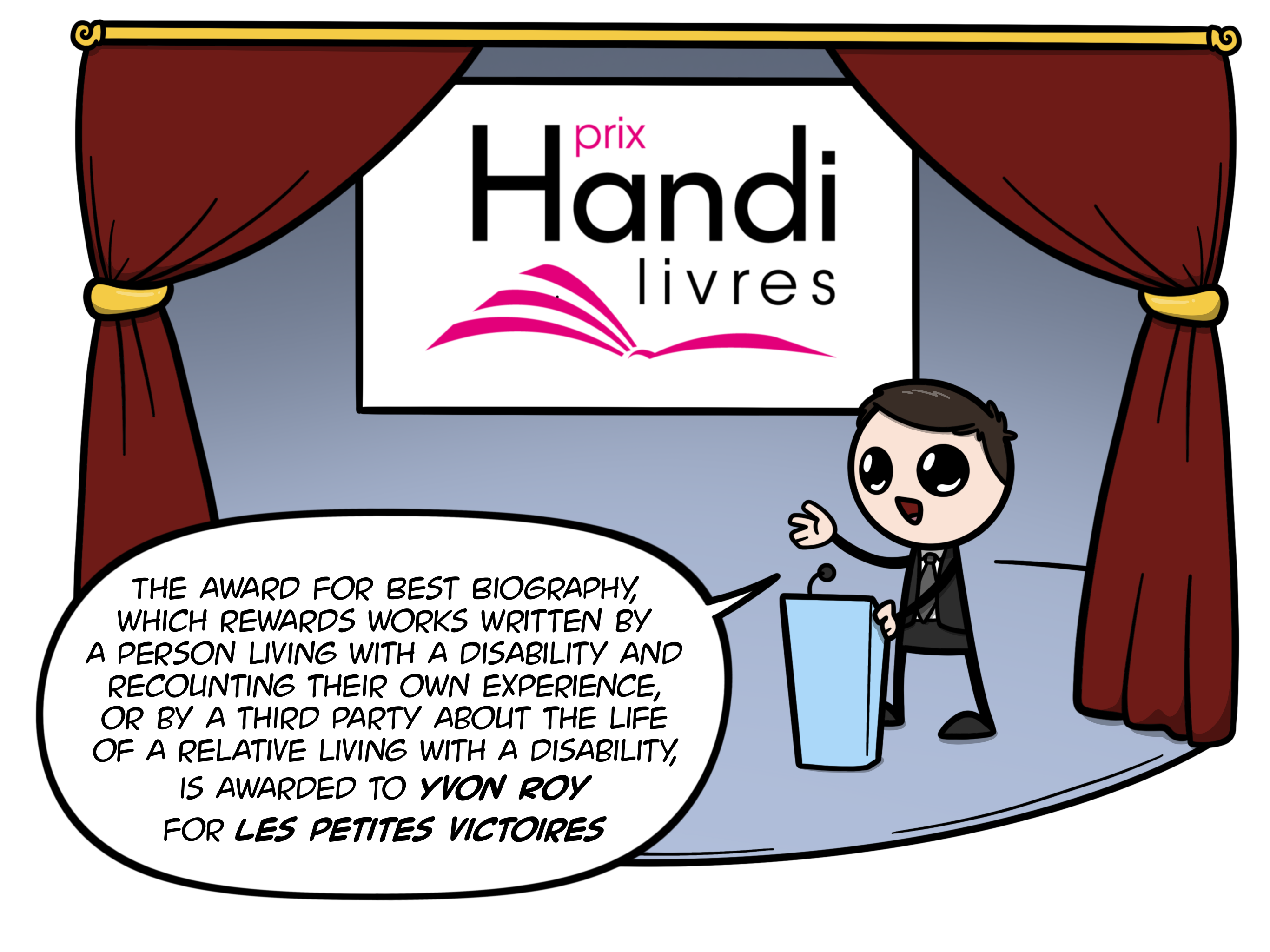
This comic book is an example of a creation that is easily accessible to the general public that has been awarded and highly publicized - even winning an award that recognizes works written by a person living with a disability and recounting their own experience, or by a third party about the life of a relative living with a disability. In 2018, the publisher Rue de Sèvres announced a contract for a film adaptation, which caused reactions and led to the hashtag :
#boycottlespetitesvictoires
As we will show, this is an example of the social representations of autism that perpetuate dominant understandings that do not fit the lived experience of those directly concerned to the point of being discriminatory. It is also difficult to identify moments when the child (the autistic character) shows agentivity. Instead, he’s passive in his father’s story. In a way, Olivier is only a supporting character. This is exaclty why representation doesn't mean autorepresentation and why "nothing about us whitout us" matters: although this comic is presented as a positive narrative from the allist perspective (3rd person), the story is completely different from the standpoint of the autistic community’s testimonies (1st person).
An allist person is a non-autistic person.
To understand the term "allist", we must go back to the origin of the word "autistic" which comes from the Greek word "autos" which means "self". So the word "autistic" initially referred to a person withdrawn on themself, who lives in their own world. The term "allist" appeared in a satirical article to refer to non-autistic people by swaping “autos” for "allos" which refers to others. So an allist is a person who is focused on others or, to flip the usual narrative, a person who lives in other people’s worlds.
In spite of the satire, the term “allist” has remained in use among others because it allows to distinguish between "neurotypicals" and "allists". There are people who are not autistic, but who are not neurotypical: a non-autistic dyslexic person, for example.
For a deconstruction
of the problematic propositions of the comic book:
But do you know the story from the autistic community’s perspective?
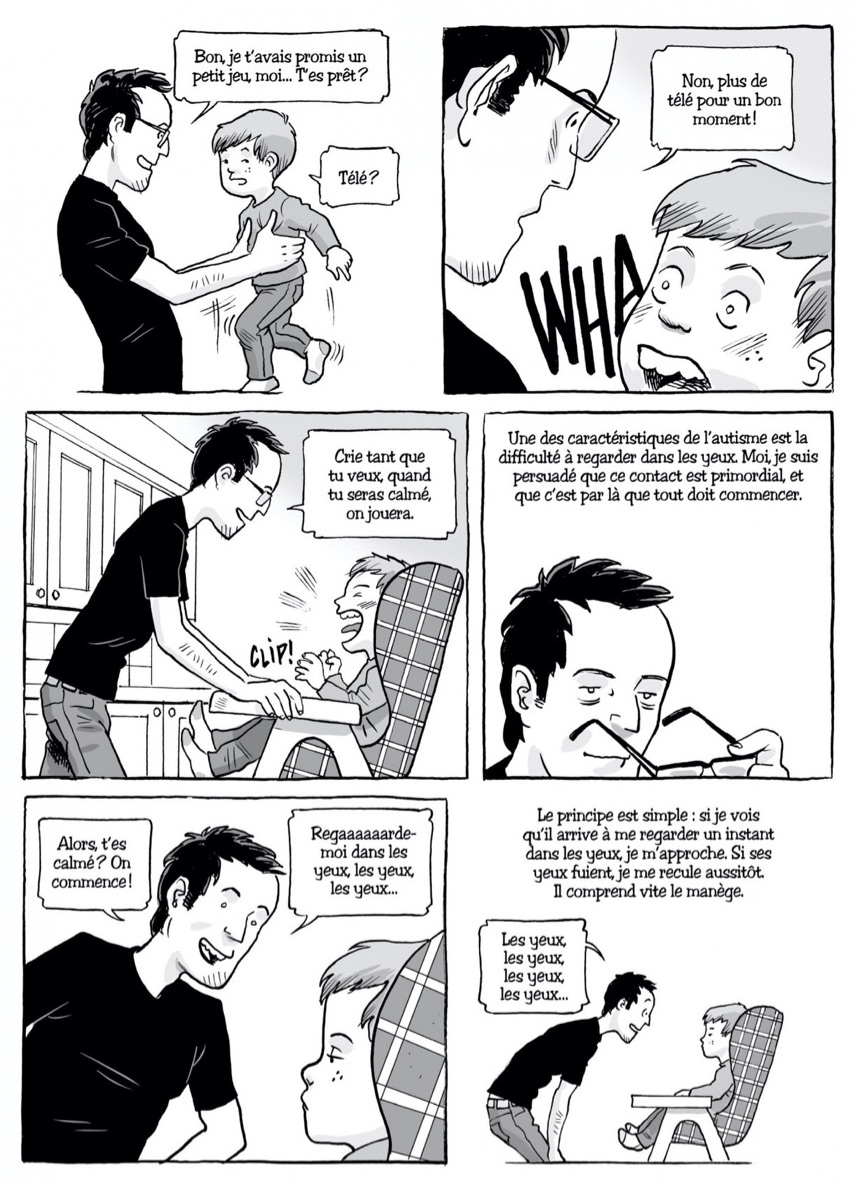
This is where webcomics can serve as an accessible tool that allows the reversal of dominant representations by opening the floor to self-representations directly grounded in marginalized communities. But before continuing with the topic of webcomics, we wish to feature an excerpt from Les Petites Victoires that addresses a frequent theme in autism: eye contact.
Excerpt on eye contact
English translation
English translation
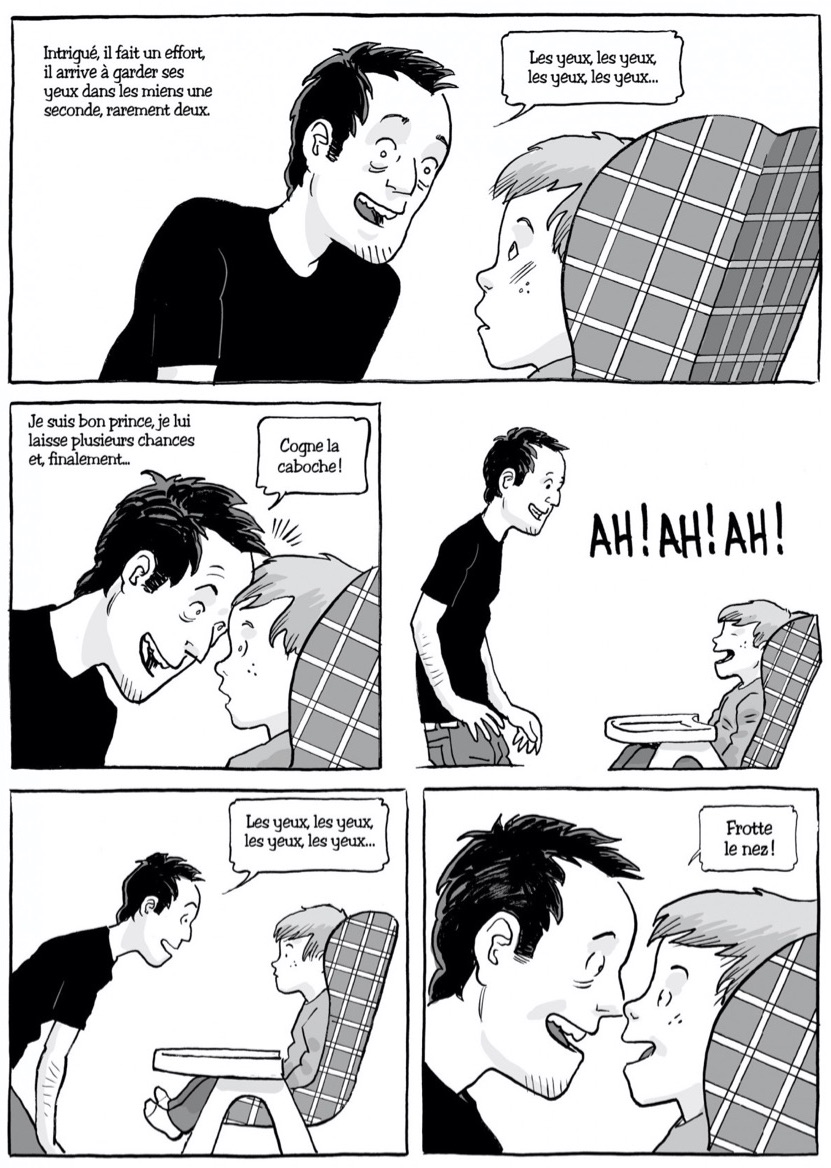
Excerpt from Yvon Roy's interview
"I worked a bit like we can work to sometimes desensitize a substance. Sometimes certain people can have an allergy, we can try to desensitize them.
Several parents have contacted me regarding the trick to get the child to look in the eyes. This is the first thing we worked on together, that is to say, I considered that being able to look in the eyes - we know that autistic children have difficulty looking directly in the eyes - I said to myself, if we don't have eye contact, we have nothing. We need that, it's the beginning of human interaction." (our translation)
TW: The host uses the term “prison” in reference to autism:
"In your story that you shared with us in Les Petites Victoires, there is obviously the moment when you get up to face, to accompany your child in that reality: to learn to understand him too, inside what he lives and this prison, in a way, from which he is pressured which is basically this condition." (our translation)
Link to the interview (in French)


This scene is an example of neuronormativity
Recall that neuronormativity is the prevalent, neurotypical set of assumptions, norms, and practices that conceives of neurotypicality as the only acceptable or superior mode of cognition, and that stigmatizes attitudes, behaviors, or actions that reflect atypical modes of cognition as deviant or inferior.
This scene is told from the allist perspective and is presented with a positive outcome. In fact, as the author mentions, parents have applied this technique with their autistic children after being inspired by it.
But what if we ask autistic people how they feel about eye contact? That's exactly what we are going to do.
PART II

Why webcomics?
The medium of webcomic enables me to do something I don't know how to do otherwise: share how things feel on the inside.
Imagine. You come across a newspaper at the local coffee shop and recognize the face of a well-known personality. Yet you can't remember their name. It annoys you, you know you know it, it’s just not coming out, it stays there, on the tip of your tongue. You have time to come back to work, coffee in hand, and the name still hasn't come back to you, it still annoys you. You come across a colleague and you ask them, you describe the person, maybe clumsily at first (it would be so much easier with their name!), but you adjust to your interlocutor and, together, you can finally recall their name, it was so obvious!
It’s important to emphasize this feeling of annoyance. We rarely take the time to mention this annoyance when talking about epistemic injustices. Yet it is there, and it can even be painful: how do we make sense, to use Fricker's classic example, of our experience of sexual harassment when the concept does not yet exist? How can we share the feeling that something is wrong? This is where community comes into play and it is why the idea of "by and for" matters more than, say, a criterion of simplicity might. This is addressed by feminist epistemologies: for example, Longino argues for pragmatic values in science such as diffusion of power (as the importance of making research programs accessible to the actors involved in the research).
The impact of inadequate social representations on neurodiversity cannot be fully resolved by the traditional narrative of epistemic oppression and justice: adding new vocabulary to collective epistemic resources is not a panacea (we already have the word "autism" for example). So it is not only words that are missing, but rich and diverse lived experiences are also missing from the pool of shared resources.
The problem is that what is missing, the hermeneutical gaps, are not automatically apparent: social representations created by and for the dominant groups inadequately fill the hermeneutical gaps of marginalized groups. To that effect, let us recall here the Handi-Livre prize for the best biography which rewards works written by a person with a disability and telling his or her own experience, or by a third party on the life of a close relative with a disability: In the case of Les Petites Victoires, the award went to the biography of an allistic (non-autistic) person talking about autism. These inadequate social representations are difficult to resist: they are constantly and persistently reproduced. It is even harder when you don't have the words to replace theirs. But do we really have to wait for the right words to share our experiences? This is where illustration can become an attention grabbing action like shouting: an action that does not need words. This is what we propose here: a form of non-propositional epistemic resistance in response to hermeneutic injustice.
Webcomics are basically online comic books. They are mostly instantiated as short comics that take many forms and cover many topics. The most common form of webcomic is probably the blog (sometimes autobiographical, sometimes entirely fictional, sometimes both). Because they are mostly published independently by their artists, webcomics are an art form that is not limited by institutionalized power dynamics such as publishing houses or art galleries.
But the most important thing for us here is that webcomics are able to generate aesthetic experiences that allow viewers to better understand different aspects of the lived experience of neurodivergent people despite the inadequacy of mainstream epistemic resources.
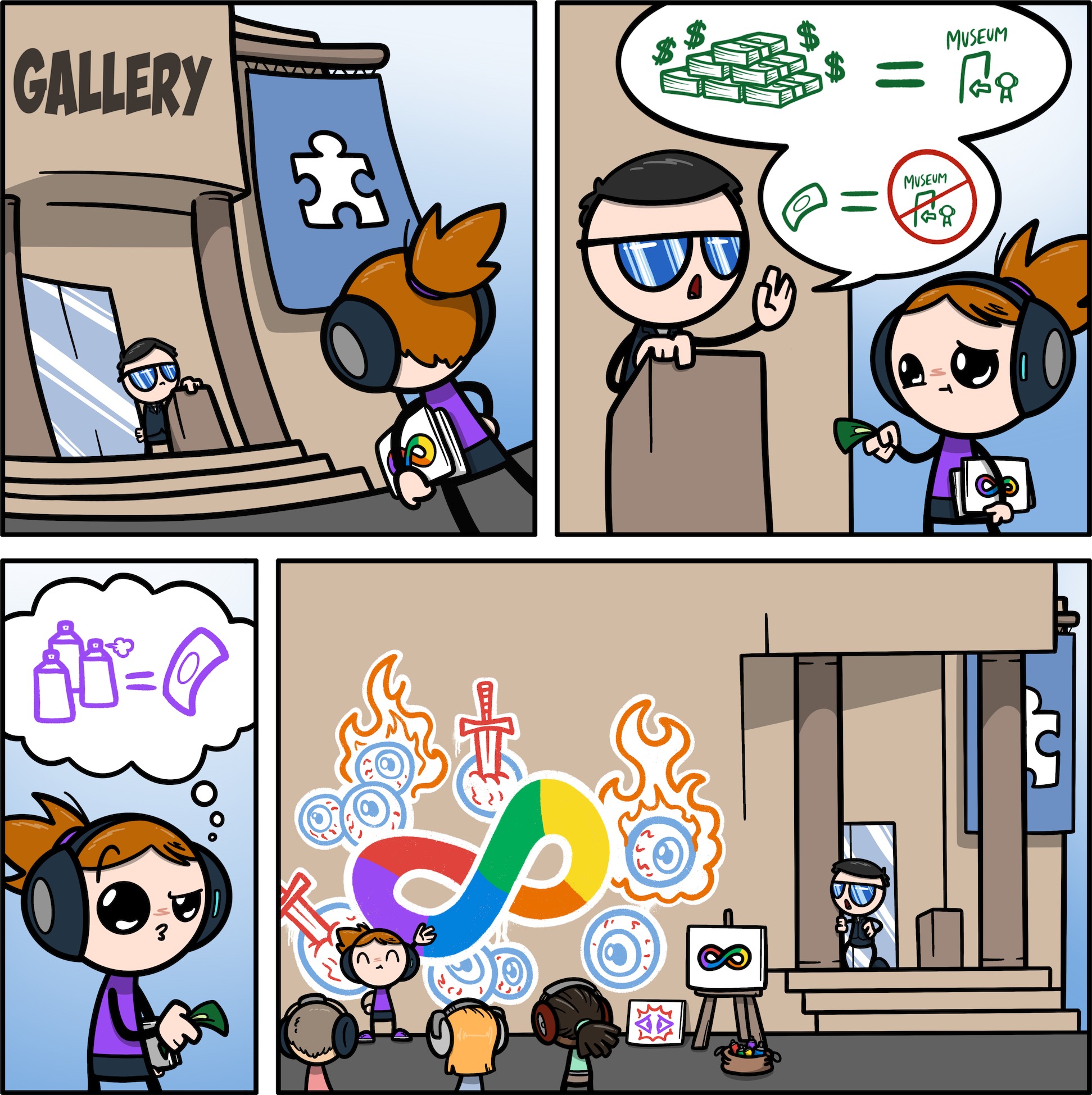
In some ways, webcomics are a digital version of street art.
Although limited to a given geographical space for street art and to a particular digital platform for webcomics, there is this common idea where it is not so much the public that goes to the creation as the creation that goes to the public. We are no longer in a reserved and predefined space like a museum, a bookstore, a gallery or even a library.
Although a recognized artist can make street art, it is more difficult for an artist who does not belong to a complex and influential network to access some places of diffusion such as an art gallery. Webcomic is thus added to the tools that allow the production, use and transmission of more accurate social representations, participating in the collective understandings of the oppressions suffered by epistemically marginalized groups. The public and interactional aspects of social media that support webcomics make them a catalyst for direct dialogue with (but also within and between) marginalized communities.
To put our epistemic resistance into action,
and to enhance our imaginative ressources, we chose to gather first-personal testimonies and descriptions of how eye contact can feel for autists.
After all, who better to provide insight into a given lived experience than those who live it? To do so, we used social media (instagram and facebook) to ask autistic followers of our webcomic (@lilyspectrum): How does eye contact feel to you? Although we are neurodivergent, it was important for us to go with the community beyond our individual experiences. For instance, we would never have thought of the sunburn idea on our own, but once we read those testimonies, it felt right.
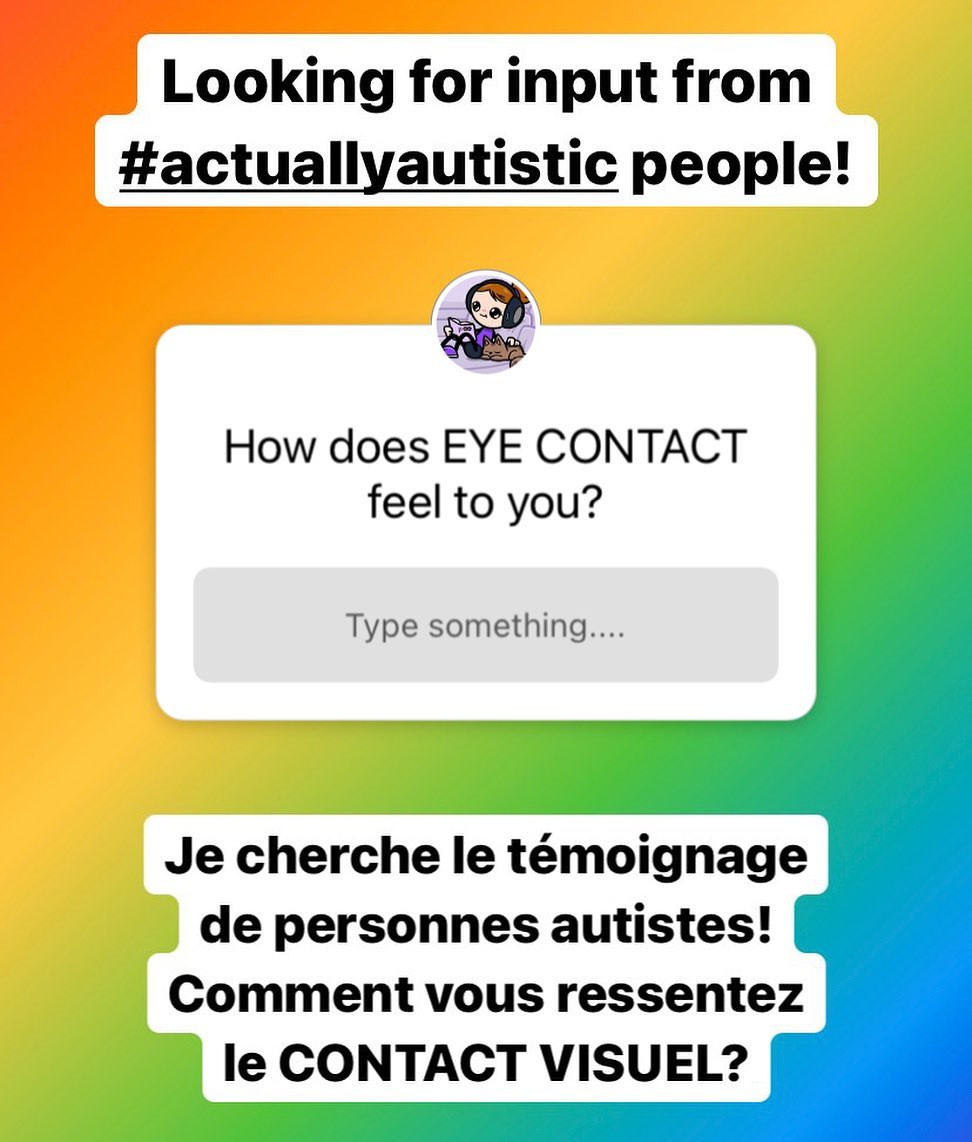
Both posts were made on November 8, and three days later, on November 11, we had received 175 testimonies. A few major themes emerged from these testimonies, which we used to base 7 webcomics or illustrations on. Keep in mind that, with this process, we do not claim to represent all there is to express about autists’ first-personal experience of eye contact. In fact, we suggest you visit these posts yourself to better understand the varied responses we got, and are still getting. And who knows, maybe this will allow you to add your own insight.
Publication
Since Monday, we have started to publish these comics on our social networks and we will continue to publish them in the following days
The interactions that take place around such webcomics are, we believe, an integral part of their complete aesthetic experience. These interactions often bring about clarifications, complementary details and descriptions or even added meaning. We thus invite you to visit these posts and interact with the community.
Webcomics
"I can do it but I can’t process anything else while doing it. My natural instinct and what feels the most right is to not look at someone’s face at all"
"It was drilled into me as a "rule" of politeness. I view it as just that, a rule. It's easy when there's multiple people because I can look around. But with one person, I have to look away or I end apparently end up staring"
"Everyone insisted on it, especially when they really wanted to correct a behavior or ensure I was paying attention. I honestly still don't love it, and prefer to look at noses or eyebrows to provide the impression I'm making eye contact"
"Eye contact was enforced during my childhood in mostly abusive ways and while it taught me to fake it, that made me hate it even more. Generally it just makes me uncomfortable and I find it quite distracting but it's also one of the most tiresome things to mask."
"Eye contact feels like they're staring into my soul, but with knives. I can make short eye contact before wanting to cry."
"It takes a concerted effort except for specific people."
"I’ve been so conditioned to make eye contact with people that when I met a lot of my friends for the first time they were kinda weirded out by me unblinkingly paying attention to them when they talked like 👁👄👁"
"It feels like someone is looking right past all my defenses and directly into my head. Not very pleasant."
"Terrifiant, j'ai vraiment l'impression qu'on me transperce à chaque fois …"
"Like I am being stabbed in the brain, itchy under the scalp, or suffocating. Anxiety is anxiety. I look at people's foreheads. They never know the difference but I am not forced to juggle the pain of eye contact and try to communicate. I am mostly non verbal and eye contact guarantees no words."
"Ça me met vraiment mal à l'aise et j'ai peur qu'on puisse mal interpréter si je regarde pas "correctement", je sais pas si je dois regarder quelqu'un dans les yeux ou combien de temps, il faut surtout pas que je regarde autre chose chez lui que ses yeux et du coup je sais pas quoi faire je préfère regarder le mur derrière mon interlocuteur 😂"
"Tout dépendra de la situation, de ma fatigue et de la personne. Certains contacts peuvent être transperçants (douloureux), d'autres envoutants (confusants), d'autres destabilisants (perturbants). En tous cas, si je regarde qqn dans les yeux, je suis sûr de perdre mon fil de pensée et/ou d'accorder mes réponses à ce que la personne ressent."
"Eye contact feels like burning discomfort, especially when I'm being told to do it."
"It’s extremely hard for me to maintain eye contact, and when people express to me that I should be looking at them when I’m talking to them, it puts me under more stress than just talking to them in the first place"
"somehow being told we should be making eye contact feels like being reprimanded as a child, at least to me.. I can't count the amount of times my mother would tell me to look her in the eyes as a child, and how humiliating/stressful it felt.. I legit forget to listen to people because I'm too busy trying to maintain eye contact."
"At best, awkward and uncomfortable. At worst, like someone's stabbed me in the eyes."
"It makes me uncomfortable but my mother forces me to look people in the eyes"
"Painful, but I feel like if I don't look ill be punished or called a liar. So I trained myself to look at something over their shoulder if not their foreheads to avoid harassment."
"Habituellement je regarde plutôt la bouche ou le nez des gens et ça semble passer crème pour donner l'illusion que je regarde dans les yeux (j'ai eu droit à l'expert en haute potentialité qui me disait que c'était impossible que je sois autiste car.. je le regardais dans les yeux ! Je regardais sa bouche depuis le début de l'entretien..). Je ne me force au contact visuel que de manière consciente et dans de rares cas précis : [suite]
(suite) par exemple si je suis attiré romantiquement par quelqu'un et désire que cette personne le perçoive (vu que le contact visuel accru est interprété de cette façon par beaucoup de neurotypiques). Mais cela reste un sacré effort et en général je détourne les yeux très rapidement, ça me met mal à l'aise, c'en est presque physique. Récemment un de nos profs en cours nous a fait faire une série d'exercices où on devait marcher vers quelqu'un/revenir à sa place à reculons en gardant le contact visuel constant avec cette personne.. je vous laisse deviner la torture que c'était"
"Transperçant!"
"J'ai l'impression que les yeux de la personne me percent à l'intérieur, je sais pas comment dire, c'est une sensation d'oppression aiguë."


"For me, looking in the eyes feels too exposed and open. It makes me feel like I can't hide and protect myself from the people."
"Eye contact makes me uncomfortable most of the time, because of the feeling that I am being silently judged or getting talked about negatively."
"It's fine when I'm listening to someone but when I'm the one talking it makes me get stage fright like I'm being put on the spot to judge for performance lol"
"Too intimate, inappropriate… I become incredibly self conscious as well, like am I doing eye contact right? Should I be mirroring their behavior or a close approximation or complete opposite? How many times should I blink? Can they tell I’m faking this human interaction? It’s incredibly stressful."
"It feels like something is a required check box. It’s like a math problem. Look, one, two, three. Okay. Look away. Zone out if you need to. Okay, it’s been 10ish seconds. Look back. One, two, three.. okay, look away! Don’t share at them! Wait! You’ve looked away too long! Look back! …..it’s that on repeat quite often lol"
"I hate it I get so nervous and then I break down."
"I don't like it, makes me really uncomfortable. I'm "good at it", because I mask well (😬). I never know what to do, if I'm looking to much or not enough and always use a whole lot of energy just on eye contact. Generally, the more comfortable I feel the less I look someone in the eyes. (Also eyes as a body part make me feel really icky so that's that)."
"Intimidating and uncomfortable, I feel too vulnerable and keep thinking am I doing this right?"
"Ça me met vraiment mal à l'aise et j'ai peur qu'on puisse mal interpréter si je regarde pas "correctement", je sais pas si je dois regarder quelqu'un dans les yeux ou combien de temps, il faut surtout pas que je regarde autre chose chez lui que ses yeux et du coup je sais pas quoi faire je préfère regarder le mur derrière mon interlocuteur 😂"
"Eh bien, quand j’étais petit, je parlais et écoutais souvent le monde sans les regarder dans les yeux. Maintenant, ça me dérange pas de parler et écouter avec le contact visuel, mais j’peux très bien comprendre ce que le monde me dit sans obligatoirement les regarder dans les yeux. Aussi, c’est vrai que ça me rend un peu mal à l’aise quand des inconnus me fixe du regard. C’est comme s’ils me jugeaient et j’sais pas ce que j’ai fait de mal."
"Direct eye contact feels like I am being judged. It also makes me feel uncomfortable because I become unable to perceive and read the rest of their body language."
"Démunie, nue. Percée à jour. C’est très fort comme sensation, et rarement agréable. J’y arrive avec mes enfants ou mon mari, mais même dans ce cas, pas trop longtemps. Si je veux tenir une conversation, et me concentrer, alors je dois ruser. Je regarde entre les deux yeux ou le plus souvent la bouche."
"Feel nausea and anxiety, and extremely naked. Yet my mother was adamant that I learned it and therefore I am able to do it, despite the uncomfortable feelings. Absolutely love your work, for once I can tell that I am not alone"
"I feel instant stress and I have to force myself to do it and to look "natural"."
"Honestly, each time it happens to me, the most awkward feeling I have is « where should I look exactly » ? When you make eye contact, are you expected to focus one eye specifically (which one, then ?), between the eyes, not focus at all, or try a weird way of having each eye "looking" into the facing one (i.e. my left eye "looking at" their right one and vice-versa) ? I'm also never sure if/when eye contact is expected, and when it happens, is there/what is the hidden message behind this specific contact, and/or am I sending an incorrect hidden message myself ? Then, with all these questions actively consuming my brain "computing power", everything else totally miss the point (sometimes, though, I can hide this issue because I have this kind of ability to "replay" the last few words/sentence I unconsciously heard, to process it with a delay but potentially without the proper context- so it's not reliable at all !!). "
"Weird and artificial. I can actually read people's eyes now, but it took me years to learn it."
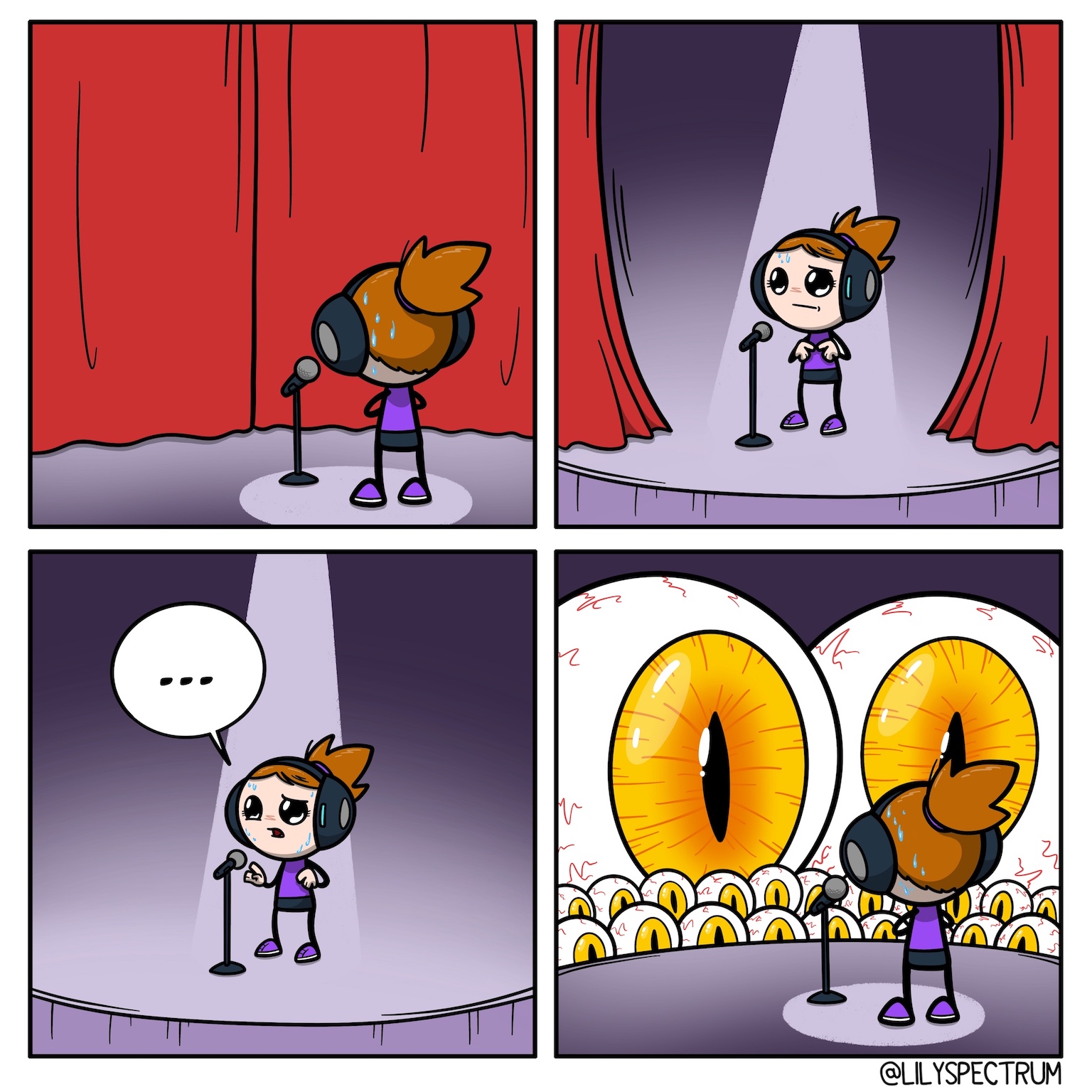
"My parents rasied me to always look into the eyes, still feels wrong. Like, I am invaiding a personal space and being rude. Like trying to stare down their soul and violating their privacy. I still try to look at people in the eyes but have learned to just looks in differents points in the face so I don't seem rude."
"Eye contact feels too intimate to me for most interactions. If I make eye contact with you, it’s because it’s important. "
"Eye contact feels very intimate. If I’m forced to hold it for too long, I feel violated, like I’ve been touched without consent."
"I really hate eye contact in almost all circumstances. About the only exception is with someone I'm very intimate with. Eye contact feels extremely intimate to me in general so it only feels natural when it's with someone I've got a suitably intimate emotional connection to. Otherwise it feels like I'm staring into someone's soul and I can see everything and they're staring into mine and seeing the same (even if I know they're not)."
"Invasive, extremely personal. I'm only comfortable looking my husband in the eyes"
"It feels like I’m standing too close to someone, I don’t know if that’s too vague of a comparison but it feels way too intimate. So I only do it when necessary or when I’m comfortable with that person."
"It feels creepy to me"
"I don't like it, makes me really uncomfortable. I'm "good at it", because I mask well (😬). I never know what to do, if I'm looking to much or not enough and always use a whole lot of energy just on eye contact. Generally, the more comfortable I feel the less I look someone in the eyes. (Also eyes as a body part make me feel really icky so that's that)."
"I hate eye contact. It almost hurts. But it’s nessesary to have a successful professional life, and my parents trained me well as a child. They would ask me people’s eye color after I met them to see if I made eye contact. Being trained like that at a very young age was incredibly difficult and felt unfair, but I’m very grateful that they pushed me now that I’m an adult."
"I can't do it, it makes me feel funny in a bad way and makes me feel kind of .. unsafe? and uncomfy I don't exactly know the word for the first one, I don't mind people looking at me but I won't look back"
"It's incredibly intimate and overwhelmingly so, particularly with strangers. And the more my emotions are revved up, the less I can tolerate it. It genuinely feels as though someone can see into my mind almost, even though I know that they can't. On the plus side, when I'm with someone I deeply, deeply love, sometimes that's okay because I want them to see how much I love them... but then that tends to make THEM feel awkward and uncomfortable too. LOL For me, it falls into the same category as standing too close, invading personal space, touching someone without consent etc. It's intimate, and can very easily become violating when you don't want it. And that;s so hard to explain to NT folk who expect you to look them in the eye all the time."
"It's okay with people I know, but I don't feel comfortable with eye contact with strangers, it almost feels like an invasion of privacy."
"eye contact feels so weird and creepy and if i have to make eye contact with someone, then ill quickly feel exhausted."
"It feels like a boundary rupture unless I completely and totally feel comfortable in a container of safety with another it probably won’t happen much."
"Well... I can't let anyone touch my eyeballs."
"Trop intrusif. Comme si l autre avait la perception de mes pensées. C est comme se montrer nue."
"Intense/ overwhelming/ fiery/ intrusive. Sometimes painful/ always difficult with strangers. Ok with intimate friends and family."
"Démunie, nue. Percée à jour. C’est très fort comme sensation, et rarement agréable. J’y arrive avec mes enfants ou mon mari, mais même dans ce cas, pas trop longtemps. Si je veux tenir une conversation, et me concentrer, alors je dois ruser. Je regarde entre les deux yeux ou le plus souvent la bouche."
"Feel nausea and anxiety, and extremely naked. Yet my mother was adamant that I learned it and therefore I am able to do it, despite the uncomfortable feelings. Absolutely love your work, for once I can tell that I am not alone"
"confronting and very intimate ..i feel naked"
"Quelque chose d'extrêmement intime, que je ne peux pas partager avec n'importe qui sinon je suis déstabilisée car je bloque sur cette sensation d'intimité forcée. Depuis le diagnostic, je me permets de ne plus regarder le visage des gens (je ne travaille pas). Quel soulagement!"
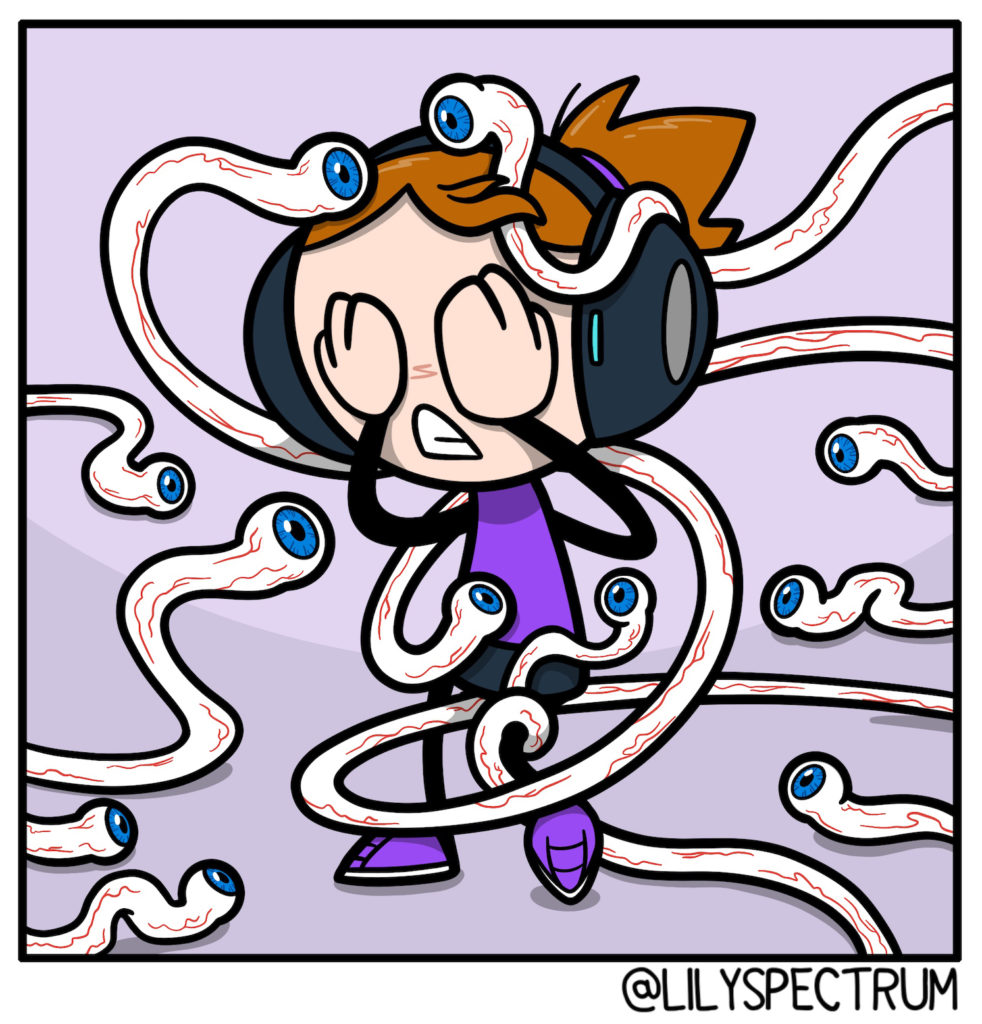
"Eye contact feels like they're staring into my soul, but with knives. I can make short eye contact before wanting to cry."
"It’s like being asked to look directly at the sun. I flinch, I can’t do it…"
"It feels like they gonna shoot me with laserbeams. Like Cyclops from X-Men. I van handle it for 10 seconds. I get panick attacks of it's to long. Even with my bf makes me on edge. I got a major panic attack during a being social etc exam (idk how it's in English is). It was so bad. They let me past because otherwise i needed to do the whole year over."
"Feels like I’m staring at the sun and I can only look a person in the eyes for 30 seconds or so before my eyes start to hurt a bit. I can only look animals in the eye."
"Like flames of intense awkwardness are scorching my retinas."
"When I was younger I always had trouble making eye contact. I’ve gotten better at it in recent years but its still painful to me."
"Eye contact feels like burning discomfort, especially when I'm being told to do it."
"Ça me demande beaucoup de concentration. J'ai l'impression que ça me fait mal aux yeux et quand j'étais plus jeune je pouvais même ne plus vraiment entendre ce que la personne me disait. Par contre ce n'est plus un problème quand je me mets vraiment en colère au point de vouloir me battre."
"Ca va de la gêne à la sensation de brûlure, ça dépend des personnes je suppose. On peut parfaitement regarder le nez, la bouche, entre les yeux sans que l'autre ne sen rende compte."

"I can’t think if I have to. Feels like pressure."
"Bad, I feel like my head is going to explode if I look at someone's eyes for too long. I suspect it's probably a blood pressure drop or adrenaline, but it feels awful. I honestly don't get why so many people require eye contact when speaking. I can make eye contact, but it's really difficult to understand what the person is saying because I'm too focused on how uncomfortable I feel and how incredibly awkward it is to stare at someone's eyes"
"It feels literally painful and I’m always afraid the other person can tell what I’m feeling/thinking. I’m comfortable with eye contact with very trusted folks in my life though."
"Painful"
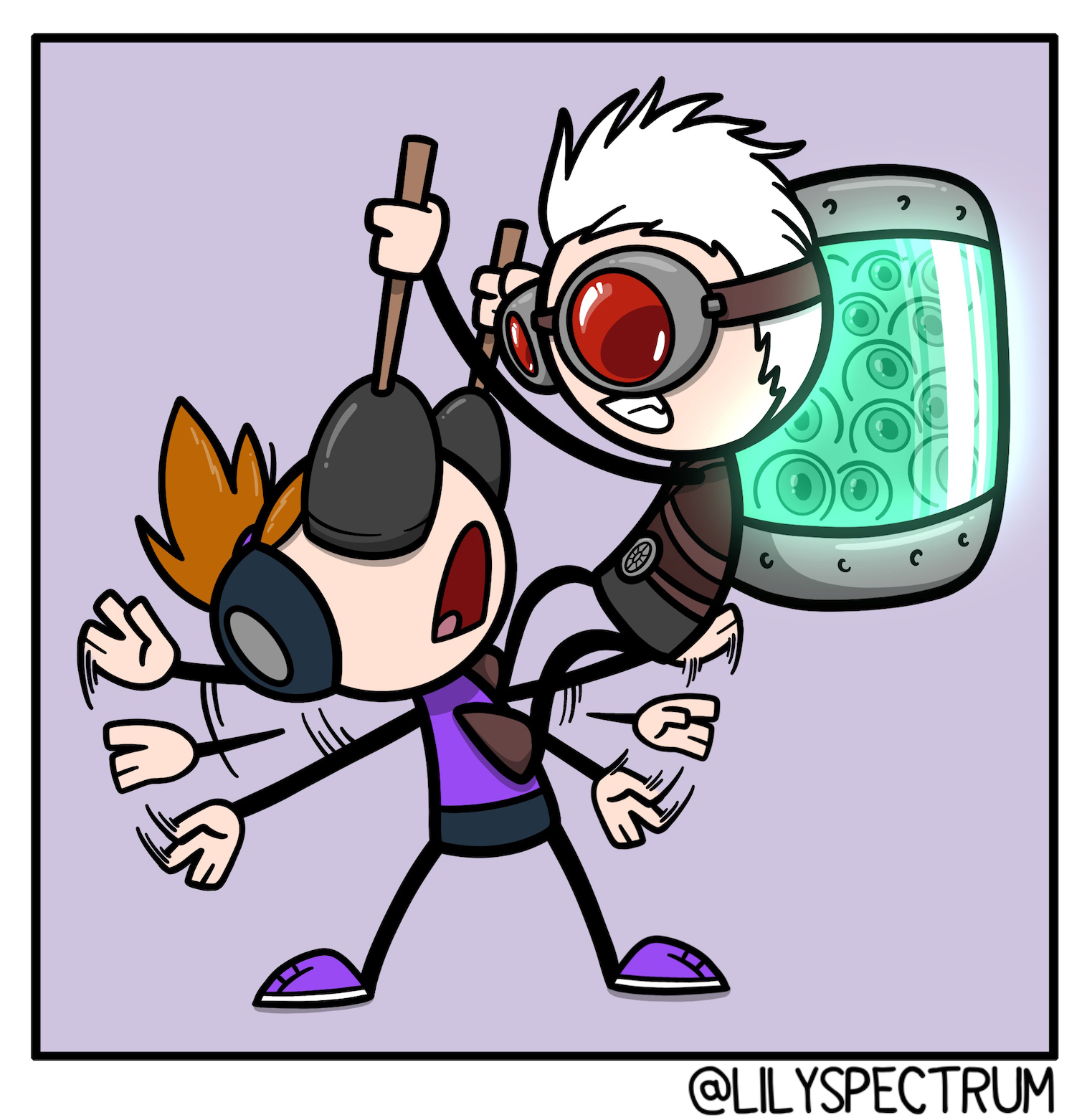
"I really hate eye contact in almost all circumstances. About the only exception is with someone I'm very intimate with. Eye contact feels extremely intimate to me in general so it only feels natural when it's with someone I've got a suitably intimate emotional connection to. Otherwise it feels like I'm staring into someone's soul and I can see everything and they're staring into mine and seeing the same (even if I know they're not)."
"I cant make eye contact with literally anyone. Its uncomfortable, and even when its not, i cant listen proberly to what people are saying when i focus on the eyes. I just cant do it at anytime with anyone, only for one second maximum. Its like staring into someone's soul, its too much."
"J’ai l’impression d’être absorbée par les yeux de la personne et en même temps comme si on pouvait voir ce qu’il y a à l’intérieur de moi."
"honestly it feels like i am being sucked into their soul… i can’t maintain it if i want a conversation because i just get lost"
"Like someone staring at my soul? I almost feel like that's the part of masking that exhausts me the most!"
"It's uncomfortable. But sometimes if I want to intimidate someone I stare deep into their eyes and make them feel unnerved like I'm looking into their soul."
"Tout dépendra de la situation, de ma fatigue et de la personne. Certains contacts peuvent être transperçants (douloureux), d'autres envoutants (confusants), d'autres destabilisants (perturbants). En tous cas, si je regarde qqn dans les yeux, je suis sûr de perdre mon fil de pensée et/ou d'accorder mes réponses à ce que la personne ressent."
"Trop intrusif. Comme si l autre avait la perception de mes pensées. C est comme se montrer nue."
"J’ai l’impression d’entrer dans l’âme de la personne. Je trouve ça trop privé. Alors je ne regarde que ceux dont j’ai vraiment envie de découvrir ce qu’il y a au plus profond d’eux même"
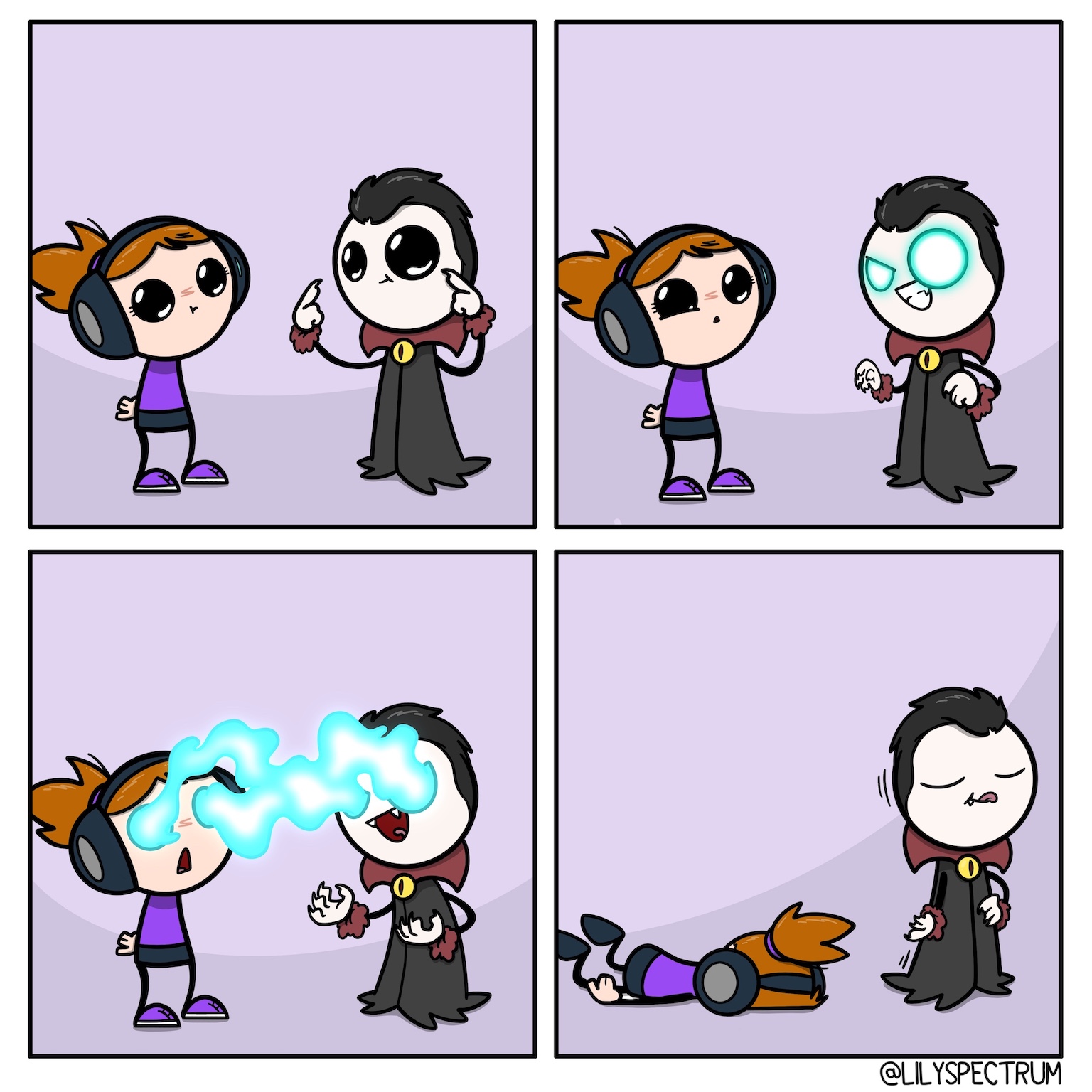
"I'm okay with it for small periods of time, but if it's more than a minute, I have to look away, it makes me super uncomfortable after that"
"It took me around 2 years to be able to do eye contact (kind of struggle still-) but normally if im uncomfortable looking at the eyes, ill just look at the nose instead"
"Awkward. The longest I can probably do it is for a few seconds, but sometimes it’s physically impossible for me to look someone in the eyes even for one second."
"Ça me met juste très mal à l’aise, et du coup je préfère regarder ailleurs et ne regarde les gens dans les yeux s’iels ne me regardent pas."
"Incapable de soutenir un eye contact sauf avec certaine personnes... Ma famille (ma mere, mon pere, ma soeur), ma nièce, mon beau frère et mon conjoint. Quelques amis specifique aussi... Mais sinon incapable. Je chercher tjrs a "évader" ses eye contact."
"Uncomfortable. I have trouble maintaining eye contact for long, especially in a conversation. However, I did figure out that talking with your hands is a great way to distract the other person's eyes from your and gives you a reason not to look at them."
"havent made eye contact with anyone (while i'm talking to them, that is) except my cats in years if that tells you anyone"
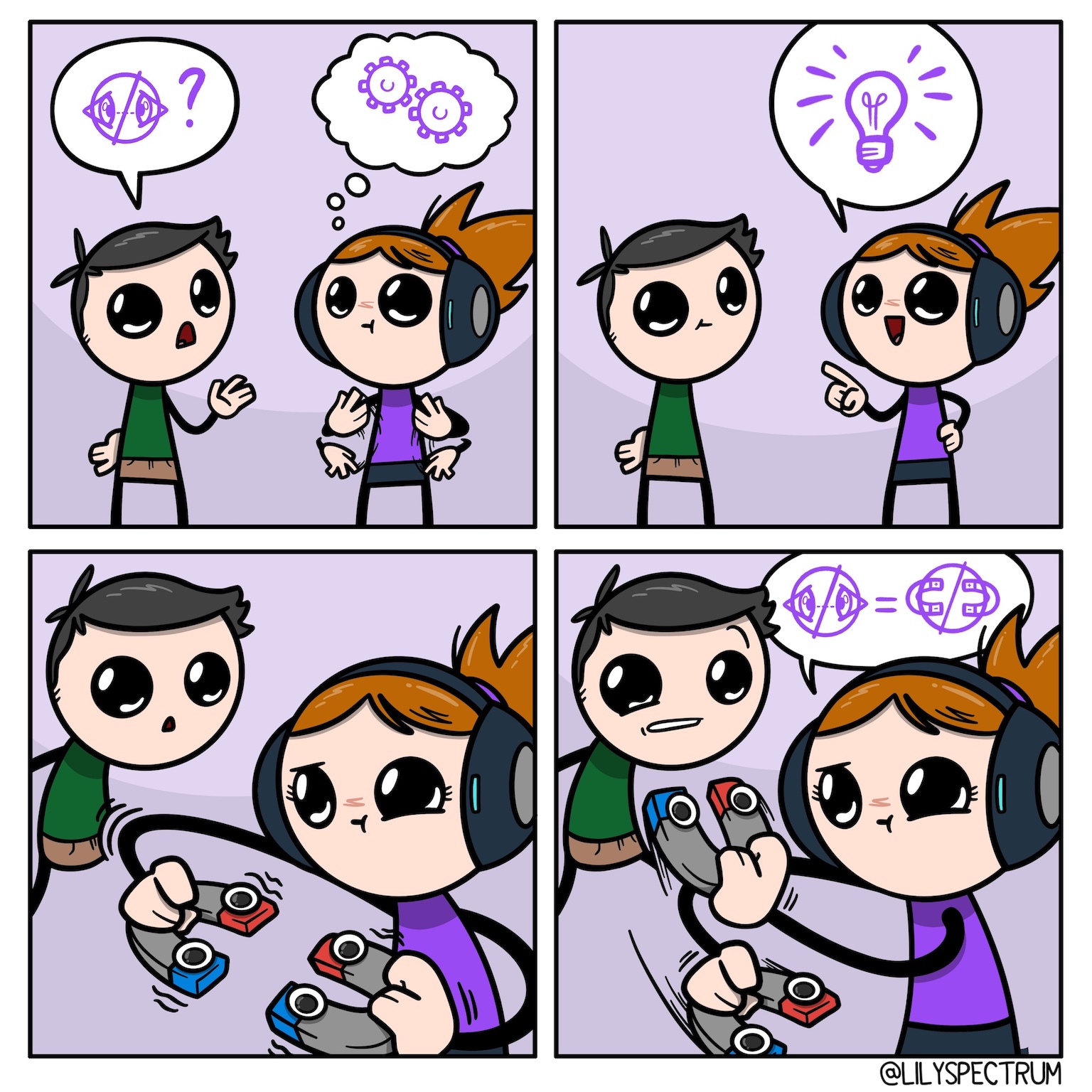
"When I was younger, it used to feel like when you held two magnets together both ends the same, it felt like no matter how hard you held them together, it would want to repel forcefully, my head wanted to repel and look past to the left or right or down or up like a magnet would, and when I managed to hold it against that feeling, my eyes would water up, not tears from sadness or anything, but they released tears, now I can manage it but it's still not comfortable to do, it depends on how comfortable I feel with the person or people or how stimulated I feel in an environment"
"It’s like when you hold two magnets with the same polarity against each other. Even if you want to put them together they won’t do it. The magnets are like my eyes. They just can’t center on the other persons eyes or it will cost a lot of energy. Like with holding magnets with the same polarity together. It’s just all in all very uncomfortable and draining. Btw I’m undiagnosed so I hope I can still answer here. Also I really really love your account and the stuff you do ^^ /g"
"Ça me met vraiment mal à l'aise et j'ai peur qu'on puisse mal interpréter si je regarde pas "correctement", je sais pas si je dois regarder quelqu'un dans les yeux ou combien de temps, il faut surtout pas que je regarde autre chose chez lui que ses yeux et du coup je sais pas quoi faire je préfère regarder le mur derrière mon interlocuteur 😂"
"Je me sens obligé de regarder chaque personne dans les yeux mais aussitôt que le contact est réciproque je baisse le regard aussi vite que mon ombre ainsi j'ai l'impression que j'ai fait ma part! haha! Par contre avec le monde avec qui je suis très, très à l'aise je vais quelque fois fixer les yeux, on dirait que j'essaie de comprendre pourquoi je fuis ceux des inconnus, alors je fixe en grand questionnement interne!"
"Awkward and physically painful , strong need to move my eyes away from it"
"Souvent trop intense… Et en plus il se passe tellement de choses autour des yeux qui m'intéressent plus et/ou me sécurisent plus! Je fixe puis je zappe, j'y reviens et je rezappe… Les sourcils, les lunettes, sont des bons compromis aussi, ou fixer mon regard dans le vague direction le visage ou le pourtour du visage… Ou fixer le visage avec une attitude très intéressée (posture corporelle de l'attention soutenue) quand la personne regarde AILLEURS, et quand son regard se tourne vers moi, fixer 1s seconde, sourire, et me tourner ailleurs vers qqn d'autre qui parle mais ne regarde pas vers moi à ce moment là, ou trouver à m'occuper avec un objet, et jongler comme ça."
"Je n'aime pas regarder sans les yeux, je ne sais pas, c'est plus fort que moi, je suis mal à l'aise, je ressens le besoin de regarder ailleurs. Du coup j'aime bien discuter quand je suis au resto ou quand on fait une activité, il y a l'excuse d'être occupée en même temps pour ne pas se regarder"
"Habituellement je regarde plutôt la bouche ou le nez des gens et ça semble passer crème pour donner l'illusion que je regarde dans les yeux (j'ai eu droit à l'expert en haute potentialité qui me disait que c'était impossible que je sois autiste car.. je le regardais dans les yeux ! Je regardais sa bouche depuis le début de l'entretien..). Je ne me force au contact visuel que de manière consciente et dans de rares cas précis : par exemple si je suis attiré romantiquement par quelqu'un et désire que cette personne le perçoive (vu que le contact visuel accru est interprété de cette façon par beaucoup de neurotypiques). Mais cela reste un sacré effort et en général je détourne les yeux très rapidement, ça me met mal à l'aise, c'en est presque physique. Récemment un de nos profs en cours nous a fait faire une série d'exercices où on devait marcher vers quelqu'un/revenir à sa place à reculons en gardant le contact visuel constant avec cette personne.. je vous laisse deviner la torture que c'était"
"Lorsque c'est quelqu'un avec qui je suis à l'aise ca va à une certaine distance mais de trop prêt je ressens un malaise assez vite. Si j'ai le malheur de croisé le regard avec un(e) inconnu(e) dans la rue ou dans un commerce, je regarde ailleurs aussitôt, gros malaise. C'est pour ça que j'évite de regarder les gens."
Thank you for joining us in this exploration!
We hope this experience was (and will be) as enriching for you as it was for us to come up with. We invite you to engage with us and the community through our posts or in the comments bellow!
get cheap artane without a prescription
get accutane without rx
Medicament information leaflet. Drug Class.
can i get generic ropinirole
Some about pills. Read now.
can i get prevacid no prescription
aviator game download
Medicine information leaflet. Long-Term Effects.
can you buy norvasc pill
Best about medication. Get here.
[url=https://blacksprutx.com/]не работает сайт blacksprut[/url] – официальная ссылка на blacksprut, blacksprut com зеркало
Компания «Анапа Транспорт» предлагает качественные услуги по перевозке пассажиров. Тут предложены разные авто, отвечающие высочайшим требованиям. Машины чистые и исправные, они будут поданы в назначенное время. Ищете автобусы в анапе заказать? Anapa-transport.ru – сайт, где размещены отзывы клиентов, ознакомится с ними, можете в любой удобный момент. Все водители доброжелательные и специальные курсы для повышения своей квалификации проходят. С удовольствием ответим на все ваши вопросы и поможем вам. Обращайтесь к нам!
Да, действительно. Это было и со мной.
4. Сибирский федеральный университет. Герагос Марк. Адвокат голливудских звезд, http://www.dachamania.ru/photo_gallrey/profile.php?uid=60762 за всю жизнь проиграл только 2 дела.
wedgewood online pharm doxycycline purchase online buy doxycycline online cheap canadian doxycycline on line doxycycline cod buy generic doxycycline Usa cvs pharmacy online shopping doxycycline overnight Us delivery high quality only. buy doxycycline on line no prescription where can I learn about internet chemists shipping doxycycline fast delivery? overnight doxycycline online to Us doxycycline buyy online doxycycline without a doctor prescription online pharmacies fastest shipping
Палитра Казино: Разнообразие опыта и азартных игр
В мире азартных игр казино занимают особое место. Одним из более ярчайших представителей этой сферы являются он-лайн-казино, предоставляющие игрокам уникальные возможности для утехи и выигрыша. Среди них выделяется понятие “палитра казино”, которое включает в себя обилие игровых предложений, платформ и услуг. В этой статье будут рассмотрены главные аспекты и достоинства палитры казино.
Что есть палитра казино?
Гамма казино это обилие игр и услуг, предлагаемых казино, которое может включать в себя классические настольные игры, автоматы, покер, букмекерские услуги и более. Важно отметить, что гамма казино может варьироваться от 1-го оператора к иному, в зависимости от их стратегии, целевой аудитории и доступных лицензий на забавы.
Виды игр в политре казино
1. Слоты: Игра на автоматах представляет из себя одну из самых популярных форм азартных игр. Современные слоты делают отличное предложение уникальные темы, захватывающие бонусные функции и большие джекпоты.
2. Настольные игры: Традиционные игры, такие как блэкджек, рулетка и баккара, предоставляют игрокам возможность проявить свои тактические способности. Почти многие он-лайн-казино предлагают как живы, так и виртуальные версии этих игр.
3. Покер: Этот вид азартной игры необыкновенно популярен посреди игроков, которые предпочитают стратегический подход. Онлайн-казино делают отличное предложение различные виды покера, включая тексасский холдем и омаху.
4. Спортивные ставки: Некие казино также предоставляют услуги бк, позволяя игрокам делать ставки на спортивные действия, в том числе футбол, баскетбол и прочие виды спорта.
5. Лотереи и игры с живыми дилерами: Лотереи и забавы с живыми дилерами предлагают игрокам интерактивный опыт с элементом человеческого взаимодействия.
Преимущества гаммы казино
1. Обилие: Гамма казино предоставляет игрокам разнообразные варианты игр, что делает азартные игры более увлекательными и интересными.
2. Доступность: Онлайн-казино доступны gama-casino-winner.ru круглосуточно всю неделю, что позволяет игрокам наслаждаться играми в любое время и в любом месте.
3. Бонусы и акции: Многие казино предлагают привлекательные бонусы и акционные предложения, что наращивает шансы на выигрыш и делает забаву более выгодной.
4. Высочайшая степень безопасности: Лицензированные казино используют передовые технологии шифрования для защиты собственных данных и финансовых транзакций игроков.
5. Клиентская поддержка: Большинство он-лайн-казино делают отличное предложение круглосуточную техно поддержку, что позволяет живо решать возникающие препядствия и получать ответы на вопросы.
Заключение
Палитра казино это многоуровневый мир азартных игр, который предлагает игрокам большой объем способностей для веселий. Сочетание уникальных игр, доступности, бонусов и безопасности делает онлайн-казино симпатичным выбором для большинства любителей азарта. Помните об ответственности при забаве и выбирайте только лицензированные и проверенные платформы для собственной деятельности. Фортуны для вас в ваших азартных приключениях!
trazodone good rx
cost of cheap co-amoxiclav without dr prescription
where to get generic celebrex tablets
can you buy cheap florinef prices
Drugs prescribing information. Generic Name.
how to get cheap lopressor tablets
Best about medicament. Read information here.
Medication information leaflet. Effects of Drug Abuse.
how to buy elavil price
Best about medication. Get information now.
아울러 K-Law Consulting의 부산 변호사가 대한민국에서의 절차 역시 저들 진행해 주기 덕에 고객은 대한민국에 갈 니즈도 없으며, 따로 대한민국의 법무사를 찾을 욕구도 없다. “단순하게 원하는 것만 말씀하시면 되고, 나머지는 저희가 우리 처리해 드릴 것입니다”라고 이 변호사는 힘주어 말했다.
부산 변호사
buying ativan online. buy antibiotics online in Canada cheap discount online antibiotics discount cytotec without prerscription antibiotic over the counter USA buy cheap onlinek antibiotics purchase antibiotics Canada mail order meds buy cheap generic antibiotics online sale online antibiotics low dose symptoms buy antibiotic cheap antibiotics without rx buy antibiotics online canada best online pharmacy
Hi autismflaps.com,
At present, your website is not ranking on Google and your competitors are sitting at the top and taking all the fruits.
If you’re still interested to get more phone calls and leads from your website, then we can put it on top 3 positions on Google Maps within your target area.
Can I send the proposal and pricing to accomplish your business goals?
Thanks,
Bests Regards,
Bruce Godon
Sr SEO consultant
http://www.increaseorganictraffic.com
Ph. No: 1-804-715-1479
If you don’t want me to contact you again about this, reply with “unsubscribe”
По моему мнению Вы допускаете ошибку. Давайте обсудим. Пишите мне в PM, пообщаемся.
незважаючи на високий попит, дилдо придбати товари засіб можна ще не абсолютно у всіх аптеках і Перукарень. Сучасні Інтимні необхідне не просто долають сором-вони вчать насолоджуватися близькістю і проявляти власну сексуальність без ганебного впливу суспільства.
Интернет-магазин «Тиффани» предлагает высококачественную мебель. У нас найдете то, что идеально впишется в ваш интерьер. Мы удерживаем стоимость на доступном уровне. Работаем исключительно с проверенными партнерами и поставщиками. Осуществляем оперативную доставку. https://stoly-stoly.ru – портал, где вы можете уже сегодня детальнее с условиями оплаты ознакомиться. Обеспечиваем сохранность товара до двери покупателя. Обращайтесь к нам, с удовольствием поможем вам подобрать нужные мебельные изделия. Превратим в мечту ваш дом!
buy prometrium 100mg pill – order generic progesterone buy generic clomiphene over the counter
amoxil 250 mg dosis apiretal
cheap advair diskus prices
can you get generic diovan without a prescription
CouldnХt help but share this piece with you http://indparks.ru/bitrix/redirect.php?goto=http://www.ncimpactcare.com/staffing-our-testimonials?unapproved=1151002&moderation-hash=09cbcb469f77c00592b7e163c9f55b56#comment-1151002
aviator bot
can i purchase requip no prescription
Medication information. What side effects?
where to buy cipro tablets
Best about medicines. Get here.
Pills information. Generic Name.
order generic fluvoxamine tablets
All information about drugs. Read information now.
This article has a lot to offer hope you like it http://airsoft-station.ru/bitrix/redirect.php?goto=https://midtrailer.com/home/img_0778/#comment-17291
Палитра Казино: Разнообразие опыта и азартных игр
Во всем мире азартных игр казино занимают особое место. Одним из наиболее ярких представителей этой сферы являются онлайн-казино, предоставляющие игрокам уникальные способности для веселия и выигрыша. Среди их выделяется понятие “палитра казино”, которое содержит в себе обилие игровых предложений, платформ и услуг. В данном посте мы рассмотрим основные нюансы и преимущества палитры казино.
Что есть палитра казино?
Гамма казино это обилие игр и услуг, предлагаемых казино, которое может включать в себя классические настольные игры, автоматы, покер, букмекерские услуги и более. Главно отметить, что гамма казино может варьироваться от одного оператора к другому, в зависимости от их стратегии, мотивированной аудитории и доступных лицензий на игры.
Виды игр в политре казино
1. Слоты: Забава на автоматах представляет из себя одну из самых известных форм азартных игр. Современные слоты делают отличное предложение уникальные темы, захватывающие бонусные функции и большие джекпоты.
2. Настольные забавы: Классические игры, в том числе блэкджек, рулетка и баккара, предоставляют игрокам возможность проявить свои тактические способности. Многие он-лайн-казино делают отличное предложение как живые, так и виртуальные версии этих игр.
3. Покер: Этот вид азартной игры особенно известен посреди игроков, которые предпочитают стратегический подход. Он-лайн-казино предлагают различные виды покера, включая тексасский холдем и омаху.
4. Спортивные ставки: Некие казино также предоставляют услуги бк, позволяя игрокам делать ставки на спортивные события, такие как футбол, баскетбол и другие виды спорта.
5. Лотереи и игры с живыми дилерами: Лотереи и забавы с живыми дилерами предлагают игрокам интерактивный опыт с элементом человеческого взаимодействия.
Преимущества гаммы казино
1. Разнообразие: Гамма казино предоставляет игрокам разнообразные варианты игр, что делает азартные забавы более увлекательными и увлекательными.
2. Доступность: Онлайн-казино доступны gamma официальный сайт круглосуточно всю неделю, что дает возможность игрокам наслаждаться забавами в любое время и в любом месте.
3. Призы и акции: Многие казино предлагают привлекательные бонусы и акционные предложения, что увеличивает шансы на выигрыш и делает забаву более прибыльной.
4. Высочайшая степень безопасности: Имеющие лицензию казино употребляют ведущие технологии шифрования для высокой защиты личных данных и финансовых транзакций игроков.
5. Клиентская поддержка: Большинство онлайн-казино делают отличное предложение круглосуточную техническую поддержку, что позволяет стремительно решать возникающие задачи и получать ответы на вопросы.
Заключение
Гамма казино это многоуровневый мир азартных игр, который делает отличное предложение игрокам большой объем способностей для веселий. Сочетание уникальных игр, доступности, призов и безопасности делает он-лайн-казино симпатичным выбором для большинства любителей пыла. Помните об ответственности при игре и избирайте только имеющие лицензию и проверенные платформы для своей деятельности. Фортуны для вас в ваших азартных приключениях!
where to get generic advair diskus price
where to get prednisone prices
buy generic celebrex pills
can i buy cheap cephalexin for sale
https://fakenews.win/wiki/User:AllanLlanas9
http://it-viking.ch/index.php/User:DrewNicholson01
Imitation designer handbags are unapproved copies that are worked off as genuine products. These reproductions usually have reduced top quality and breach trademark guidelines.
Phony designer purses are a significant trouble in the style globe. They copy the styles of premium brands but do not possess the very same level of quality and skill as authentic items. These knock-off products trick purchasers into getting substandard product.
They additionally hurt the track record and sales of legitimate developers. Recognizing counterfeit bags can be challenging, as they often replicate the detailed information of real items. Purchasers should beware and purchase from reputable resources. Authenticity certifications and serial numbers can help validate a bag’s reliability. Preventing counterfeit goods supports the stability of the fashion industry and secures consumer civil liberties.
The Appeal Of Luxury
Luxury purses have constantly been very desired in the garment industry. The appeal of luxury is tempting, drawing in numerous individuals to acquire these top-tier accessories. With their trendy visual appeals and prominent branding, developer bags indicate more than simply a trend; they signify sophistication, stature, and a tip of opulence. Nonetheless, what takes place when the expenditure becomes unattainable? This is where counterfeit developer bags come into play, giving the appearance of luxury at a more affordable price factor.
What is the appeal of designer bags?
Fashion lovers are drawn to designer bags for different factors, as their appeal prolongs beyond just their visual look. Below are some important elements to think about:
Quality Craftsmanship: Designer bags usually flaunt premium materials and meticulous workmanship.
One-of-a-kind Designs: These bags include unique and trendsetting styles that stick out.
Brand Name Tradition: Various designer tags flaunt a fabled past and heritage, boosting their appeal.
Longevity: High-quality materials and construction mean these bags often last for many years.
In the world of style, some brands are their association with luxury. Labels such as Chanel, Louis Vuitton, and Gucci their exceptional craftsmanship and perfect standards. Having a handbag from these labels is not merely a issue of looks; it represents inclusion in a pick group.
Checking out legendary developer purses and their attributes
Brand name
Legendary Bag
Key Includes
Chanel
Timeless Flap
Leather with stitching, chain take care of, logo design with 2 Cs
Luxury Style Brand Symbol
Rapid
Monogram canvas, top handles, sizable indoor
Gucci
Dionysus
GG logo design, tiger head closure, suede details
The Status Sign
Designer bags are more than devices; they are standing icons. Lugging a developer bag can indicate wealth, success, and elegance. This importance plays a significant duty in their allure.
Why High-end Handbags Are Typically Viewed as Signs of Social Condition and Wide Range.
Exclusivity: These bags are usually produced in limited amounts, making them exclusive.
High Cost: The high price of developer bags makes them available to a pick couple of.
Distinctive branding: Classic logo designs and layouts stimulate a feeling of premium quality at first look.
A luxury circles, conveying a sense of improvement and abundance. By carrying such a bag, the proprietor sends a subtle yet impactful message that can elevate their confidence and reputation among their peers.
Consider the influence of social networks. Celebrities and influencers regularly display their premium bags, strengthening their standing. Their followers intend to have comparable products, connecting these bags with success and elegance.
At their core, high-end developer handbags hold a particular attraction because of their extraordinary craftsmanship, streamlined appearances, and the prestige they communicate. These bags transcend their functional purpose, functioning as sought after standing icons that not just showcase one’s.
Current Market Insights
Counterfeit luxury bags have actually come to be a substantial existence in the fashion landscape. The characteristics driving their popularity are moving at an extraordinary speed. As a influencing consumer acquiring practices and adding to the spreading of immoral markets.
Surge in Counterfeit Item Endangers Authenticity
The increasing frequency of fake developer bags is causing worry within the style field. Phony markets are thriving as a result of for premium items at decreased costs. These imitation bags are readily available in multiple places:
Open-air markets
Ecommerce trading platforms
Social media platforms
The increase of fake products is greatly attributed to allowing phony bags to very closely mimic authentic things with enhanced methods. Consequently, consumers are discovering it increasingly challenging to set apart in between genuine and phony items.
The adhering to table shows the typical characteristics of phony developer bags:
Attribute
Fake Bag
Actual Bag
Product High quality
Low-Quality Leather
High-grade Leather
Sewing
Unequal
Completely Straightened
Brand Logo
Fuzzy
Crisp and Clear
Police are actively combating this issue. They perform raids and confiscate counterfeit products. Yet, the marketplace continues to prosper as a result of ever-increasing demand. Customers need to remain attentive and educate themselves about distinguishing real products from counterfeits.
Consumer Actions
Customer actions in the direction of fake designer bags is facility. Lots of people buy these bags to enjoy the luxury appearance without the substantial cost. Several aspects influence this habits:
Price Sensitivity: High rates of authentic designer bags drive individuals in the direction of less costly options.
Social Pressure: The desire to harmonize style patterns presses customers to acquire phony bags.
Absence of Understanding: Some buyers are unaware that they are purchasing imitations.
Social media site plays a pivotal function in shaping consumer habits. Influencers typically display luxury items, developing a need amongst followers. This results in a greater need for designer bags, including imitations. Peer influence also influences purchasing decisions. Buddies and member of the family often suggest cheaper alternatives, causing more purchases of fake bags.
The adhering to factors summarize crucial customer behaviors:
Preference for trendy looks
Wish to display condition
Willingness to endanger on quality
Education and recognition projects can help change customer behavior. By understanding the adverse effect of counterfeits on the economic climate and brand name online reputation, consumers may make even more enlightened options.
Recognizing Fakes
Phony developer bags flooding the marketplace, making it tough to spot the genuine treasures. Discovering to recognize fakes conserves you cash and frustration. Below’s how to find fake designer bags easily.
Typical Indications
Identifying phony designer bags begins with usual signs. Here are some red flags:
Cost: If it’s as well affordable, it’s likely phony.
Stitching: Actual bags have excellent, also sewing.
Logos: Genuine logo designs are precise, clear, and regular.
Hardware: Initial hardware is premium and hefty.
Tags: Authentic labels are remarkable and well-attached.
Actual bags usually come with credibility cards and dirt bags. Inspect the vendor’s online reputation if buying used. Constantly purchase from respectable stores or verified resellers.
Material Distinctions
Material distinctions are vital in determining counterfeits. Genuine bags use superior materials.
Natural leather: Real leather really feels soft and smells all-natural. Phony natural leather feels stiff or plasticky.
Canvas: Top quality canvas is thick and sturdy. Phony canvas feels slim.
Cellular lining: Genuine bags have remarkable lining products. Fake cellular linings are frequently cheap and lightweight.
Check the bag’s weight. Authentic designer bags are usually much heavier as a result of much better materials. Evaluate the material very closely. High-end products have a unique structure and high quality.
Fakes Vuitton
Louis Vuitton bags are usually fabricated. Detecting a fake Vuitton can be tricky. Search for these details:
Monogrammed pattern: Genuine patterns are symmetrical and lined up.
Vachetta leather: Real Vachetta leather changes shade with time.
Day code: Authentic bags have a date code marked inside.
Genuine Louis Vuitton bags utilize high-quality hardware. The zippers are smooth, and the metal components are strong. Beware of sellers offering massive price cuts. Authenticity comes with a cost.
Phony Birkin
Hermès Birkin bags are luxury at its height. Counterfeit Birkins are all over due to high need. Right here’s how to tell them apart:
Stitching: Real Birkins have excellent, hand-stitched seams.
Stamp: The Hermès stamp is clear and deep.
Clochette: The natural leather essential owner ought to match the bag’s color and quality.
Check the bag’s shape. Genuine Birkins keep their shape even when vacant. Take note of the odor. Real leather has a distinct, abundant scent. Avoid vendors without a strong credibility or proper paperwork.
The Cost Of Replica
Fake developer bags could feel like a large amount, however the rate of imitation can be steep. Many individuals are lured by the lower price and the attraction of having a luxury product. Yet, buying counterfeit bags has hidden expenses and dangers. These consist of financial loss, legal trouble, and ethical concerns. Recognizing these issues can aid you make better selections.
Expense Vs. Authenticity
Authentic developer bags feature a high price tag for a factor. They make use of high-quality materials, specialist craftsmanship, and initial designs. On the other hand, phony bags reduced corners to conserve cash. This frequently leads to poor quality and shorter lifespan.
Right here are some vital differences:
Products: Real bags utilize premium leather and textiles. Phony ones utilize more affordable products like plastic or artificial natural leather.
Workmanship: Authentic bags are hand-crafted by proficient artisans. Counterfeit bags are mass-produced in manufacturing facilities.
Style: Real developer bags feature special styles and exact details. Phony bags frequently have defects and errors.
Let’s contrast the costs:
Aspect
Authentic Bag
Phony Bag
Initial Cost
$ 1000+.
$ 100 – $300.
Material High quality.
High.
Reduced.
Workmanship.
Outstanding.
Poor.
Layout Accuracy.
Accurate.
Flawed.
While an genuine bag is a significant investment, it offers unrivaled top quality and durability. A phony bag might conserve you money initially, yet it won’t last as long or look as great.
Long-term Value.
Buying an genuine designer bag can supply long-lasting benefits. These bags commonly preserve or even enhance in worth in time. They are additionally much more long lasting and can be given as treasures. On the other hand, fake bags have a tendency to wear rapidly and shed their allure.
Take into consideration these points:.
Resale Worth: Genuine developer bags can be resold for a great cost. Fake bags have little to no resale worth.
Longevity: Genuine bags are developed to last for several years, even decades. Fake bags frequently fall apart after a couple of months.
Psychological Value: Owning a genuine designer bag can bring a sense of satisfaction and contentment. Fake bags might not provide the same feeling.
Below’s a fast contrast of lasting value:.
Facet.
Authentic Bag.
Fake Bag.
Resale Worth.
High.
Low.
Sturdiness.
Durable.
Short-lived.
Emotional Worth.
High.
Reduced.
While the upfront expense of an genuine bag is high, the long-lasting worth makes it a rewarding investment. Phony bags could look like a deal, however their absence of toughness and value can make them costly over time.
Getting Guidelines.
Phony developer bags can be a great different to costly deluxe products. With the best buying standards, you can discover high-grade reproductions that look nearly similar to the originals. Right here are some crucial suggestions to aid you make notified decisions when purchasing phony developer bags.
Where To Shop.
Locating the best place to purchase fake designer bags is crucial. Some areas supply far better quality and more reliable solution than others. Below are some options:.
Online Marketplaces: Internet sites like eBay and Etsy commonly have a range of phony developer bags. Inspect testimonials and vendor ratings to make certain quality.
Specialty Site: Some sites concentrate on high-grade reproductions. These websites typically have much better quality control.
Social Media Groups: Lots of sellers utilize platforms like Facebook and Instagram to sell fake developer bags. Join teams and check for referrals.
Here is a fast contrast table for your reference:.
Shopping Alternative.
Pros.
Cons.
Online Marketplaces.
Wide array, client evaluations.
Quality varies, danger of rip-offs.
Specialty Internet site.
Premium quality, good customer care.
Greater prices, minimal option.
Social Media Site Groups.
Personal referrals, special finds.
Less protected, high quality varies.
Trustworthy Sellers.
Purchasing from credible sellers can conserve you a great deal of problem. Below are some tips to identify dependable vendors:.
Examine Evaluations: Constantly read client testimonials. Seek vendors with high scores and favorable responses.
Request For Thorough Pictures: Genuine sellers will certainly offer comprehensive photos of the bags. Focus on sewing, logo designs, and products.
Return Plan: Trustworthy sellers normally use a return policy. This shows they are positive in their product top quality.
Interaction: Trusted sellers react promptly to inquiries. Clear interaction is a excellent sign of professionalism and reliability.
Right here is a sample checklist to assist you identify trustworthy sellers:.
Requirements.
What to Search for.
Client Reviews.
High scores, favorable comments.
Thorough Photos.
Clear photos of stitching, logos.
Return Plan.
Used, clear terms.
Communication.
Quick, clear actions.
Social Impact.
Phony developer bags have actually ended up being a substantial part of contemporary culture. Their influence appears throughout numerous elements of culture. From style trends to social media, phony bags have actually left a mark that can not be ignored. This blog post explores the social influence of fake developer bags, shedding light on their role in today’s globe.
Style Trends.
Fake developer bags have influenced style trends in countless means. These bags provide a method for people to access high-end fashion without investing a fortune. As a result, they have become a staple in closets all over the world.
Cost: Phony developer bags permit even more people to participate in fashion trends.
Availability: These bags make high-end styles offered to a more comprehensive target market.
Selection: Phony bags often resemble the latest styles, maintaining customers updated with fads.
Demographic.
Effect.
Teenagers.
Comply with trends without high expenses.
Young person.
Keep fashionable on a budget plan.
Style Fanatics.
Trying out designs without dedication.
Phony designer bags have actually democratized style. They give a means for everyone to enjoy the current fads without breaking the financial institution.
Social Media Influence.
Social media site has played a crucial role in the rise of phony developer bags. Systems like Instagram and TikTok have actually made it less complicated for these products to acquire appeal.
Exposure: Influencers usually display fake bags, making them fashionable.
Peer Pressure: Seeing peers with trendy bags encourages others to acquire them.
Viral Patterns: Hashtags and obstacles enhance the appeal of fake designer bags.
System.
Impact Degree.
Instagram.
High.
TikTok.
Tool.
Facebook.
Low.
Social media site has actually made fake developer bags extra acceptable. It has stabilized their usage by showcasing them in a favorable light. This has brought about an boost in their need and popularity.
Conclusion.
Picking genuine developer bags over fakes makes certain long lasting top quality and worth. Counterfeit items typically let down with substandard craftsmanship. Spend sensibly to delight in ageless design and sturdiness. Authenticity brings satisfaction and self-confidence. Focus on authentic items for a really rewarding experience. Bear in mind, true luxury deserves every penny.
https://filmy-hd.ru/user/binassoirl
Лечение молочных зубов в Мурманске https://nova-51.ru/detskaya-stomatologiya-murmansk/lechenie-molochnykh-zubov-murmansk это теплое человеческое отношение и комфортная атмосфера. Зайдите на страницу узнайте все о лечении молочных зубов и стоимости наших услуг.
https://bbarlock.com/index.php/User:RheaKwj7935
can i order luvox prices
can i get cheap lipitor tablets
buy cheap lexapro without dr prescription
На сайте https://doskaob.ru/ воспользуйтесь доской объявлений, где вы сможете приобрести либо реализовать все необходимое и из таких категорий, как: бизнес, автотранспорт, мебель, интерьер, растения, животные, мобильные телефоны и многое другое. Все, что вам нужно, продают по привлекательной стоимости. Можно даже приобрести почти новые вещи. А для того, чтобы получить больше полезных опций, доступ к функционалу, необходимо пройти регистрацию. На нее уходит небольшое количество времени.
aviator predictor apk
иммобилайзер starline
Палитра Казино: Разнообразие опыта и азартных игр
Во всем мире азартных игр казино занимают особое место. Одним из более ярчайших представителей этой сферы являются он-лайн-казино, предоставляющие игрокам уникальные способности для веселия и выигрыша. Среди них выделяется понятие “гамма казино”, которое включает в себя разнообразие игровых предложений, платформ и услуг. В данном посте будут рассмотрены главные нюансы и преимущества гаммы казино.
Что такое палитра казино?
Гамма казино это разнообразие игр и услуг, предлагаемых казино, которое может включать в себя традиционные настольные забавы, автоматы, покер, букмекерские услуги и более. Принципиально отметить, что палитра казино может варьироваться от 1-го оператора к иному, в зависимости от их стратегии, мотивированной аудитории и доступных лицензий на забавы.
Виды игр в политре казино
1. Слоты: Игра на автоматах является одной из самых популярных форм азартных игр. Современные слоты делают отличное предложение уникальные темы, захватывающие бонусные функции и огромные джекпоты.
2. Настольные игры: Традиционные игры, в том числе блэкджек, рулетка и баккара, предоставляют игрокам возможность проявить свои тактические навыки. Многие он-лайн-казино делают отличное предложение как живы, так и виртуальные версии этих игр.
3. Покер: Этот вид азартной игры в особенности популярен посреди игроков, которые предпочитают стратегический подход. Он-лайн-казино предлагают различные виды покера, включая тексасский холдем и омаху.
4. Спортивные ставки: Некие казино также предоставляют услуги бк, дозволяя игрокам делать ставки на спортивные события, в том числе футбол, баскетбол и прочие виды спорта.
5. Лотереи и игры с живыми дилерами: Лотереи и забавы с живыми дилерами предлагают игрокам интерактивный опыт с элементом людского взаимодействия.
Преимущества гаммы казино
1. Обилие: Гамма казино предоставляет игрокам разнообразные варианты игр, что делает азартные игры более увлекательными и занимательными.
2. Доступность: Онлайн-казино доступны gama рабочее зеркало круглосуточно всю неделю, что дает возможность игрокам наслаждаться забавами в любое время и в любом месте.
3. Бонусы и акции: Многие казино делают отличное предложение привлекательные призы и акционные предложения, что наращивает шансы на выигрыш и делает игру более прибыльной.
4. Высочайшая степень безопасности: Имеющие лицензию казино используют ведущие технологии шифрования для высокой защиты личных данных и денежных транзакций игроков.
5. Клиентская поддержка: Большинство он-лайн-казино делают отличное предложение круглосуточную техно поддержку, что дает возможность скоро решать возникающие препядствия и получать ответы на вопросы.
Заключение
Гамма казино это многоуровневый мир азартных игр, который предлагает игрокам широкий спектр возможностей для веселий. Сочетание уникальных игр, доступности, бонусов и безопасности делает онлайн-казино привлекательным выбором для многих любителей пыла. Помните об ответственности при игре и выбирайте только имеющие лицензию и испытанные платформы для собственной деятельности. Удачи для вас в ваших азартных приключениях!
cefixime tablets 400 mg