"Neurodiversity through Webcomics: Using Aesthetic Experiences for Epistemic Resistance"
At the heart of the ideas proposed in today's panel is that of epistemic enablement through trajectories other than propositional, which can be offered by aesthetic experience.
PANEL
"Dancing Toward Epistemic Justice: An Embodied Account of Epistemic Agency"
Amandine Catala and Camille Zimmermann covered the example of dance, an embodied account of epistemic enablement.
PhD Candidate - Philosophy (UQAM)
Camille Zimmermann
zimmermann.camille@courrier.uqam.ca

Professor - Philosophy (UQAM)
Amandine Catala
catala.amandine@uqam.ca
"Comics and Epistemic Enablement"
Luc Faucher discussed the medium of comics in the context of neurodiversity, again as epistemic enablement.
Professor - Philosophy (UQAM)
Luc Faucher
"Neurodiversity through Webcomics: Using Aesthetic Experiences for Epistemic Resistance"
We now continue with webcomics.
PhD Candidate - Philosophy (UQAM)
Mylène Legault
legault.mylene.2@courrier.uqam.ca

PhD Candidate - Philosophy (UQAM)
Jean-Nicolas Bourdon
bourdon.jean-nicolas@courrier.uqam.ca
PREFACE
About the
Format
Force of habit leads us to take the established ways of doing things as fixed, even though they are circumstantial. We were able to explore this reality, for example, during the pandemic: going to the office for work meetings, which, in all honesty, could have been e-mails. We also know that cultural habits are not insignificant, they allow the reproduction of comfortable modalities of interaction for dominant groups: those with the power to choose these modalities.
For our part of the panel, we propose to do things differently. Don't worry, we're not criticizing power point presentations and their timely sip of water pauses. Instead, we're inviting you to explore an alternative modality for interaction.
Public Speaking
Many people hate public speaking. It generally comes with discomforts and even fears, but some people have cognitive profiles that function in ways far removed from this type of interaction. However, this practice is socially maintained and considered essential for meeting and sharing. But is it really necessary? Does the public space absolutely have to be occupied in an oratory and synchronous way? What if these modalities are, in fact, infused with neuronormativity?
Human society is permeated by collective cultural resources with which individuals can, among other things, interpret, understand and communicate various aspects of their experiences. Since they are collective resources, their genesis, maintenance and dissemination are a function of the power dynamics that permeate our societies. One of these power dynamics is organized around norms regarding what is considered appropriate cognitive functioning: the group whose cognition corresponds to the norm (i.e., neurotypicals) dominates and those whose cognition deviates from the norm (i.e., neurodivergent) are marginalized. This epistemic marginalization has the effect of limiting the access of neurodivergent individuals to so-called "collective" epistemic resources, both in their elaboration and in their use.
This norm corresponds to neuronormativity, which is presented by Amandine Catala, Luc Faucher et Pierre Poirier (2021) in their paper Autism, epistemic injustice, and epistemic disablement: a relational account of epistemic agency.
Neuronormativity refers to the prevalent, neurotypical set of assumptions, norms, and practices that construes neurotypicality as the sole acceptable or superior mode of cognition, and that stigmatizes attitudes, behaviors, or actions that reflect neu- roatypical modes of cognition as deviant or inferior. Neuronormative assumptions, norms, and practices uphold standards regarding, for example, (what is neurotypi- cally considered) appropriate eye contact, facial expressions, prosody, conversa- tional flow, processing, and responsiveness—all of which can be difficult for autistic individuals to understand, sense, or apply, due to neurocognitive differences. (Catala & al., 2021)
Catala, A., Faucher, L. & Poirier, P. Autism, epistemic injustice, and epistemic disablement: a relational account of epistemic agency. Synthese (2021).
For a presentation on these questions, see Epistemic justice and epistemic authority on autism, Philosophy of Psychiatry Webinar, Montreal (Amandine Catala)
What’s with all these neuro- words?
Neurodiversity can refer to the neurological or neurocognitive variation naturally present in the human population. The term was first introduced by Judy Singer in a book published in 1993. The term also refers to a growing sociopolitical movement that promotes the recognition and inclusion of natural neurocognitive diversity (see, for example, Autistic Self Advocacy Network (ASAN), whose slogan is "Nothing About Us Without US!").
Nick Walker (2012) describes the neurodiversity movement as a new paradigm (the neurodiversity paradigm) in response to the pathology paradigm. It should be noted, however, that this movement has not been and is not immune to certain exclusionary mechanisms. For example, the movement began with verbal autistic individuals, but although the movement has since expanded to include many cognitive profiles, autistic individuals (and more recently ADHD individuals) still seem to dominate the movement.
Walker, N. (2012). Throw away the master's tools: Liberating ourselves from the pathology paradigm. Loud hands: Autistic people, speaking, 225-237.
Some progress can also be noted with the recent publication of "Neurodiversity Studies: A New Critical Paradigm" (Rosqvist et al., 2020), which illustrates the growing acceptance of this sociopolitical movement by the scientific community.
Rosqvist, H. B., Chown, N., & Stenning, A. (2020). Neurodiversity Studies: A New Critical Paradigm. Routledge.
Refers to individuals who fit the norm of cognitive functioning.
Neurodivergence belongs to a normative vocabulary. It requires a norm, which can be qualitative or quantitative, to distinguish typical from atypical neurocognitive profiles among natural neurological variation. However, the narrative is not so simple; cognition is a complex and dynamic process, and simply distinguishing between neurotypical and neuroatypical individuals shapes, at least in part, the cognition of those same individuals. Note that these criteria, quantitative or qualitative, are generally chosen for medical, practical, economic or moral reasons: because a type is considered "more functional", "more adapted, evolutionarily", "easier to interact with", "less demanding in resources" more characteristic of a human life worth living", etc.
Refers to individuals who do not fit the norm for cognitive functioning.
For those who are curious, we address these "neuro- words" here :
- Legault, M., Bourdon, J. & Poirier, P. (2021). From neurodiversity to neurodivergence by way of epistemic marginalization, Epistemological Issues in Neurodivergence and Atypical Cognition. Synthese.
- Legault, M., Bourdon, J. & Poirier, P. (2019) Neurocognitive variety in neurotypical environments: the source of “deficits” in autism, Journal of Behavioral and Brain Science (JBBS), vol.9, 246-272.
This is all well and good in theory, but what does it have to do with our presentation?
What we are trying to say - probably with too many words - is that those with cognitive profiles similar to ours tend to feel unsafe in traditional academic frameworks. This very presentation is the perfect opportunity to experiment with an alternative format where we can occupy the epistemic space and exist as we are. When the parameters of a common space of exchange only correspond to one type of cognitive profile, neurotypical profiles in this case, there can hardly be any exchange that is fair and inclusive. Our hope is that offering this alternative might open this type of space to those who remain outside the exchange.
Although this is an aside before we get into our main topic, you will notice that the form of our presentation reproduces our subject: the online viewing of webcomics, that is, asynchronous interactions around a shared representation, or the infamous content.
What a great question! Of course. If we have different cognitive and processing profiles with different modalities of expression, we can expect adjustments in synchronicity. Strategies for better epistemic justice include suspending judgment, giving the time, respecting varied forms of exchange and being open to different modalities of exchange.
Feel free to contact us for any comments and input into this exploration:
legault.mylene.2@courrier.uqam.ca
bourdon.jean-nicolas@courrier.uqam.ca
PART I

This is Marc, stand in for the author: Yvon Roy
This is his son, Olivier, who is autistic.
Les Petites Victoires showcases the fight of a father for his son, diagnosed with autism "in order to transform an announced defeat into small victories" (sic, our translation).
In his preface, Roy explains the contextualises the creation of his comic book:
"The idea was first suggested to me by a special educator who had worked with my son. She thought that what we had accomplished together was worth sharing so that other parents could find, through our experience, some useful information, if not a little hope" (our translation).
Interview
"When I started working with my boy to help him, with all the professionals in the field, I realized that often we were told, or they tried to tell us, that we had to work on living with autism, on accommodating autism. How we had to deal with different crises, different problems, whereas I thought, well, no, it's better, definitely, to try to overcome it than to live with it. And that's been kind of my master idea, let's say, for years with my boy, which is to try to push the boundaries constantly, always further." (Our translation)
Why choose this comic book?
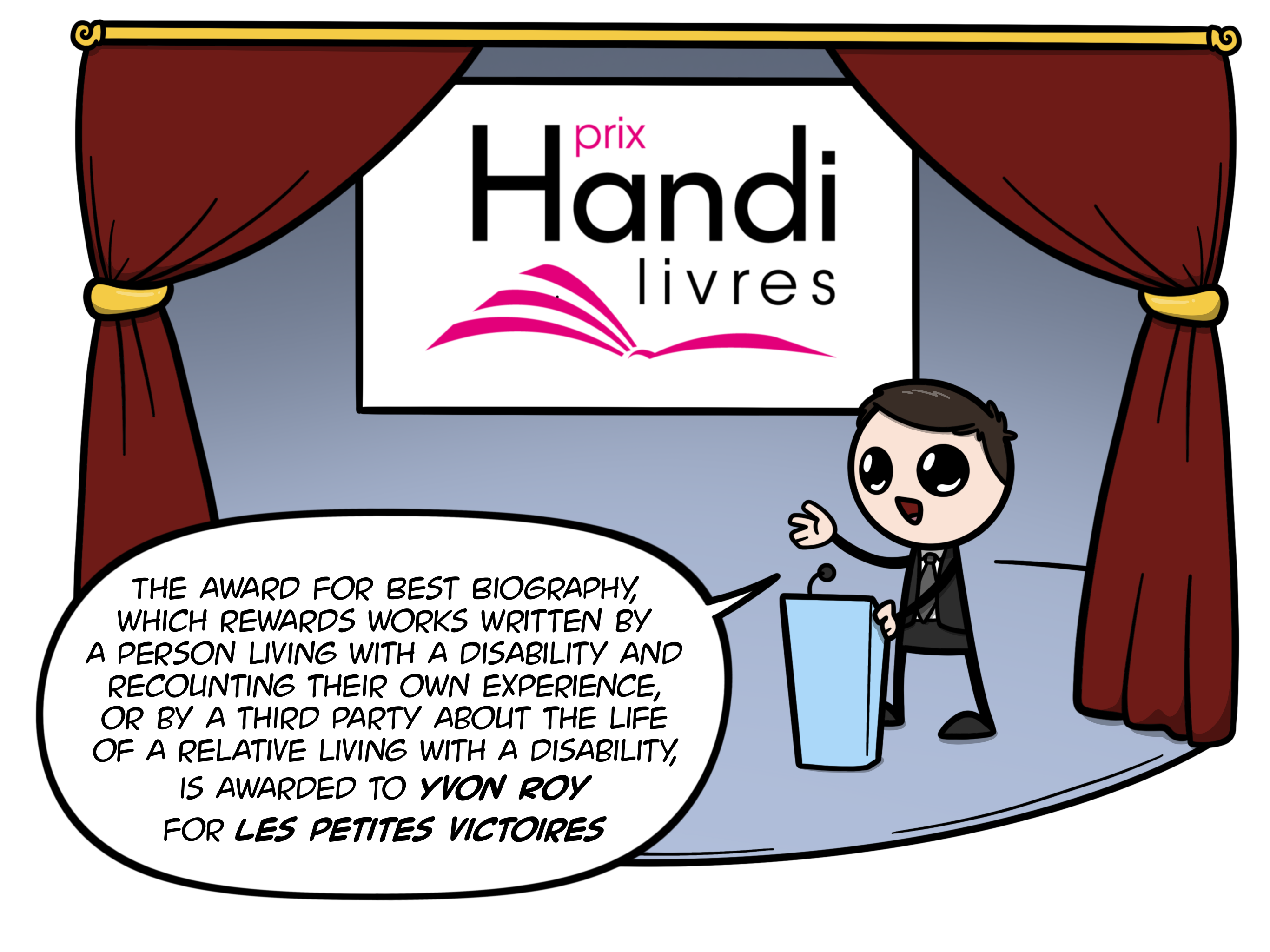
This comic book is an example of a creation that is easily accessible to the general public that has been awarded and highly publicized - even winning an award that recognizes works written by a person living with a disability and recounting their own experience, or by a third party about the life of a relative living with a disability. In 2018, the publisher Rue de Sèvres announced a contract for a film adaptation, which caused reactions and led to the hashtag :
#boycottlespetitesvictoires
As we will show, this is an example of the social representations of autism that perpetuate dominant understandings that do not fit the lived experience of those directly concerned to the point of being discriminatory. It is also difficult to identify moments when the child (the autistic character) shows agentivity. Instead, he’s passive in his father’s story. In a way, Olivier is only a supporting character. This is exaclty why representation doesn't mean autorepresentation and why "nothing about us whitout us" matters: although this comic is presented as a positive narrative from the allist perspective (3rd person), the story is completely different from the standpoint of the autistic community’s testimonies (1st person).
An allist person is a non-autistic person.
To understand the term "allist", we must go back to the origin of the word "autistic" which comes from the Greek word "autos" which means "self". So the word "autistic" initially referred to a person withdrawn on themself, who lives in their own world. The term "allist" appeared in a satirical article to refer to non-autistic people by swaping “autos” for "allos" which refers to others. So an allist is a person who is focused on others or, to flip the usual narrative, a person who lives in other people’s worlds.
In spite of the satire, the term “allist” has remained in use among others because it allows to distinguish between "neurotypicals" and "allists". There are people who are not autistic, but who are not neurotypical: a non-autistic dyslexic person, for example.
For a deconstruction
of the problematic propositions of the comic book:
But do you know the story from the autistic community’s perspective?
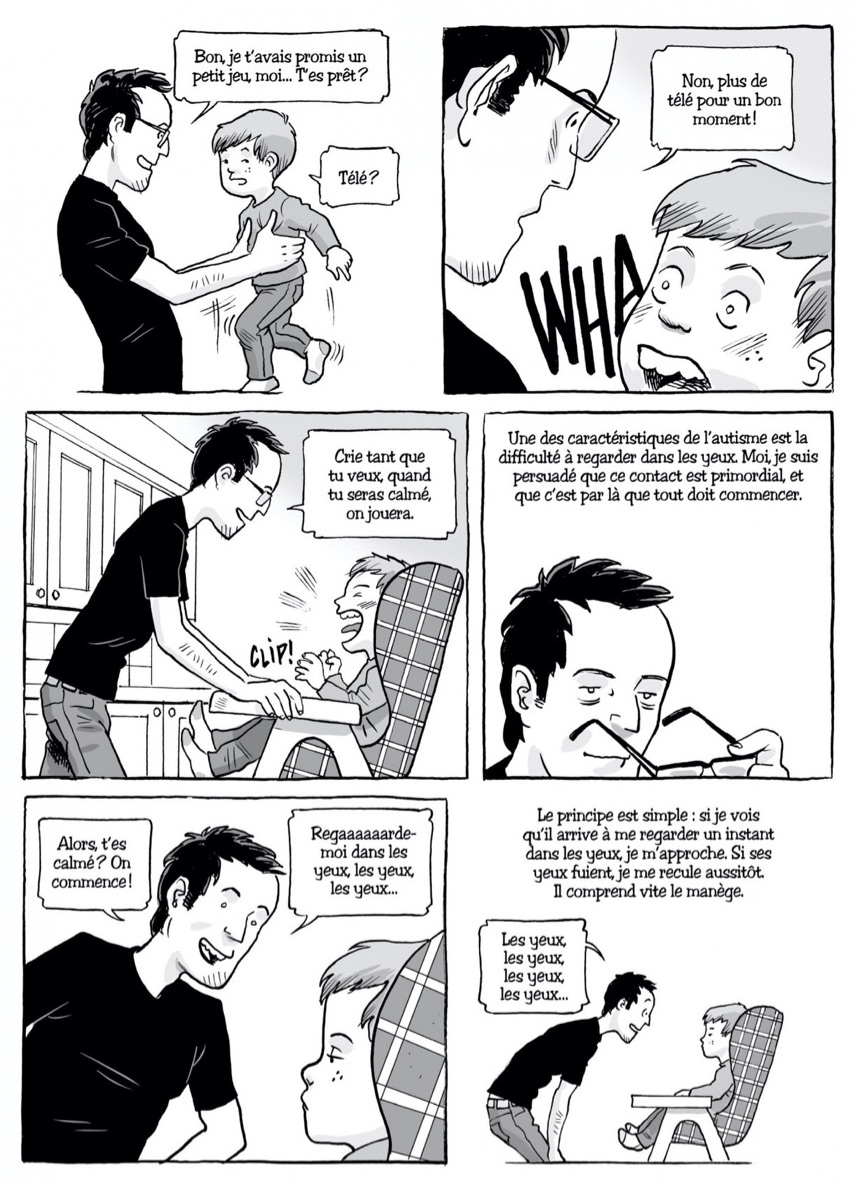
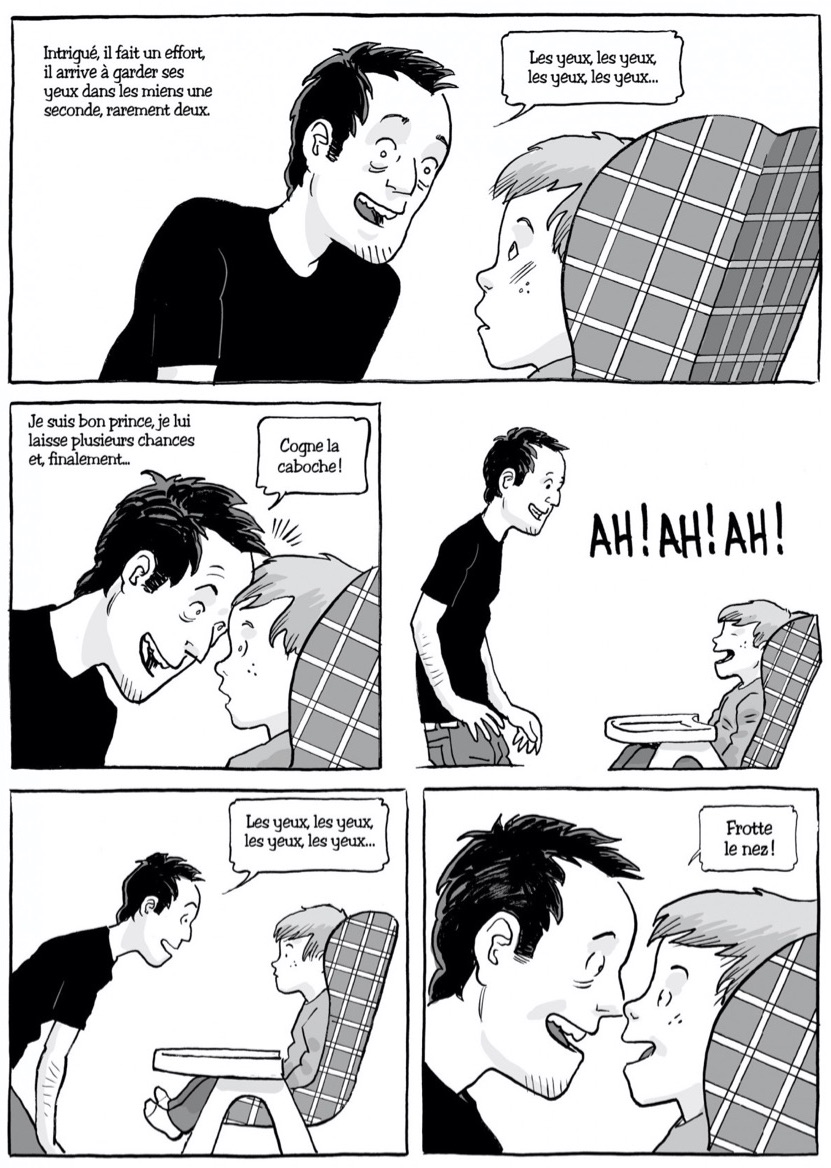
This is where webcomics can serve as an accessible tool that allows the reversal of dominant representations by opening the floor to self-representations directly grounded in marginalized communities. But before continuing with the topic of webcomics, we wish to feature an excerpt from Les Petites Victoires that addresses a frequent theme in autism: eye contact.
Excerpt on eye contact
English translation
English translation
Excerpt from Yvon Roy's interview
"I worked a bit like we can work to sometimes desensitize a substance. Sometimes certain people can have an allergy, we can try to desensitize them.
Several parents have contacted me regarding the trick to get the child to look in the eyes. This is the first thing we worked on together, that is to say, I considered that being able to look in the eyes - we know that autistic children have difficulty looking directly in the eyes - I said to myself, if we don't have eye contact, we have nothing. We need that, it's the beginning of human interaction." (our translation)
TW: The host uses the term “prison” in reference to autism:
"In your story that you shared with us in Les Petites Victoires, there is obviously the moment when you get up to face, to accompany your child in that reality: to learn to understand him too, inside what he lives and this prison, in a way, from which he is pressured which is basically this condition." (our translation)
Link to the interview (in French)
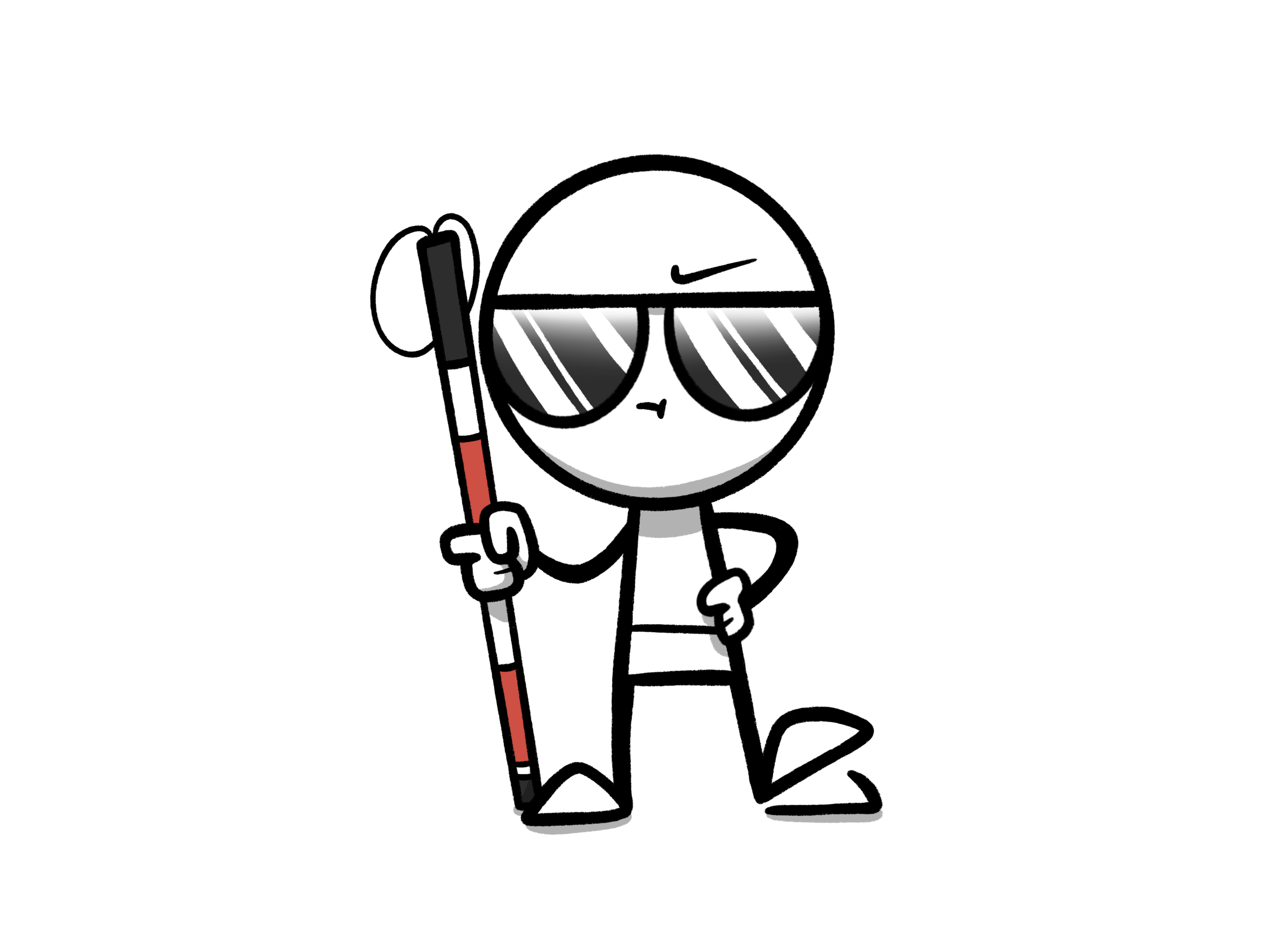
This scene is an example of neuronormativity
Recall that neuronormativity is the prevalent, neurotypical set of assumptions, norms, and practices that conceives of neurotypicality as the only acceptable or superior mode of cognition, and that stigmatizes attitudes, behaviors, or actions that reflect atypical modes of cognition as deviant or inferior.
This scene is told from the allist perspective and is presented with a positive outcome. In fact, as the author mentions, parents have applied this technique with their autistic children after being inspired by it.
But what if we ask autistic people how they feel about eye contact? That's exactly what we are going to do.
PART II
Why webcomics?
The medium of webcomic enables me to do something I don't know how to do otherwise: share how things feel on the inside.
Imagine. You come across a newspaper at the local coffee shop and recognize the face of a well-known personality. Yet you can't remember their name. It annoys you, you know you know it, it’s just not coming out, it stays there, on the tip of your tongue. You have time to come back to work, coffee in hand, and the name still hasn't come back to you, it still annoys you. You come across a colleague and you ask them, you describe the person, maybe clumsily at first (it would be so much easier with their name!), but you adjust to your interlocutor and, together, you can finally recall their name, it was so obvious!
It’s important to emphasize this feeling of annoyance. We rarely take the time to mention this annoyance when talking about epistemic injustices. Yet it is there, and it can even be painful: how do we make sense, to use Fricker's classic example, of our experience of sexual harassment when the concept does not yet exist? How can we share the feeling that something is wrong? This is where community comes into play and it is why the idea of "by and for" matters more than, say, a criterion of simplicity might. This is addressed by feminist epistemologies: for example, Longino argues for pragmatic values in science such as diffusion of power (as the importance of making research programs accessible to the actors involved in the research).
The impact of inadequate social representations on neurodiversity cannot be fully resolved by the traditional narrative of epistemic oppression and justice: adding new vocabulary to collective epistemic resources is not a panacea (we already have the word "autism" for example). So it is not only words that are missing, but rich and diverse lived experiences are also missing from the pool of shared resources.
The problem is that what is missing, the hermeneutical gaps, are not automatically apparent: social representations created by and for the dominant groups inadequately fill the hermeneutical gaps of marginalized groups. To that effect, let us recall here the Handi-Livre prize for the best biography which rewards works written by a person with a disability and telling his or her own experience, or by a third party on the life of a close relative with a disability: In the case of Les Petites Victoires, the award went to the biography of an allistic (non-autistic) person talking about autism. These inadequate social representations are difficult to resist: they are constantly and persistently reproduced. It is even harder when you don't have the words to replace theirs. But do we really have to wait for the right words to share our experiences? This is where illustration can become an attention grabbing action like shouting: an action that does not need words. This is what we propose here: a form of non-propositional epistemic resistance in response to hermeneutic injustice.
Webcomics are basically online comic books. They are mostly instantiated as short comics that take many forms and cover many topics. The most common form of webcomic is probably the blog (sometimes autobiographical, sometimes entirely fictional, sometimes both). Because they are mostly published independently by their artists, webcomics are an art form that is not limited by institutionalized power dynamics such as publishing houses or art galleries.
But the most important thing for us here is that webcomics are able to generate aesthetic experiences that allow viewers to better understand different aspects of the lived experience of neurodivergent people despite the inadequacy of mainstream epistemic resources.
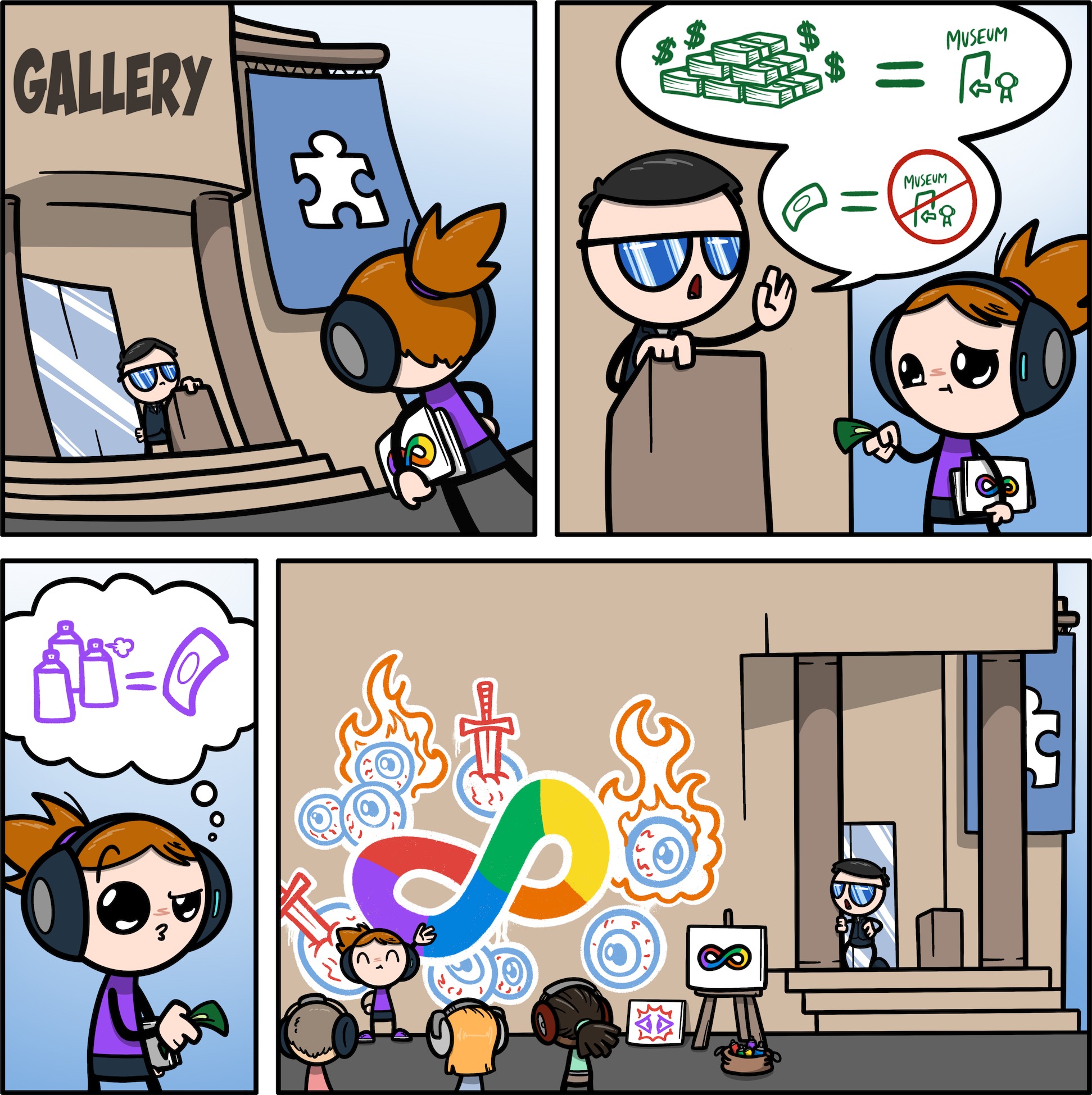
In some ways, webcomics are a digital version of street art.
Although limited to a given geographical space for street art and to a particular digital platform for webcomics, there is this common idea where it is not so much the public that goes to the creation as the creation that goes to the public. We are no longer in a reserved and predefined space like a museum, a bookstore, a gallery or even a library.
Although a recognized artist can make street art, it is more difficult for an artist who does not belong to a complex and influential network to access some places of diffusion such as an art gallery. Webcomic is thus added to the tools that allow the production, use and transmission of more accurate social representations, participating in the collective understandings of the oppressions suffered by epistemically marginalized groups. The public and interactional aspects of social media that support webcomics make them a catalyst for direct dialogue with (but also within and between) marginalized communities.
To put our epistemic resistance into action,
and to enhance our imaginative ressources, we chose to gather first-personal testimonies and descriptions of how eye contact can feel for autists.
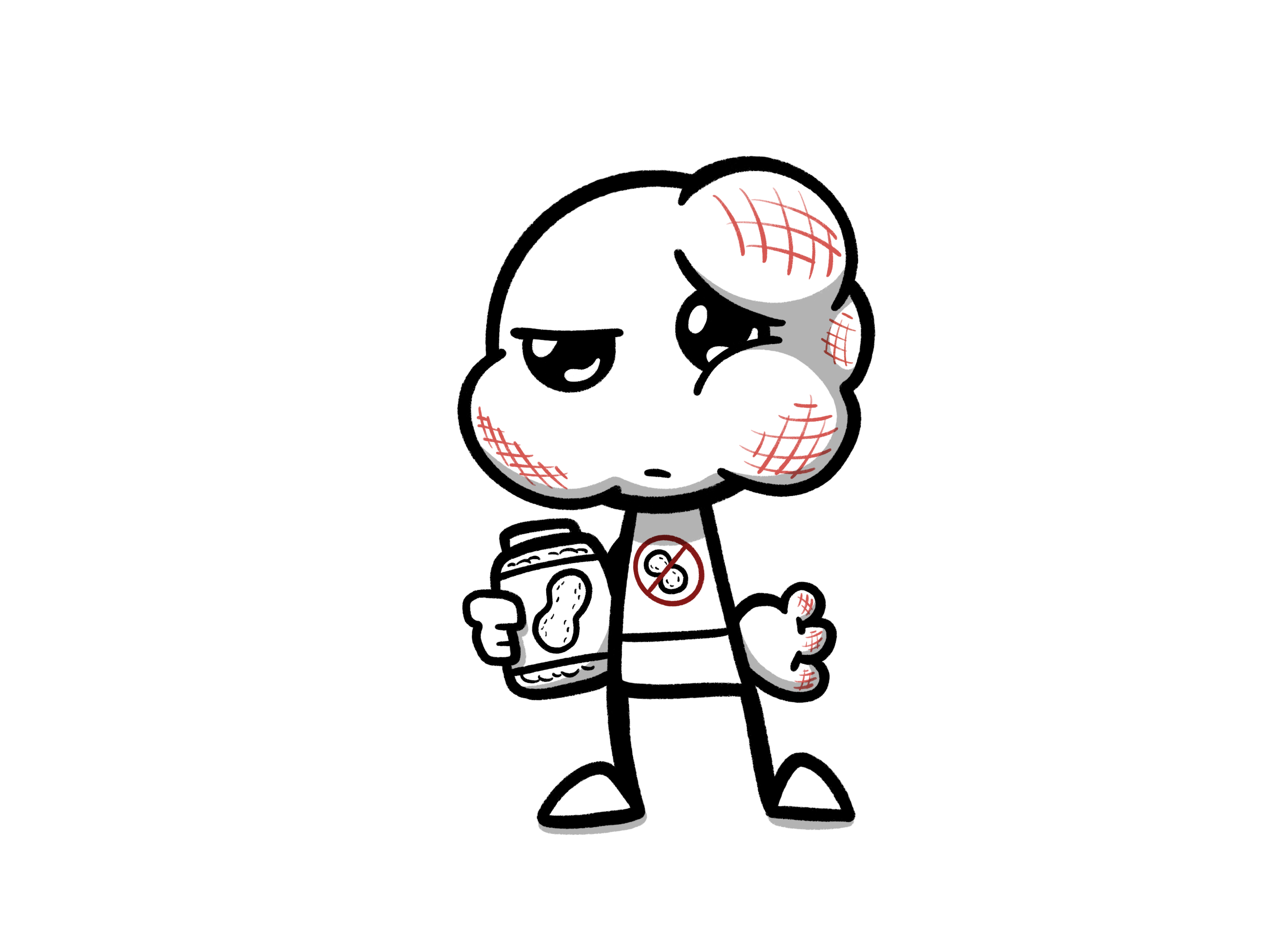
After all, who better to provide insight into a given lived experience than those who live it? To do so, we used social media (instagram and facebook) to ask autistic followers of our webcomic (@lilyspectrum): How does eye contact feel to you? Although we are neurodivergent, it was important for us to go with the community beyond our individual experiences. For instance, we would never have thought of the sunburn idea on our own, but once we read those testimonies, it felt right.
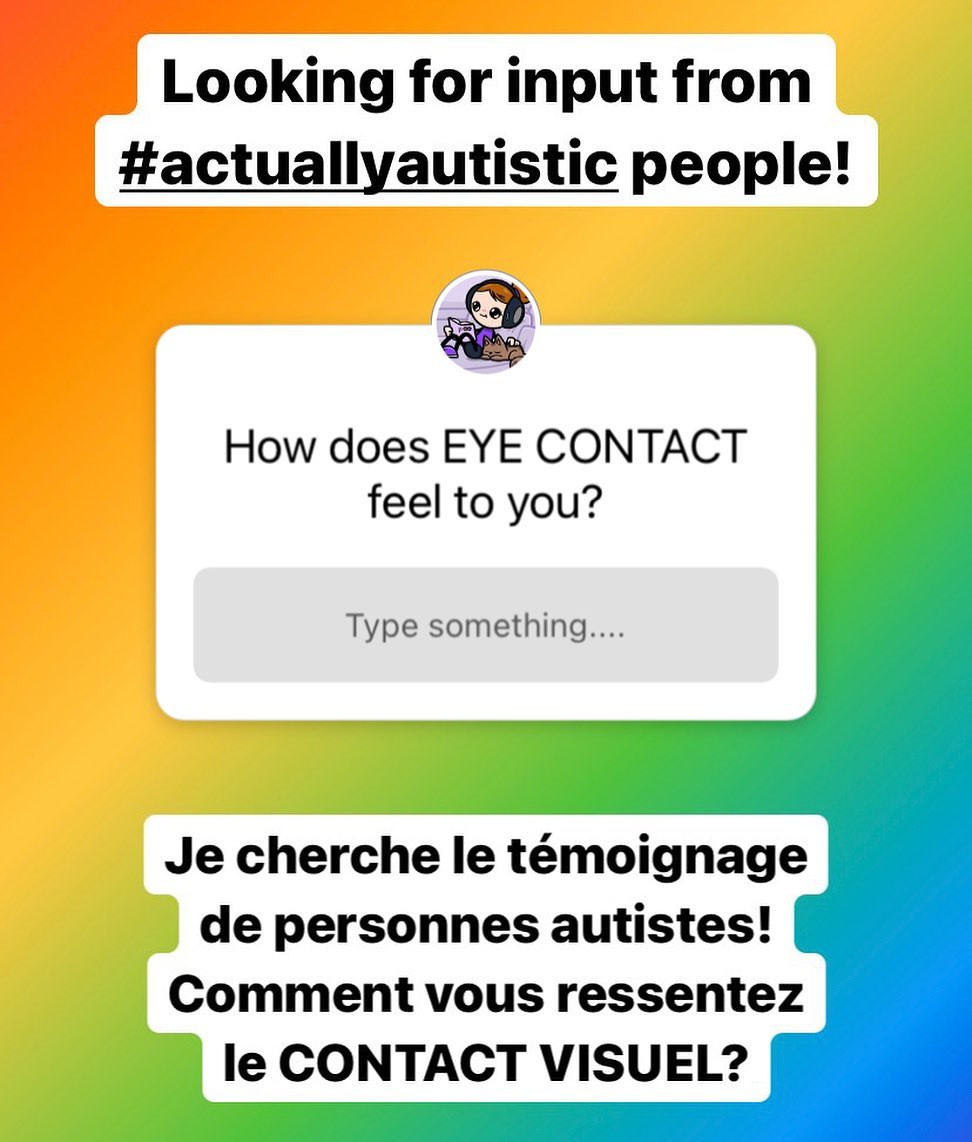
Both posts were made on November 8, and three days later, on November 11, we had received 175 testimonies. A few major themes emerged from these testimonies, which we used to base 7 webcomics or illustrations on. Keep in mind that, with this process, we do not claim to represent all there is to express about autists’ first-personal experience of eye contact. In fact, we suggest you visit these posts yourself to better understand the varied responses we got, and are still getting. And who knows, maybe this will allow you to add your own insight.
Publication
Since Monday, we have started to publish these comics on our social networks and we will continue to publish them in the following days
The interactions that take place around such webcomics are, we believe, an integral part of their complete aesthetic experience. These interactions often bring about clarifications, complementary details and descriptions or even added meaning. We thus invite you to visit these posts and interact with the community.
Webcomics
"I can do it but I can’t process anything else while doing it. My natural instinct and what feels the most right is to not look at someone’s face at all"
"It was drilled into me as a "rule" of politeness. I view it as just that, a rule. It's easy when there's multiple people because I can look around. But with one person, I have to look away or I end apparently end up staring"
"Everyone insisted on it, especially when they really wanted to correct a behavior or ensure I was paying attention. I honestly still don't love it, and prefer to look at noses or eyebrows to provide the impression I'm making eye contact"
"Eye contact was enforced during my childhood in mostly abusive ways and while it taught me to fake it, that made me hate it even more. Generally it just makes me uncomfortable and I find it quite distracting but it's also one of the most tiresome things to mask."
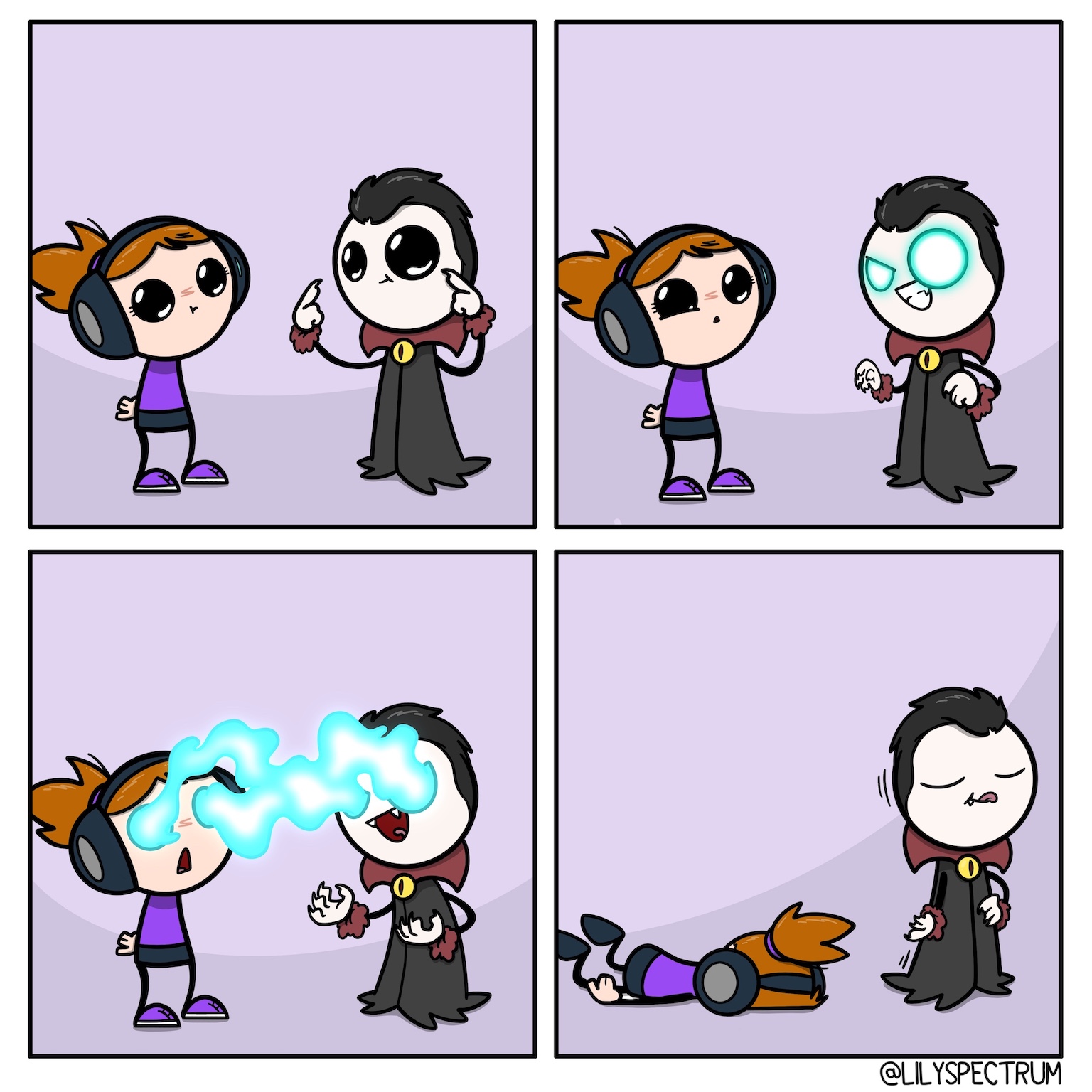
"Eye contact feels like they're staring into my soul, but with knives. I can make short eye contact before wanting to cry."
"It takes a concerted effort except for specific people."
"I’ve been so conditioned to make eye contact with people that when I met a lot of my friends for the first time they were kinda weirded out by me unblinkingly paying attention to them when they talked like 👁👄👁"
"It feels like someone is looking right past all my defenses and directly into my head. Not very pleasant."
"Terrifiant, j'ai vraiment l'impression qu'on me transperce à chaque fois …"
"Like I am being stabbed in the brain, itchy under the scalp, or suffocating. Anxiety is anxiety. I look at people's foreheads. They never know the difference but I am not forced to juggle the pain of eye contact and try to communicate. I am mostly non verbal and eye contact guarantees no words."
"Ça me met vraiment mal à l'aise et j'ai peur qu'on puisse mal interpréter si je regarde pas "correctement", je sais pas si je dois regarder quelqu'un dans les yeux ou combien de temps, il faut surtout pas que je regarde autre chose chez lui que ses yeux et du coup je sais pas quoi faire je préfère regarder le mur derrière mon interlocuteur 😂"
"Tout dépendra de la situation, de ma fatigue et de la personne. Certains contacts peuvent être transperçants (douloureux), d'autres envoutants (confusants), d'autres destabilisants (perturbants). En tous cas, si je regarde qqn dans les yeux, je suis sûr de perdre mon fil de pensée et/ou d'accorder mes réponses à ce que la personne ressent."
"Eye contact feels like burning discomfort, especially when I'm being told to do it."
"It’s extremely hard for me to maintain eye contact, and when people express to me that I should be looking at them when I’m talking to them, it puts me under more stress than just talking to them in the first place"
"somehow being told we should be making eye contact feels like being reprimanded as a child, at least to me.. I can't count the amount of times my mother would tell me to look her in the eyes as a child, and how humiliating/stressful it felt.. I legit forget to listen to people because I'm too busy trying to maintain eye contact."
"At best, awkward and uncomfortable. At worst, like someone's stabbed me in the eyes."
"It makes me uncomfortable but my mother forces me to look people in the eyes"
"Painful, but I feel like if I don't look ill be punished or called a liar. So I trained myself to look at something over their shoulder if not their foreheads to avoid harassment."
"Habituellement je regarde plutôt la bouche ou le nez des gens et ça semble passer crème pour donner l'illusion que je regarde dans les yeux (j'ai eu droit à l'expert en haute potentialité qui me disait que c'était impossible que je sois autiste car.. je le regardais dans les yeux ! Je regardais sa bouche depuis le début de l'entretien..). Je ne me force au contact visuel que de manière consciente et dans de rares cas précis : [suite]
(suite) par exemple si je suis attiré romantiquement par quelqu'un et désire que cette personne le perçoive (vu que le contact visuel accru est interprété de cette façon par beaucoup de neurotypiques). Mais cela reste un sacré effort et en général je détourne les yeux très rapidement, ça me met mal à l'aise, c'en est presque physique. Récemment un de nos profs en cours nous a fait faire une série d'exercices où on devait marcher vers quelqu'un/revenir à sa place à reculons en gardant le contact visuel constant avec cette personne.. je vous laisse deviner la torture que c'était"
"Transperçant!"
"J'ai l'impression que les yeux de la personne me percent à l'intérieur, je sais pas comment dire, c'est une sensation d'oppression aiguë."
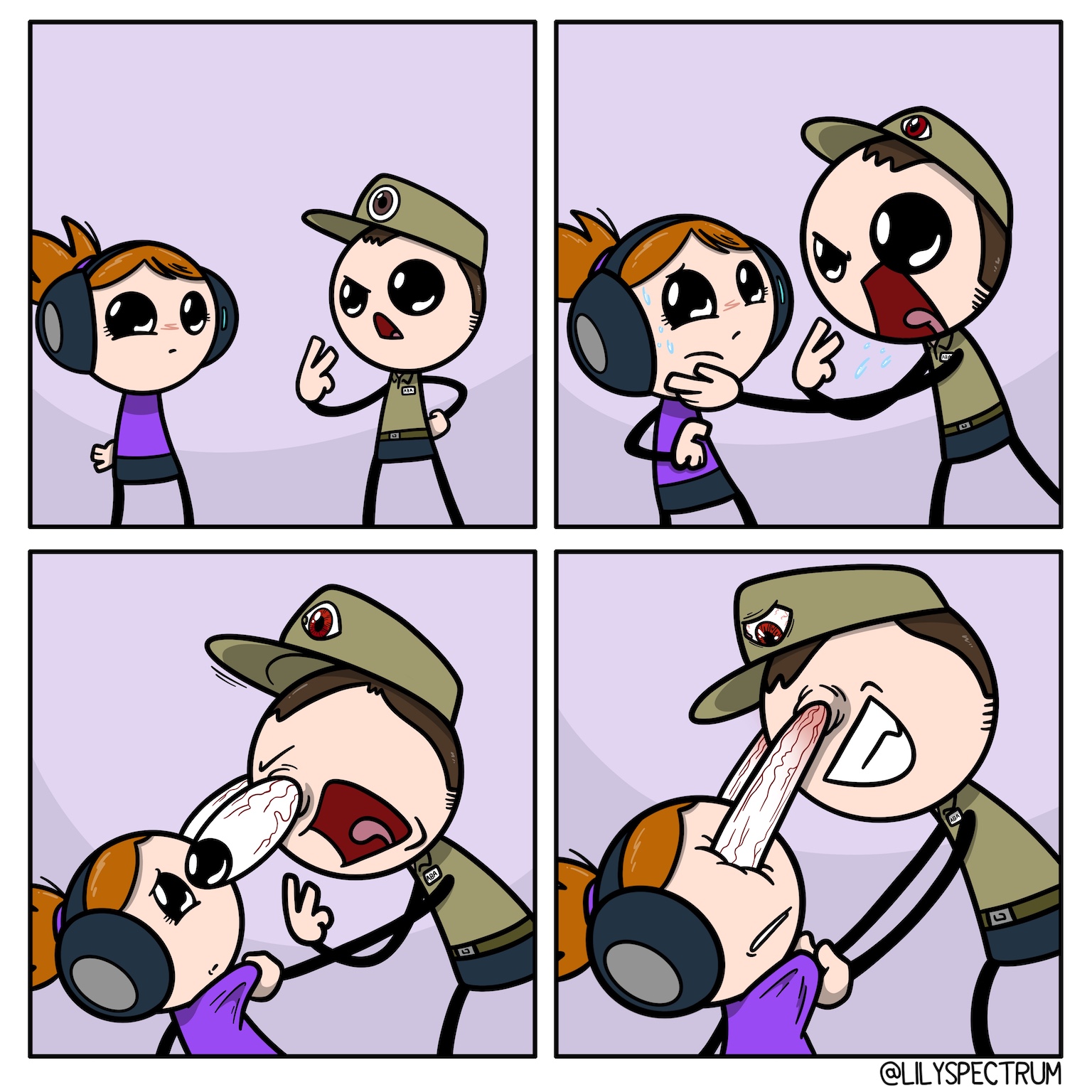
"For me, looking in the eyes feels too exposed and open. It makes me feel like I can't hide and protect myself from the people."
"Eye contact makes me uncomfortable most of the time, because of the feeling that I am being silently judged or getting talked about negatively."
"It's fine when I'm listening to someone but when I'm the one talking it makes me get stage fright like I'm being put on the spot to judge for performance lol"
"Too intimate, inappropriate… I become incredibly self conscious as well, like am I doing eye contact right? Should I be mirroring their behavior or a close approximation or complete opposite? How many times should I blink? Can they tell I’m faking this human interaction? It’s incredibly stressful."
"It feels like something is a required check box. It’s like a math problem. Look, one, two, three. Okay. Look away. Zone out if you need to. Okay, it’s been 10ish seconds. Look back. One, two, three.. okay, look away! Don’t share at them! Wait! You’ve looked away too long! Look back! …..it’s that on repeat quite often lol"
"I hate it I get so nervous and then I break down."
"I don't like it, makes me really uncomfortable. I'm "good at it", because I mask well (😬). I never know what to do, if I'm looking to much or not enough and always use a whole lot of energy just on eye contact. Generally, the more comfortable I feel the less I look someone in the eyes. (Also eyes as a body part make me feel really icky so that's that)."
"Intimidating and uncomfortable, I feel too vulnerable and keep thinking am I doing this right?"
"Ça me met vraiment mal à l'aise et j'ai peur qu'on puisse mal interpréter si je regarde pas "correctement", je sais pas si je dois regarder quelqu'un dans les yeux ou combien de temps, il faut surtout pas que je regarde autre chose chez lui que ses yeux et du coup je sais pas quoi faire je préfère regarder le mur derrière mon interlocuteur 😂"
"Eh bien, quand j’étais petit, je parlais et écoutais souvent le monde sans les regarder dans les yeux. Maintenant, ça me dérange pas de parler et écouter avec le contact visuel, mais j’peux très bien comprendre ce que le monde me dit sans obligatoirement les regarder dans les yeux. Aussi, c’est vrai que ça me rend un peu mal à l’aise quand des inconnus me fixe du regard. C’est comme s’ils me jugeaient et j’sais pas ce que j’ai fait de mal."
"Direct eye contact feels like I am being judged. It also makes me feel uncomfortable because I become unable to perceive and read the rest of their body language."
"Démunie, nue. Percée à jour. C’est très fort comme sensation, et rarement agréable. J’y arrive avec mes enfants ou mon mari, mais même dans ce cas, pas trop longtemps. Si je veux tenir une conversation, et me concentrer, alors je dois ruser. Je regarde entre les deux yeux ou le plus souvent la bouche."
"Feel nausea and anxiety, and extremely naked. Yet my mother was adamant that I learned it and therefore I am able to do it, despite the uncomfortable feelings. Absolutely love your work, for once I can tell that I am not alone"
"I feel instant stress and I have to force myself to do it and to look "natural"."
"Honestly, each time it happens to me, the most awkward feeling I have is « where should I look exactly » ? When you make eye contact, are you expected to focus one eye specifically (which one, then ?), between the eyes, not focus at all, or try a weird way of having each eye "looking" into the facing one (i.e. my left eye "looking at" their right one and vice-versa) ? I'm also never sure if/when eye contact is expected, and when it happens, is there/what is the hidden message behind this specific contact, and/or am I sending an incorrect hidden message myself ? Then, with all these questions actively consuming my brain "computing power", everything else totally miss the point (sometimes, though, I can hide this issue because I have this kind of ability to "replay" the last few words/sentence I unconsciously heard, to process it with a delay but potentially without the proper context- so it's not reliable at all !!). "
"Weird and artificial. I can actually read people's eyes now, but it took me years to learn it."
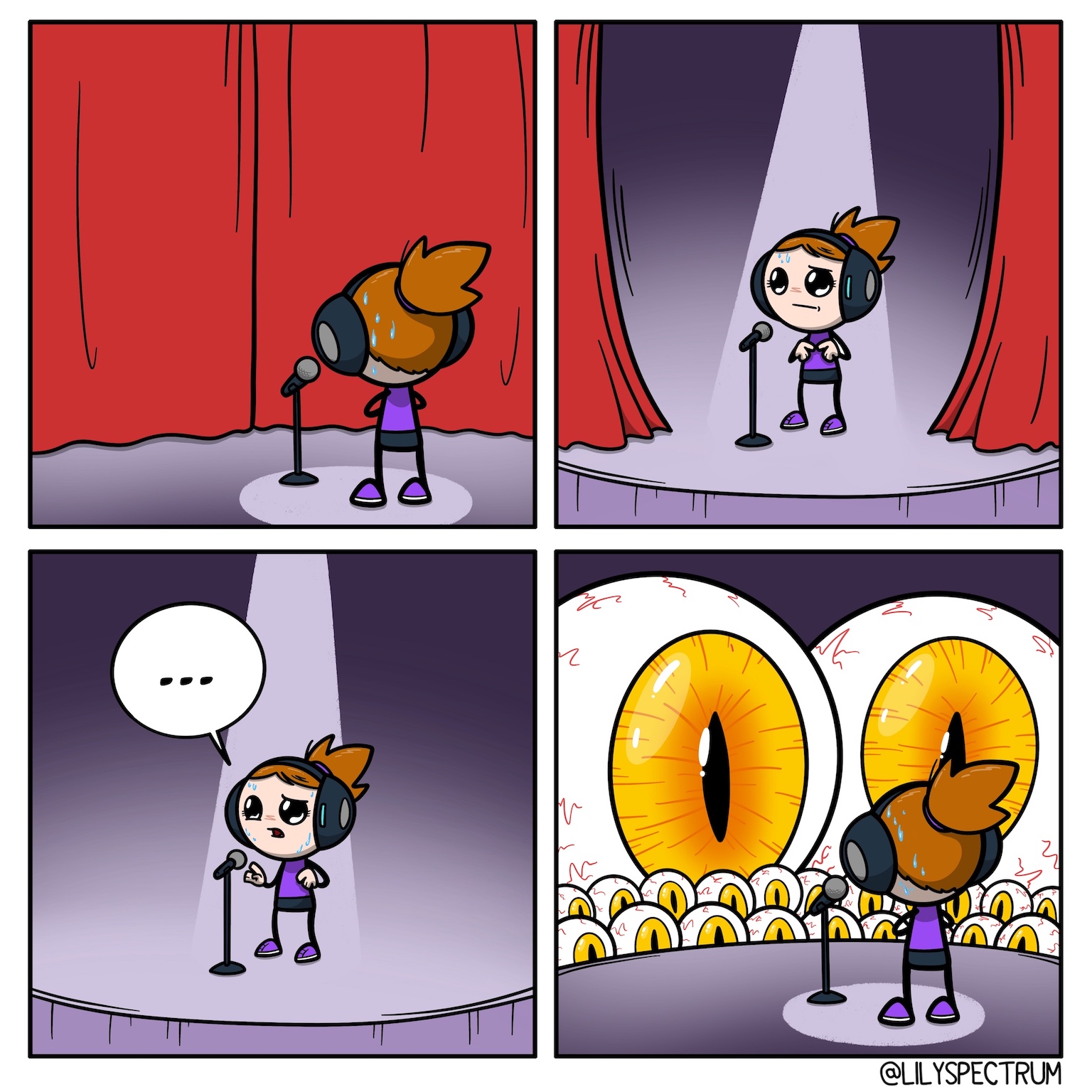
"My parents rasied me to always look into the eyes, still feels wrong. Like, I am invaiding a personal space and being rude. Like trying to stare down their soul and violating their privacy. I still try to look at people in the eyes but have learned to just looks in differents points in the face so I don't seem rude."
"Eye contact feels too intimate to me for most interactions. If I make eye contact with you, it’s because it’s important. "
"Eye contact feels very intimate. If I’m forced to hold it for too long, I feel violated, like I’ve been touched without consent."
"I really hate eye contact in almost all circumstances. About the only exception is with someone I'm very intimate with. Eye contact feels extremely intimate to me in general so it only feels natural when it's with someone I've got a suitably intimate emotional connection to. Otherwise it feels like I'm staring into someone's soul and I can see everything and they're staring into mine and seeing the same (even if I know they're not)."
"Invasive, extremely personal. I'm only comfortable looking my husband in the eyes"
"It feels like I’m standing too close to someone, I don’t know if that’s too vague of a comparison but it feels way too intimate. So I only do it when necessary or when I’m comfortable with that person."
"It feels creepy to me"
"I don't like it, makes me really uncomfortable. I'm "good at it", because I mask well (😬). I never know what to do, if I'm looking to much or not enough and always use a whole lot of energy just on eye contact. Generally, the more comfortable I feel the less I look someone in the eyes. (Also eyes as a body part make me feel really icky so that's that)."
"I hate eye contact. It almost hurts. But it’s nessesary to have a successful professional life, and my parents trained me well as a child. They would ask me people’s eye color after I met them to see if I made eye contact. Being trained like that at a very young age was incredibly difficult and felt unfair, but I’m very grateful that they pushed me now that I’m an adult."
"I can't do it, it makes me feel funny in a bad way and makes me feel kind of .. unsafe? and uncomfy I don't exactly know the word for the first one, I don't mind people looking at me but I won't look back"
"It's incredibly intimate and overwhelmingly so, particularly with strangers. And the more my emotions are revved up, the less I can tolerate it. It genuinely feels as though someone can see into my mind almost, even though I know that they can't. On the plus side, when I'm with someone I deeply, deeply love, sometimes that's okay because I want them to see how much I love them... but then that tends to make THEM feel awkward and uncomfortable too. LOL For me, it falls into the same category as standing too close, invading personal space, touching someone without consent etc. It's intimate, and can very easily become violating when you don't want it. And that;s so hard to explain to NT folk who expect you to look them in the eye all the time."
"It's okay with people I know, but I don't feel comfortable with eye contact with strangers, it almost feels like an invasion of privacy."
"eye contact feels so weird and creepy and if i have to make eye contact with someone, then ill quickly feel exhausted."
"It feels like a boundary rupture unless I completely and totally feel comfortable in a container of safety with another it probably won’t happen much."
"Well... I can't let anyone touch my eyeballs."
"Trop intrusif. Comme si l autre avait la perception de mes pensées. C est comme se montrer nue."
"Intense/ overwhelming/ fiery/ intrusive. Sometimes painful/ always difficult with strangers. Ok with intimate friends and family."
"Démunie, nue. Percée à jour. C’est très fort comme sensation, et rarement agréable. J’y arrive avec mes enfants ou mon mari, mais même dans ce cas, pas trop longtemps. Si je veux tenir une conversation, et me concentrer, alors je dois ruser. Je regarde entre les deux yeux ou le plus souvent la bouche."
"Feel nausea and anxiety, and extremely naked. Yet my mother was adamant that I learned it and therefore I am able to do it, despite the uncomfortable feelings. Absolutely love your work, for once I can tell that I am not alone"
"confronting and very intimate ..i feel naked"
"Quelque chose d'extrêmement intime, que je ne peux pas partager avec n'importe qui sinon je suis déstabilisée car je bloque sur cette sensation d'intimité forcée. Depuis le diagnostic, je me permets de ne plus regarder le visage des gens (je ne travaille pas). Quel soulagement!"
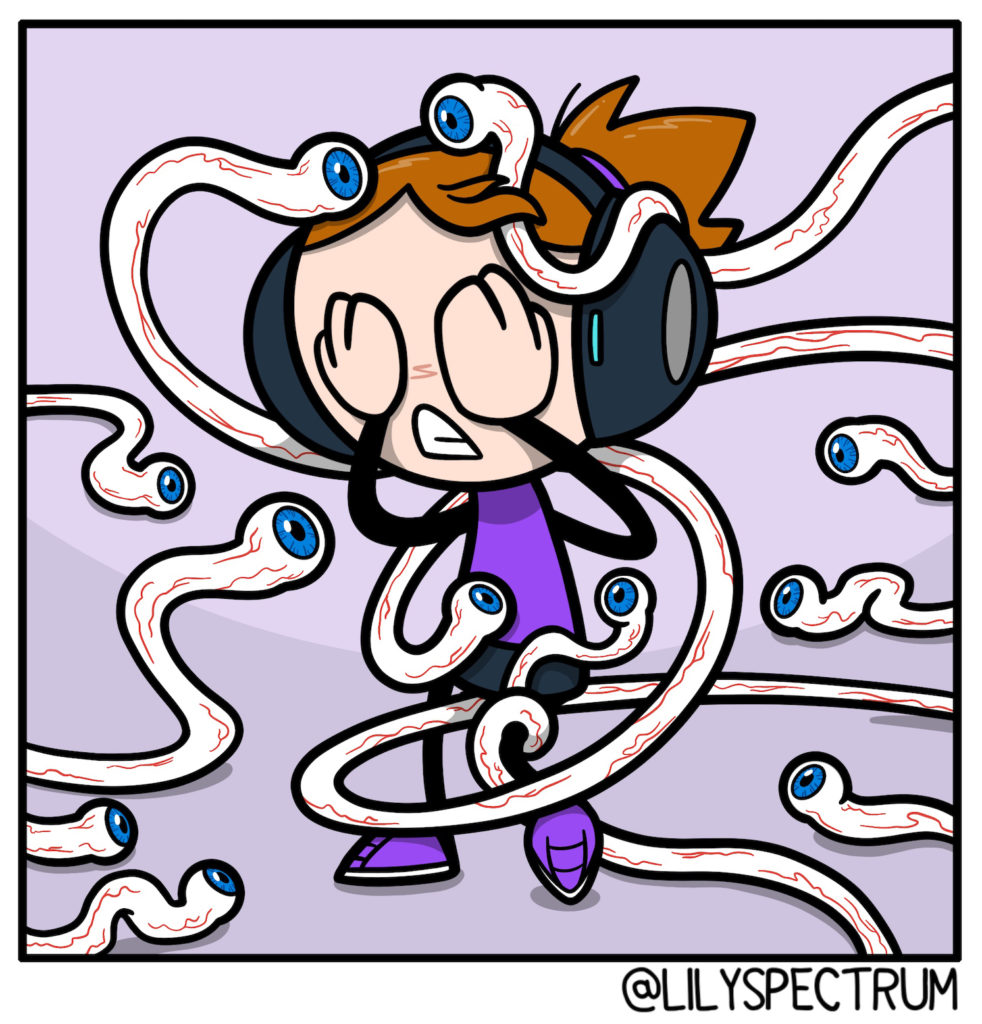
"Eye contact feels like they're staring into my soul, but with knives. I can make short eye contact before wanting to cry."
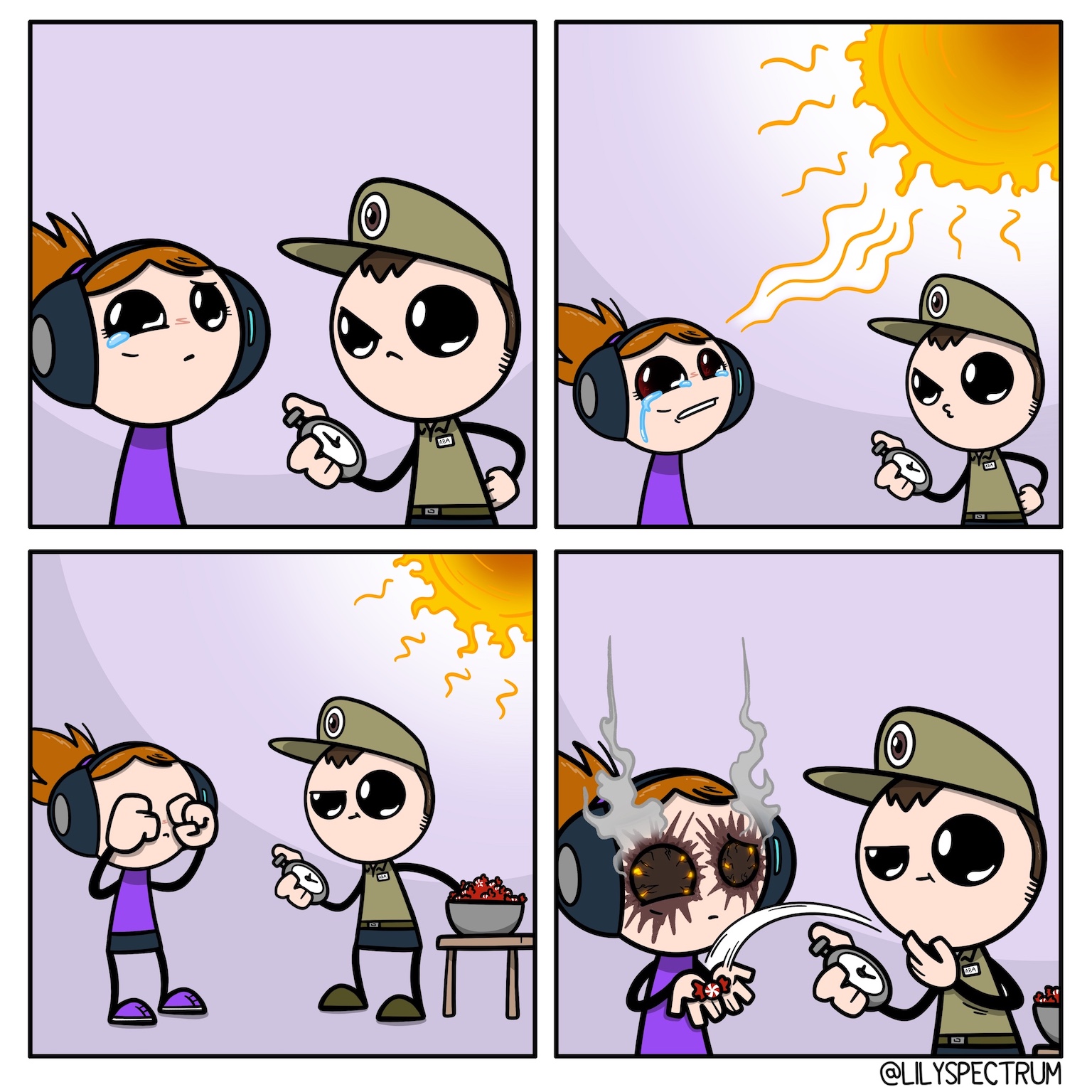
"It’s like being asked to look directly at the sun. I flinch, I can’t do it…"
"It feels like they gonna shoot me with laserbeams. Like Cyclops from X-Men. I van handle it for 10 seconds. I get panick attacks of it's to long. Even with my bf makes me on edge. I got a major panic attack during a being social etc exam (idk how it's in English is). It was so bad. They let me past because otherwise i needed to do the whole year over."
"Feels like I’m staring at the sun and I can only look a person in the eyes for 30 seconds or so before my eyes start to hurt a bit. I can only look animals in the eye."
"Like flames of intense awkwardness are scorching my retinas."
"When I was younger I always had trouble making eye contact. I’ve gotten better at it in recent years but its still painful to me."
"Eye contact feels like burning discomfort, especially when I'm being told to do it."
"Ça me demande beaucoup de concentration. J'ai l'impression que ça me fait mal aux yeux et quand j'étais plus jeune je pouvais même ne plus vraiment entendre ce que la personne me disait. Par contre ce n'est plus un problème quand je me mets vraiment en colère au point de vouloir me battre."
"Ca va de la gêne à la sensation de brûlure, ça dépend des personnes je suppose. On peut parfaitement regarder le nez, la bouche, entre les yeux sans que l'autre ne sen rende compte."
"I can’t think if I have to. Feels like pressure."
"Bad, I feel like my head is going to explode if I look at someone's eyes for too long. I suspect it's probably a blood pressure drop or adrenaline, but it feels awful. I honestly don't get why so many people require eye contact when speaking. I can make eye contact, but it's really difficult to understand what the person is saying because I'm too focused on how uncomfortable I feel and how incredibly awkward it is to stare at someone's eyes"
"It feels literally painful and I’m always afraid the other person can tell what I’m feeling/thinking. I’m comfortable with eye contact with very trusted folks in my life though."
"Painful"
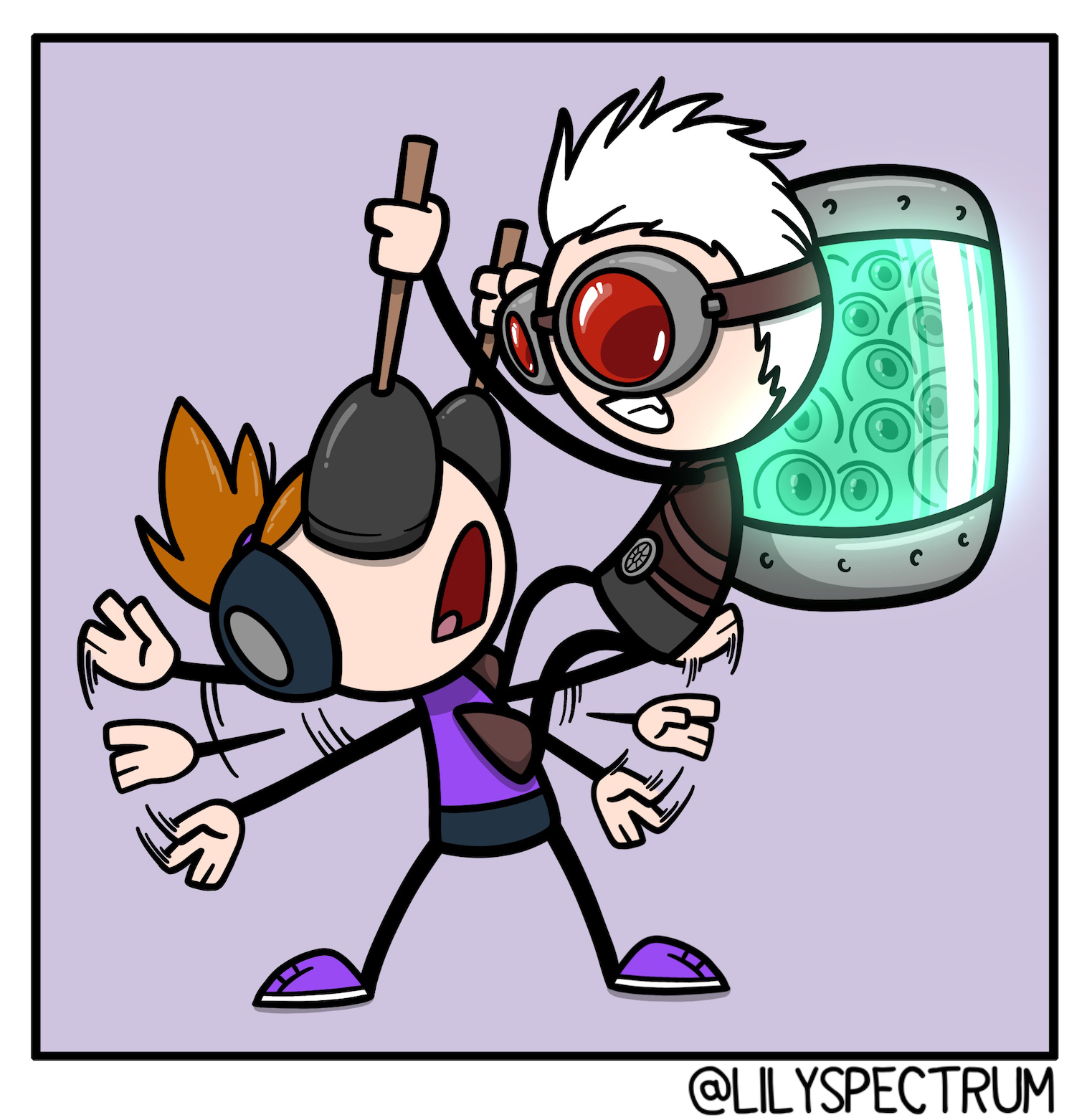
"I really hate eye contact in almost all circumstances. About the only exception is with someone I'm very intimate with. Eye contact feels extremely intimate to me in general so it only feels natural when it's with someone I've got a suitably intimate emotional connection to. Otherwise it feels like I'm staring into someone's soul and I can see everything and they're staring into mine and seeing the same (even if I know they're not)."
"I cant make eye contact with literally anyone. Its uncomfortable, and even when its not, i cant listen proberly to what people are saying when i focus on the eyes. I just cant do it at anytime with anyone, only for one second maximum. Its like staring into someone's soul, its too much."
"J’ai l’impression d’être absorbée par les yeux de la personne et en même temps comme si on pouvait voir ce qu’il y a à l’intérieur de moi."
"honestly it feels like i am being sucked into their soul… i can’t maintain it if i want a conversation because i just get lost"
"Like someone staring at my soul? I almost feel like that's the part of masking that exhausts me the most!"
"It's uncomfortable. But sometimes if I want to intimidate someone I stare deep into their eyes and make them feel unnerved like I'm looking into their soul."
"Tout dépendra de la situation, de ma fatigue et de la personne. Certains contacts peuvent être transperçants (douloureux), d'autres envoutants (confusants), d'autres destabilisants (perturbants). En tous cas, si je regarde qqn dans les yeux, je suis sûr de perdre mon fil de pensée et/ou d'accorder mes réponses à ce que la personne ressent."
"Trop intrusif. Comme si l autre avait la perception de mes pensées. C est comme se montrer nue."
"J’ai l’impression d’entrer dans l’âme de la personne. Je trouve ça trop privé. Alors je ne regarde que ceux dont j’ai vraiment envie de découvrir ce qu’il y a au plus profond d’eux même"
"I'm okay with it for small periods of time, but if it's more than a minute, I have to look away, it makes me super uncomfortable after that"
"It took me around 2 years to be able to do eye contact (kind of struggle still-) but normally if im uncomfortable looking at the eyes, ill just look at the nose instead"
"Awkward. The longest I can probably do it is for a few seconds, but sometimes it’s physically impossible for me to look someone in the eyes even for one second."
"Ça me met juste très mal à l’aise, et du coup je préfère regarder ailleurs et ne regarde les gens dans les yeux s’iels ne me regardent pas."
"Incapable de soutenir un eye contact sauf avec certaine personnes... Ma famille (ma mere, mon pere, ma soeur), ma nièce, mon beau frère et mon conjoint. Quelques amis specifique aussi... Mais sinon incapable. Je chercher tjrs a "évader" ses eye contact."
"Uncomfortable. I have trouble maintaining eye contact for long, especially in a conversation. However, I did figure out that talking with your hands is a great way to distract the other person's eyes from your and gives you a reason not to look at them."
"havent made eye contact with anyone (while i'm talking to them, that is) except my cats in years if that tells you anyone"
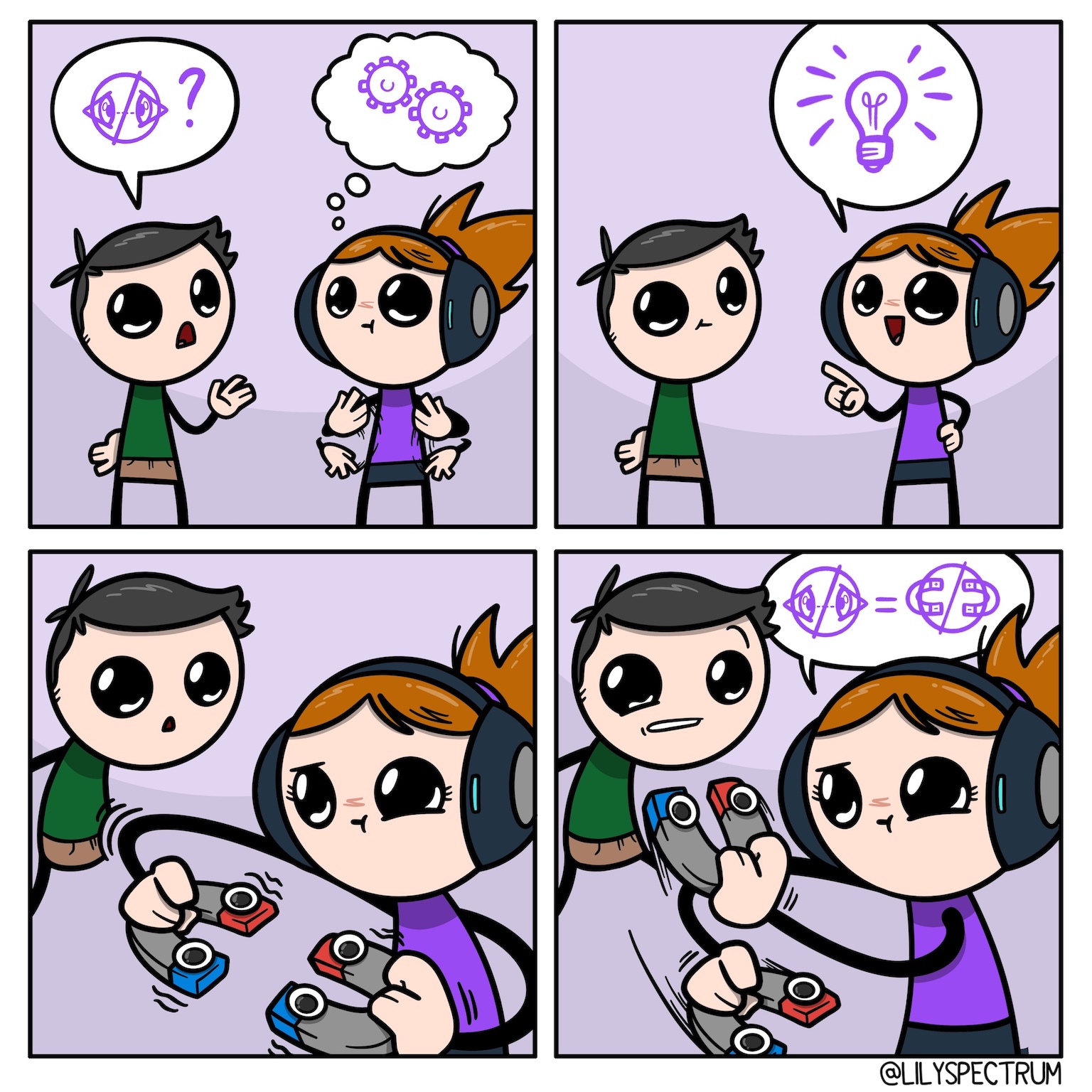
"When I was younger, it used to feel like when you held two magnets together both ends the same, it felt like no matter how hard you held them together, it would want to repel forcefully, my head wanted to repel and look past to the left or right or down or up like a magnet would, and when I managed to hold it against that feeling, my eyes would water up, not tears from sadness or anything, but they released tears, now I can manage it but it's still not comfortable to do, it depends on how comfortable I feel with the person or people or how stimulated I feel in an environment"
"It’s like when you hold two magnets with the same polarity against each other. Even if you want to put them together they won’t do it. The magnets are like my eyes. They just can’t center on the other persons eyes or it will cost a lot of energy. Like with holding magnets with the same polarity together. It’s just all in all very uncomfortable and draining. Btw I’m undiagnosed so I hope I can still answer here. Also I really really love your account and the stuff you do ^^ /g"
"Ça me met vraiment mal à l'aise et j'ai peur qu'on puisse mal interpréter si je regarde pas "correctement", je sais pas si je dois regarder quelqu'un dans les yeux ou combien de temps, il faut surtout pas que je regarde autre chose chez lui que ses yeux et du coup je sais pas quoi faire je préfère regarder le mur derrière mon interlocuteur 😂"
"Je me sens obligé de regarder chaque personne dans les yeux mais aussitôt que le contact est réciproque je baisse le regard aussi vite que mon ombre ainsi j'ai l'impression que j'ai fait ma part! haha! Par contre avec le monde avec qui je suis très, très à l'aise je vais quelque fois fixer les yeux, on dirait que j'essaie de comprendre pourquoi je fuis ceux des inconnus, alors je fixe en grand questionnement interne!"
"Awkward and physically painful , strong need to move my eyes away from it"
"Souvent trop intense… Et en plus il se passe tellement de choses autour des yeux qui m'intéressent plus et/ou me sécurisent plus! Je fixe puis je zappe, j'y reviens et je rezappe… Les sourcils, les lunettes, sont des bons compromis aussi, ou fixer mon regard dans le vague direction le visage ou le pourtour du visage… Ou fixer le visage avec une attitude très intéressée (posture corporelle de l'attention soutenue) quand la personne regarde AILLEURS, et quand son regard se tourne vers moi, fixer 1s seconde, sourire, et me tourner ailleurs vers qqn d'autre qui parle mais ne regarde pas vers moi à ce moment là, ou trouver à m'occuper avec un objet, et jongler comme ça."
"Je n'aime pas regarder sans les yeux, je ne sais pas, c'est plus fort que moi, je suis mal à l'aise, je ressens le besoin de regarder ailleurs. Du coup j'aime bien discuter quand je suis au resto ou quand on fait une activité, il y a l'excuse d'être occupée en même temps pour ne pas se regarder"
"Habituellement je regarde plutôt la bouche ou le nez des gens et ça semble passer crème pour donner l'illusion que je regarde dans les yeux (j'ai eu droit à l'expert en haute potentialité qui me disait que c'était impossible que je sois autiste car.. je le regardais dans les yeux ! Je regardais sa bouche depuis le début de l'entretien..). Je ne me force au contact visuel que de manière consciente et dans de rares cas précis : par exemple si je suis attiré romantiquement par quelqu'un et désire que cette personne le perçoive (vu que le contact visuel accru est interprété de cette façon par beaucoup de neurotypiques). Mais cela reste un sacré effort et en général je détourne les yeux très rapidement, ça me met mal à l'aise, c'en est presque physique. Récemment un de nos profs en cours nous a fait faire une série d'exercices où on devait marcher vers quelqu'un/revenir à sa place à reculons en gardant le contact visuel constant avec cette personne.. je vous laisse deviner la torture que c'était"
"Lorsque c'est quelqu'un avec qui je suis à l'aise ca va à une certaine distance mais de trop prêt je ressens un malaise assez vite. Si j'ai le malheur de croisé le regard avec un(e) inconnu(e) dans la rue ou dans un commerce, je regarde ailleurs aussitôt, gros malaise. C'est pour ça que j'évite de regarder les gens."
Thank you for joining us in this exploration!
We hope this experience was (and will be) as enriching for you as it was for us to come up with. We invite you to engage with us and the community through our posts or in the comments bellow!
ติดตั้งไฟหน้ารถ LED เสร็จแล้ว ขับออกไปลองเลย! ไฟ led รถยนต์
Thanks for the useful post. More like this at tubidy for mobile devices .
Действующие альтернативные домены официальных игорных заведений на типпи РІС…РѕРґ обеспечивают устойчивый подключение к азартным сервисам. Принцип копирования формирует точные дубликаты базового веб-площадки с удержанием всех опций.
Алгоритм оформления профиля через альтернативный домен в точности дублирует оригинальную анкету. Новые геймеры указывают действующий email, генерируют стойкий шифр и устанавливают базовую платежное средство.
Идентификация аккаунта требует представления удостоверений опираясь на KYC-нормам. Фото удостоверения личности, валидация регистрации и банковские координаты проходят программную контроль в течение 24-72 часа.
Авторизация существующих игроков осуществляется через стандартную форму с усиленной валидацией. Временные токены поступают на смс девайс или почтовый ящик.
Механизмы входящего модуля через зеркала содержит востребованные платежные сервисы. Visa, Mastercard, веб кошельки Skrill, Neteller, crypto Bitcoin, Ethereum реализуются с сокращенными сборами 0-3%.
Игровая коллекция воспроизводится абсолютно включая барабаны, традиционные геймплей, live-операторов и мегавыигрыши. RTP-индикаторы, колебания и вейджер фиксируются аналогичными.
Промо система работает аналогично главному порталу. Welcome-бандлы, даровые прокруты, денежный возврат и VIP-схемы активируются машинально при реализации прописанных критериев.
Thanks for the detailed guidance. More at https://x.com/gkontosroofing .
I do accept as true with all the ideas you have offered to your post.
They’re really convincing and can certainly work.
Nonetheless, the posts are very quick for novices.
Could you please prolong them a bit from subsequent
time? Thanks for the post.
Современные провайдеры беттинг услуг гарантируют беттерам вход к элитному азарту через надежные миллион казино порталы. Лицензированная операционная активность влечет исполнения строгих надзорных стандартов.
Система регистрации клиентского кабинета включает проверку индивидуальных сведений. Провайдеры задействуют углубленные системы KYC и AML для недопущения поддельных платежей.
Цифровые платформы актуальных развлекательных порталов базируются на надежных серверах с HTTPS стандартами. IP-фильтрация вынуждает операторов создавать дублирующие ссылки.
Зеркальные порталы формируют полные репликации главного платформы с фиксацией всех возможностей и сведений. Пользователи приобретают непрерывный соединение к депозиту, игровой данным и пользовательским установкам.
Денежные процедуры осуществляются через встроенные платежные шлюзы. Пределы на пополнения и обналичивания фиксируются в соотношении с правовыми критериями и собственными правилами снижения потерь.
Квалифицированные беттеры рекомендуют анализировать положение авторизации через государственные списки азартных организаций. Престижные характеристики содержат ранги на экспертных порталах и мнения подлинных пользователей.
Thanks for the clear guidance! For reporting to HR vs. manager in Atlanta, see Work injury lawyer .
Don’t wait for swelling to go down to get checked. accident lawyer recommends early evaluation.
It feels reassuring knowing there exists such supportive environments aimed strictly towards enhancing confidence levels amongst individuals navigating through journeys commencing right here within familiar grounds belonging solely within quaint little Clear Braces
In the modern digital landscape, the era has brought forth a revolution in how we perceive intimacy and adult content. Sites like sex tube, https://valetinowiki.racing/wiki/Watch_Exclusive_Sex_Videos_For_Young_Champions have become an oasis for those seeking diverse and engaging material. The extensive array of content available caters to various preferences, allowing users to explore their desires without judgment. As societal norms surrounding adult entertainment continue to fade, more individuals are embracing the benefits of such platforms.In addition, the user-friendly interfaces of these sites enhance the overall experience. Visitors can easily search for specific categories or genres, making searching a breeze. Additionally, the community aspects of many of these sites allow for interaction among users, fostering a sense of belonging and shared interests.With security at the forefront, many sex tube platforms prioritize user safety. This commitment ensures that individuals can enjoy explicit entertainment without fear of exposure or backlash. As technology advances, it will be fascinating to see how the landscape of adult entertainment continues to evolve, maintaining its role as a significant aspect of contemporary culture.
Solid tactics for founder earnouts. We tie to controllable metrics at Business Acquisition Training .
Ориентирование в сфере официальных порталов включает владения передовых способов подключения. Квалифицированные игроки используют tip top casino для приобретения релевантной информации о работающих ссылках.
Процедура формирования профиля в проверенных операторах подразумевает тщательную валидацию. Новейшие провайдеры используют KYC-механизмы и AML-требования. Документальная процедура занимает от 24 до 72 промежутков.
Компьютерные способы для избежания препятствий прогрессируют сообща с укреплением законодательных решений. VPN-сервисы категории premium дают безопасность AES-256 и системы OpenVPN. Непрерывность соединения критически существенна для высокоролловых игровых периодов.
Запасные домены действуют через локально расположенные IT мощности. CDN-системы обеспечивают оптимальную отклик для глобальных клиентов. Программное роутинг включается при идентификации барьера главного ресурса.
Банковские движения в сертифицированных зонах подчиняются конкретным критериям PCI DSS. Цифровые платежи увеличивают актуальность в результате секретности и оперативности процессинга.
Портативные утилиты топовых брендов объединяют голосовую авторизацию и push-сообщения для ключевых ситуаций. Настраиваемый оформление самостоятельно корректируется под особенности матрицы.
Just had my first appointment at a dental clinic in Edinburgh, and it was a breeze! Thanks to Invisible Braces for making it so easy.
Appreciate your emphasis on hiring local contractors familiar with our climate here in Southfield! Will check out recommendations at Home improvement Southfield MI !
Your insights into DIY skincare are refreshing! I’m interested in finding ingredients online, especially from beauty salon barnsley .
Проверенные провайдеры азартных услуг дают пользователям право к качественному азартному досугу через профильные домены, включая лаки Р±РёСЂ казино , которые точно выполняют мировые стандарты защиты.
Схема создания аккаунта включает внесения валидационных данных через безопасные SSL-протоколы. Менеджмент требуют документальное verification age verification и локации регистрации для поддержания legal норм.
Многоуровневая проверка выступает обязательным составляющей современных систем безопасности. Users обретают SMS-шифры, push-оповещения или эксплуатируют targeted программы вроде Google Authenticator.
Дублирующие ссылки ликвидируют проблемы geographic санкций и DDoS-штурмов. Технически дубли образуют идентичные реплики основного портала с maintaining features и user деталей.
Skilled игроки рекомендуют поддерживать актуальные перечни функционирующих дублей в закладках обозревателя. Операторы направляют обновления о свежих адресах через e-mail, Telegram-каналы и мобильные приложения.
Финансовые переводы через официальные сайты покрыты защитными технологиями level банковского индустрии. Изъятие капитала реализуется исключительно на верифицированные карты владельца учётной записи.
Great insights on orthodontics! I’m considering braces in Livingston. Any tips? Clear Braces
Действующие альтернативные домены лицензированных гемблинг-платформ на СЌРЅРѕРјРѕ казино обеспечивают постоянный доступ к игровым платформам. Схема реплицирования образует точные реплики центрального домена с сохранением всех опций.
Механизм открытия счета через зеркало на сто процентов воспроизводит оригинальную анкету. Начинающие участники прописывают рабочий email, устанавливают надежный пароль и выбирают основную валюту.
Идентификация аккаунта требует передачи документов в соответствии с KYC-политике. Скан удостоверения личности, валидация места жительства и платежные данные проходят программную верификацию в течение 24-72 периодов.
Вход зарегистрированных пользователей осуществляется через обычную интерфейс с двухфакторной проверкой. Краткосрочные коды передаются на телефонный гаджет или e-mail адрес.
Функционал депозитного компонента через зеркала включает популярные денежные механизмы. Visa, Mastercard, онлайн хранилища Skrill, Neteller, crypto Bitcoin, Ethereum процессируются с оптимизированными процентами 0-3%.
Игровая ассортимент дублируется целиком включая автоматы, традиционные активности, live-крупье и максимальные награды. RTP-параметры, дисперсия и отыгрыш сохраняются такими же.
Бонусная механизм оперирует похоже корневому домену. Welcome-бандлы, бесплатные вращения, возврат средств и VIP-схемы активируются системно при достижении прописанных параметров.
Привет всем !!!! https://orletsky.ru это не спиша эндеграунд улица полна”Район довольно близкий для меня(СТРЕЛА)” самое норм) я думаю лучше лс нет) а сайт это вы о нас заботетесь) комфорта только себе и клиентам больше) а это GUD!
Sandals Resorts truly knows how to pamper their guests. From the gourmet dining to the luxurious accommodations, every moment felt special. For those looking to book their dream vacation, don’t miss out on ##Rivage Travel##! sandals agents reviews
“It’s fantastic to see mental health resources being promoted alongside traditional addiction treatments—holistic care matters!” tampa detox
Very useful post. For similar content, visit bufete de abogados Vigo .
Подбор качественного азартного портала в актуальных реалиях требует детального рассмотрения к регулятивному режиму. Профессиональные клиенты представляют, что Вован зеркало демонстрирует актуальную информацию о функционирующих операторах.
Процесс оформления профиля в легальных сервисах содержит требуемую верификацию личности. KYC-нормы охраняют как сервис, так и геймера от махинаций. Кратковременные ограничения на перечисление активов до выполнения верификации – привычная практика.
Электронные запреты на вход к игровым сервисам нейтрализуются через дублирующие адреса. Действующие копии сохраняют всестороннюю возможности центрального сервиса. Платежные транзакции, азартный прогресс и льготные планы поддерживаются устойчивыми.
Материальная защищенность оценивается степенью используемых расчетных механизмов. SSL-безопасность, PCI DSS сертификация и усиленная подтверждение устанавливают прочный щит охраны.
Геймплейная каталог официальных сервисов включает машины от главных создателей. RTP-значения, дисперсия и математические системы подвергаются независимую валидацию в аккредитованных центрах.
Схемы мотивации в качественных казино базируются на прозрачных требованиях ставок. Условия ставок x35-40 признается справедливым для барабан-бонусов, в то время как классические развлечения учитываются в подсчет с сниженным показателем.
Trong mỗi trận đấu đều có vô số bài học quý giá – hãy cùng khám phá chúng cùng với sự hỗ trợ tận tình từ @ Any Keywords@ tỷ lệ kèo
Great insights! Find more at casa rural con jardín Segovia .
This was very enlightening. For more, visit contable Saltillo .
This article clearly explains why self-representation is risky without a qualified Waco personal injury lawyer. Waco truck accident lawyer
Thanks for addressing frequent cycling at night. heater repair corrected thermostat settings and insulation gaps.
For HOA plumbing compliance, affordable plumbing contractors San Diego provided clear documentation and timely work.
”Thankful every day that businesses like these exist—life savers indeed: ### any Keyword###!” garbage disposal replacement & installation san dimas
Ориентирование в пространстве легальных порталов подразумевает понимания современных инструментов подключения. Продвинутые клиенты используют винити казино для извлечения современной материалов о действующих URL.
Процедура оформления аккаунта в официальных операторах предполагает детальную подтверждение. Продвинутые поставщики эксплуатируют KYC-протоколы и AML-правила. Документальная процедура занимает от 24 до 72 часов.
IT способы для обхода запретов эволюционируют параллельно с интенсификацией правовых шагов. VPN-платформы разряда premium гарантируют безопасность AES-256 и методы OpenVPN. Стабильность подключения критически значима для привилегированных игровых периодов.
Зеркальные ресурсы оперируют через пространственно распределенные технические системы. CDN-архитектуры обеспечивают минимальную задержку для азиатских клиентов. Автоматическое маршрутизация включается при выявлении ограничения центрального ресурса.
Финансовые операции в легальных регионах соответствуют четким правилам PCI DSS. Цифровые расчеты завоевывают распространение благодаря секретности и скорости реализации.
Переносные утилиты премиальных операторов интегрируют лицевую проверку и push-уведомления для критических эпизодов. Настраиваемый дизайн самостоятельно изменяется под особенности дисплея.
Активные mirror-ссылки надежных гемблинг-платформ на типпи казино предоставляют постоянный соединение к игровым порталам. Методика дублирования образует точные версии базового домена с консервацией всех опций.
Алгоритм создания аккаунта через дублирующий портал полностью копирует оригинальную бланк. Начинающие геймеры вводят рабочий email, создают сложный код доступа и фиксируют рабочую денежную единицу.
Валидация аккаунта предполагает отправки документов следуя KYC-нормам. Снимок ID-карты, доказательство регистрации и карточные реквизиты контролируются системой машинную проверку в течение 24-72 часа.
Вход действующих клиентов выполняется через базовую интерфейс с многоступенчатой аутентификацией. Временные токены доставляются на мессенджер девайс или e-mail адрес.
Инструменты пополнительного блока через дублирующие порталы включает топовые денежные системы. Visa, Mastercard, веб кошельки Skrill, Neteller, crypto Bitcoin, Ethereum реализуются с сокращенными сборами 0-3%.
Развлекательная база дублируется абсолютно включая машины, настольные забавы, live-хостов и джекпоты. RTP-коэффициенты, вариативность и ставочные требования фиксируются такими же.
Подарочная механизм работает похоже основному порталу. Welcome-бандлы, безвозмездные спины, возврат средств и VIP-программы стартуют алгоритмически при реализации определенных требований.
A San Antonio car wreck lawyer can simplify a stressful situation, and this post shows how. San Antonio car wreck lawyer
Insulin resistance treatment improved my energy and cravings. If you want a step-by-step plan, see how bioidentical hormone replacement therapy works .
Very helpful. For language access in Atlanta claims, interpreter rights at workers compensation law firm .
Гемблинговая область показывает интенсивный расширение, привлекая массы участников. Опытные порталы предлагают безопасную атмосферу для ставок. Детальную сведения о подобных провайдерах допустимо изучить на Голд официальный сайт .
Легализация является главным критерием отбора портала. Контролёры Олдерни создают жёсткий аудит валютных процедур. Всякая легальная сайт реализует регулярные проверки RNG-алгоритмов.
Программные параметры передовых беттинг-платформ предусматривают SSL-криптографию расчётного ранга. Поставщики программного ПО типа Microgaming, NetEnt, Pragmatic Play подключают комплексные механизмы случайных чисел.
Процесс валидации учётной записи подразумевает передачи удостоверений KYC-типа. Свидетельство, документ о финансах, подтверждение местожительства — классический перечень для окончательного подключения.
Альтернативные порталы убирают проблемы с запретами организаций. Рабочие зеркала адаптируются регулярно техническими специалистами. Планшетные утилиты нередко функционируют лучше сетевых версий.
Банкролл-менеджмент формирует длительную эффективность азартных циклов. Грамотные геймеры советуют контролировать размер вейджера до 1-2% от совокупного фонда.
Excited by just how PPE glove recycling conserves money and minimizes waste. Find out more at recycling used safety equipment .
Insurance adjusters tried to lowball me. A Fort Worth attorney protected my rights. Sites like Fort Worth car wreck lawyer explain what to do right away.
Love the focus on functional training— weight loss training blends mobility, strength, and conditioning for everyday performance.
Data classification changed our approach. With cybersecurity strategies for businesses we implemented DLP that actually fits our workflows.
Off-grid solar systems seem daunting, but doable with the right planning. There’s an off-grid starter guide on solar company that’s ace.
Актуальные зеркала легальных gaming-операторов на тип топ казино предоставляют постоянный соединение к азартным ресурсам. Технология реплицирования образует точные клоны базового веб-площадки с сохранением всех функций.
Схема создания аккаунта через альтернативный домен в точности повторяет стандартную заявку. Начинающие клиенты заполняют действующий email, придумывают безопасный код доступа и определяют игровую курренси.
Верификация профиля подразумевает загрузки справок согласно KYC-политике. Копия паспорта, верификация места жительства и карточные координаты контролируются системой автоматическую верификацию в течение 24-72 часов.
Логин верифицированных геймеров производится через базовую панель с многоступенчатой идентификацией. Сессионные коды поступают на мессенджер гаджет или электронную почту.
Функционал денежного блока через mirror-сайты обеспечивает топовые банковские сервисы. Visa, Mastercard, электронные кошельки Skrill, Neteller, криптовалюты Bitcoin, Ethereum осуществляются с низкими сборами 0-3%.
Развлекательная ассортимент воспроизводится полностью включая машины, карточные активности, live-крупье и джекпоты. RTP-коэффициенты, колебания и условия отыгрыша фиксируются точными.
Бонусная механизм оперирует идентично основному ресурсу. Welcome-комплекты, даровые прокруты, кешбэк и VIP-курсы активируются автоматически при соблюдении определенных условий.
Excellent article. I started looking for metal roofing near me and discovered how much homeowners save on cooling costs. roofing company
Официальные операторы развлекательных сервисов дают геймерам доступ к качественному азартному досугу через dedicated домены, включая казино СЌРЅРѕРјРѕ , которые специально придерживаются мировые требования защиты.
Последовательность регистрации включает внесения проверочных данных через шифрованные SSL-каналы. Операторы просят official свидетельство правоспособности и региона нахождения для исполнения юрисдикционных норм.
Многоуровневая идентификация считается необходимым частью передовых систем надёжности. Пользователи получают SMS-коды, push-уведомления или внедряют targeted софт типа Google Authenticator.
Резервные домены решают сложности geographic барьеров и DDoS-атак. Технически копии формируют аналогичные версии базового платформы с удержанием инструментария и пользовательских параметров.
Профессиональные участники предлагают keeping актуальные базы функционирующих mirrors в избранном веб-клиента. Букмекеры отправляют сведения о fresh ссылках через электронную почту, Telegram-communities и портативные приложения.
Payment movements через лицензионные сайты обеспечены шифровальными протоколами стандарта банковского сектора. Extraction денег происходит единственно на проверенные wallets хозяина учётной записи.
First off I want to say superb blog! I had
a quick question in which I’d like to ask if you do not mind.
I was curious to know how you center yourself and clear your mind prior to writing.
I have had trouble clearing my thoughts in getting my thoughts
out there. I truly do take pleasure in writing however it just seems like the first 10 to
15 minutes are generally wasted just trying to figure out how to
begin. Any suggestions or tips? Cheers!
Don’t drive if your neck mobility is limited. Safety tip I also saw on Pedestrian accident attorney .
Рабочие резервные адреса легальных азартных клубов на mad казино дают беспрерывный соединение к развлекательным сервисам. Принцип дублирования формирует полноценные версии главного веб-площадки с сохранением всех механизмов.
Схема создания аккаунта через mirror-сайт абсолютно повторяет стандартную анкету. Начинающие клиенты указывают рабочий email, генерируют надежный шифр и устанавливают игровую платежное средство.
Валидация аккаунта включает загрузки свидетельств по KYC-требованиям. Снимок национального документа, подтверждение места жительства и карточные реквизиты проходят машинную верификацию в течение 24-72 часа.
Вход существующих пользователей производится через стандартную интерфейс с усиленной верификацией. Временные коды доставляются на телефонный устройство или электронную почту.
Возможности пополнительного сектора через mirror-сайты поддерживает востребованные платежные системы. Visa, Mastercard, виртуальные счета Skrill, Neteller, цифровые активы Bitcoin, Ethereum процессируются с низкими сборами 0-3%.
Gaming коллекция копируется в точности включая автоматы, классические забавы, live-крупье и максимальные награды. RTP-значения, вариативность и отыгрыш поддерживаются аналогичными.
Акционная механизм оперирует идентично центральному сайту. Welcome-предложения, бесплатные вращения, денежный возврат и VIP-программы активируются программно при реализации заданных стандартов.
Уважаемы участники форума! https://creative-pink-showroom.com 5мг реально из области фантастики…желаю попробыватьспасибо вам уважаемый магазин за то что вы есть! ведь пока что лучшего на легале я не видел не чего! По прошествии полутора часов снова вылез джаббер. Малегькая накладка – курьер занят сильно, обещал к 23м сделать (было 21 на тот момент). Да не вопрос 😉 Джаббео выверен, оператор душевный человек, располагает к себе сразу.
Пин Ап Казино Общее описание
Пин Ап казино представляет собой популярной виртуальным казино, предлагающей широкий выбор азартных игр. Этот ресурс привлекает игроков своей легкостью использования и интересными бонусами.
Игровой ассортимент в Пин Ап казино Разнообразие игр
В Пин Ап казино предлагаются сотни различных игр, включая слот-машины, классические игры, такие как блэкджек, а также живое общение с крупье.
Бонусы и акции Пин Ап казино Активные бонусы
Одним из главных достоинств Пин Ап казино являются щедрые вознаграждения для новых и постоянных игроков. Здесь можно получить бонус для новичков, бонус за пополнение счета и периодические акции.
Безопасность и поддержка Надежность
Пин Ап казино соблюдает требования конфиденциальности, используя современные технологии безопасного соединения. Служба поддержки работает круглосуточно, что обеспечивает оперативную помощь клиентов.
Платежные методы Финансовые операции
Для пополнения счета и вывода выигрышей Пин Ап казино обеспечивает множество удобных методов оплаты, включая кредитные карты, цифровые платежные системы и блокчейн-транзакции https://ягоржусь.рф
Мобильная версия и удобство игры Игры на мобильных устройствах
Пин Ап казино имеет оптимизированную версию для смартфонов, позволяя наслаждаться игрой в любое время и в любом месте. Это обеспечивает полную функциональность без потери качества.
Итог
Пин Ап казино — это современная платформа с богатым выбором игр и щедрыми бонусами. Надежность, удобство и безопасность делают Пин Ап казино отличным выбором для интересного времяпрепровождения любителей азартных игр.
Everyone loves what you guys are up too. This sort of clever work and coverage!
Keep up the fantastic works guys I’ve included you guys
to my personal blogroll.