"Neurodiversity through Webcomics: Using Aesthetic Experiences for Epistemic Resistance"
At the heart of the ideas proposed in today's panel is that of epistemic enablement through trajectories other than propositional, which can be offered by aesthetic experience.
PANEL
"Dancing Toward Epistemic Justice: An Embodied Account of Epistemic Agency"
Amandine Catala and Camille Zimmermann covered the example of dance, an embodied account of epistemic enablement.
PhD Candidate - Philosophy (UQAM)
Camille Zimmermann
zimmermann.camille@courrier.uqam.ca

Professor - Philosophy (UQAM)
Amandine Catala
catala.amandine@uqam.ca
"Comics and Epistemic Enablement"
Luc Faucher discussed the medium of comics in the context of neurodiversity, again as epistemic enablement.
Professor - Philosophy (UQAM)
Luc Faucher
"Neurodiversity through Webcomics: Using Aesthetic Experiences for Epistemic Resistance"
We now continue with webcomics.
PhD Candidate - Philosophy (UQAM)
Mylène Legault
legault.mylene.2@courrier.uqam.ca

PhD Candidate - Philosophy (UQAM)
Jean-Nicolas Bourdon
bourdon.jean-nicolas@courrier.uqam.ca
PREFACE
About the
Format
Force of habit leads us to take the established ways of doing things as fixed, even though they are circumstantial. We were able to explore this reality, for example, during the pandemic: going to the office for work meetings, which, in all honesty, could have been e-mails. We also know that cultural habits are not insignificant, they allow the reproduction of comfortable modalities of interaction for dominant groups: those with the power to choose these modalities.
For our part of the panel, we propose to do things differently. Don't worry, we're not criticizing power point presentations and their timely sip of water pauses. Instead, we're inviting you to explore an alternative modality for interaction.
Public Speaking
Many people hate public speaking. It generally comes with discomforts and even fears, but some people have cognitive profiles that function in ways far removed from this type of interaction. However, this practice is socially maintained and considered essential for meeting and sharing. But is it really necessary? Does the public space absolutely have to be occupied in an oratory and synchronous way? What if these modalities are, in fact, infused with neuronormativity?
Human society is permeated by collective cultural resources with which individuals can, among other things, interpret, understand and communicate various aspects of their experiences. Since they are collective resources, their genesis, maintenance and dissemination are a function of the power dynamics that permeate our societies. One of these power dynamics is organized around norms regarding what is considered appropriate cognitive functioning: the group whose cognition corresponds to the norm (i.e., neurotypicals) dominates and those whose cognition deviates from the norm (i.e., neurodivergent) are marginalized. This epistemic marginalization has the effect of limiting the access of neurodivergent individuals to so-called "collective" epistemic resources, both in their elaboration and in their use.
This norm corresponds to neuronormativity, which is presented by Amandine Catala, Luc Faucher et Pierre Poirier (2021) in their paper Autism, epistemic injustice, and epistemic disablement: a relational account of epistemic agency.
Neuronormativity refers to the prevalent, neurotypical set of assumptions, norms, and practices that construes neurotypicality as the sole acceptable or superior mode of cognition, and that stigmatizes attitudes, behaviors, or actions that reflect neu- roatypical modes of cognition as deviant or inferior. Neuronormative assumptions, norms, and practices uphold standards regarding, for example, (what is neurotypi- cally considered) appropriate eye contact, facial expressions, prosody, conversa- tional flow, processing, and responsiveness—all of which can be difficult for autistic individuals to understand, sense, or apply, due to neurocognitive differences. (Catala & al., 2021)
Catala, A., Faucher, L. & Poirier, P. Autism, epistemic injustice, and epistemic disablement: a relational account of epistemic agency. Synthese (2021).
For a presentation on these questions, see Epistemic justice and epistemic authority on autism, Philosophy of Psychiatry Webinar, Montreal (Amandine Catala)
What’s with all these neuro- words?
Neurodiversity can refer to the neurological or neurocognitive variation naturally present in the human population. The term was first introduced by Judy Singer in a book published in 1993. The term also refers to a growing sociopolitical movement that promotes the recognition and inclusion of natural neurocognitive diversity (see, for example, Autistic Self Advocacy Network (ASAN), whose slogan is "Nothing About Us Without US!").
Nick Walker (2012) describes the neurodiversity movement as a new paradigm (the neurodiversity paradigm) in response to the pathology paradigm. It should be noted, however, that this movement has not been and is not immune to certain exclusionary mechanisms. For example, the movement began with verbal autistic individuals, but although the movement has since expanded to include many cognitive profiles, autistic individuals (and more recently ADHD individuals) still seem to dominate the movement.
Walker, N. (2012). Throw away the master's tools: Liberating ourselves from the pathology paradigm. Loud hands: Autistic people, speaking, 225-237.
Some progress can also be noted with the recent publication of "Neurodiversity Studies: A New Critical Paradigm" (Rosqvist et al., 2020), which illustrates the growing acceptance of this sociopolitical movement by the scientific community.
Rosqvist, H. B., Chown, N., & Stenning, A. (2020). Neurodiversity Studies: A New Critical Paradigm. Routledge.
Refers to individuals who fit the norm of cognitive functioning.
Neurodivergence belongs to a normative vocabulary. It requires a norm, which can be qualitative or quantitative, to distinguish typical from atypical neurocognitive profiles among natural neurological variation. However, the narrative is not so simple; cognition is a complex and dynamic process, and simply distinguishing between neurotypical and neuroatypical individuals shapes, at least in part, the cognition of those same individuals. Note that these criteria, quantitative or qualitative, are generally chosen for medical, practical, economic or moral reasons: because a type is considered "more functional", "more adapted, evolutionarily", "easier to interact with", "less demanding in resources" more characteristic of a human life worth living", etc.
Refers to individuals who do not fit the norm for cognitive functioning.
For those who are curious, we address these "neuro- words" here :
- Legault, M., Bourdon, J. & Poirier, P. (2021). From neurodiversity to neurodivergence by way of epistemic marginalization, Epistemological Issues in Neurodivergence and Atypical Cognition. Synthese.
- Legault, M., Bourdon, J. & Poirier, P. (2019) Neurocognitive variety in neurotypical environments: the source of “deficits” in autism, Journal of Behavioral and Brain Science (JBBS), vol.9, 246-272.
This is all well and good in theory, but what does it have to do with our presentation?
What we are trying to say - probably with too many words - is that those with cognitive profiles similar to ours tend to feel unsafe in traditional academic frameworks. This very presentation is the perfect opportunity to experiment with an alternative format where we can occupy the epistemic space and exist as we are. When the parameters of a common space of exchange only correspond to one type of cognitive profile, neurotypical profiles in this case, there can hardly be any exchange that is fair and inclusive. Our hope is that offering this alternative might open this type of space to those who remain outside the exchange.
Although this is an aside before we get into our main topic, you will notice that the form of our presentation reproduces our subject: the online viewing of webcomics, that is, asynchronous interactions around a shared representation, or the infamous content.
What a great question! Of course. If we have different cognitive and processing profiles with different modalities of expression, we can expect adjustments in synchronicity. Strategies for better epistemic justice include suspending judgment, giving the time, respecting varied forms of exchange and being open to different modalities of exchange.
Feel free to contact us for any comments and input into this exploration:
legault.mylene.2@courrier.uqam.ca
bourdon.jean-nicolas@courrier.uqam.ca
PART I

This is Marc, stand in for the author: Yvon Roy
This is his son, Olivier, who is autistic.
Les Petites Victoires showcases the fight of a father for his son, diagnosed with autism "in order to transform an announced defeat into small victories" (sic, our translation).
In his preface, Roy explains the contextualises the creation of his comic book:
"The idea was first suggested to me by a special educator who had worked with my son. She thought that what we had accomplished together was worth sharing so that other parents could find, through our experience, some useful information, if not a little hope" (our translation).
Interview
"When I started working with my boy to help him, with all the professionals in the field, I realized that often we were told, or they tried to tell us, that we had to work on living with autism, on accommodating autism. How we had to deal with different crises, different problems, whereas I thought, well, no, it's better, definitely, to try to overcome it than to live with it. And that's been kind of my master idea, let's say, for years with my boy, which is to try to push the boundaries constantly, always further." (Our translation)
Why choose this comic book?
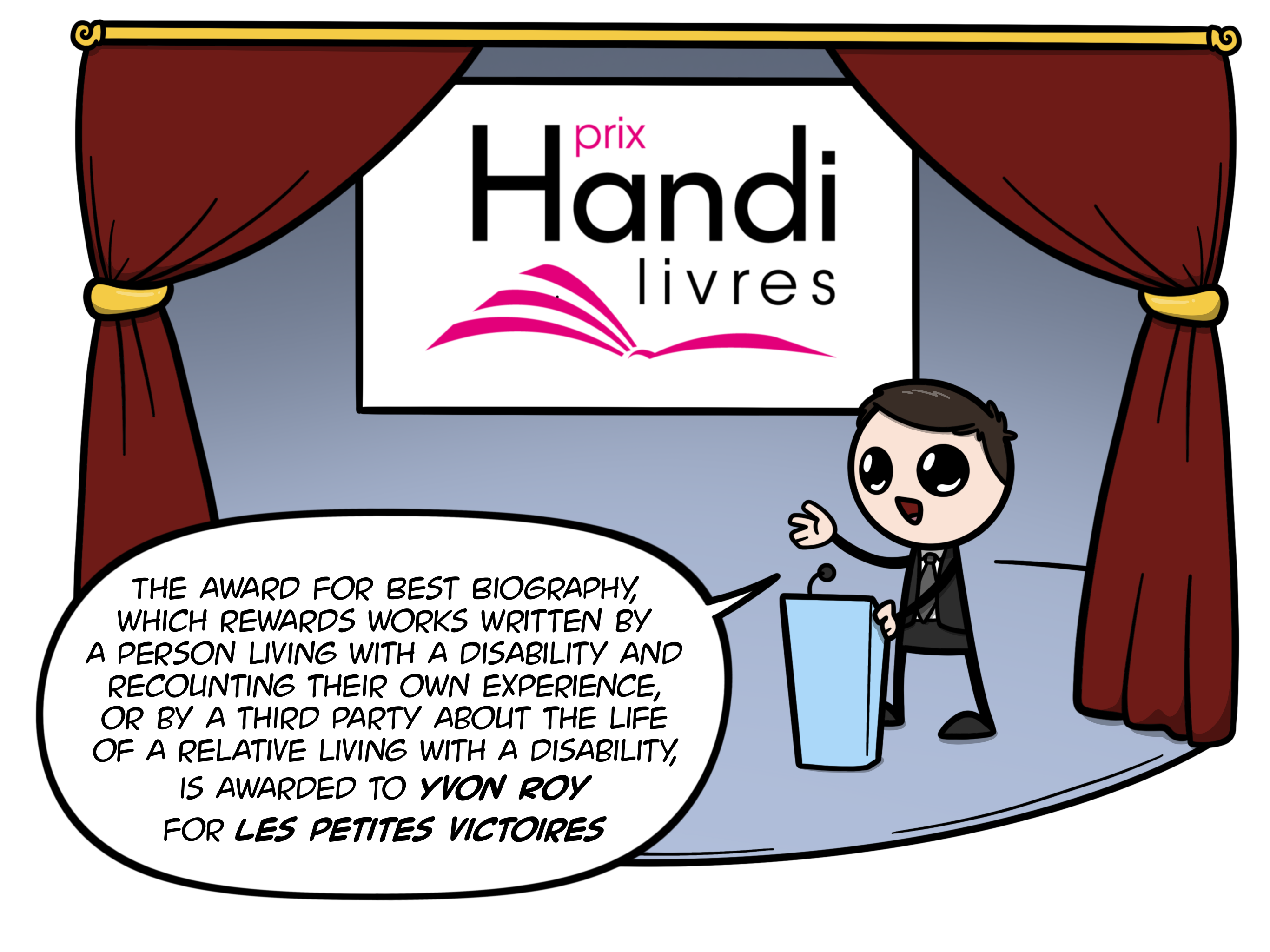
This comic book is an example of a creation that is easily accessible to the general public that has been awarded and highly publicized - even winning an award that recognizes works written by a person living with a disability and recounting their own experience, or by a third party about the life of a relative living with a disability. In 2018, the publisher Rue de Sèvres announced a contract for a film adaptation, which caused reactions and led to the hashtag :
#boycottlespetitesvictoires
As we will show, this is an example of the social representations of autism that perpetuate dominant understandings that do not fit the lived experience of those directly concerned to the point of being discriminatory. It is also difficult to identify moments when the child (the autistic character) shows agentivity. Instead, he’s passive in his father’s story. In a way, Olivier is only a supporting character. This is exaclty why representation doesn't mean autorepresentation and why "nothing about us whitout us" matters: although this comic is presented as a positive narrative from the allist perspective (3rd person), the story is completely different from the standpoint of the autistic community’s testimonies (1st person).
An allist person is a non-autistic person.
To understand the term "allist", we must go back to the origin of the word "autistic" which comes from the Greek word "autos" which means "self". So the word "autistic" initially referred to a person withdrawn on themself, who lives in their own world. The term "allist" appeared in a satirical article to refer to non-autistic people by swaping “autos” for "allos" which refers to others. So an allist is a person who is focused on others or, to flip the usual narrative, a person who lives in other people’s worlds.
In spite of the satire, the term “allist” has remained in use among others because it allows to distinguish between "neurotypicals" and "allists". There are people who are not autistic, but who are not neurotypical: a non-autistic dyslexic person, for example.
For a deconstruction
of the problematic propositions of the comic book:
But do you know the story from the autistic community’s perspective?
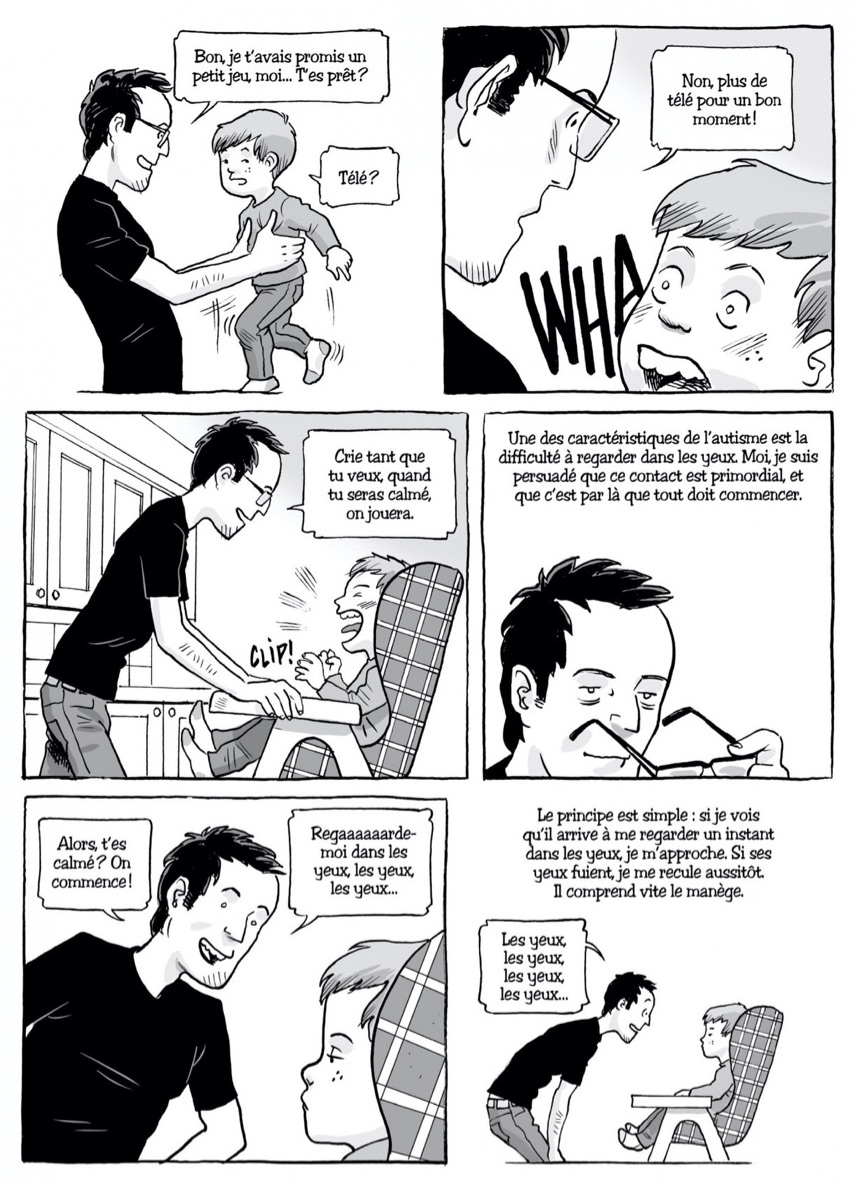
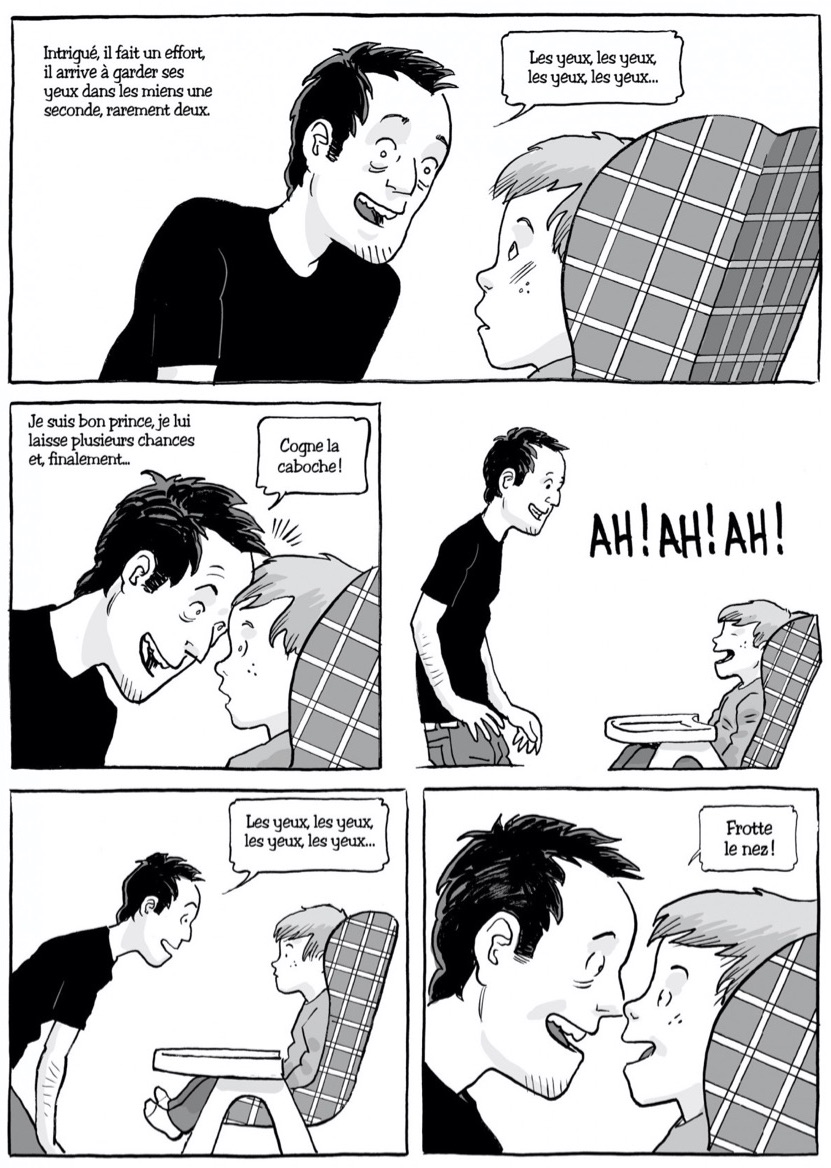
This is where webcomics can serve as an accessible tool that allows the reversal of dominant representations by opening the floor to self-representations directly grounded in marginalized communities. But before continuing with the topic of webcomics, we wish to feature an excerpt from Les Petites Victoires that addresses a frequent theme in autism: eye contact.
Excerpt on eye contact
English translation
English translation
Excerpt from Yvon Roy's interview
"I worked a bit like we can work to sometimes desensitize a substance. Sometimes certain people can have an allergy, we can try to desensitize them.
Several parents have contacted me regarding the trick to get the child to look in the eyes. This is the first thing we worked on together, that is to say, I considered that being able to look in the eyes - we know that autistic children have difficulty looking directly in the eyes - I said to myself, if we don't have eye contact, we have nothing. We need that, it's the beginning of human interaction." (our translation)
TW: The host uses the term “prison” in reference to autism:
"In your story that you shared with us in Les Petites Victoires, there is obviously the moment when you get up to face, to accompany your child in that reality: to learn to understand him too, inside what he lives and this prison, in a way, from which he is pressured which is basically this condition." (our translation)
Link to the interview (in French)


This scene is an example of neuronormativity
Recall that neuronormativity is the prevalent, neurotypical set of assumptions, norms, and practices that conceives of neurotypicality as the only acceptable or superior mode of cognition, and that stigmatizes attitudes, behaviors, or actions that reflect atypical modes of cognition as deviant or inferior.
This scene is told from the allist perspective and is presented with a positive outcome. In fact, as the author mentions, parents have applied this technique with their autistic children after being inspired by it.
But what if we ask autistic people how they feel about eye contact? That's exactly what we are going to do.
PART II
Why webcomics?
The medium of webcomic enables me to do something I don't know how to do otherwise: share how things feel on the inside.
Imagine. You come across a newspaper at the local coffee shop and recognize the face of a well-known personality. Yet you can't remember their name. It annoys you, you know you know it, it’s just not coming out, it stays there, on the tip of your tongue. You have time to come back to work, coffee in hand, and the name still hasn't come back to you, it still annoys you. You come across a colleague and you ask them, you describe the person, maybe clumsily at first (it would be so much easier with their name!), but you adjust to your interlocutor and, together, you can finally recall their name, it was so obvious!
It’s important to emphasize this feeling of annoyance. We rarely take the time to mention this annoyance when talking about epistemic injustices. Yet it is there, and it can even be painful: how do we make sense, to use Fricker's classic example, of our experience of sexual harassment when the concept does not yet exist? How can we share the feeling that something is wrong? This is where community comes into play and it is why the idea of "by and for" matters more than, say, a criterion of simplicity might. This is addressed by feminist epistemologies: for example, Longino argues for pragmatic values in science such as diffusion of power (as the importance of making research programs accessible to the actors involved in the research).
The impact of inadequate social representations on neurodiversity cannot be fully resolved by the traditional narrative of epistemic oppression and justice: adding new vocabulary to collective epistemic resources is not a panacea (we already have the word "autism" for example). So it is not only words that are missing, but rich and diverse lived experiences are also missing from the pool of shared resources.
The problem is that what is missing, the hermeneutical gaps, are not automatically apparent: social representations created by and for the dominant groups inadequately fill the hermeneutical gaps of marginalized groups. To that effect, let us recall here the Handi-Livre prize for the best biography which rewards works written by a person with a disability and telling his or her own experience, or by a third party on the life of a close relative with a disability: In the case of Les Petites Victoires, the award went to the biography of an allistic (non-autistic) person talking about autism. These inadequate social representations are difficult to resist: they are constantly and persistently reproduced. It is even harder when you don't have the words to replace theirs. But do we really have to wait for the right words to share our experiences? This is where illustration can become an attention grabbing action like shouting: an action that does not need words. This is what we propose here: a form of non-propositional epistemic resistance in response to hermeneutic injustice.
Webcomics are basically online comic books. They are mostly instantiated as short comics that take many forms and cover many topics. The most common form of webcomic is probably the blog (sometimes autobiographical, sometimes entirely fictional, sometimes both). Because they are mostly published independently by their artists, webcomics are an art form that is not limited by institutionalized power dynamics such as publishing houses or art galleries.
But the most important thing for us here is that webcomics are able to generate aesthetic experiences that allow viewers to better understand different aspects of the lived experience of neurodivergent people despite the inadequacy of mainstream epistemic resources.
In some ways, webcomics are a digital version of street art.
Although limited to a given geographical space for street art and to a particular digital platform for webcomics, there is this common idea where it is not so much the public that goes to the creation as the creation that goes to the public. We are no longer in a reserved and predefined space like a museum, a bookstore, a gallery or even a library.
Although a recognized artist can make street art, it is more difficult for an artist who does not belong to a complex and influential network to access some places of diffusion such as an art gallery. Webcomic is thus added to the tools that allow the production, use and transmission of more accurate social representations, participating in the collective understandings of the oppressions suffered by epistemically marginalized groups. The public and interactional aspects of social media that support webcomics make them a catalyst for direct dialogue with (but also within and between) marginalized communities.
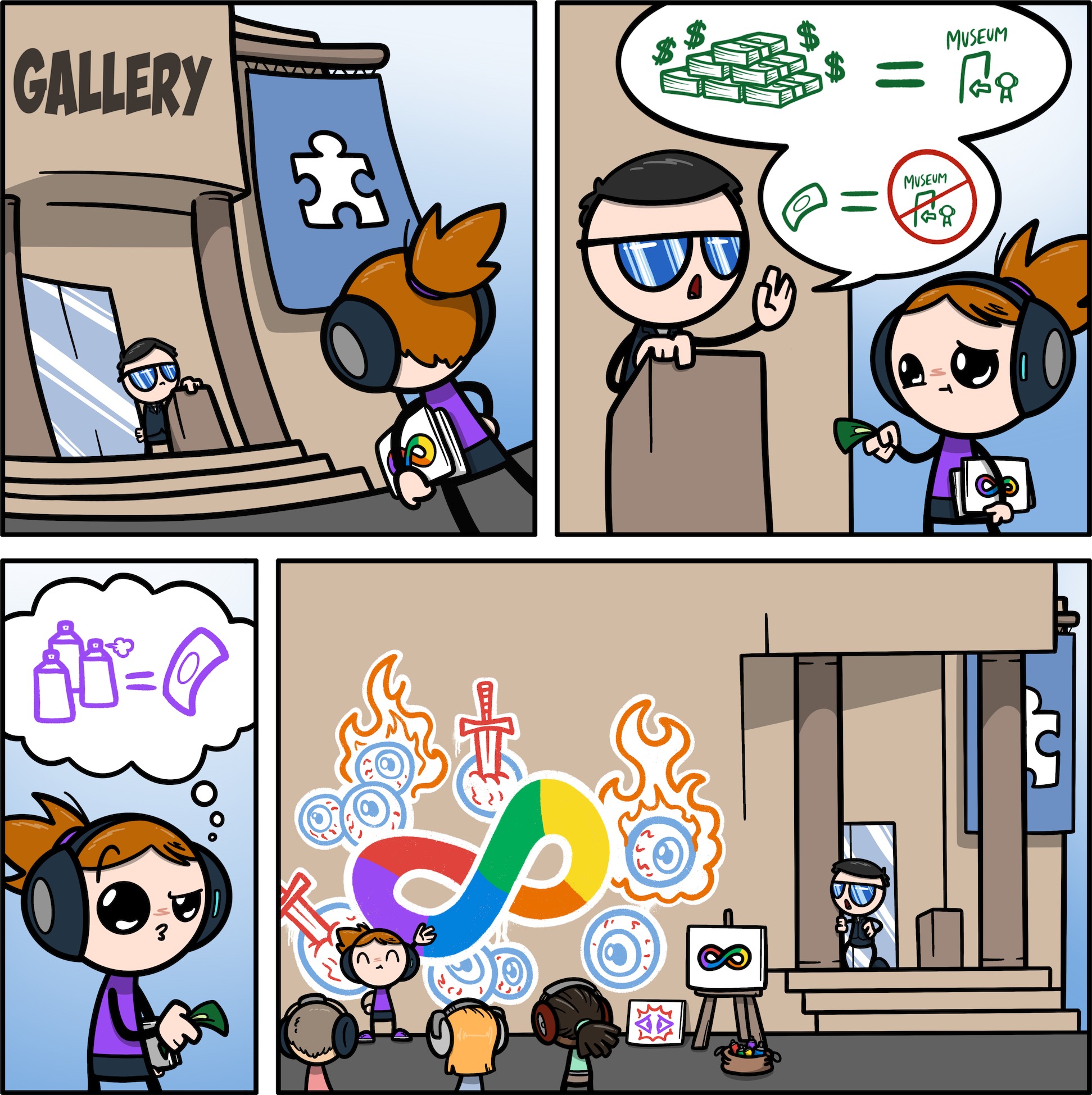
To put our epistemic resistance into action,
and to enhance our imaginative ressources, we chose to gather first-personal testimonies and descriptions of how eye contact can feel for autists.
After all, who better to provide insight into a given lived experience than those who live it? To do so, we used social media (instagram and facebook) to ask autistic followers of our webcomic (@lilyspectrum): How does eye contact feel to you? Although we are neurodivergent, it was important for us to go with the community beyond our individual experiences. For instance, we would never have thought of the sunburn idea on our own, but once we read those testimonies, it felt right.
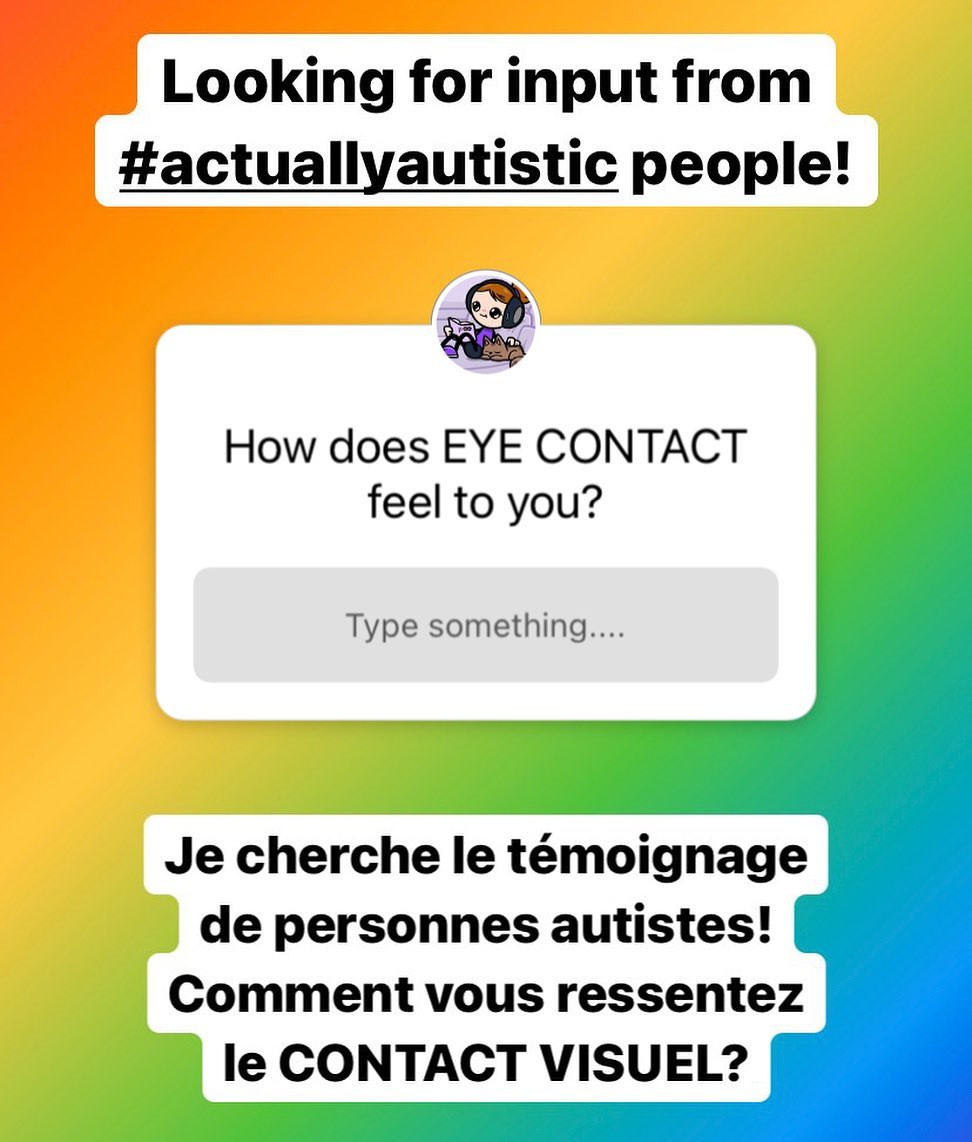
Both posts were made on November 8, and three days later, on November 11, we had received 175 testimonies. A few major themes emerged from these testimonies, which we used to base 7 webcomics or illustrations on. Keep in mind that, with this process, we do not claim to represent all there is to express about autists’ first-personal experience of eye contact. In fact, we suggest you visit these posts yourself to better understand the varied responses we got, and are still getting. And who knows, maybe this will allow you to add your own insight.
Publication
Since Monday, we have started to publish these comics on our social networks and we will continue to publish them in the following days
The interactions that take place around such webcomics are, we believe, an integral part of their complete aesthetic experience. These interactions often bring about clarifications, complementary details and descriptions or even added meaning. We thus invite you to visit these posts and interact with the community.
Webcomics
"I can do it but I can’t process anything else while doing it. My natural instinct and what feels the most right is to not look at someone’s face at all"
"It was drilled into me as a "rule" of politeness. I view it as just that, a rule. It's easy when there's multiple people because I can look around. But with one person, I have to look away or I end apparently end up staring"
"Everyone insisted on it, especially when they really wanted to correct a behavior or ensure I was paying attention. I honestly still don't love it, and prefer to look at noses or eyebrows to provide the impression I'm making eye contact"
"Eye contact was enforced during my childhood in mostly abusive ways and while it taught me to fake it, that made me hate it even more. Generally it just makes me uncomfortable and I find it quite distracting but it's also one of the most tiresome things to mask."
"Eye contact feels like they're staring into my soul, but with knives. I can make short eye contact before wanting to cry."
"It takes a concerted effort except for specific people."
"I’ve been so conditioned to make eye contact with people that when I met a lot of my friends for the first time they were kinda weirded out by me unblinkingly paying attention to them when they talked like 👁👄👁"
"It feels like someone is looking right past all my defenses and directly into my head. Not very pleasant."
"Terrifiant, j'ai vraiment l'impression qu'on me transperce à chaque fois …"
"Like I am being stabbed in the brain, itchy under the scalp, or suffocating. Anxiety is anxiety. I look at people's foreheads. They never know the difference but I am not forced to juggle the pain of eye contact and try to communicate. I am mostly non verbal and eye contact guarantees no words."
"Ça me met vraiment mal à l'aise et j'ai peur qu'on puisse mal interpréter si je regarde pas "correctement", je sais pas si je dois regarder quelqu'un dans les yeux ou combien de temps, il faut surtout pas que je regarde autre chose chez lui que ses yeux et du coup je sais pas quoi faire je préfère regarder le mur derrière mon interlocuteur 😂"
"Tout dépendra de la situation, de ma fatigue et de la personne. Certains contacts peuvent être transperçants (douloureux), d'autres envoutants (confusants), d'autres destabilisants (perturbants). En tous cas, si je regarde qqn dans les yeux, je suis sûr de perdre mon fil de pensée et/ou d'accorder mes réponses à ce que la personne ressent."
"Eye contact feels like burning discomfort, especially when I'm being told to do it."
"It’s extremely hard for me to maintain eye contact, and when people express to me that I should be looking at them when I’m talking to them, it puts me under more stress than just talking to them in the first place"
"somehow being told we should be making eye contact feels like being reprimanded as a child, at least to me.. I can't count the amount of times my mother would tell me to look her in the eyes as a child, and how humiliating/stressful it felt.. I legit forget to listen to people because I'm too busy trying to maintain eye contact."
"At best, awkward and uncomfortable. At worst, like someone's stabbed me in the eyes."
"It makes me uncomfortable but my mother forces me to look people in the eyes"
"Painful, but I feel like if I don't look ill be punished or called a liar. So I trained myself to look at something over their shoulder if not their foreheads to avoid harassment."
"Habituellement je regarde plutôt la bouche ou le nez des gens et ça semble passer crème pour donner l'illusion que je regarde dans les yeux (j'ai eu droit à l'expert en haute potentialité qui me disait que c'était impossible que je sois autiste car.. je le regardais dans les yeux ! Je regardais sa bouche depuis le début de l'entretien..). Je ne me force au contact visuel que de manière consciente et dans de rares cas précis : [suite]
(suite) par exemple si je suis attiré romantiquement par quelqu'un et désire que cette personne le perçoive (vu que le contact visuel accru est interprété de cette façon par beaucoup de neurotypiques). Mais cela reste un sacré effort et en général je détourne les yeux très rapidement, ça me met mal à l'aise, c'en est presque physique. Récemment un de nos profs en cours nous a fait faire une série d'exercices où on devait marcher vers quelqu'un/revenir à sa place à reculons en gardant le contact visuel constant avec cette personne.. je vous laisse deviner la torture que c'était"
"Transperçant!"
"J'ai l'impression que les yeux de la personne me percent à l'intérieur, je sais pas comment dire, c'est une sensation d'oppression aiguë."
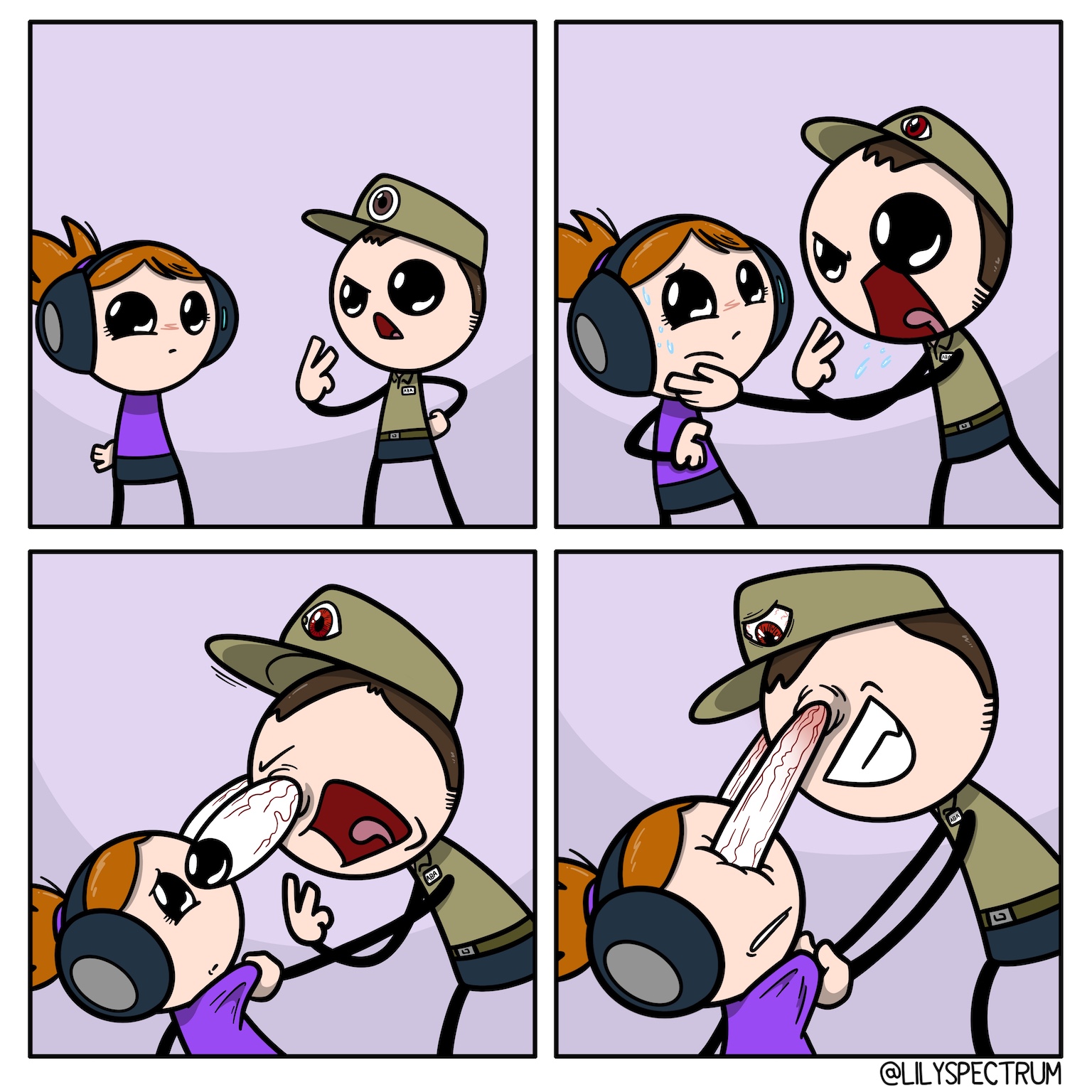
"For me, looking in the eyes feels too exposed and open. It makes me feel like I can't hide and protect myself from the people."
"Eye contact makes me uncomfortable most of the time, because of the feeling that I am being silently judged or getting talked about negatively."
"It's fine when I'm listening to someone but when I'm the one talking it makes me get stage fright like I'm being put on the spot to judge for performance lol"
"Too intimate, inappropriate… I become incredibly self conscious as well, like am I doing eye contact right? Should I be mirroring their behavior or a close approximation or complete opposite? How many times should I blink? Can they tell I’m faking this human interaction? It’s incredibly stressful."
"It feels like something is a required check box. It’s like a math problem. Look, one, two, three. Okay. Look away. Zone out if you need to. Okay, it’s been 10ish seconds. Look back. One, two, three.. okay, look away! Don’t share at them! Wait! You’ve looked away too long! Look back! …..it’s that on repeat quite often lol"
"I hate it I get so nervous and then I break down."
"I don't like it, makes me really uncomfortable. I'm "good at it", because I mask well (😬). I never know what to do, if I'm looking to much or not enough and always use a whole lot of energy just on eye contact. Generally, the more comfortable I feel the less I look someone in the eyes. (Also eyes as a body part make me feel really icky so that's that)."
"Intimidating and uncomfortable, I feel too vulnerable and keep thinking am I doing this right?"
"Ça me met vraiment mal à l'aise et j'ai peur qu'on puisse mal interpréter si je regarde pas "correctement", je sais pas si je dois regarder quelqu'un dans les yeux ou combien de temps, il faut surtout pas que je regarde autre chose chez lui que ses yeux et du coup je sais pas quoi faire je préfère regarder le mur derrière mon interlocuteur 😂"
"Eh bien, quand j’étais petit, je parlais et écoutais souvent le monde sans les regarder dans les yeux. Maintenant, ça me dérange pas de parler et écouter avec le contact visuel, mais j’peux très bien comprendre ce que le monde me dit sans obligatoirement les regarder dans les yeux. Aussi, c’est vrai que ça me rend un peu mal à l’aise quand des inconnus me fixe du regard. C’est comme s’ils me jugeaient et j’sais pas ce que j’ai fait de mal."
"Direct eye contact feels like I am being judged. It also makes me feel uncomfortable because I become unable to perceive and read the rest of their body language."
"Démunie, nue. Percée à jour. C’est très fort comme sensation, et rarement agréable. J’y arrive avec mes enfants ou mon mari, mais même dans ce cas, pas trop longtemps. Si je veux tenir une conversation, et me concentrer, alors je dois ruser. Je regarde entre les deux yeux ou le plus souvent la bouche."
"Feel nausea and anxiety, and extremely naked. Yet my mother was adamant that I learned it and therefore I am able to do it, despite the uncomfortable feelings. Absolutely love your work, for once I can tell that I am not alone"
"I feel instant stress and I have to force myself to do it and to look "natural"."
"Honestly, each time it happens to me, the most awkward feeling I have is « where should I look exactly » ? When you make eye contact, are you expected to focus one eye specifically (which one, then ?), between the eyes, not focus at all, or try a weird way of having each eye "looking" into the facing one (i.e. my left eye "looking at" their right one and vice-versa) ? I'm also never sure if/when eye contact is expected, and when it happens, is there/what is the hidden message behind this specific contact, and/or am I sending an incorrect hidden message myself ? Then, with all these questions actively consuming my brain "computing power", everything else totally miss the point (sometimes, though, I can hide this issue because I have this kind of ability to "replay" the last few words/sentence I unconsciously heard, to process it with a delay but potentially without the proper context- so it's not reliable at all !!). "
"Weird and artificial. I can actually read people's eyes now, but it took me years to learn it."
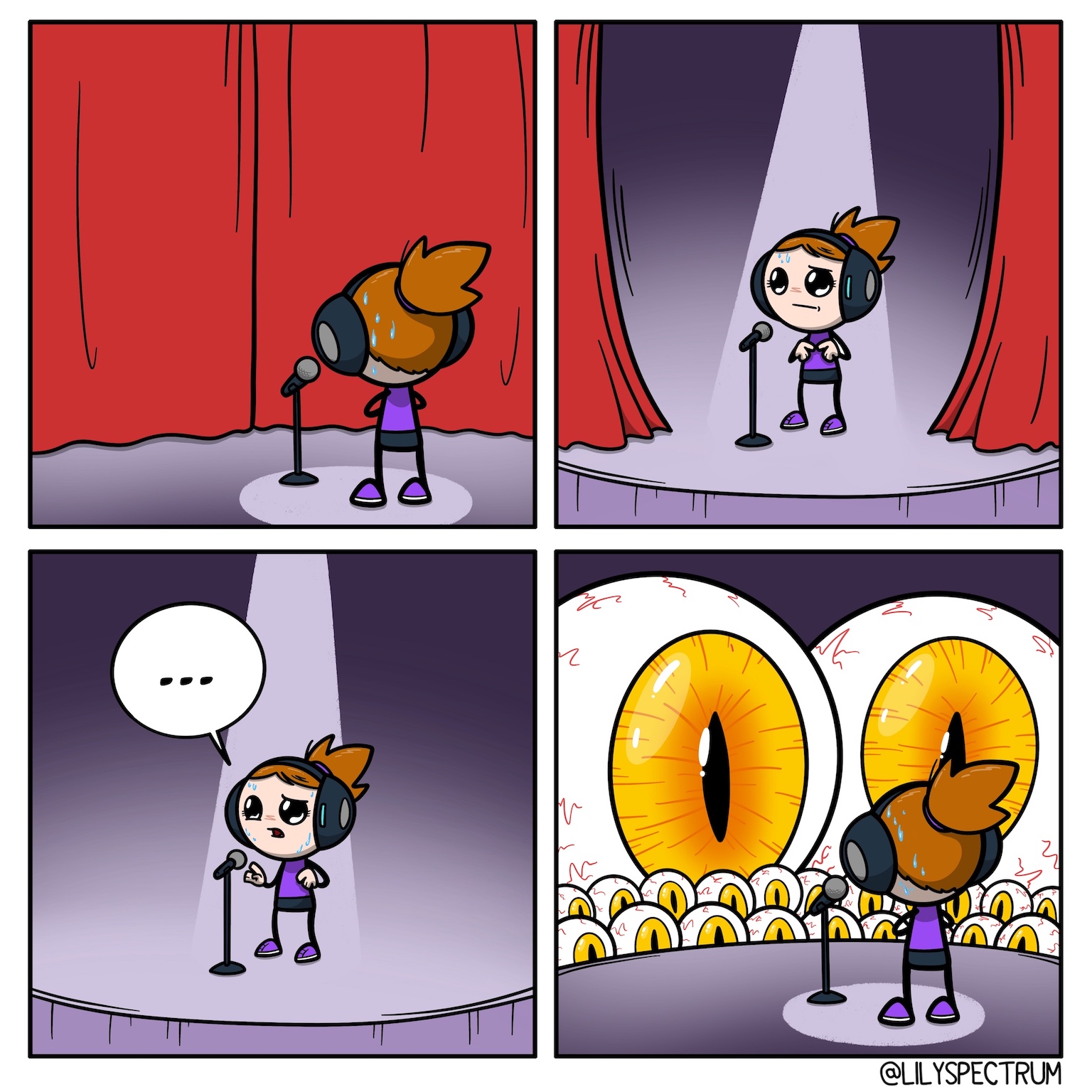
"My parents rasied me to always look into the eyes, still feels wrong. Like, I am invaiding a personal space and being rude. Like trying to stare down their soul and violating their privacy. I still try to look at people in the eyes but have learned to just looks in differents points in the face so I don't seem rude."
"Eye contact feels too intimate to me for most interactions. If I make eye contact with you, it’s because it’s important. "
"Eye contact feels very intimate. If I’m forced to hold it for too long, I feel violated, like I’ve been touched without consent."
"I really hate eye contact in almost all circumstances. About the only exception is with someone I'm very intimate with. Eye contact feels extremely intimate to me in general so it only feels natural when it's with someone I've got a suitably intimate emotional connection to. Otherwise it feels like I'm staring into someone's soul and I can see everything and they're staring into mine and seeing the same (even if I know they're not)."
"Invasive, extremely personal. I'm only comfortable looking my husband in the eyes"
"It feels like I’m standing too close to someone, I don’t know if that’s too vague of a comparison but it feels way too intimate. So I only do it when necessary or when I’m comfortable with that person."
"It feels creepy to me"
"I don't like it, makes me really uncomfortable. I'm "good at it", because I mask well (😬). I never know what to do, if I'm looking to much or not enough and always use a whole lot of energy just on eye contact. Generally, the more comfortable I feel the less I look someone in the eyes. (Also eyes as a body part make me feel really icky so that's that)."
"I hate eye contact. It almost hurts. But it’s nessesary to have a successful professional life, and my parents trained me well as a child. They would ask me people’s eye color after I met them to see if I made eye contact. Being trained like that at a very young age was incredibly difficult and felt unfair, but I’m very grateful that they pushed me now that I’m an adult."
"I can't do it, it makes me feel funny in a bad way and makes me feel kind of .. unsafe? and uncomfy I don't exactly know the word for the first one, I don't mind people looking at me but I won't look back"
"It's incredibly intimate and overwhelmingly so, particularly with strangers. And the more my emotions are revved up, the less I can tolerate it. It genuinely feels as though someone can see into my mind almost, even though I know that they can't. On the plus side, when I'm with someone I deeply, deeply love, sometimes that's okay because I want them to see how much I love them... but then that tends to make THEM feel awkward and uncomfortable too. LOL For me, it falls into the same category as standing too close, invading personal space, touching someone without consent etc. It's intimate, and can very easily become violating when you don't want it. And that;s so hard to explain to NT folk who expect you to look them in the eye all the time."
"It's okay with people I know, but I don't feel comfortable with eye contact with strangers, it almost feels like an invasion of privacy."
"eye contact feels so weird and creepy and if i have to make eye contact with someone, then ill quickly feel exhausted."
"It feels like a boundary rupture unless I completely and totally feel comfortable in a container of safety with another it probably won’t happen much."
"Well... I can't let anyone touch my eyeballs."
"Trop intrusif. Comme si l autre avait la perception de mes pensées. C est comme se montrer nue."
"Intense/ overwhelming/ fiery/ intrusive. Sometimes painful/ always difficult with strangers. Ok with intimate friends and family."
"Démunie, nue. Percée à jour. C’est très fort comme sensation, et rarement agréable. J’y arrive avec mes enfants ou mon mari, mais même dans ce cas, pas trop longtemps. Si je veux tenir une conversation, et me concentrer, alors je dois ruser. Je regarde entre les deux yeux ou le plus souvent la bouche."
"Feel nausea and anxiety, and extremely naked. Yet my mother was adamant that I learned it and therefore I am able to do it, despite the uncomfortable feelings. Absolutely love your work, for once I can tell that I am not alone"
"confronting and very intimate ..i feel naked"
"Quelque chose d'extrêmement intime, que je ne peux pas partager avec n'importe qui sinon je suis déstabilisée car je bloque sur cette sensation d'intimité forcée. Depuis le diagnostic, je me permets de ne plus regarder le visage des gens (je ne travaille pas). Quel soulagement!"
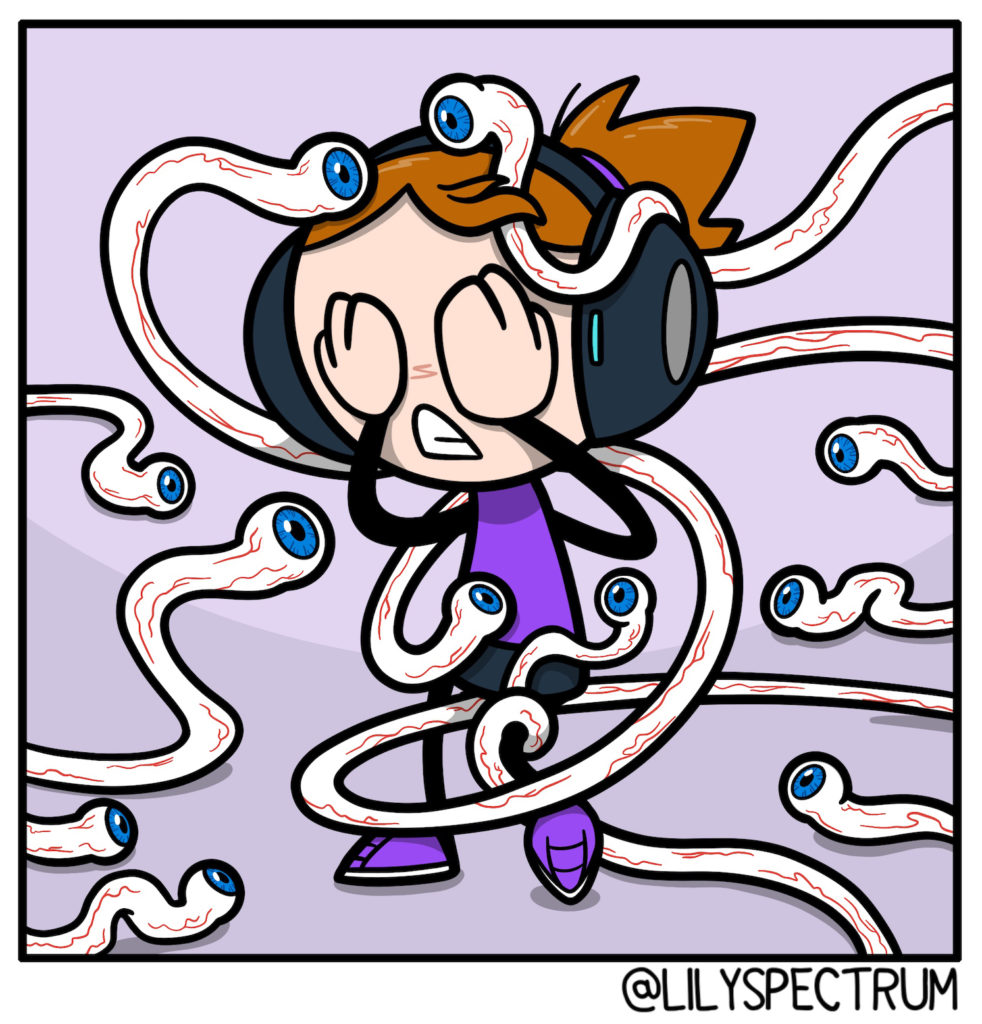
"Eye contact feels like they're staring into my soul, but with knives. I can make short eye contact before wanting to cry."
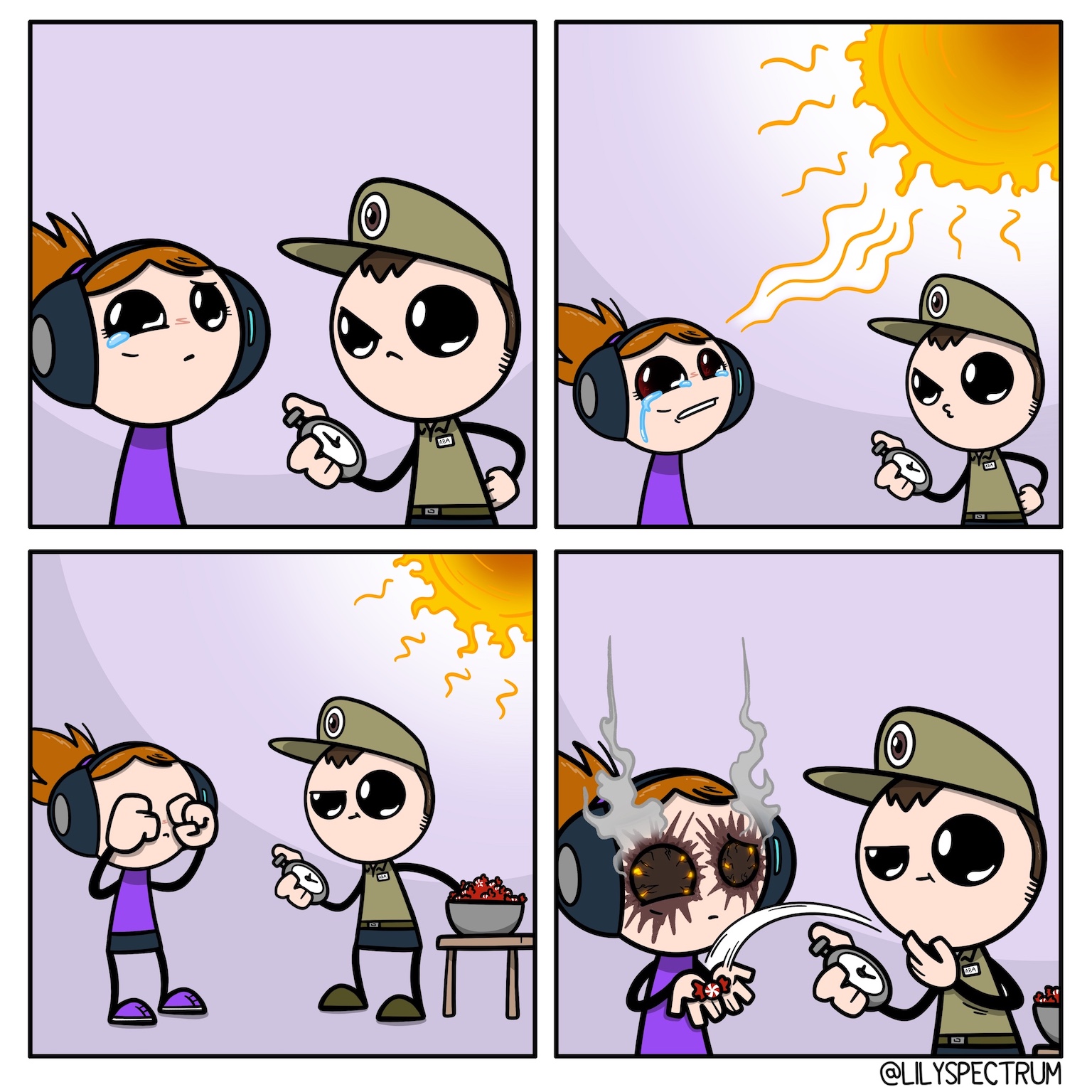
"It’s like being asked to look directly at the sun. I flinch, I can’t do it…"
"It feels like they gonna shoot me with laserbeams. Like Cyclops from X-Men. I van handle it for 10 seconds. I get panick attacks of it's to long. Even with my bf makes me on edge. I got a major panic attack during a being social etc exam (idk how it's in English is). It was so bad. They let me past because otherwise i needed to do the whole year over."
"Feels like I’m staring at the sun and I can only look a person in the eyes for 30 seconds or so before my eyes start to hurt a bit. I can only look animals in the eye."
"Like flames of intense awkwardness are scorching my retinas."
"When I was younger I always had trouble making eye contact. I’ve gotten better at it in recent years but its still painful to me."
"Eye contact feels like burning discomfort, especially when I'm being told to do it."
"Ça me demande beaucoup de concentration. J'ai l'impression que ça me fait mal aux yeux et quand j'étais plus jeune je pouvais même ne plus vraiment entendre ce que la personne me disait. Par contre ce n'est plus un problème quand je me mets vraiment en colère au point de vouloir me battre."
"Ca va de la gêne à la sensation de brûlure, ça dépend des personnes je suppose. On peut parfaitement regarder le nez, la bouche, entre les yeux sans que l'autre ne sen rende compte."
"I can’t think if I have to. Feels like pressure."
"Bad, I feel like my head is going to explode if I look at someone's eyes for too long. I suspect it's probably a blood pressure drop or adrenaline, but it feels awful. I honestly don't get why so many people require eye contact when speaking. I can make eye contact, but it's really difficult to understand what the person is saying because I'm too focused on how uncomfortable I feel and how incredibly awkward it is to stare at someone's eyes"
"It feels literally painful and I’m always afraid the other person can tell what I’m feeling/thinking. I’m comfortable with eye contact with very trusted folks in my life though."
"Painful"
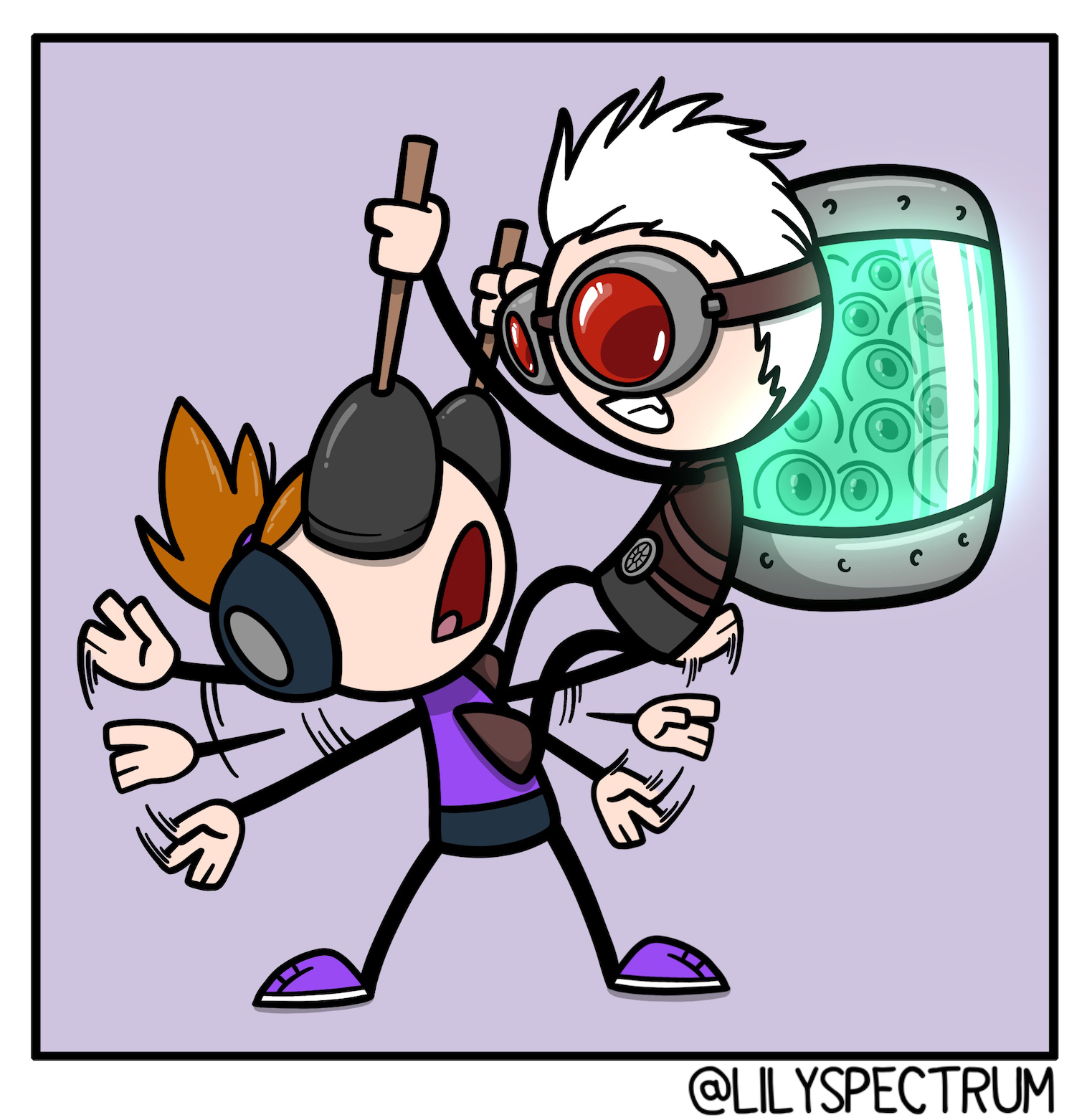
"I really hate eye contact in almost all circumstances. About the only exception is with someone I'm very intimate with. Eye contact feels extremely intimate to me in general so it only feels natural when it's with someone I've got a suitably intimate emotional connection to. Otherwise it feels like I'm staring into someone's soul and I can see everything and they're staring into mine and seeing the same (even if I know they're not)."
"I cant make eye contact with literally anyone. Its uncomfortable, and even when its not, i cant listen proberly to what people are saying when i focus on the eyes. I just cant do it at anytime with anyone, only for one second maximum. Its like staring into someone's soul, its too much."
"J’ai l’impression d’être absorbée par les yeux de la personne et en même temps comme si on pouvait voir ce qu’il y a à l’intérieur de moi."
"honestly it feels like i am being sucked into their soul… i can’t maintain it if i want a conversation because i just get lost"
"Like someone staring at my soul? I almost feel like that's the part of masking that exhausts me the most!"
"It's uncomfortable. But sometimes if I want to intimidate someone I stare deep into their eyes and make them feel unnerved like I'm looking into their soul."
"Tout dépendra de la situation, de ma fatigue et de la personne. Certains contacts peuvent être transperçants (douloureux), d'autres envoutants (confusants), d'autres destabilisants (perturbants). En tous cas, si je regarde qqn dans les yeux, je suis sûr de perdre mon fil de pensée et/ou d'accorder mes réponses à ce que la personne ressent."
"Trop intrusif. Comme si l autre avait la perception de mes pensées. C est comme se montrer nue."
"J’ai l’impression d’entrer dans l’âme de la personne. Je trouve ça trop privé. Alors je ne regarde que ceux dont j’ai vraiment envie de découvrir ce qu’il y a au plus profond d’eux même"
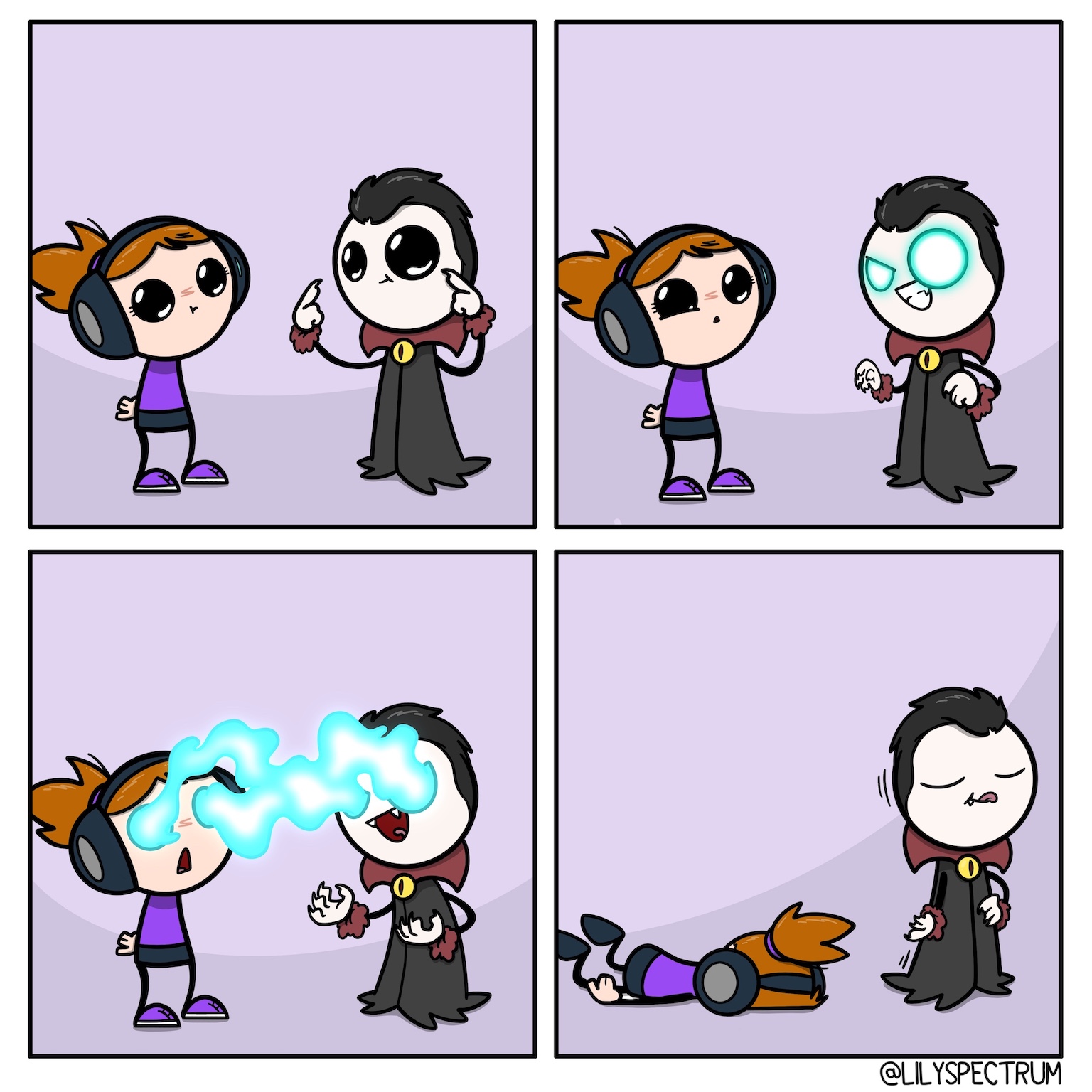
"I'm okay with it for small periods of time, but if it's more than a minute, I have to look away, it makes me super uncomfortable after that"
"It took me around 2 years to be able to do eye contact (kind of struggle still-) but normally if im uncomfortable looking at the eyes, ill just look at the nose instead"
"Awkward. The longest I can probably do it is for a few seconds, but sometimes it’s physically impossible for me to look someone in the eyes even for one second."
"Ça me met juste très mal à l’aise, et du coup je préfère regarder ailleurs et ne regarde les gens dans les yeux s’iels ne me regardent pas."
"Incapable de soutenir un eye contact sauf avec certaine personnes... Ma famille (ma mere, mon pere, ma soeur), ma nièce, mon beau frère et mon conjoint. Quelques amis specifique aussi... Mais sinon incapable. Je chercher tjrs a "évader" ses eye contact."
"Uncomfortable. I have trouble maintaining eye contact for long, especially in a conversation. However, I did figure out that talking with your hands is a great way to distract the other person's eyes from your and gives you a reason not to look at them."
"havent made eye contact with anyone (while i'm talking to them, that is) except my cats in years if that tells you anyone"
"When I was younger, it used to feel like when you held two magnets together both ends the same, it felt like no matter how hard you held them together, it would want to repel forcefully, my head wanted to repel and look past to the left or right or down or up like a magnet would, and when I managed to hold it against that feeling, my eyes would water up, not tears from sadness or anything, but they released tears, now I can manage it but it's still not comfortable to do, it depends on how comfortable I feel with the person or people or how stimulated I feel in an environment"
"It’s like when you hold two magnets with the same polarity against each other. Even if you want to put them together they won’t do it. The magnets are like my eyes. They just can’t center on the other persons eyes or it will cost a lot of energy. Like with holding magnets with the same polarity together. It’s just all in all very uncomfortable and draining. Btw I’m undiagnosed so I hope I can still answer here. Also I really really love your account and the stuff you do ^^ /g"
"Ça me met vraiment mal à l'aise et j'ai peur qu'on puisse mal interpréter si je regarde pas "correctement", je sais pas si je dois regarder quelqu'un dans les yeux ou combien de temps, il faut surtout pas que je regarde autre chose chez lui que ses yeux et du coup je sais pas quoi faire je préfère regarder le mur derrière mon interlocuteur 😂"
"Je me sens obligé de regarder chaque personne dans les yeux mais aussitôt que le contact est réciproque je baisse le regard aussi vite que mon ombre ainsi j'ai l'impression que j'ai fait ma part! haha! Par contre avec le monde avec qui je suis très, très à l'aise je vais quelque fois fixer les yeux, on dirait que j'essaie de comprendre pourquoi je fuis ceux des inconnus, alors je fixe en grand questionnement interne!"
"Awkward and physically painful , strong need to move my eyes away from it"
"Souvent trop intense… Et en plus il se passe tellement de choses autour des yeux qui m'intéressent plus et/ou me sécurisent plus! Je fixe puis je zappe, j'y reviens et je rezappe… Les sourcils, les lunettes, sont des bons compromis aussi, ou fixer mon regard dans le vague direction le visage ou le pourtour du visage… Ou fixer le visage avec une attitude très intéressée (posture corporelle de l'attention soutenue) quand la personne regarde AILLEURS, et quand son regard se tourne vers moi, fixer 1s seconde, sourire, et me tourner ailleurs vers qqn d'autre qui parle mais ne regarde pas vers moi à ce moment là, ou trouver à m'occuper avec un objet, et jongler comme ça."
"Je n'aime pas regarder sans les yeux, je ne sais pas, c'est plus fort que moi, je suis mal à l'aise, je ressens le besoin de regarder ailleurs. Du coup j'aime bien discuter quand je suis au resto ou quand on fait une activité, il y a l'excuse d'être occupée en même temps pour ne pas se regarder"
"Habituellement je regarde plutôt la bouche ou le nez des gens et ça semble passer crème pour donner l'illusion que je regarde dans les yeux (j'ai eu droit à l'expert en haute potentialité qui me disait que c'était impossible que je sois autiste car.. je le regardais dans les yeux ! Je regardais sa bouche depuis le début de l'entretien..). Je ne me force au contact visuel que de manière consciente et dans de rares cas précis : par exemple si je suis attiré romantiquement par quelqu'un et désire que cette personne le perçoive (vu que le contact visuel accru est interprété de cette façon par beaucoup de neurotypiques). Mais cela reste un sacré effort et en général je détourne les yeux très rapidement, ça me met mal à l'aise, c'en est presque physique. Récemment un de nos profs en cours nous a fait faire une série d'exercices où on devait marcher vers quelqu'un/revenir à sa place à reculons en gardant le contact visuel constant avec cette personne.. je vous laisse deviner la torture que c'était"
"Lorsque c'est quelqu'un avec qui je suis à l'aise ca va à une certaine distance mais de trop prêt je ressens un malaise assez vite. Si j'ai le malheur de croisé le regard avec un(e) inconnu(e) dans la rue ou dans un commerce, je regarde ailleurs aussitôt, gros malaise. C'est pour ça que j'évite de regarder les gens."
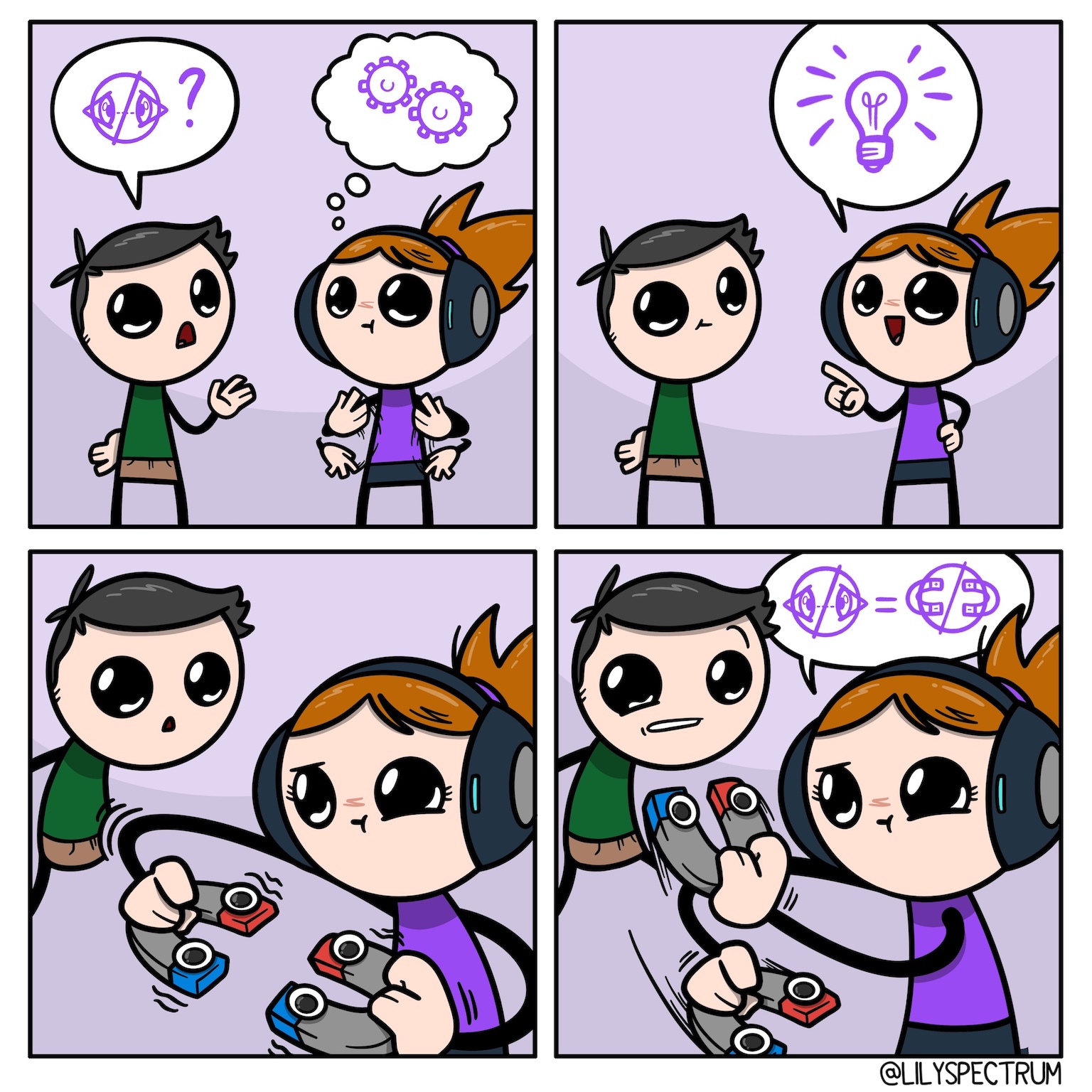
Thank you for joining us in this exploration!
We hope this experience was (and will be) as enriching for you as it was for us to come up with. We invite you to engage with us and the community through our posts or in the comments bellow!
The way you broke down “red flags” to watch for was very helpful. I may summarize those on senior care for quick reference.
virtualni kasino Robocat je dost novy digitalni system, ktery se snazi přilakat uzivatele svou přehlednou a intuitivni aplikaci robocat casino recenze .
Tento zajem je znamy take jako robo cat casino a nabizi rozmanitou skupinu zabavnich moznosti pro přivrzence zabavy. Pokud hledate jiny způsob, jak se vyhnout standardnim hracim mistům, můze byt Robocat Hraci System vhodnou alternativou, zejmena diky svemu netradičnimu jmenu a konceptu.
Zakladnim prvkem faktoru, ktery si přinasi zajem, je schopnost zalozeni učtu a ověřeni do systemu. Proces robo cat login je poměrně jednoduchy, coz je pro velke mnozstvi zajimavych osob zakladni faktor při vyběru kasina. Po uspěsnem přistupu se zajemci mohou radovat na bohaty sortiment aktivit, včetně standardnich hracich aktivit, hracich strojů a různych zabavnich způsobů.
Pokud se zajimate zkusenosti, hodnoceni Robocat často zdůrazňuji jeho přehlednou grafiku a snadne řizeni. Někteři uzivatele vsak varuji na malou sanci bonusů a nabidek ve kontrastu s dalsimi kasiny. To vsak nepotřebuje byt zaklad v připadě, ze hledate zvlastě kvalitni hru bez nadměrnych komplikaci.
Pro ty, kteři preferuji zajimave jmeno, můze byt Robocat zajimavou volbou. Platforma se snazi kombinovat zazitky s přehlednosti, coz můze byt vhodne pro začatečniky i zkusene osoby. Pokud se mate seznamit podrobněji o tomto kasinu, stoji za to si přečist nejnovějsi zkusenosti a ověřit zda plni vasim přednostem.
V neposledni souvislosti je zakladni uvedout, ze jakekoli digitalni hraci platforma by mělo byt kontrolovano a regulovano, aby garantovalo ochranu her. Robocat Online, podobně jako dalsi kasina, by mělo dodrzovat zakladni normy, ale vzdy je nutne si zjistit informace dřive nez registraci. Pokud hledate zajimavou a originalni siť, Robocat Online můze byt jednou z moznosti, kterou stoji za to testovat.
Вывод начинается с осмотра пациента. Квалифицированный врач уточняет продолжительность запоя, возраст, хронические заболевания, сведения о ранее принятых лекарствах и примерное количество выпитого. Для правильного выбора схемы нужно знать о заболеваниях сердца, печени, почек, психических нарушениях и аллергических реакциях. При необходимости берут анализы крови или мочи, выполняют ЭКГ и назначают дополнительные исследования.
Ознакомиться с деталями – капельница от запоя нарколог
casino ziar nad hronom hry zdarma automaty sizzling bonus bez vkladu za registrГЎciu Automaty online banco casino live report online casino slovensko casinofreak
Ce plateforme de jeux connu sous le nom de Pampago Casino attire de plus en plus d’attention sur le marché français, notamment grâce à ses offres attrayantes et son ergonomie révolutionnaire Pampago Avis . Si vous souhaitez de découvrir cette plateforme de jeux, voici une étude approfondie afin de mieux comprendre ses atouts, les feedbacks et son mode opératoire.
Il est primordial de s’assurer que Pampago est bien le site officiel. En effet, dans un contexte de croissance des sites virtuels, il est fréquent de se retrouver face à des sites non officiels. Afin d’écarter les arnaques, choisissez toujours la plateforme validée disposant de des licences valides et une protection optimisée. Les membres dans l’Hexagone ont l’obligation de vérifier que le casino applique les lois locales, notamment les directives de par l’ARJEL.
Les feedbacks sur Pampago Casino sont majoritairement encourageants, notamment la diversité des titres accessibles. Qu’il s’agisse de fan de slots, de jeux de table, ou de parties en direct, Ce casino met à disposition une large sélection de contenus, généralement édités par des éditeurs de renom par exemple Evolution Gaming. Les offres spéciales incluant les tours de roulette gratuits ou les jeux sans dépôts sont également évoqués comme des atouts majeurs par les utilisateurs.
Pour les nouveaux joueurs, Cette plateforme propose des conditions favorables, en particulier des offres réservées aux nouveaux membres. Il faut tout de même il est important d’examiner les conditions les termes et conditions des offres, car il arrive que prennent en compte des limites sur les jeux ou les modalités de dépôt. Les retours des joueurs mettront en avant aussi la rapidité des transactions, généralement effectués en un temps record, ce qui constitue un facteur clé pour les habitués.
En dernier lieu, si vous envisagez de vous inscrire dans ce casino, assurez-vous d’examiner les modalités de dépôt et de retrait, sans oublier les restrictions applicables. Les membres préfèrent choisissent les plateformes proposant des solutions de règlement flexibles, tels que les portefeuilles électroniques. En résumé, Ce casino en ligne émerge comme une solution attrayante pour les passionnés de divertissements numériques, à condition de contrôler son authenticité et ses modalités avant de s’engager.
Just used Junk Removal in Aurora and I’m thrilled with the results. Highly recommend! affordable junk removal in Aurora
cock ninja porn
Ωραίες προτάσεις για διασκέδαση στο κέντρο. Αν κάποιος ψάχνει και για VIP athens escorts greece, μπορεί να ρίξει μια ματιά στο private vip escorts Athens για περισσότερες πληροφορίες.
automati zdarma free hry zdarma automaty admiral hracie automaty zdarma turbo kajot Hrat automaty za peniaze rembrandt casino 5 € najlepsie zahranicne online casino
vyherne automaty online bez vkladu ЕЎvejk hracie automaty online video ruleta Casino 5 eur free spiny bez vkladu slovensko 2026 21 3 blackjack online free
reliable service notable brand swiftly secured attention towards players seeking for a trustworthy and dynamic wagering opportunity Casino Gamblezen .
Whether you’re pondering *is Gamblezen legit* or reading *Gamblezen reviews*, it’s essential to grasp what this casino offers before enrolling.
Based on available data, this operator looks to be a modern site appealing to home enthusiasts, though it’s important to note that its legitimacy can fluctuate depending on licensing, defences, and player feedback.
One of the early aspects punters commonly inspect when exploring a unfamiliar betting operator is whether it’s *Gamblezen Casino UK*. While the operator states to perform in accordance with English gaming standards, it’s undeniably important to check its certification standing on its own. A reputable gambling operator should be honest about its oversight agency, guaranteeing fair wagering and considerate gambling standards.
If you’re pursuing for a *Gamblezen Casino review*, genuine gambler experiences can provide useful perspectives. Some users note polished gameplay, ample rewards, and a convenient interface, while others may have doubts about withdrawal times or user engagement.
For those new to virtual casino, *Gamblezen* might seem as a attractive option, specifically if you’re drawn to its exclusive perks. However, it’s crucial to handle any wagering platform with discretion. Consistently check for valid approval, read *Gamblezen reviews* from reliable publications, and confirm the platform implements secure security to defend your private and monetary particulars.
Responsible wagering is essential—never go beyond what you can manage.
If you’re ongoing hesitating whether to try *Gamblezen Casino*, evaluate launching with a modest allocation to evaluate the platform before dedicating larger sums. While it may barely be as widely identified as some established local betting platforms, its growing prestige indicates it could be worth reviewing for those searching a fresh prospect. Just recall that not a single gambling establishment is completely risk-free, so necessarily casino sensibly.
The examples of specific questions to ask made this very practical. We’ll be adapting some of them for our tools on respite care near me .
девушки ДНР
When there are fewer residents, caregivers can spend more time helping seniors maintain independence instead of rushing through ADL tasks. elder care seems like a good example of this approach.
Great examine on scalable healthcare structures; we’re pursuing modular options a twin of this at IHBS practice management Florida
artofzoo porn
Рекомендации строятся вокруг состояния человека, а не по универсальному шаблону для всех случаев.
Узнать больше – лечение в наркологической клинике Красноярск
Une plateforme de paris en ligne fascine de plus en plus de utilisateurs francophones en quete d’des jeux en ligne diversifies Only Spins casino . Situe sur l’adresse le site Only Spins|l’URL Only Spins Casino, ce site se se demarque par ses promotions attractives optimisee aux parieurs francophones. Que vous cherchiez une plateforme de jeux securisee, voici les elements cles pour faire le bon choix.
Le casino Only Spins propose des centaines de jeux allant des machines a sous classiques aux machines a sous innovantes et aux jeux de table comme le blackjack comme le blackjack. Le site met aussi un point fort sur des offres speciales pour les nouveaux joueurs, ce qui peut etre un avantage pour augmenter ses chances. Cependant, comme pour tout casino en ligne, il est crucial de comprendre les regles notamment les conditions de retrait et les limites de depot.
Un des points forts souvent soulignes est la simplicite d’utilisation du site. Les joueurs francophones sont generalement ravis l’experience utilisateur et les options de paiement variees incluant les virements et les solutions digitales. Cela rend l’experience plus agreable pour ceux qui recherchent une plateforme simple et efficace.
Pour les futurs utilisateurs, les avis Only Spins casino sont globalement positifs, mais il est recommande de s’assurer de la legalite et les agrements avant de s’inscrire. Une plateforme serieuse doit garantir la securite des donnees et des transactions, ce qui est une condition indispensable pour securiser les paris.
Pour conclure, Le casino Only Spins se affirme comme une plateforme attractive pour les amateurs de jeux en ligne. Que vous vouliez trouver des avis Only Spins fiables ou une offre de jeux adaptee, il est crucial de comparer les offres et de consulter les avis avant de vous engager. Comme pour tout casino, la responsabilite et le bon sens sont de mise pour tirer le meilleur parti de la plateforme de maniere responsable.
skrytych virtualnich kasin co se snazi vyvolat pozornost svym jedinečnym grafickym provedenim a nabidkou her robocat casino .
Pokud hledate dalsi moznost k velkym a uznavanym kasinům, jako jsou Egtone, můze byt robo-cat-2 dobrou volbou.
Tento interni system, ktery bězi pod URL robo-cat-2.workers.dev, nabizi zajemcům moznost hrat na sirokou skalu her, včetně hracich strojů, blackjacku nebo rulety. Jeho specificky identifikator a grafika odkazuji k tematu koček, coz můze vyvolat, ze pro některe hrače lakave.
Pokud se zajimate o hodnoceni s robo-cat, je zakladni mit na uvahu, ze kazdy zajemce ma odlisnou perspektivu. Někteři ocenuji přehlednost, zatimco jini mohou mit neuspokojeni malym vyběrem bonusů nebo vyběrem her.
Pro ty, kteři hledaji přistupne ovladani, můze byt, ale je nutne si uvědomit, ze neni to o schvalene hraci platformu, ktere by měl potřebne licence.
Pokud se rozhodnete zahrat si robo-cat, mějte na paměti, ze se jedna o system, ktera neni regulovana rovněz jako zname provozovatele. To implikuje, ze penězni vyhody nemusi byt jako spolehlive a spolehlive jako u licencovanych provozovatelů.
Pokud hledate jiste a kontrolovane prostředi, je nutne se zaměřit na online herny s oficialnimi certifikaty, jako jsou česke digitalni kasina s kontrolou UKGC a MGA regulaci.
Pokud vas zajima robo-cat-2, zvazte, ze mnoho těchto iniciativ je vazana s rizikem podvodu. Vzdy je důlezite provest důkladnou kontrolu a zpracovat komentaře od zkusenych hračů, nez se zamyslite investovat čas.
Pokud hledate dalsi variantu, ale s větsi jistotou, je nutne se vyhnout neznamym platformam a je vhodne se obratit na zname provozovatele, ktera ma dobre hodnoceni a transparentni provoz.
Where can someone find published studies specifically evaluating AcCELLerate™ Therapy Houston TX?
For AcCELLerate™ Therapy Houston TX AcCELLerate™ Therapy Houston TX
automaty hry zdarma bez registrace bonus 7 euro slot mr bet bonus 10 € Free spiny v slovenskom casine viherne hracie automati knight rider slot
The ratio of staff to residents is critical. In a small community, help with daily activities is more proactive instead of reactive. assisted living lamesa tx looks like it emphasizes that responsive care.
Un plateforme en ligne Pampago devient une attention accrue parmi les fans de jeux d’argent sur le territoire français Pampago .
Avec son site officiel disponible, Pampago Casino s’impose comme une solution moderne pour les joueurs recherchant des moments à jouer innovantes et sécurisées.
Cependant, pour commencer sur ce site, il est essentiel de lire des avis Pampago réputés pour évaluer sa fiabilité et les règles de paris.
Le casino Pampago se distingue grâce à son interface intuitive et son large éventail de jeux incluant des slots aux jeux de cartes et aux divertissements classiques.
Les amateurs sur le sol français ont la possibilité y accéder facilement en quelques clics, ce qui en fait un casino en ligne Pampago accessible à toute heure.
Néanmoins, de même que pour chaque plateforme de jeux d’argent, il est nécessaire de contrôler les retours pour s’inscrire car certains joueurs déplorent des retards dans les paiements ou des restrictions de dépense souvent très rigoureuses.
Les retours disponibles sur Internet sont souvent contradictoires. Des utilisateurs satisfaits soulignent une bonne variété de divertissements et un design intuitive, tandis que d’autres déplorent des problèmes concernant les bonus ou la vitesse des paiements.
Pour une plateforme numérique Pampago Online fiable, il est conseillé de privilégier les sites agréées et validées, comme celles agréées par les régulateurs françaises ou internationales.
Si vous recherchez un casino Pampago Online dans l’Hexagone, vérifiez bien de comparer les options avec des alternatives fiables. Les avis Pampago vous donner une vision des atouts et des limites de le site, mais rien ne remplace une immersion personnelle.
Pour commencer sur la plateforme de Pampago, lisez attentivement les conditions générales et les modalités des promotions, ainsi que les options de transaction acceptées.
Finalement, Pampago Online représente une option intéressante pour les amateurs en quête de plaisir, mais il est indispensable de vérifier les retours actualisés et de maîtriser les règles pour jouer.
Une approche prudente et informée vous donnera de profiter pleinement de votre séjour sur ce casino numérique Pampago.
Your article pairs perfectly with some of the comparison worksheets we offer on assisted living . I’ll be linking them together.
This gives people researching Dental Implants Calabasas CA useful questions to bring to a consultation Dental Implants Calabasas CA
Your article pairs perfectly with some of the comparison worksheets we offer on ##anyKeyword##. I’ll be linking them together.
Good reminder to ask about staff training and turnover. I’ll add this as a key evaluation point on my site assisted living white rock nm .
This gives people researching Dental Implants Calabasas CA useful questions to bring to a consultation
Good reminder to ask about staff training and turnover. I’ll add this as a key evaluation point on my site ##anyKeyword##.
elastigirl hentai
My family learned the hard way that large facilities can be overwhelming. Smaller homes made it easier for my dad to get timely support with medications and daily routines. I’m glad I came across respite care while researching.
My family learned the hard way that large facilities can be overwhelming. Smaller homes made it easier for my dad to get timely support with medications and daily routines. I’m glad I came across ##anyKeyword## while researching.
meet singles online; namoro online para relacionamento serio;
Diese Welt des Online-Glucksspiels entwickelt sich rasant sowie immer mehr Spieler suchen nach aufregenden Plattformen, um ihr Gluck herauszufordern moro spin casino . In diesem Kontext hat sich morospin als ein interessanter Anbieter auf dem Markt etabliert. Wer auf der Suche nach einem spannenden Spielerlebnis ist, findet bei morospin online eine gro?e Auswahl an Optionen, die sowohl fur Anfanger als auch fur Profis gestaltet sind. Besonders in der Community wird morospin deutschland momentan intensiv besprochen, da die Plattform mit einer einfachen Benutzeroberflache und einer beeindruckenden Auswahl an Spielen uberzeugt.
Wenn Sie sich entscheiden, das morospin casino zu besuchen, erwartet Sie eine moderne Umgebung, die fur eine perfekte Darstellung auf verschiedenen Geraten optimiert wurde. Das moro spin casino legt gro?en Wert darauf, dass Nutzer sich schnell zurechtfinden. Dies ist vor allem wichtig fur Nutzer, die auf der Suche nach einem unkomplizierten Zugang zu ihren Lieblingsspielen sind. Ein haufiger Punkt, der bei der Wahl eines Anbieters entscheidend ist, betrifft die Abwicklung von Gewinnen. Viele Spieler fragen sich, wie schnell die moro spin auszahlung funktioniert. Hierbei zeigt sich, dass moro spin deutschland darauf bedacht ist, Transparenz und Sicherheit in den Vordergrund zu rucken, um ein sicheres Spielerlebnis zu garantieren.
Die Webseite morospin de bietet alle wichtigen Informationen, um einen ersten Eindruck von der Plattform zu gewinnen. Wer sich fur das morospin kasino entscheidet, profitiert von einer stetig wachsenden Spieleauswahl, die stetig aktualisiert wird. Zusammenfassend lasst sich sagen, dass morospin eine solide Wahl fur diejenigen ist, die Wert auf moderne Technik und eine benutzerfreundliche Gestaltung legen. Wenn Sie das nachste Mal nach einer neuen Herausforderung suchen, konnte ein Besuch bei moro spin genau die richtige Anlaufstelle fur Sie sein. Prufen Sie vorab immer uber die geltenden Regeln und Bedingungen, um das Beste aus Ihrem Aufenthalt auf der Plattform herauszuholen. Mit einer ubersichtlichen Struktur und einem Fokus auf den Spieler hat sich das Angebot fest in der deutschen Glucksspiellandschaft positioniert.
Where can someone find published studies specifically evaluating AcCELLerate™ Therapy Houston TX?
For AcCELLerate™ Therapy Houston TX AcCELLerate™ Therapy Houston TX
Where can someone find published studies specifically evaluating AcCELLerate™ Therapy Houston TX?
For AcCELLerate™ Therapy Houston TX
What online casino has the best deposit bonus vlt automaty online casino free bonus bez vkladu Ruleta za peniaze automaty online zdarma sk nine casino recenzie
This article is a good reminder that Nursing Homes often include rehabilitation services, which Assisted Living usually does not. I learned more about short-term rehab versus long-term care on assisted living .
This article is a good reminder that Nursing Homes often include rehabilitation services, which Assisted Living usually does not. I learned more about short-term rehab versus long-term care on ##anyKeyword##.
I love that many small senior homes encourage residents to move around and participate, instead of doing everything for them. That balance of help and independence, highlighted at respite care near me , is so important.
I love that many small senior homes encourage residents to move around and participate, instead of doing everything for them. That balance of help and independence, highlighted at ##anyKeyword##, is so important.
где продавать товары бесплатно где продавать товары бесплатно
A kockazati jatek interneten ismert, hires jatek, amely a hagyomanyos roulette szarmazekabol szarmazik, de kisebb valtozataval all elő roulettino online . A internetes roulettino oldalak kerultek egyre tobb magyar jatekos koreben, mivel onkormanyzati modon hasznalhatok es tobbfele betetlehetőseget kinalnak. Ha keresesben vagy egy olyan helyet, ahol elvezheted a roulettinot interneten, akkor a roulettino online kaszino is egy olyan oldal, amelyre forditani figyelmet.
A internetes roulettino jatekban a jatekok egyszerűbb feltetelekkel rendelkeznek, mint a klasszikus kockajatek. A roulettino jatekban tortenő tetjei altalaban alacsonyabbak, igy idealis azoknak, akik kisebb osszegokkel jatszanak. A roulettino platformjan lehetőseg nyilik, hogy kulonboző strategiak es strategiak segitsegevel megnoveljuk, de tartsunk szem előtt, hogy a veletlen is fontos szerepet az eredmenyben.
Ha nem ertesultel rola, mi is a roulettino, akkor egyszerűen egy konnyitett valtozatu roulette jatek, amely online kaszinoban jatszhato. A roulettino online kaszinoban a jatekosok kockazatokat vallalnak, hogy elerjenek celokat, de a nyeremenyeket jatekossagi tetjektől fuggően erkeznek. A internetes roulettino kaszinok sokszor ajanljak jatekos ajanlatokat ujabb jatekosoknak, igy fontos keresni a licencelt roulettino oldalak is, hogy a optimalis kedvezmenyeket hasznalni.
A roulettino velemenyek altalaban pozitivak, mivel a jatekok rendszeresen hasznalhatok es a szolgaltatas hatekony. A roulettino tetjeit tobbfelekeppen lehet befektetni, elektronikus penzugyekkel. Ha keresesben vagy egy biztonsagos es hivatalos roulettino platformot, akkor a roulettino online kaszino is egy jo valasztas lehet.
Fontos azonban, hogy a roulettino online kaszinokat csak biztonsagos platformokrol hasznaljuk, mivel ezzel biztositjuk, hogy a jatekok szabalyosan zajlanak es a tetjeink biztonsagban vannak. A rouletino vagy roulettino casino nevet gyakran hasznaljak, de a roulettino-casino-57.onrender.com egy olyan jatek, amely a jatekokhoz a jatekosok szamara kenyelmes elmenyhez kovetkezik. Ha szeretnel megprobalni, akkor a roulettino online kaszinoban gyakran talalhatod olyan jatekokat, amelyek megfelelnek a kivanalmaidnak.
It’s helpful that you mention the emotional side of moving, not just the logistical differences. On elder care , I saw advice about supporting seniors emotionally through transitions that complements what you’re saying.
Excellent take on interoperability and zero-trust architecture in healthcare IT. Our resolution aspect aligns with this at IHBS Florida healthcare solutions
It’s helpful that you mention the emotional side of moving, not just the logistical differences. On ##anyKeyword##, I saw advice about supporting seniors emotionally through transitions that complements what you’re saying.
Excellent take on interoperability and zero-trust architecture in healthcare IT. Our resolution aspect aligns with this at ##anyKeyword##
I’m really enjoying the theme/design of your web site. Do you
ever run into any browser compatibility issues? A few of my blog visitors have complained about my website not working correctly in Explorer but looks great in Chrome.
Do you have any solutions to help fix this issue?
renowned online gaming site GambleZen UK has become a standout online entertainment venue for enthusiasts hunting for a seamless and enriching gaming experience Casino Gamblezen . Whether you’re a newbie to virtual wagering or a veteran fan, figuring out whether Gamblezen is trustworthy and what GambleZen UK Casino delivers can enable you to formulate an informed selection.
This review examines the platform’s authenticity, features, and general credibility to offer transparency for upcoming players.
One of the early concerns many gamblers raise is, *is Gamblezen trustworthy?* GambleZen works under rigorous governing requirements, ensuring just play and secure exchanges. The site complies legal demands, which suggests it adopts smart betting and offers a safe space for its customers. What’s more, Gamblezen Casino UK is praised for its open terms, significantly boosting its credibility. Many GambleZen feedback emphasise the casino’s consistency, turning it a reliable choice for British wagerers.
When considering GambleZen Casino Great Britain, players frequently search for a fusion of engaging activities, generous perks, and smooth betting. Gamblezen provides a broad range of slot games, classic games, and interactive dealer alternatives, adapting to varied tastes. The platform’s easy-to-navigate system ensures an seamless venture, whether you’re gambling on desktop or smartphone. Gamblezen reviews frequently acclaim the selection of options available, covering popular games from top-tier developers, guaranteeing there’s something for everyone.
Another essential aspect of GambleZen’s allure is its special rewards. New gamblers can frequently appreciate welcome bonuses, complimentary revolutions, and rewards schemes, boosting the general gaming journey. Still, it’s crucial to read the agreements attentively, as some offers may have wagering requirements. GambleZen Casino ratings often note these perks as a big highlight, but gamblers should always verify the particulars before taking them.
For those wondering about the authenticity of GambleZen, honest Gamblezen ratings and player opinions assume a essential contribution. Many users report great experiences, celebrating the casino’s equity, client service, and payment timeliness. While no casino is devoid of its critics, the overall consensus proposes that Gamblezen is a reputable choice for Great Britain players.
In conclusion, GambleZen Great Britain stands out as a legitimate and well-regarded digital betting site, featuring a fusion of fun, equity, and attractive perks. Whether you’re searching for a different betting experience or looking a GambleZen Casino assessment to assist your choice, the casino’s commitment to enthusiast happiness establishes it a solid contender in the dynamic digital wagering market. Always bet sensibly and confirm you satisfy the legal age standards for online wagering in the the United Kingdom.
Общаемся без осуждения и давления, сохраняя спокойную атмосферу для пациента и семьи.
Дополнительная информация – вызов нарколога на дом