"Neurodiversity through Webcomics: Using Aesthetic Experiences for Epistemic Resistance"
At the heart of the ideas proposed in today's panel is that of epistemic enablement through trajectories other than propositional, which can be offered by aesthetic experience.
PANEL
"Dancing Toward Epistemic Justice: An Embodied Account of Epistemic Agency"
Amandine Catala and Camille Zimmermann covered the example of dance, an embodied account of epistemic enablement.
PhD Candidate - Philosophy (UQAM)
Camille Zimmermann
zimmermann.camille@courrier.uqam.ca

Professor - Philosophy (UQAM)
Amandine Catala
catala.amandine@uqam.ca
"Comics and Epistemic Enablement"
Luc Faucher discussed the medium of comics in the context of neurodiversity, again as epistemic enablement.
Professor - Philosophy (UQAM)
Luc Faucher
"Neurodiversity through Webcomics: Using Aesthetic Experiences for Epistemic Resistance"
We now continue with webcomics.
PhD Candidate - Philosophy (UQAM)
Mylène Legault
legault.mylene.2@courrier.uqam.ca

PhD Candidate - Philosophy (UQAM)
Jean-Nicolas Bourdon
bourdon.jean-nicolas@courrier.uqam.ca
PREFACE
About the
Format
Force of habit leads us to take the established ways of doing things as fixed, even though they are circumstantial. We were able to explore this reality, for example, during the pandemic: going to the office for work meetings, which, in all honesty, could have been e-mails. We also know that cultural habits are not insignificant, they allow the reproduction of comfortable modalities of interaction for dominant groups: those with the power to choose these modalities.
For our part of the panel, we propose to do things differently. Don't worry, we're not criticizing power point presentations and their timely sip of water pauses. Instead, we're inviting you to explore an alternative modality for interaction.
Public Speaking
Many people hate public speaking. It generally comes with discomforts and even fears, but some people have cognitive profiles that function in ways far removed from this type of interaction. However, this practice is socially maintained and considered essential for meeting and sharing. But is it really necessary? Does the public space absolutely have to be occupied in an oratory and synchronous way? What if these modalities are, in fact, infused with neuronormativity?
Human society is permeated by collective cultural resources with which individuals can, among other things, interpret, understand and communicate various aspects of their experiences. Since they are collective resources, their genesis, maintenance and dissemination are a function of the power dynamics that permeate our societies. One of these power dynamics is organized around norms regarding what is considered appropriate cognitive functioning: the group whose cognition corresponds to the norm (i.e., neurotypicals) dominates and those whose cognition deviates from the norm (i.e., neurodivergent) are marginalized. This epistemic marginalization has the effect of limiting the access of neurodivergent individuals to so-called "collective" epistemic resources, both in their elaboration and in their use.
This norm corresponds to neuronormativity, which is presented by Amandine Catala, Luc Faucher et Pierre Poirier (2021) in their paper Autism, epistemic injustice, and epistemic disablement: a relational account of epistemic agency.
Neuronormativity refers to the prevalent, neurotypical set of assumptions, norms, and practices that construes neurotypicality as the sole acceptable or superior mode of cognition, and that stigmatizes attitudes, behaviors, or actions that reflect neu- roatypical modes of cognition as deviant or inferior. Neuronormative assumptions, norms, and practices uphold standards regarding, for example, (what is neurotypi- cally considered) appropriate eye contact, facial expressions, prosody, conversa- tional flow, processing, and responsiveness—all of which can be difficult for autistic individuals to understand, sense, or apply, due to neurocognitive differences. (Catala & al., 2021)
Catala, A., Faucher, L. & Poirier, P. Autism, epistemic injustice, and epistemic disablement: a relational account of epistemic agency. Synthese (2021).
For a presentation on these questions, see Epistemic justice and epistemic authority on autism, Philosophy of Psychiatry Webinar, Montreal (Amandine Catala)
What’s with all these neuro- words?
Neurodiversity can refer to the neurological or neurocognitive variation naturally present in the human population. The term was first introduced by Judy Singer in a book published in 1993. The term also refers to a growing sociopolitical movement that promotes the recognition and inclusion of natural neurocognitive diversity (see, for example, Autistic Self Advocacy Network (ASAN), whose slogan is "Nothing About Us Without US!").
Nick Walker (2012) describes the neurodiversity movement as a new paradigm (the neurodiversity paradigm) in response to the pathology paradigm. It should be noted, however, that this movement has not been and is not immune to certain exclusionary mechanisms. For example, the movement began with verbal autistic individuals, but although the movement has since expanded to include many cognitive profiles, autistic individuals (and more recently ADHD individuals) still seem to dominate the movement.
Walker, N. (2012). Throw away the master's tools: Liberating ourselves from the pathology paradigm. Loud hands: Autistic people, speaking, 225-237.
Some progress can also be noted with the recent publication of "Neurodiversity Studies: A New Critical Paradigm" (Rosqvist et al., 2020), which illustrates the growing acceptance of this sociopolitical movement by the scientific community.
Rosqvist, H. B., Chown, N., & Stenning, A. (2020). Neurodiversity Studies: A New Critical Paradigm. Routledge.
Refers to individuals who fit the norm of cognitive functioning.
Neurodivergence belongs to a normative vocabulary. It requires a norm, which can be qualitative or quantitative, to distinguish typical from atypical neurocognitive profiles among natural neurological variation. However, the narrative is not so simple; cognition is a complex and dynamic process, and simply distinguishing between neurotypical and neuroatypical individuals shapes, at least in part, the cognition of those same individuals. Note that these criteria, quantitative or qualitative, are generally chosen for medical, practical, economic or moral reasons: because a type is considered "more functional", "more adapted, evolutionarily", "easier to interact with", "less demanding in resources" more characteristic of a human life worth living", etc.
Refers to individuals who do not fit the norm for cognitive functioning.
For those who are curious, we address these "neuro- words" here :
- Legault, M., Bourdon, J. & Poirier, P. (2021). From neurodiversity to neurodivergence by way of epistemic marginalization, Epistemological Issues in Neurodivergence and Atypical Cognition. Synthese.
- Legault, M., Bourdon, J. & Poirier, P. (2019) Neurocognitive variety in neurotypical environments: the source of “deficits” in autism, Journal of Behavioral and Brain Science (JBBS), vol.9, 246-272.
This is all well and good in theory, but what does it have to do with our presentation?
What we are trying to say - probably with too many words - is that those with cognitive profiles similar to ours tend to feel unsafe in traditional academic frameworks. This very presentation is the perfect opportunity to experiment with an alternative format where we can occupy the epistemic space and exist as we are. When the parameters of a common space of exchange only correspond to one type of cognitive profile, neurotypical profiles in this case, there can hardly be any exchange that is fair and inclusive. Our hope is that offering this alternative might open this type of space to those who remain outside the exchange.
Although this is an aside before we get into our main topic, you will notice that the form of our presentation reproduces our subject: the online viewing of webcomics, that is, asynchronous interactions around a shared representation, or the infamous content.
What a great question! Of course. If we have different cognitive and processing profiles with different modalities of expression, we can expect adjustments in synchronicity. Strategies for better epistemic justice include suspending judgment, giving the time, respecting varied forms of exchange and being open to different modalities of exchange.
Feel free to contact us for any comments and input into this exploration:
legault.mylene.2@courrier.uqam.ca
bourdon.jean-nicolas@courrier.uqam.ca
PART I

This is Marc, stand in for the author: Yvon Roy
This is his son, Olivier, who is autistic.
Les Petites Victoires showcases the fight of a father for his son, diagnosed with autism "in order to transform an announced defeat into small victories" (sic, our translation).
In his preface, Roy explains the contextualises the creation of his comic book:
"The idea was first suggested to me by a special educator who had worked with my son. She thought that what we had accomplished together was worth sharing so that other parents could find, through our experience, some useful information, if not a little hope" (our translation).
Interview
"When I started working with my boy to help him, with all the professionals in the field, I realized that often we were told, or they tried to tell us, that we had to work on living with autism, on accommodating autism. How we had to deal with different crises, different problems, whereas I thought, well, no, it's better, definitely, to try to overcome it than to live with it. And that's been kind of my master idea, let's say, for years with my boy, which is to try to push the boundaries constantly, always further." (Our translation)
Why choose this comic book?
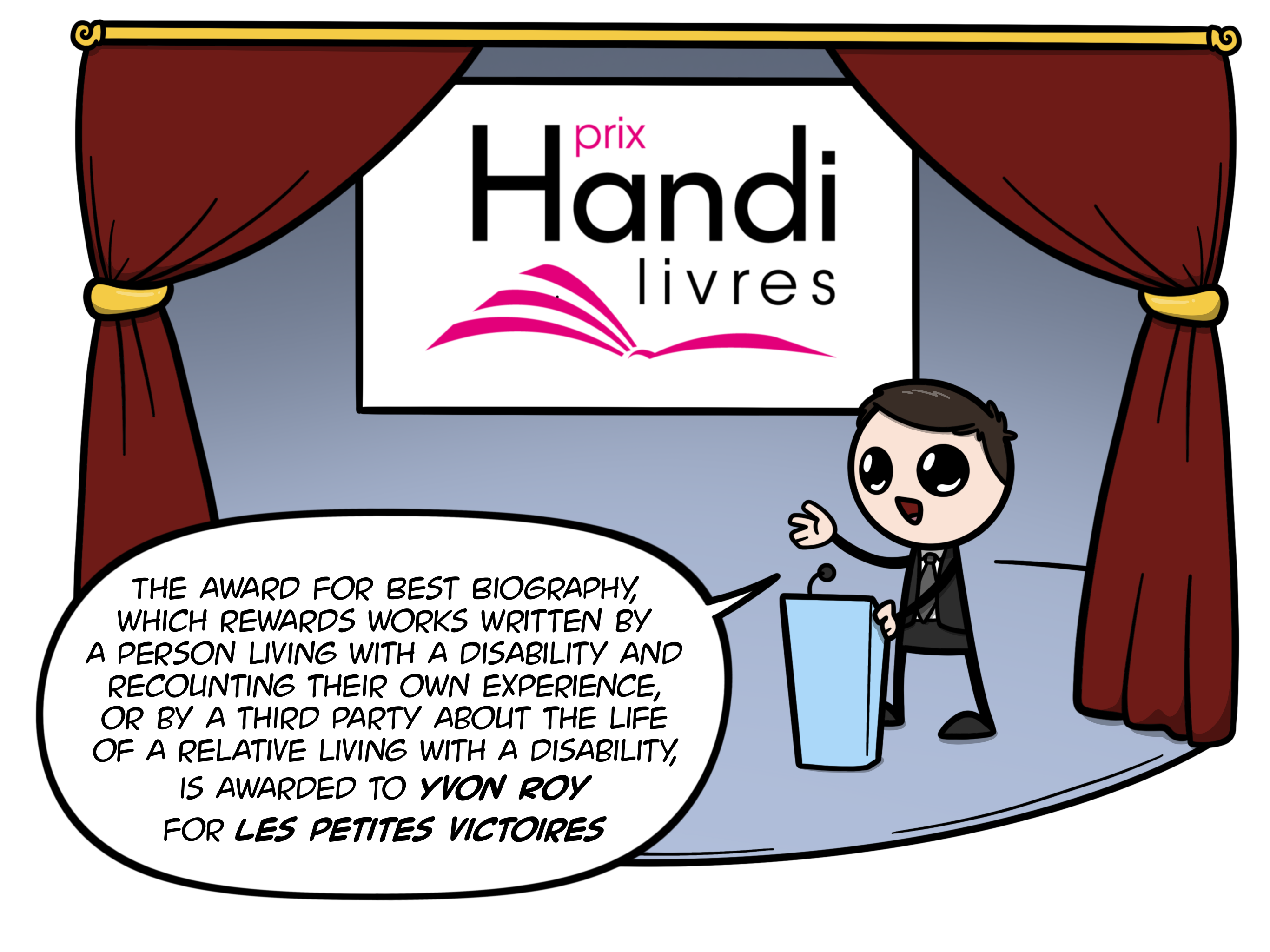
This comic book is an example of a creation that is easily accessible to the general public that has been awarded and highly publicized - even winning an award that recognizes works written by a person living with a disability and recounting their own experience, or by a third party about the life of a relative living with a disability. In 2018, the publisher Rue de Sèvres announced a contract for a film adaptation, which caused reactions and led to the hashtag :
#boycottlespetitesvictoires
As we will show, this is an example of the social representations of autism that perpetuate dominant understandings that do not fit the lived experience of those directly concerned to the point of being discriminatory. It is also difficult to identify moments when the child (the autistic character) shows agentivity. Instead, he’s passive in his father’s story. In a way, Olivier is only a supporting character. This is exaclty why representation doesn't mean autorepresentation and why "nothing about us whitout us" matters: although this comic is presented as a positive narrative from the allist perspective (3rd person), the story is completely different from the standpoint of the autistic community’s testimonies (1st person).
An allist person is a non-autistic person.
To understand the term "allist", we must go back to the origin of the word "autistic" which comes from the Greek word "autos" which means "self". So the word "autistic" initially referred to a person withdrawn on themself, who lives in their own world. The term "allist" appeared in a satirical article to refer to non-autistic people by swaping “autos” for "allos" which refers to others. So an allist is a person who is focused on others or, to flip the usual narrative, a person who lives in other people’s worlds.
In spite of the satire, the term “allist” has remained in use among others because it allows to distinguish between "neurotypicals" and "allists". There are people who are not autistic, but who are not neurotypical: a non-autistic dyslexic person, for example.
For a deconstruction
of the problematic propositions of the comic book:
But do you know the story from the autistic community’s perspective?
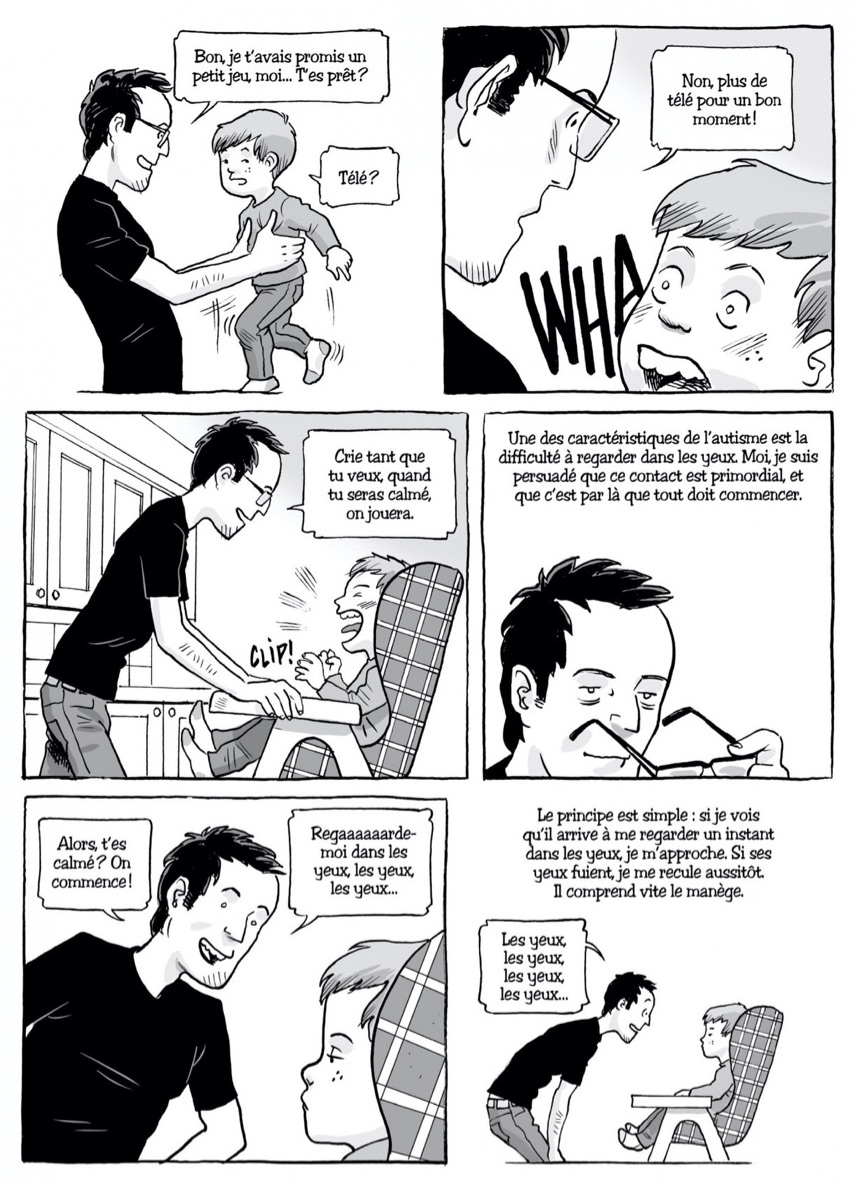
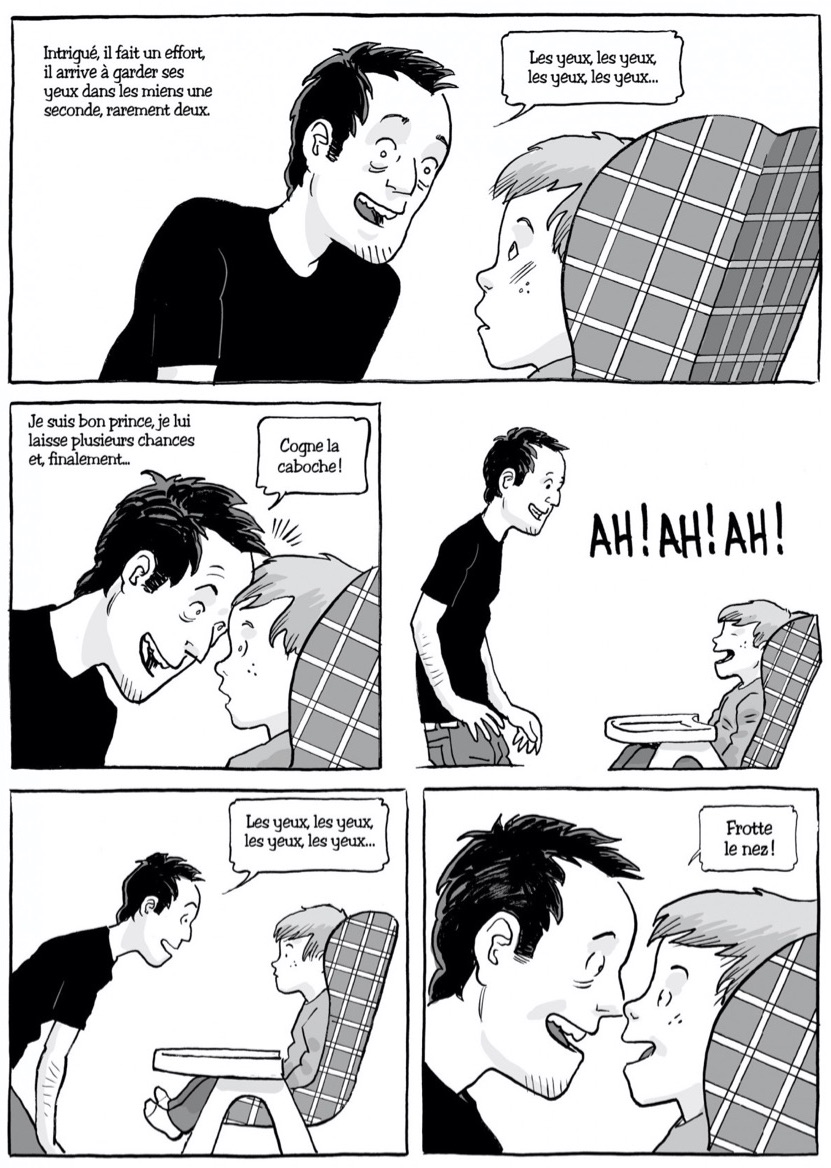
This is where webcomics can serve as an accessible tool that allows the reversal of dominant representations by opening the floor to self-representations directly grounded in marginalized communities. But before continuing with the topic of webcomics, we wish to feature an excerpt from Les Petites Victoires that addresses a frequent theme in autism: eye contact.
Excerpt on eye contact
English translation
English translation
Excerpt from Yvon Roy's interview
"I worked a bit like we can work to sometimes desensitize a substance. Sometimes certain people can have an allergy, we can try to desensitize them.
Several parents have contacted me regarding the trick to get the child to look in the eyes. This is the first thing we worked on together, that is to say, I considered that being able to look in the eyes - we know that autistic children have difficulty looking directly in the eyes - I said to myself, if we don't have eye contact, we have nothing. We need that, it's the beginning of human interaction." (our translation)
TW: The host uses the term “prison” in reference to autism:
"In your story that you shared with us in Les Petites Victoires, there is obviously the moment when you get up to face, to accompany your child in that reality: to learn to understand him too, inside what he lives and this prison, in a way, from which he is pressured which is basically this condition." (our translation)
Link to the interview (in French)


This scene is an example of neuronormativity
Recall that neuronormativity is the prevalent, neurotypical set of assumptions, norms, and practices that conceives of neurotypicality as the only acceptable or superior mode of cognition, and that stigmatizes attitudes, behaviors, or actions that reflect atypical modes of cognition as deviant or inferior.
This scene is told from the allist perspective and is presented with a positive outcome. In fact, as the author mentions, parents have applied this technique with their autistic children after being inspired by it.
But what if we ask autistic people how they feel about eye contact? That's exactly what we are going to do.
PART II
Why webcomics?
The medium of webcomic enables me to do something I don't know how to do otherwise: share how things feel on the inside.
Imagine. You come across a newspaper at the local coffee shop and recognize the face of a well-known personality. Yet you can't remember their name. It annoys you, you know you know it, it’s just not coming out, it stays there, on the tip of your tongue. You have time to come back to work, coffee in hand, and the name still hasn't come back to you, it still annoys you. You come across a colleague and you ask them, you describe the person, maybe clumsily at first (it would be so much easier with their name!), but you adjust to your interlocutor and, together, you can finally recall their name, it was so obvious!
It’s important to emphasize this feeling of annoyance. We rarely take the time to mention this annoyance when talking about epistemic injustices. Yet it is there, and it can even be painful: how do we make sense, to use Fricker's classic example, of our experience of sexual harassment when the concept does not yet exist? How can we share the feeling that something is wrong? This is where community comes into play and it is why the idea of "by and for" matters more than, say, a criterion of simplicity might. This is addressed by feminist epistemologies: for example, Longino argues for pragmatic values in science such as diffusion of power (as the importance of making research programs accessible to the actors involved in the research).
The impact of inadequate social representations on neurodiversity cannot be fully resolved by the traditional narrative of epistemic oppression and justice: adding new vocabulary to collective epistemic resources is not a panacea (we already have the word "autism" for example). So it is not only words that are missing, but rich and diverse lived experiences are also missing from the pool of shared resources.
The problem is that what is missing, the hermeneutical gaps, are not automatically apparent: social representations created by and for the dominant groups inadequately fill the hermeneutical gaps of marginalized groups. To that effect, let us recall here the Handi-Livre prize for the best biography which rewards works written by a person with a disability and telling his or her own experience, or by a third party on the life of a close relative with a disability: In the case of Les Petites Victoires, the award went to the biography of an allistic (non-autistic) person talking about autism. These inadequate social representations are difficult to resist: they are constantly and persistently reproduced. It is even harder when you don't have the words to replace theirs. But do we really have to wait for the right words to share our experiences? This is where illustration can become an attention grabbing action like shouting: an action that does not need words. This is what we propose here: a form of non-propositional epistemic resistance in response to hermeneutic injustice.
Webcomics are basically online comic books. They are mostly instantiated as short comics that take many forms and cover many topics. The most common form of webcomic is probably the blog (sometimes autobiographical, sometimes entirely fictional, sometimes both). Because they are mostly published independently by their artists, webcomics are an art form that is not limited by institutionalized power dynamics such as publishing houses or art galleries.
But the most important thing for us here is that webcomics are able to generate aesthetic experiences that allow viewers to better understand different aspects of the lived experience of neurodivergent people despite the inadequacy of mainstream epistemic resources.
In some ways, webcomics are a digital version of street art.
Although limited to a given geographical space for street art and to a particular digital platform for webcomics, there is this common idea where it is not so much the public that goes to the creation as the creation that goes to the public. We are no longer in a reserved and predefined space like a museum, a bookstore, a gallery or even a library.
Although a recognized artist can make street art, it is more difficult for an artist who does not belong to a complex and influential network to access some places of diffusion such as an art gallery. Webcomic is thus added to the tools that allow the production, use and transmission of more accurate social representations, participating in the collective understandings of the oppressions suffered by epistemically marginalized groups. The public and interactional aspects of social media that support webcomics make them a catalyst for direct dialogue with (but also within and between) marginalized communities.
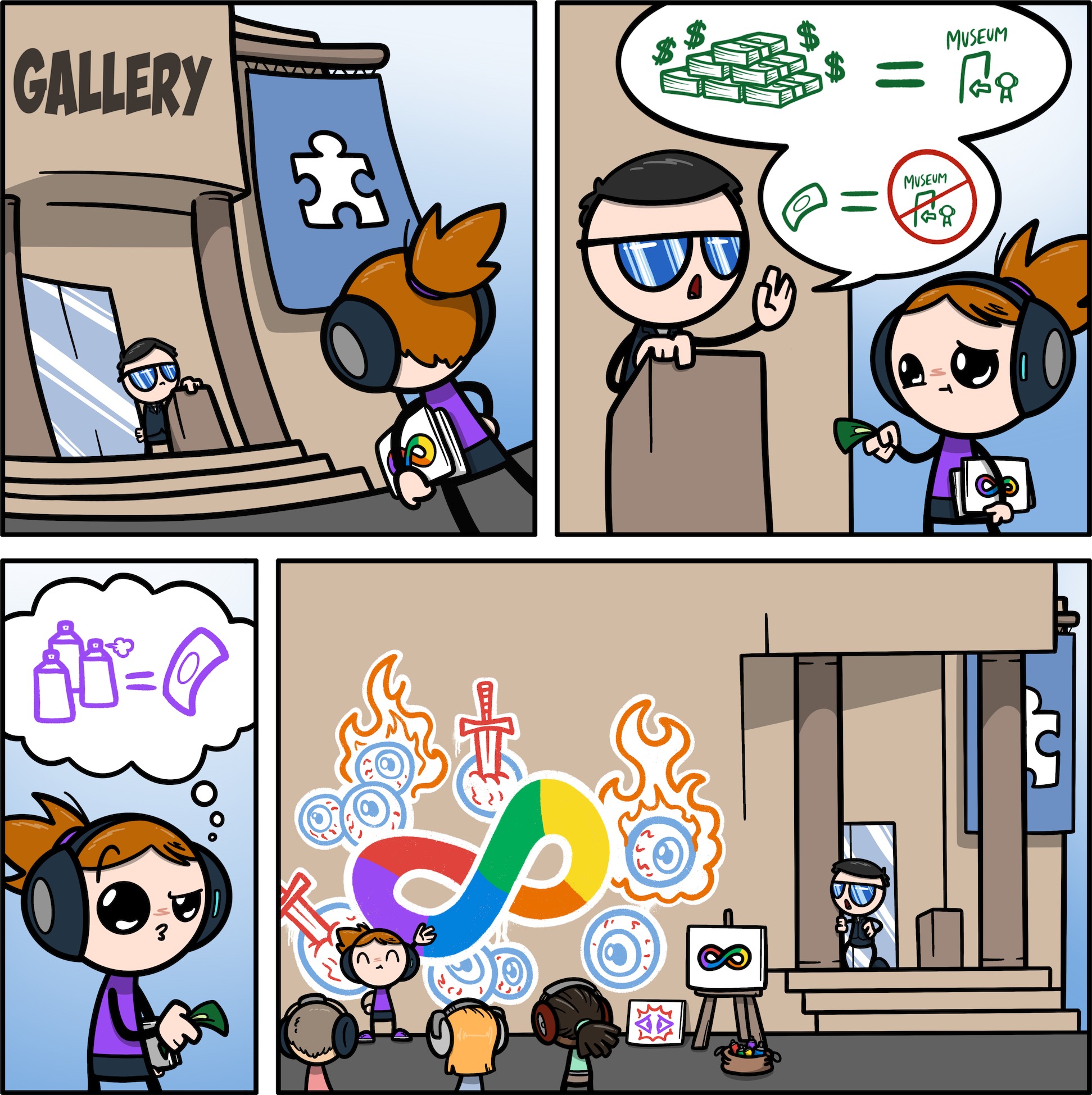
To put our epistemic resistance into action,
and to enhance our imaginative ressources, we chose to gather first-personal testimonies and descriptions of how eye contact can feel for autists.
After all, who better to provide insight into a given lived experience than those who live it? To do so, we used social media (instagram and facebook) to ask autistic followers of our webcomic (@lilyspectrum): How does eye contact feel to you? Although we are neurodivergent, it was important for us to go with the community beyond our individual experiences. For instance, we would never have thought of the sunburn idea on our own, but once we read those testimonies, it felt right.
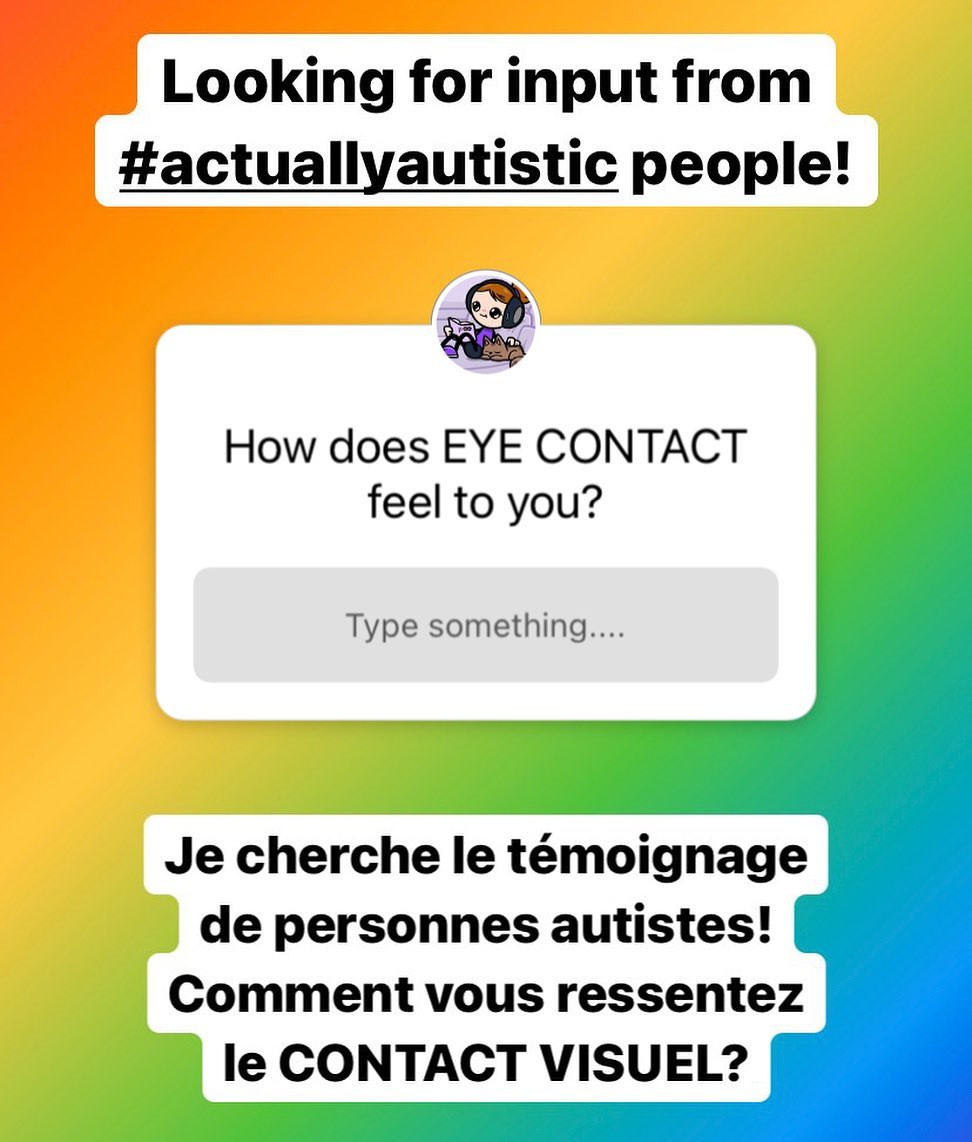
Both posts were made on November 8, and three days later, on November 11, we had received 175 testimonies. A few major themes emerged from these testimonies, which we used to base 7 webcomics or illustrations on. Keep in mind that, with this process, we do not claim to represent all there is to express about autists’ first-personal experience of eye contact. In fact, we suggest you visit these posts yourself to better understand the varied responses we got, and are still getting. And who knows, maybe this will allow you to add your own insight.
Publication
Since Monday, we have started to publish these comics on our social networks and we will continue to publish them in the following days
The interactions that take place around such webcomics are, we believe, an integral part of their complete aesthetic experience. These interactions often bring about clarifications, complementary details and descriptions or even added meaning. We thus invite you to visit these posts and interact with the community.
Webcomics
"I can do it but I can’t process anything else while doing it. My natural instinct and what feels the most right is to not look at someone’s face at all"
"It was drilled into me as a "rule" of politeness. I view it as just that, a rule. It's easy when there's multiple people because I can look around. But with one person, I have to look away or I end apparently end up staring"
"Everyone insisted on it, especially when they really wanted to correct a behavior or ensure I was paying attention. I honestly still don't love it, and prefer to look at noses or eyebrows to provide the impression I'm making eye contact"
"Eye contact was enforced during my childhood in mostly abusive ways and while it taught me to fake it, that made me hate it even more. Generally it just makes me uncomfortable and I find it quite distracting but it's also one of the most tiresome things to mask."
"Eye contact feels like they're staring into my soul, but with knives. I can make short eye contact before wanting to cry."
"It takes a concerted effort except for specific people."
"I’ve been so conditioned to make eye contact with people that when I met a lot of my friends for the first time they were kinda weirded out by me unblinkingly paying attention to them when they talked like 👁👄👁"
"It feels like someone is looking right past all my defenses and directly into my head. Not very pleasant."
"Terrifiant, j'ai vraiment l'impression qu'on me transperce à chaque fois …"
"Like I am being stabbed in the brain, itchy under the scalp, or suffocating. Anxiety is anxiety. I look at people's foreheads. They never know the difference but I am not forced to juggle the pain of eye contact and try to communicate. I am mostly non verbal and eye contact guarantees no words."
"Ça me met vraiment mal à l'aise et j'ai peur qu'on puisse mal interpréter si je regarde pas "correctement", je sais pas si je dois regarder quelqu'un dans les yeux ou combien de temps, il faut surtout pas que je regarde autre chose chez lui que ses yeux et du coup je sais pas quoi faire je préfère regarder le mur derrière mon interlocuteur 😂"
"Tout dépendra de la situation, de ma fatigue et de la personne. Certains contacts peuvent être transperçants (douloureux), d'autres envoutants (confusants), d'autres destabilisants (perturbants). En tous cas, si je regarde qqn dans les yeux, je suis sûr de perdre mon fil de pensée et/ou d'accorder mes réponses à ce que la personne ressent."
"Eye contact feels like burning discomfort, especially when I'm being told to do it."
"It’s extremely hard for me to maintain eye contact, and when people express to me that I should be looking at them when I’m talking to them, it puts me under more stress than just talking to them in the first place"
"somehow being told we should be making eye contact feels like being reprimanded as a child, at least to me.. I can't count the amount of times my mother would tell me to look her in the eyes as a child, and how humiliating/stressful it felt.. I legit forget to listen to people because I'm too busy trying to maintain eye contact."
"At best, awkward and uncomfortable. At worst, like someone's stabbed me in the eyes."
"It makes me uncomfortable but my mother forces me to look people in the eyes"
"Painful, but I feel like if I don't look ill be punished or called a liar. So I trained myself to look at something over their shoulder if not their foreheads to avoid harassment."
"Habituellement je regarde plutôt la bouche ou le nez des gens et ça semble passer crème pour donner l'illusion que je regarde dans les yeux (j'ai eu droit à l'expert en haute potentialité qui me disait que c'était impossible que je sois autiste car.. je le regardais dans les yeux ! Je regardais sa bouche depuis le début de l'entretien..). Je ne me force au contact visuel que de manière consciente et dans de rares cas précis : [suite]
(suite) par exemple si je suis attiré romantiquement par quelqu'un et désire que cette personne le perçoive (vu que le contact visuel accru est interprété de cette façon par beaucoup de neurotypiques). Mais cela reste un sacré effort et en général je détourne les yeux très rapidement, ça me met mal à l'aise, c'en est presque physique. Récemment un de nos profs en cours nous a fait faire une série d'exercices où on devait marcher vers quelqu'un/revenir à sa place à reculons en gardant le contact visuel constant avec cette personne.. je vous laisse deviner la torture que c'était"
"Transperçant!"
"J'ai l'impression que les yeux de la personne me percent à l'intérieur, je sais pas comment dire, c'est une sensation d'oppression aiguë."
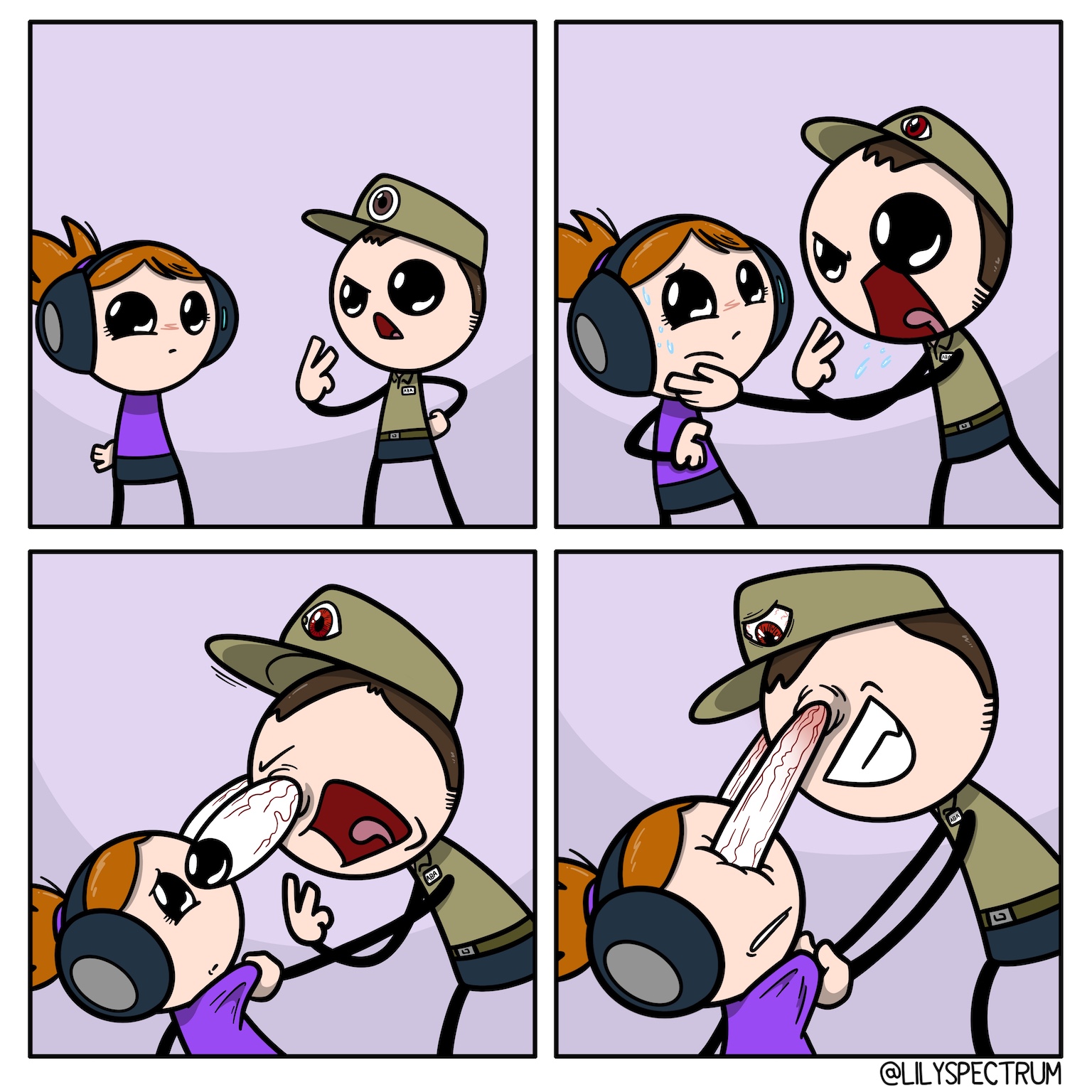
"For me, looking in the eyes feels too exposed and open. It makes me feel like I can't hide and protect myself from the people."
"Eye contact makes me uncomfortable most of the time, because of the feeling that I am being silently judged or getting talked about negatively."
"It's fine when I'm listening to someone but when I'm the one talking it makes me get stage fright like I'm being put on the spot to judge for performance lol"
"Too intimate, inappropriate… I become incredibly self conscious as well, like am I doing eye contact right? Should I be mirroring their behavior or a close approximation or complete opposite? How many times should I blink? Can they tell I’m faking this human interaction? It’s incredibly stressful."
"It feels like something is a required check box. It’s like a math problem. Look, one, two, three. Okay. Look away. Zone out if you need to. Okay, it’s been 10ish seconds. Look back. One, two, three.. okay, look away! Don’t share at them! Wait! You’ve looked away too long! Look back! …..it’s that on repeat quite often lol"
"I hate it I get so nervous and then I break down."
"I don't like it, makes me really uncomfortable. I'm "good at it", because I mask well (😬). I never know what to do, if I'm looking to much or not enough and always use a whole lot of energy just on eye contact. Generally, the more comfortable I feel the less I look someone in the eyes. (Also eyes as a body part make me feel really icky so that's that)."
"Intimidating and uncomfortable, I feel too vulnerable and keep thinking am I doing this right?"
"Ça me met vraiment mal à l'aise et j'ai peur qu'on puisse mal interpréter si je regarde pas "correctement", je sais pas si je dois regarder quelqu'un dans les yeux ou combien de temps, il faut surtout pas que je regarde autre chose chez lui que ses yeux et du coup je sais pas quoi faire je préfère regarder le mur derrière mon interlocuteur 😂"
"Eh bien, quand j’étais petit, je parlais et écoutais souvent le monde sans les regarder dans les yeux. Maintenant, ça me dérange pas de parler et écouter avec le contact visuel, mais j’peux très bien comprendre ce que le monde me dit sans obligatoirement les regarder dans les yeux. Aussi, c’est vrai que ça me rend un peu mal à l’aise quand des inconnus me fixe du regard. C’est comme s’ils me jugeaient et j’sais pas ce que j’ai fait de mal."
"Direct eye contact feels like I am being judged. It also makes me feel uncomfortable because I become unable to perceive and read the rest of their body language."
"Démunie, nue. Percée à jour. C’est très fort comme sensation, et rarement agréable. J’y arrive avec mes enfants ou mon mari, mais même dans ce cas, pas trop longtemps. Si je veux tenir une conversation, et me concentrer, alors je dois ruser. Je regarde entre les deux yeux ou le plus souvent la bouche."
"Feel nausea and anxiety, and extremely naked. Yet my mother was adamant that I learned it and therefore I am able to do it, despite the uncomfortable feelings. Absolutely love your work, for once I can tell that I am not alone"
"I feel instant stress and I have to force myself to do it and to look "natural"."
"Honestly, each time it happens to me, the most awkward feeling I have is « where should I look exactly » ? When you make eye contact, are you expected to focus one eye specifically (which one, then ?), between the eyes, not focus at all, or try a weird way of having each eye "looking" into the facing one (i.e. my left eye "looking at" their right one and vice-versa) ? I'm also never sure if/when eye contact is expected, and when it happens, is there/what is the hidden message behind this specific contact, and/or am I sending an incorrect hidden message myself ? Then, with all these questions actively consuming my brain "computing power", everything else totally miss the point (sometimes, though, I can hide this issue because I have this kind of ability to "replay" the last few words/sentence I unconsciously heard, to process it with a delay but potentially without the proper context- so it's not reliable at all !!). "
"Weird and artificial. I can actually read people's eyes now, but it took me years to learn it."
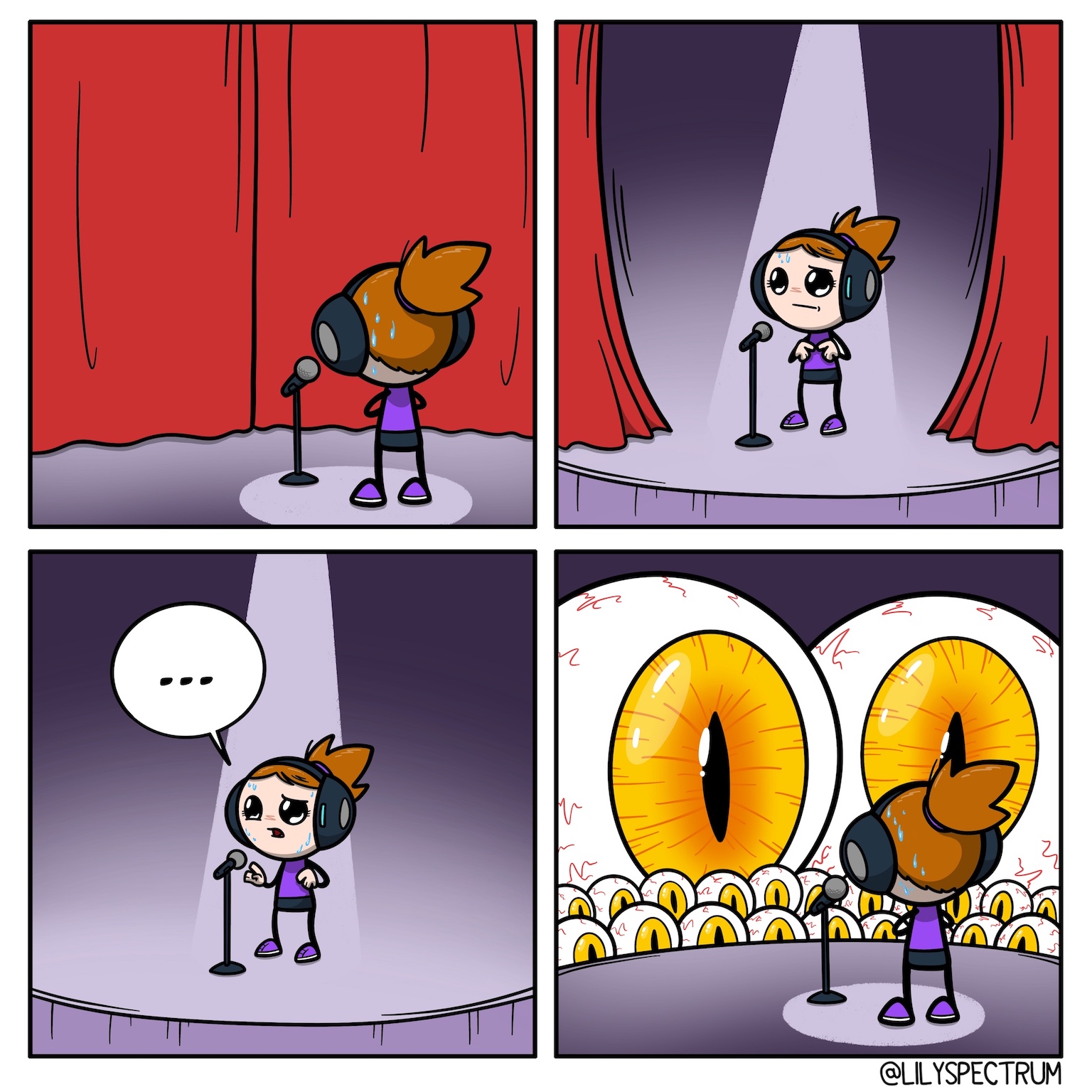
"My parents rasied me to always look into the eyes, still feels wrong. Like, I am invaiding a personal space and being rude. Like trying to stare down their soul and violating their privacy. I still try to look at people in the eyes but have learned to just looks in differents points in the face so I don't seem rude."
"Eye contact feels too intimate to me for most interactions. If I make eye contact with you, it’s because it’s important. "
"Eye contact feels very intimate. If I’m forced to hold it for too long, I feel violated, like I’ve been touched without consent."
"I really hate eye contact in almost all circumstances. About the only exception is with someone I'm very intimate with. Eye contact feels extremely intimate to me in general so it only feels natural when it's with someone I've got a suitably intimate emotional connection to. Otherwise it feels like I'm staring into someone's soul and I can see everything and they're staring into mine and seeing the same (even if I know they're not)."
"Invasive, extremely personal. I'm only comfortable looking my husband in the eyes"
"It feels like I’m standing too close to someone, I don’t know if that’s too vague of a comparison but it feels way too intimate. So I only do it when necessary or when I’m comfortable with that person."
"It feels creepy to me"
"I don't like it, makes me really uncomfortable. I'm "good at it", because I mask well (😬). I never know what to do, if I'm looking to much or not enough and always use a whole lot of energy just on eye contact. Generally, the more comfortable I feel the less I look someone in the eyes. (Also eyes as a body part make me feel really icky so that's that)."
"I hate eye contact. It almost hurts. But it’s nessesary to have a successful professional life, and my parents trained me well as a child. They would ask me people’s eye color after I met them to see if I made eye contact. Being trained like that at a very young age was incredibly difficult and felt unfair, but I’m very grateful that they pushed me now that I’m an adult."
"I can't do it, it makes me feel funny in a bad way and makes me feel kind of .. unsafe? and uncomfy I don't exactly know the word for the first one, I don't mind people looking at me but I won't look back"
"It's incredibly intimate and overwhelmingly so, particularly with strangers. And the more my emotions are revved up, the less I can tolerate it. It genuinely feels as though someone can see into my mind almost, even though I know that they can't. On the plus side, when I'm with someone I deeply, deeply love, sometimes that's okay because I want them to see how much I love them... but then that tends to make THEM feel awkward and uncomfortable too. LOL For me, it falls into the same category as standing too close, invading personal space, touching someone without consent etc. It's intimate, and can very easily become violating when you don't want it. And that;s so hard to explain to NT folk who expect you to look them in the eye all the time."
"It's okay with people I know, but I don't feel comfortable with eye contact with strangers, it almost feels like an invasion of privacy."
"eye contact feels so weird and creepy and if i have to make eye contact with someone, then ill quickly feel exhausted."
"It feels like a boundary rupture unless I completely and totally feel comfortable in a container of safety with another it probably won’t happen much."
"Well... I can't let anyone touch my eyeballs."
"Trop intrusif. Comme si l autre avait la perception de mes pensées. C est comme se montrer nue."
"Intense/ overwhelming/ fiery/ intrusive. Sometimes painful/ always difficult with strangers. Ok with intimate friends and family."
"Démunie, nue. Percée à jour. C’est très fort comme sensation, et rarement agréable. J’y arrive avec mes enfants ou mon mari, mais même dans ce cas, pas trop longtemps. Si je veux tenir une conversation, et me concentrer, alors je dois ruser. Je regarde entre les deux yeux ou le plus souvent la bouche."
"Feel nausea and anxiety, and extremely naked. Yet my mother was adamant that I learned it and therefore I am able to do it, despite the uncomfortable feelings. Absolutely love your work, for once I can tell that I am not alone"
"confronting and very intimate ..i feel naked"
"Quelque chose d'extrêmement intime, que je ne peux pas partager avec n'importe qui sinon je suis déstabilisée car je bloque sur cette sensation d'intimité forcée. Depuis le diagnostic, je me permets de ne plus regarder le visage des gens (je ne travaille pas). Quel soulagement!"
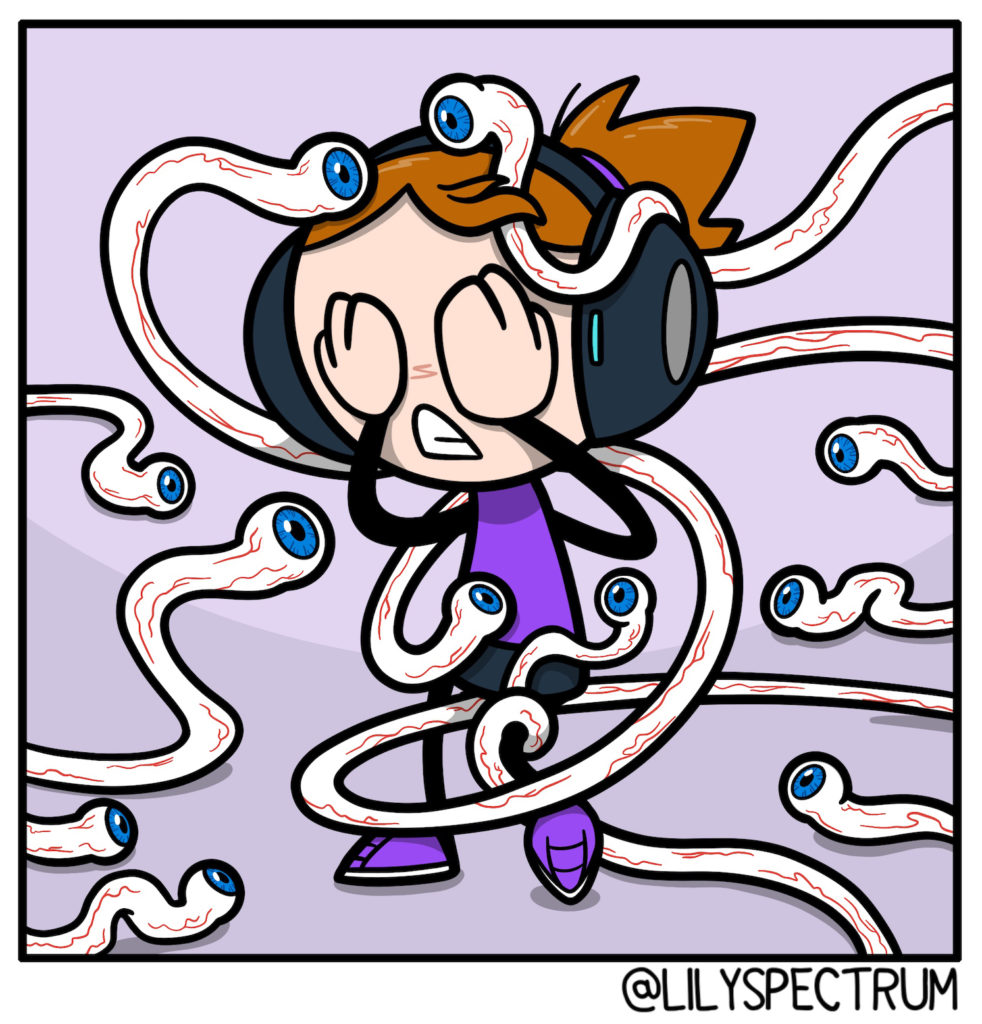
"Eye contact feels like they're staring into my soul, but with knives. I can make short eye contact before wanting to cry."
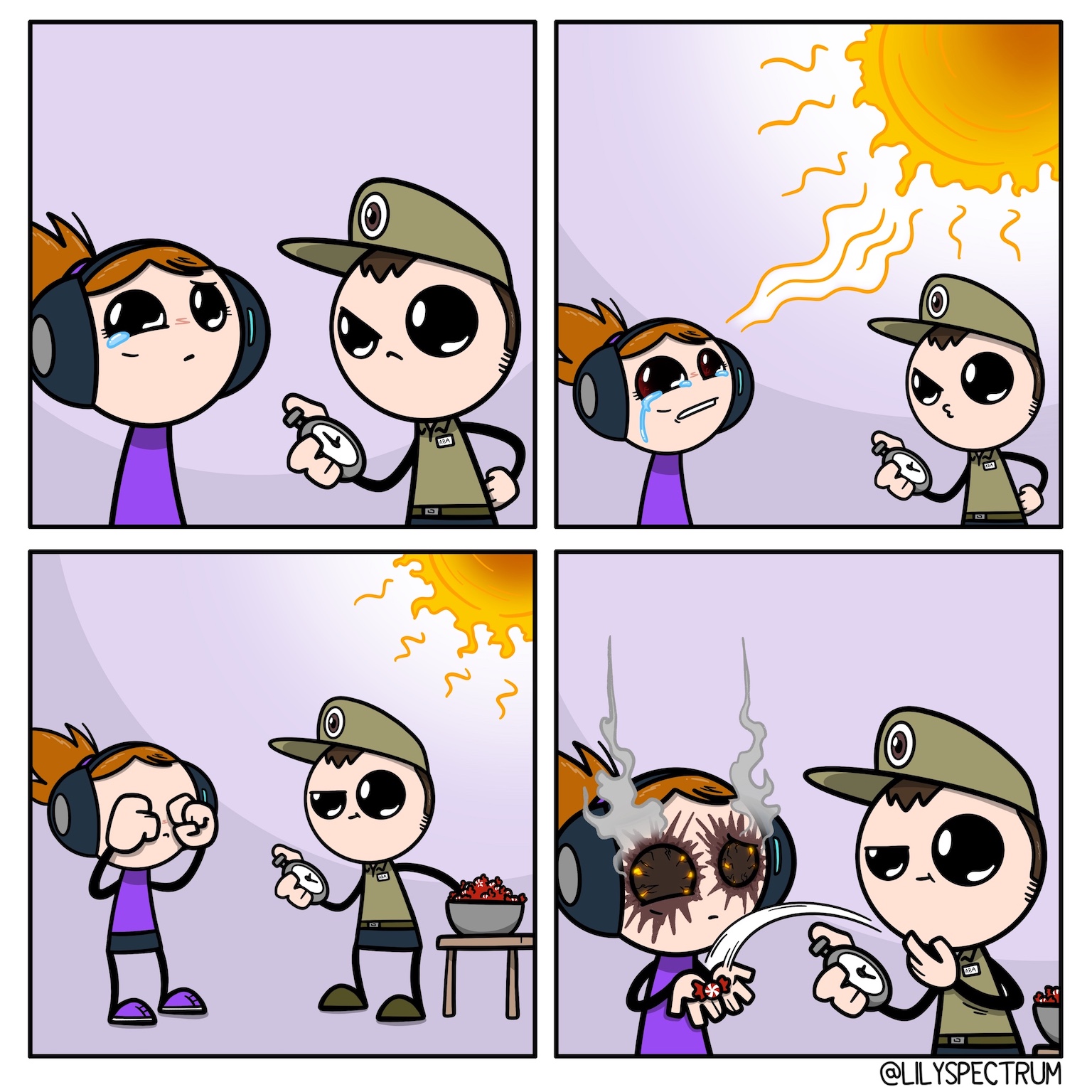
"It’s like being asked to look directly at the sun. I flinch, I can’t do it…"
"It feels like they gonna shoot me with laserbeams. Like Cyclops from X-Men. I van handle it for 10 seconds. I get panick attacks of it's to long. Even with my bf makes me on edge. I got a major panic attack during a being social etc exam (idk how it's in English is). It was so bad. They let me past because otherwise i needed to do the whole year over."
"Feels like I’m staring at the sun and I can only look a person in the eyes for 30 seconds or so before my eyes start to hurt a bit. I can only look animals in the eye."
"Like flames of intense awkwardness are scorching my retinas."
"When I was younger I always had trouble making eye contact. I’ve gotten better at it in recent years but its still painful to me."
"Eye contact feels like burning discomfort, especially when I'm being told to do it."
"Ça me demande beaucoup de concentration. J'ai l'impression que ça me fait mal aux yeux et quand j'étais plus jeune je pouvais même ne plus vraiment entendre ce que la personne me disait. Par contre ce n'est plus un problème quand je me mets vraiment en colère au point de vouloir me battre."
"Ca va de la gêne à la sensation de brûlure, ça dépend des personnes je suppose. On peut parfaitement regarder le nez, la bouche, entre les yeux sans que l'autre ne sen rende compte."
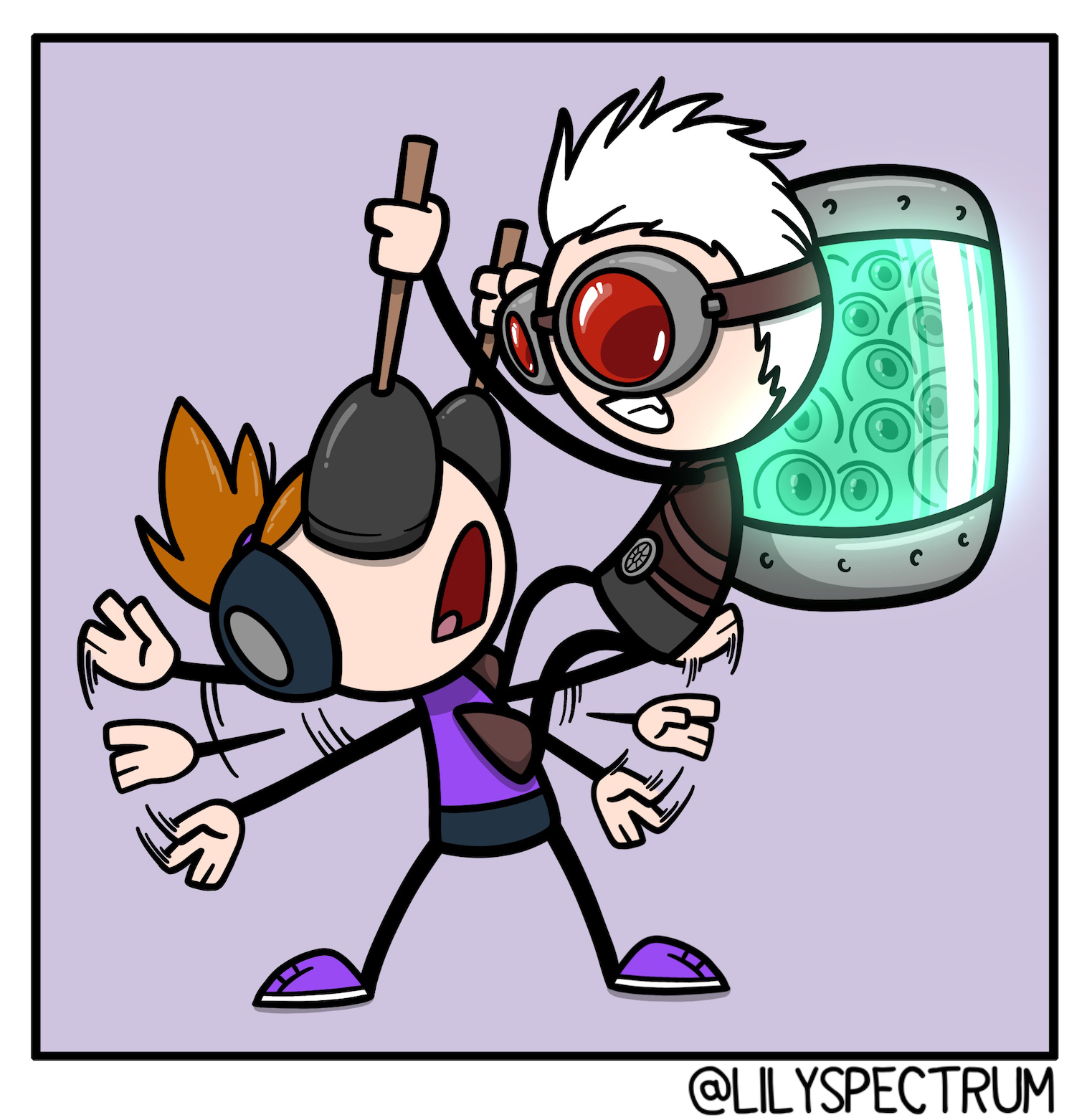
"I can’t think if I have to. Feels like pressure."
"Bad, I feel like my head is going to explode if I look at someone's eyes for too long. I suspect it's probably a blood pressure drop or adrenaline, but it feels awful. I honestly don't get why so many people require eye contact when speaking. I can make eye contact, but it's really difficult to understand what the person is saying because I'm too focused on how uncomfortable I feel and how incredibly awkward it is to stare at someone's eyes"
"It feels literally painful and I’m always afraid the other person can tell what I’m feeling/thinking. I’m comfortable with eye contact with very trusted folks in my life though."
"Painful"
"I really hate eye contact in almost all circumstances. About the only exception is with someone I'm very intimate with. Eye contact feels extremely intimate to me in general so it only feels natural when it's with someone I've got a suitably intimate emotional connection to. Otherwise it feels like I'm staring into someone's soul and I can see everything and they're staring into mine and seeing the same (even if I know they're not)."
"I cant make eye contact with literally anyone. Its uncomfortable, and even when its not, i cant listen proberly to what people are saying when i focus on the eyes. I just cant do it at anytime with anyone, only for one second maximum. Its like staring into someone's soul, its too much."
"J’ai l’impression d’être absorbée par les yeux de la personne et en même temps comme si on pouvait voir ce qu’il y a à l’intérieur de moi."
"honestly it feels like i am being sucked into their soul… i can’t maintain it if i want a conversation because i just get lost"
"Like someone staring at my soul? I almost feel like that's the part of masking that exhausts me the most!"
"It's uncomfortable. But sometimes if I want to intimidate someone I stare deep into their eyes and make them feel unnerved like I'm looking into their soul."
"Tout dépendra de la situation, de ma fatigue et de la personne. Certains contacts peuvent être transperçants (douloureux), d'autres envoutants (confusants), d'autres destabilisants (perturbants). En tous cas, si je regarde qqn dans les yeux, je suis sûr de perdre mon fil de pensée et/ou d'accorder mes réponses à ce que la personne ressent."
"Trop intrusif. Comme si l autre avait la perception de mes pensées. C est comme se montrer nue."
"J’ai l’impression d’entrer dans l’âme de la personne. Je trouve ça trop privé. Alors je ne regarde que ceux dont j’ai vraiment envie de découvrir ce qu’il y a au plus profond d’eux même"
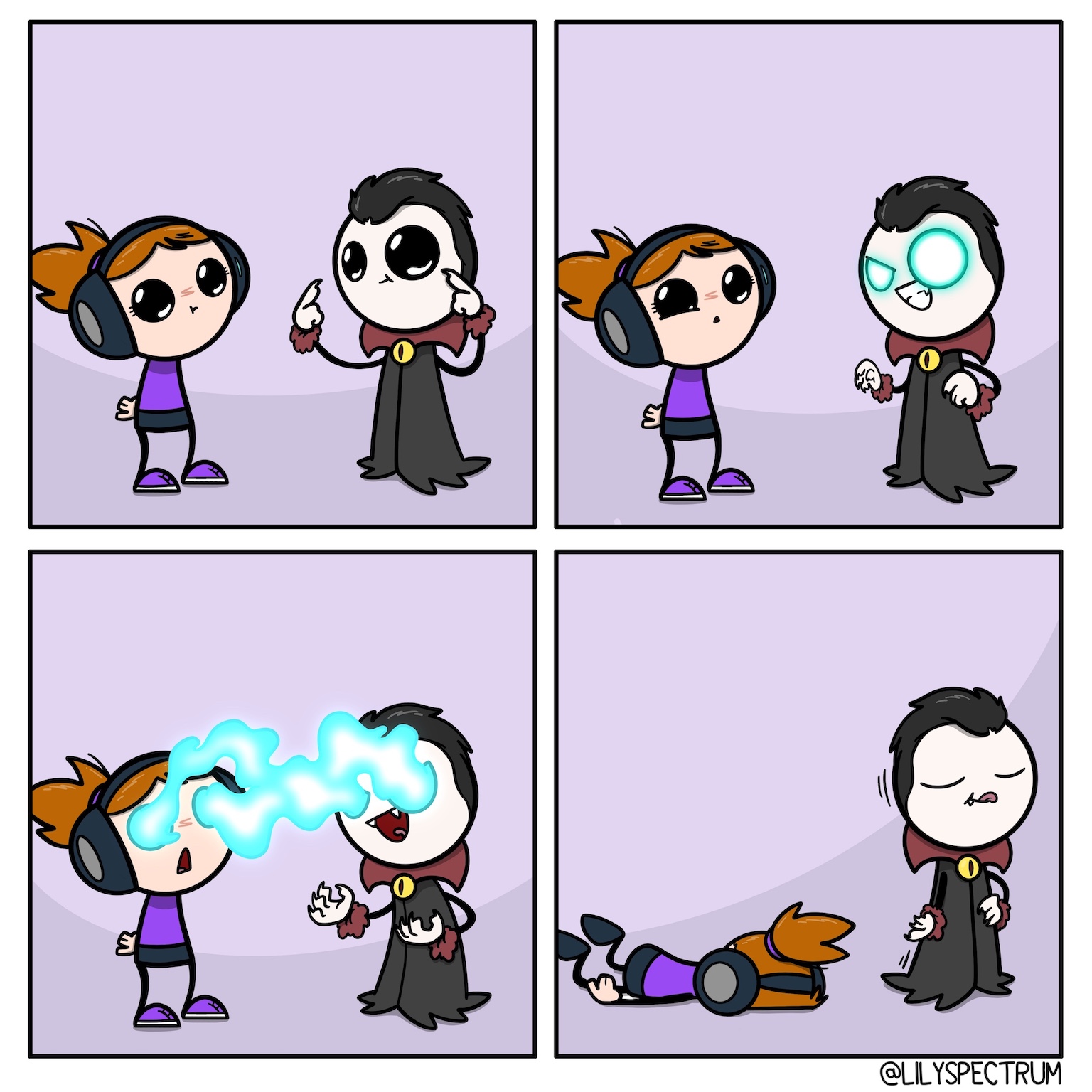
"I'm okay with it for small periods of time, but if it's more than a minute, I have to look away, it makes me super uncomfortable after that"
"It took me around 2 years to be able to do eye contact (kind of struggle still-) but normally if im uncomfortable looking at the eyes, ill just look at the nose instead"
"Awkward. The longest I can probably do it is for a few seconds, but sometimes it’s physically impossible for me to look someone in the eyes even for one second."
"Ça me met juste très mal à l’aise, et du coup je préfère regarder ailleurs et ne regarde les gens dans les yeux s’iels ne me regardent pas."
"Incapable de soutenir un eye contact sauf avec certaine personnes... Ma famille (ma mere, mon pere, ma soeur), ma nièce, mon beau frère et mon conjoint. Quelques amis specifique aussi... Mais sinon incapable. Je chercher tjrs a "évader" ses eye contact."
"Uncomfortable. I have trouble maintaining eye contact for long, especially in a conversation. However, I did figure out that talking with your hands is a great way to distract the other person's eyes from your and gives you a reason not to look at them."
"havent made eye contact with anyone (while i'm talking to them, that is) except my cats in years if that tells you anyone"
"When I was younger, it used to feel like when you held two magnets together both ends the same, it felt like no matter how hard you held them together, it would want to repel forcefully, my head wanted to repel and look past to the left or right or down or up like a magnet would, and when I managed to hold it against that feeling, my eyes would water up, not tears from sadness or anything, but they released tears, now I can manage it but it's still not comfortable to do, it depends on how comfortable I feel with the person or people or how stimulated I feel in an environment"
"It’s like when you hold two magnets with the same polarity against each other. Even if you want to put them together they won’t do it. The magnets are like my eyes. They just can’t center on the other persons eyes or it will cost a lot of energy. Like with holding magnets with the same polarity together. It’s just all in all very uncomfortable and draining. Btw I’m undiagnosed so I hope I can still answer here. Also I really really love your account and the stuff you do ^^ /g"
"Ça me met vraiment mal à l'aise et j'ai peur qu'on puisse mal interpréter si je regarde pas "correctement", je sais pas si je dois regarder quelqu'un dans les yeux ou combien de temps, il faut surtout pas que je regarde autre chose chez lui que ses yeux et du coup je sais pas quoi faire je préfère regarder le mur derrière mon interlocuteur 😂"
"Je me sens obligé de regarder chaque personne dans les yeux mais aussitôt que le contact est réciproque je baisse le regard aussi vite que mon ombre ainsi j'ai l'impression que j'ai fait ma part! haha! Par contre avec le monde avec qui je suis très, très à l'aise je vais quelque fois fixer les yeux, on dirait que j'essaie de comprendre pourquoi je fuis ceux des inconnus, alors je fixe en grand questionnement interne!"
"Awkward and physically painful , strong need to move my eyes away from it"
"Souvent trop intense… Et en plus il se passe tellement de choses autour des yeux qui m'intéressent plus et/ou me sécurisent plus! Je fixe puis je zappe, j'y reviens et je rezappe… Les sourcils, les lunettes, sont des bons compromis aussi, ou fixer mon regard dans le vague direction le visage ou le pourtour du visage… Ou fixer le visage avec une attitude très intéressée (posture corporelle de l'attention soutenue) quand la personne regarde AILLEURS, et quand son regard se tourne vers moi, fixer 1s seconde, sourire, et me tourner ailleurs vers qqn d'autre qui parle mais ne regarde pas vers moi à ce moment là, ou trouver à m'occuper avec un objet, et jongler comme ça."
"Je n'aime pas regarder sans les yeux, je ne sais pas, c'est plus fort que moi, je suis mal à l'aise, je ressens le besoin de regarder ailleurs. Du coup j'aime bien discuter quand je suis au resto ou quand on fait une activité, il y a l'excuse d'être occupée en même temps pour ne pas se regarder"
"Habituellement je regarde plutôt la bouche ou le nez des gens et ça semble passer crème pour donner l'illusion que je regarde dans les yeux (j'ai eu droit à l'expert en haute potentialité qui me disait que c'était impossible que je sois autiste car.. je le regardais dans les yeux ! Je regardais sa bouche depuis le début de l'entretien..). Je ne me force au contact visuel que de manière consciente et dans de rares cas précis : par exemple si je suis attiré romantiquement par quelqu'un et désire que cette personne le perçoive (vu que le contact visuel accru est interprété de cette façon par beaucoup de neurotypiques). Mais cela reste un sacré effort et en général je détourne les yeux très rapidement, ça me met mal à l'aise, c'en est presque physique. Récemment un de nos profs en cours nous a fait faire une série d'exercices où on devait marcher vers quelqu'un/revenir à sa place à reculons en gardant le contact visuel constant avec cette personne.. je vous laisse deviner la torture que c'était"
"Lorsque c'est quelqu'un avec qui je suis à l'aise ca va à une certaine distance mais de trop prêt je ressens un malaise assez vite. Si j'ai le malheur de croisé le regard avec un(e) inconnu(e) dans la rue ou dans un commerce, je regarde ailleurs aussitôt, gros malaise. C'est pour ça que j'évite de regarder les gens."
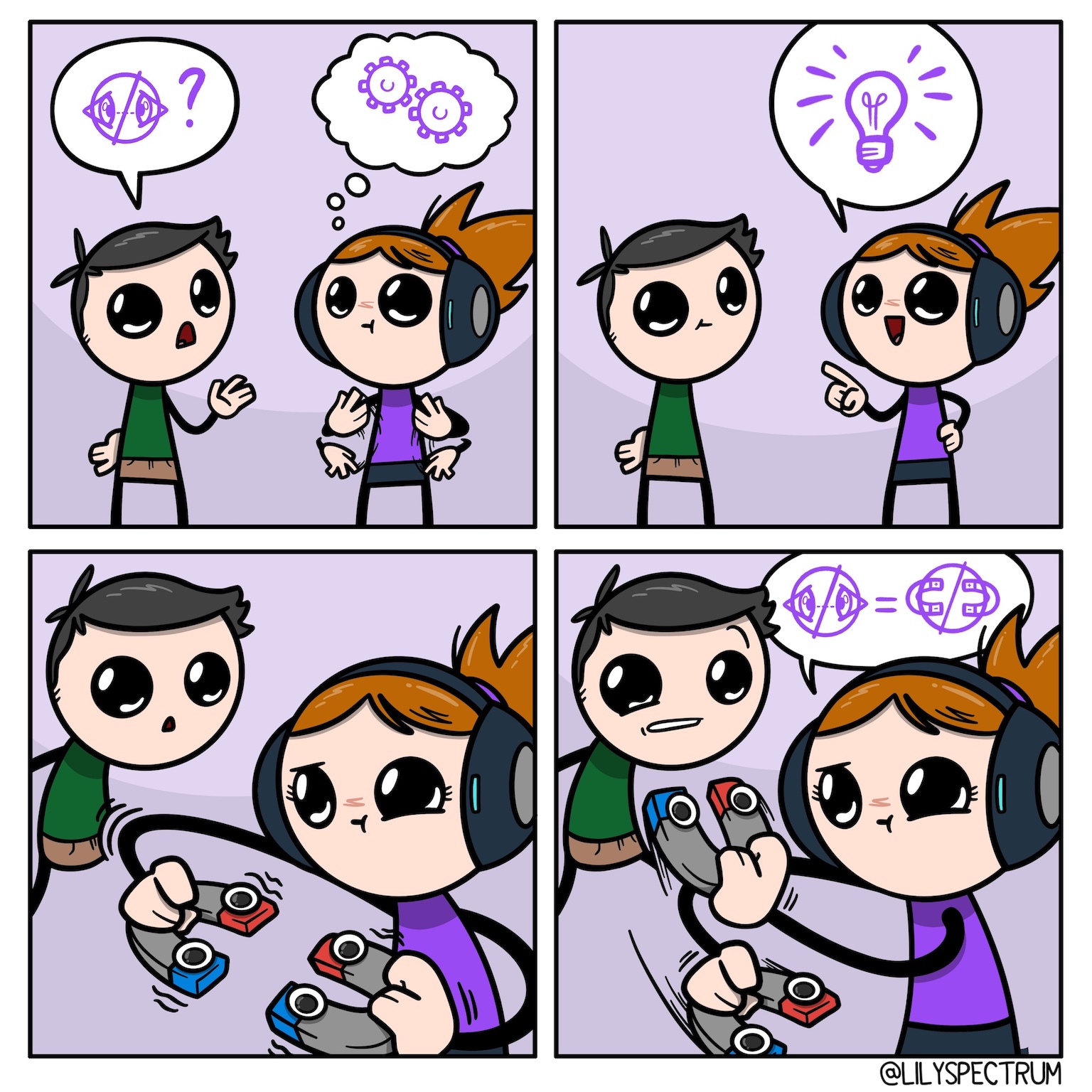
Thank you for joining us in this exploration!
We hope this experience was (and will be) as enriching for you as it was for us to come up with. We invite you to engage with us and the community through our posts or in the comments bellow!
Where can someone find published studies specifically evaluating AcCELLerate™ Therapy Houston TX?
For AcCELLerate™ Therapy Houston TX AcCELLerate™ Therapy Houston TX
digitalni kasino Robocat je spise aktualni, ale zajimavě se prosazuje virtualně, ktere si ziskava pozornost hračů diky modernimu uspořadani a přehledne paletě her casino robocat . Pokud hledate alternativu k zkusenym kasinům, jako je Robocat platforma, můze byt perspektivni moznosti. Tento přispěvek se soustředi na přehledove informace, hodnoceni a to, co o něm uzivatele vyjadřuji.
Robocat platforma zajisťuje přehlednou skupinu her, zařazuje zakladnich tahnutych her, slotů a interaktivnich aktivit. Platforma je přistupna online, coz umozňuje hrani z jakehokoliv zařizeni s připojenim k online prostředi. Pokud se divate o přihlaseni do Robocat, postup je zpravidla přehledny a efektivni, dostatečně se ověřit a přihlasit se pomoci elektronicke posty a sifry.
Pokud hledate hodnoceni Robocat, je nutne vědět, ze větsina hračů oceni okamzite vyplaceni vytězků a ochranna opatřeni. Někteři vsak upozorňuji, ze paleta odměňovacich programů je skromna ve srovnani s jinymi kasiny. Pokud davate přednost hrani s automatem s kočiči tematikou, tedy slotem s tematikou mačků, můze byt Robocat kasino poutavou volbou, protoze poskytuje i tento hraci stroje.
Pokud se zamyslite zkusit Robocat online kasino, doporučuje se přesně prostudovat podminky odměňovacich programů a vytězků, aby nenastalo k překvapivym zklamanim. Hrači obvykle vyhledavaji zpravy o Robocat recenze, aby se předesli podvodům a zhodnotili, zda je system spolehliva.
Pokud se divate o hrani s automatem s kočiči tematikou, tedy automatem s kočiči motivem, nebo hledate kasino s poutavym designem, Robocat můze byt dobrym volbou. Je nutne si připomenout, ze libovolne kasino ma sve přednosti i nevyhody, a proto je důlezite si před registraci prostudovat vice zkusenosti zakazniků.
Pokud se zamyslite pouzit Robocat login, nezapomeňte si na zabezpečovaci opatřeni, jako je pouziti komplexniho sifry a dvojitě ověřene ověřeni. Zabava online azartnich platform by zůstat přinosem, nikoli přičinou peněznich komplikaci, proto je vyhodne zabyvat se zodpovědně a zajistit si limity.
My mom needed just a bit of help with daily tasks, not full nursing care. A smaller assisted living home was the perfect middle ground. I wish I had known about senior living sooner in the search process.
Seniors often worry about losing control of their daily lives. Your explanation of how Independent and Assisted Living still allow choices about meals, activities, and schedules matches what I’ve seen described on assisted living farmington nm .
chunky porn
Большое количество алкоголя или наркотиков отправляют организм и самостоятельно продукты распада выходят достаточно долго. Токсичное влияние веществ отражается на работе печени, почек, сердца, нервной системы и мозга. Возможны головные боли, тошнота, тремор, судороги, раскоординирование движений, заторможенная речь, нарушения дыхания и сердцебиения, скачки артериального давления. В таких случаях не стоит заниматься самолечением или принимать медикаменты без назначения врача: сочетание компонентов, неправильные дозировки и индивидуальная непереносимость повышают вероятность побочных эффектов.
Подробнее – наркологическая клиника цены в Красноярске
Loved that you encouraged multiple visits with different family members. I’ll reference this idea in my planning articles on respite care .
Well done! Find more at affordable house wahing services .
Un|Ce|Cegrand plateforme le casino Pampago, accessible via l’adresse Pampago Review , retient une attention croissante parmi les passionnés de divertissements virtuels en territoire français.
Ce casino en ligne se se distingue par sa philosophie moderne et sa simplicité, mais avant de s’y déposer un compte, il est indispensable de faire des recherches pour éviter les arnaques et vivre une aventure fiable. Voilà évaluation complète pour vous aider à comprendre ce qu’est la plateforme Pampago, ses avantages, ainsi que les avis des clients.
Pampago Casino est la alternative de jeux virtuels qui propose une vaste gamme de jeux, allant des machines à sous aux casinos traditionnels comme la roulette. L’adresse spécifique, parfois sujet des changements d’hébergement comme chez les fournisseurs, continue à être une référence pour les amateurs de désirent une option aux plateformes classiques en présentiel.
Contrairement plusieurs plateformes douteux, Pampago Casino France se présente comme une alternative crédible, avec une architecture intuitive et des outils adaptées pour les joueurs locaux.
Les avis concernant Pampago sont majoritairement favorables, notamment pour sa rapidité de transaction et sa diversité de activités. Les clients valorisent surtout les offres et les bonus de bienvenue, qui être donner des opportunités remarquables pour lancer. Cependant, comme pour toute solution en ligne, il est crucial de vérifier la légalité et la supervision du plateforme lors de l’enregistrement. En territoire français, les plateformes en ligne doivent appliquer des règles exigeantes en matière de sécurité et de clarté, ce qui est une exigence fondamental pour sélectionner une plateforme recommandable.
Pour ceux qui un casino sur Pampago, il est recommandé de consulter les avis Pampago accessibles sur des forums ainsi que des sites spécialisés. Ces retours d’expérience facilitent la mieux comprendre les atouts et les éventuels défauts du portail. Comme illustration, plusieurs utilisateurs soulignent la simplicité de utilisation, tandis que certains mentionnent des délais parfois importants pour les paiements, malgré cela dépendre en fonction des options de paiement choisies.
Pour conclure, le casino Pampago se positionne comme une solution crédible pour les fans de jeux numériques en France, à condition de vérifier les informations lors de l’inscription. Que vous souhaitiez une plateforme Pampago ou encore une option crédible, il est systématiquement meilleur de choisir les plateformes contrôlées et réputées pour ne pas tomber dans les pièges. Pensez à comparer les avis Pampago et les expériences d’utilisateur pour faire un choix informed.
I appreciate how you explained that Independent Living is great for seniors who are still fairly self-sufficient but want community. For more information on these options, I’ve also been reading guides on assisted living granbury tx .
I like that you highlight family involvement and visiting policies. For my family, ease of visiting was a big factor. We used mapping and distance tools on senior living to narrow down suitable communities.
My family learned the hard way that large facilities can be overwhelming. Smaller homes made it easier for my dad to get timely support with medications and daily routines. I’m glad I came across assisted living andrews tx while researching.
After seeing a relative in a crowded nursing home, I’m convinced that small assisted living homes offer more humane support with personal care. senior care has been a helpful research tool.
After seeing a relative in a crowded nursing home, I’m convinced that small assisted living homes offer more humane support with personal care. ##anyKeyword## has been a helpful research tool.
Humedad ascendente en muros bichitos en la pared del baño
This was a fantastic read. Check out trusted carpet cleaning company for more.
Families often don’t realize they can negotiate or ask for customized care plans. We highlight that option on senior living near me as well.
Families often don’t realize they can negotiate or ask for customized care plans. We highlight that option on ##anyKeyword## as well.
Le portail OnlySpins-casinola plateforme est une solution specialisee aux fans de casinos en ligne, surtout aux amateurs de paris sportifs Only Spins . Ce casino en ligne se distinge par sa strategie orientee sur le confort des joueurs, et les possibilites de recompenses, tout en proposant une plateforme facile a utiliser.
Que vous soyez a la quete d’evaluations honnetes ou d’informations sur les fonctionnalites du site, voici ce qu’il faut connaitre pour bien l’evaluer.
Ce site est un casino en ligne qui mise sur le confort et la variete des parcs de jeux disponibles. Que vous souhaitiez les slots, les jeux sportifs ou les paris de table, la solution offre une selection variee pour satisfaire aux attentes des utilisateurs francophones. Le site est notamment plebiscite pour ses evaluations favorables, insistant sa celerite des retraits et son interface conviviale. Les joueurs peuvent y experimenter leurs aptitudes sans risque grace aux paris sans mise, une option plebiscitee des nouveaux joueurs comme des experts.
Pour les adeptes de plateforme OnlySpins, ce site se presente comme une alternative credible aux grands noms du marche. Les evaluations trouvables en plateforme soulignent son serieux, surtout en quant a protection et clarte. Les joueurs peuvent y deposer et rapporter leurs gains en securite totale, ce qui est un element essentiel pour opter un portail de jeux. De autre part, OnlySpins betting met l’accent sur des bonus attractifs et des avantages periodiques, ce qui renforce son attractivite aupres des clients en recherche de recompenses.
Si vous recherchez OnlySpins en francais, ce site est une excellente option. Les evaluations accessibles sur les reseaux sociaux mettent en avant son accessibilite et sa diversite de jeux. Que vous recherchiez a la quete de bonus gratuits ou de mises sportives, OnlySpins met a disposition une alternative integrale et adaptee aux attentes des utilisateurs francophones. En conclusion, ce site se positionne comme un modele dans le secteur des casinos en ligne, alliant simplicite, securite et opportunites de gains. Pour en savoir plus, lisez les retours d’experience et analysez les services proposees.
당신의 블로그 기사에서 좋은 조언을 찾을 수 있었습니다.
Very energetic article, I liked that a lot. Will there be
a part 2?
Wow, what an outstanding site! Your posts on 비아그라 are
spot-on. I love how you break down complex topics into easy-to-understand points.
I’ll be sharing this with my friends. Thanks for
the great content!
이 블로그는 정말 놀랍습니다! 콘텐츠가 유익하고 재미있어요.
비아그라 관련 비디오 콘텐츠를 추가하면 더 좋을 것 같아요.
멋진 작업 계속해 주세요! 감사합니다!
Интересует сертификация продукции? http://www.certif-test.ru Сертификация продукции — важный этап для законного производства, импорта и реализации товаров. Поможем определить необходимые разрешительные документы, оформить сертификат или декларацию соответствия, организовать испытания продукции и пройти процедуру с учетом действующих требований. Сопровождаем процесс от консультации до получения готовых документов.
Πολύ βοηθητικό για όσους έρχονται πρώτη φορά Αθήνα. Για athens escorts greece με καλή φήμη, μια ματιά στο local Greek call girls αξίζει.
Πολύ βοηθητικό για όσους έρχονται πρώτη φορά Αθήνα. Για athens escorts greece με καλή φήμη, μια ματιά στο ##anyKeyword## αξίζει.
masturbating porn
Appreciate the helpful advice. For more, visit deep carpet cleaning services .
Appreciate the helpful advice. For more, visit ##anyKeyword##.
“Si me preguntan por mi procedimiento favorito, siempre digo lo mismo: el que ofrece resultados elegantes y nada artificiales. Eso para mí marca la diferencia.” lifting de pestañas barcelona precio
Die Suche nach einem hochwertigen Spielerlebnis online fuhrt immer haufiger zu morospin morospin casino . Als innovative Gaming-Plattform hat sich moro spin als feste Gro?e etabliert und bietet Nutzern ein breites Spektrum an digitalen Spielen. Wer nach dem morospin casino sucht, findet dort eine intuitive Benutzeroberflache und eine gro?e Auswahl an unterhaltsamen Games, die sowohl Gelegenheitsspieler als auch erfahrene Nutzer ansprechen. Besonders bei Spielern aus der Region ist das moro spin casino aufgrund seiner transparenten Struktur und der gebotenen Sicherheit sehr beliebt.
Wer sich fur morospin online interessiert, wird von der Spitzenqualitat der Software und den schnellen Reaktionszeiten begeistert sein. Die Plattform morospin deutschland wurde speziell fur den lokalen Markt optimiert, um eine reibungslose Navigation zu gewahrleisten. Dabei steht der Unterhaltungsfaktor bei morospin de immer an erster Stelle. Viele Nutzer stellen sich bei der Auswahl eines Anbieters vor allem die Frage nach der finanziellen Abwicklung. Hier punktet das moro spin deutschland durch effiziente Prozesse, insbesondere wenn es um die moro spin auszahlung geht. Prompte und sichere Transaktionen sind ein zentrales Versprechen, das das Ansehen bei den Spielern nachhaltig starkt.
Egal ob man das morospin kasino fur eine kurze Spielsession oder fur ausgiebiges Gaming besucht, die Plattform bietet fur jeden Geschmack das passende Angebot. Das Design ist modern, benutzerfreundlich und auch auf mobilen Endgeraten hervorragend spielbar. Durch die kontinuierliche Aktualisierung des Angebots sorgt das Team hinter der Seite dafur, dass es nie langweilig wird. Wenn Sie also auf der Suche nach einer neuen digitalen Anlaufstelle fur Ihre Unterhaltung sind, ist ein Blick auf die Seite eine gute Wahl. Die Kombination aus einer gro?en Spielvielfalt, einem starken Fokus auf Sicherheit und einem erstklassigen Support macht moro spin zu einer der Top-Adressen im Netz. Entdecken Sie selbst, warum zahlreiche User auf die Qualitat von morospin setzen und erleben Sie Unterhaltung auf einem neuen Level.
“Si me preguntan por mi procedimiento favorito, siempre digo lo mismo: el que ofrece resultados elegantes y nada artificiales. Eso para mí marca la diferencia.”
gained traction as a well-liked web-based gaming platform in the United Kingdom, winning over enthusiastic bettors seeking a effortless and rewarding playing experience Casino Gamblezen . As curiosity for digital gambling continues, many users are searching for reliable sources to figure out whether the site is trustworthy and justified their time. With a vast selection of gaming platforms promising to provide fair play and generous bonuses, it’s crucial to evaluate the site based on honest player feedback and professional guidelines.
One of the top questions among upcoming visitors is whether the site is genuine. While the network runs under a refined presentation, it’s necessary to verify its reputation through external testimonials. Many Gamblezen reviews highlight its easy-to-navigate interface, varied offerings, and prompt customer service. Nevertheless, as with all digital betting site, players should proactively examine for proper approval, transparent gaming practices, and reliable transaction systems before committing their funds.
For those weighing up the platform as their ideal casino choice, grasping its standing is critical. The casino claims to provide a broad array of entertainment titles, featuring digital reels, baccarat, and interactive choices. Favourable Gamblezen Casino feedback commonly point out seamless entertainment, generous offers, and a welcoming vibe. Despite this, some players have raised issues about cashout problems and reward clauses, which are common challenges in the web-based gaming field.
When exploring the platform reviews, it’s evident that gambler happiness changes. While many enjoy the site’s straightforwardness and engagement worth, others have run into problems with identity confirmation or payout slowdowns. To guarantee a enjoyable outcome, visitors should diligently study Gamblezen assessments before signing up and think about reviewing third-party better evaluation websites for neutral insights.
Fundamentally, whether this casino is the right selection hinges on own choices. If you’re looking for a legitimate digital betting site in the British Isles, comparing the benefits and downsides of the platform against other competitors like this British platform can help you in forming an knowledgeable decision. Consistently networks that prioritise equity, transparency, and visitor welfare to assure a protected and enjoyable gaming experience.
The reminder that Nursing Homes are best for complex medical needs, while Assisted Living suits those who need help with daily tasks, really helps clarify options. I also found care-level checklists on assisted living andrews tx that were very useful.
Well-argued case for effect-driven platforms. Our workforce is handing over comparable value at Florida Innovative Healthcare Solutions
The reminder that Nursing Homes are best for complex medical needs, while Assisted Living suits those who need help with daily tasks, really helps clarify options. I also found care-level checklists on ##anyKeyword## that were very useful.
Well-argued case for effect-driven platforms. Our workforce is handing over comparable value at ##anyKeyword##
When there are fewer residents, caregivers can spend more time helping seniors maintain independence instead of rushing through ADL tasks. assisted living farmington nm seems like a good example of this approach.
When there are fewer residents, caregivers can spend more time helping seniors maintain independence instead of rushing through ADL tasks. ##anyKeyword## seems like a good example of this approach.
internetove hraci dům Robocat je zajimavě rozvijejici se online webu, ktery si vyvolal pozornost hračů diky modernimu uspořadani a siroke sortimentu hracich moznosti robocat casino .
Pokud hledate zakladni variantu k starym kasinům, jako je Robocat online platforma, můze byt přitazlivou alternativou. Tento server zajisťuje nejen klasicke stolove hry, ale take poutave sloty a zive azartni platformu. Nazory Robocat virtualni sitě často upozorňuji, ze zakladni nastaveni je snadna a přizpůsobene ovladani, coz je idealni jak pro začatečni hrače, tak pro povolane uzivatele.
Pokud se přemyslite o Robocat digitalni hraci dům, je důlezite vědět, ze se jedna o webu, ktera upřednostňuje pozornost na ochranu a jasnost. Hrači mohou rychle zajistit Robocat login a zahajit zapojit se ihned registraci. Platforma umozňuje různe uhrady, včetně platby kartou, online penězenek a finančnich transferů, coz optimalizuje depozy a vydaje.
Pokud hledate dalsi variantu nez zakladni virtualni siť, můzete narazit na robo cat, coz je obvykle chybečně vykladano s Robocatem. Zajimava online soubor s robo mazličkem (neboli robo zviře) se vyvinulo viralnim trendem, ale Robocat online platforma je odlisně původ. Pokud se informujete o hodnoceni, je zakladni si zpracovat různe nazory Robocat virtualni sitě, abyste obdrzeli celkovy vnimani o jeho vyhodach a nevyhodach.
Pokud se rozhodnete zkusit Robocat webu, můzete si byt jisti, ze se jedna o moderni webu s optimalni vyběrem hracich moznosti. Zabezpečovaci opatřeni a jednoducha přihlaseni jsou kličovymi strankami, ktere si osoby hromadně popisuji v nazorech Robocat virtualni sitě. Pokud hledate virtualni azartni platformu s dobrou reputaci, Robocat webu můze byt zakladni variantou z variant, kterou zajima za to zahajit.
This gives people researching Dental Implants Calabasas CA useful questions to bring to a consultation Dental Implants Calabasas CA
Good day! Do you know if they make any plugins to protect against hackers?
I’m kinda paranoid about losing everything I’ve worked hard on. Any tips? http://Teploenergodar.ru/redirect.php?url=http://Ebmpapst-Fan.com/comment/html/?74969.html
Mal olor permanente en el apartamento — quitar moho paredes por condensacion
roulettino online kaszinoja kapcsolatos informaciok keresesenel a roulette es a hozza kapcsolodo szolgaltatasok ismerete fontos roulettino bet . A roulettino egy elterjedt internetes jatek, amely a klasszikus roulette alapjain alapul, de sok modern funkcio es lehetőseg bővul. Ez a jatek nem csak a klasszikus amerikai vagy amerikai rulet valtozatat tartalmazza, hanem specialis valtozatokat is, mint peldaul a roulette 00 vagy a miniroulette.
A roulettino internetes kaszinokban gyakran talalhatok sokfele ajanlatok, jotekonyitasok es kampanyok, amelyek segitik a jatekok szamara a jatek elmenyt novelni.
Ha keresesre kerul a roulette kaszino, akkor altalaban egy olyan felulet keresunk, amely biztositja a jatekok biztonsagos es tiszta vegrehajtasat. A roulettino online kaszinok altalaban hivatalosan engedelyezett es szabalyozott feluletek, amelyek garantaljak a jatekok minőseget es a jatekok anyagi vedelmet. A roulettino fogadas lehetősege is jelen van, ahol a jatekosok kulonfele fogadasokkal, mint peldaul a paros szamok vagy paratlan szamok, vagy a piros/feher fogadasokkal tudnak penzt keresni.
A roulette online jatekhazakban talalhatok kulonfele valtozatok, mint peldaul a roulettino live casino, ahol elő kockasok es banki jatekosok kozreműkodesevel jatszhatunk. Ez a valtozat kulonosen nepszerű, mivel a jatekok valos kommunikaciot elvezhetnek, es a jatekok valos zajlanak. A roulettino site valasztasakor fontos figyelembe venni a felulet hirnevere es a felhasznaloi elmenyeire, mivel ez tamogathat a legjobb dontes megteteleben.
A roulettino review olvasasa szinten hasznos lehet, mivel ezekben a elmenyeikben tudhatjuk meg a jatekok minőseget, a kinalatokat es a jatekok eredmenyet. A roulettino internetes kaszino feluletek altalaban kulonfele fogadasi lehetősegeket kinalnak, es gyakran talalhatunk specialis kampanyokat, mint peldaul a roulettino bonuszokat, amelyek segitik a jatek elvezetet novelni.
A roulettino official weboldalak eseteben fontos ellenőrizni, hogy a felulet valoban hivatalosan engedelyezett es licencelt, mivel ez biztositja a jatekok tisztasagat es a jatekok biztonsagat. A rouletino es roulette kaszino nevek is gyakran elterjedtek, es ezek a nevvaltozatok is hasonlo szolgaltatasokra utalnak. Fontos emlekeztetni, hogy a roulettino internetes jatekokkal kapcsolatban mindig figyelni kell a jogi szabalyokra es a kaszinok licenceltsegere, hogy biztositsuk a jatek elmenyt es vedelmet.
I like how you emphasized talking directly with current residents. That’s also one of the main suggestions we highlight on senior living near me .
Where can someone find published studies specifically evaluating AcCELLerate™ Therapy Houston TX?
For AcCELLerate™ Therapy Houston TX AcCELLerate™ Therapy Houston TX
I like how you emphasized talking directly with current residents. That’s also one of the main suggestions we highlight on ##anyKeyword##.
Where can someone find published studies specifically evaluating AcCELLerate™ Therapy Houston TX?
For AcCELLerate™ Therapy Houston TX
Where can someone find published studies specifically evaluating AcCELLerate™ Therapy Houston TX?
For AcCELLerate™ Therapy Houston TX AcCELLerate™ Therapy Houston TX
Where can someone find published studies specifically evaluating AcCELLerate™ Therapy Houston TX?
For AcCELLerate™ Therapy Houston TX
Si vous vous intéressez pour des informations fiables sur le casino Pampago, cette site en numérique est régulièrement évoqué dans les discussions autour des plateformes de jeux numériques Pampago Avis .
Cependant, avant de vous inscrire ou transférer de l’argent, il est indispensable de examiner sa validité et sa sécurité. Voilà étude complète basée sur avis partagés et les critères à considérer pour un site de jeux en numérique fiable.
Pampago Casino, également Pampago Casino En Ligne, fait partie des sites récentes dans le secteur des activités d’argent. Certains clients donnent des retours sur Pampago sur des forums ou des sites exclusifs, mais il est indispensable de comparer ces différents retours avec des sources indépendantes. Les avis Pampago diffèrent: certains utilisateurs destinent une interface facile à utiliser et des promotions, tandis que d’autres dénoncent des remises en question sur la clarté des règles de mises.
Pour mesurer la fiabilité de la plateforme Pampago sur le marché français, il est suggéré de visiter le portail officiel de Pampago, s’il existe, et de vérifier s’il est autorisé par une organisme réglementaire fiable. En France, les casinos en ligne doivent nécessairement recevoir une licence de l’ANJ. Malheureusement, le casino Pampago ne appareît pas être listé parmi les opérateurs validés par cette même autorité, ce qui pose question sur sa validité.
Un encore un aspect à analyser est la fiabilité des paiements. Les retours sur Pampago signalent parfois des lents ou des obstacles pour obtenir ses bénéfices, ce qui est un indice d’avertissement critique. Un casino reconnu doit garantir des retraits rapides, avec des options de dépôt et de retrait diversifiées (virement bancaire, carte, portefeuilles électroniques).
Si vous enviez tester le casino Pampago, commencez par une modeste quantité et vérifiez les règles standard, notamment les bonus et les limites de mise. Les commentaires des clients sur des sites comme Trustpilot ou des forums consacrés aux sites de jeux en ligne peuvent de plus vous assister à préciser votre choix.
En résumé, même si le casino Pampago semble paraître intéressant avec ses promotions, il est recommandé de choisir des opérateurs officiels de casinos en France, agréés en France. Immanquablement privilégiez la vigilance et contrôlez les avis Pampago lorsque vous vous engager, afin d’éviter les pièges et de parier dans un cadre sécurisé.
синтол заказать синтол заказать
“A veces menos cambio produce mejores sensaciones. Mi procedimiento favorito me gusta precisamente porque apuesta por esa filosofía.” lifting de pestañas barcelona precio