"Neurodiversity through Webcomics: Using Aesthetic Experiences for Epistemic Resistance"
At the heart of the ideas proposed in today's panel is that of epistemic enablement through trajectories other than propositional, which can be offered by aesthetic experience.
PANEL
"Dancing Toward Epistemic Justice: An Embodied Account of Epistemic Agency"
Amandine Catala and Camille Zimmermann covered the example of dance, an embodied account of epistemic enablement.
PhD Candidate - Philosophy (UQAM)
Camille Zimmermann
zimmermann.camille@courrier.uqam.ca

Professor - Philosophy (UQAM)
Amandine Catala
catala.amandine@uqam.ca
"Comics and Epistemic Enablement"
Luc Faucher discussed the medium of comics in the context of neurodiversity, again as epistemic enablement.
Professor - Philosophy (UQAM)
Luc Faucher
"Neurodiversity through Webcomics: Using Aesthetic Experiences for Epistemic Resistance"
We now continue with webcomics.
PhD Candidate - Philosophy (UQAM)
Mylène Legault
legault.mylene.2@courrier.uqam.ca

PhD Candidate - Philosophy (UQAM)
Jean-Nicolas Bourdon
bourdon.jean-nicolas@courrier.uqam.ca
PREFACE
About the
Format
Force of habit leads us to take the established ways of doing things as fixed, even though they are circumstantial. We were able to explore this reality, for example, during the pandemic: going to the office for work meetings, which, in all honesty, could have been e-mails. We also know that cultural habits are not insignificant, they allow the reproduction of comfortable modalities of interaction for dominant groups: those with the power to choose these modalities.
For our part of the panel, we propose to do things differently. Don't worry, we're not criticizing power point presentations and their timely sip of water pauses. Instead, we're inviting you to explore an alternative modality for interaction.
Public Speaking
Many people hate public speaking. It generally comes with discomforts and even fears, but some people have cognitive profiles that function in ways far removed from this type of interaction. However, this practice is socially maintained and considered essential for meeting and sharing. But is it really necessary? Does the public space absolutely have to be occupied in an oratory and synchronous way? What if these modalities are, in fact, infused with neuronormativity?
Human society is permeated by collective cultural resources with which individuals can, among other things, interpret, understand and communicate various aspects of their experiences. Since they are collective resources, their genesis, maintenance and dissemination are a function of the power dynamics that permeate our societies. One of these power dynamics is organized around norms regarding what is considered appropriate cognitive functioning: the group whose cognition corresponds to the norm (i.e., neurotypicals) dominates and those whose cognition deviates from the norm (i.e., neurodivergent) are marginalized. This epistemic marginalization has the effect of limiting the access of neurodivergent individuals to so-called "collective" epistemic resources, both in their elaboration and in their use.
This norm corresponds to neuronormativity, which is presented by Amandine Catala, Luc Faucher et Pierre Poirier (2021) in their paper Autism, epistemic injustice, and epistemic disablement: a relational account of epistemic agency.
Neuronormativity refers to the prevalent, neurotypical set of assumptions, norms, and practices that construes neurotypicality as the sole acceptable or superior mode of cognition, and that stigmatizes attitudes, behaviors, or actions that reflect neu- roatypical modes of cognition as deviant or inferior. Neuronormative assumptions, norms, and practices uphold standards regarding, for example, (what is neurotypi- cally considered) appropriate eye contact, facial expressions, prosody, conversa- tional flow, processing, and responsiveness—all of which can be difficult for autistic individuals to understand, sense, or apply, due to neurocognitive differences. (Catala & al., 2021)
Catala, A., Faucher, L. & Poirier, P. Autism, epistemic injustice, and epistemic disablement: a relational account of epistemic agency. Synthese (2021).
For a presentation on these questions, see Epistemic justice and epistemic authority on autism, Philosophy of Psychiatry Webinar, Montreal (Amandine Catala)
What’s with all these neuro- words?
Neurodiversity can refer to the neurological or neurocognitive variation naturally present in the human population. The term was first introduced by Judy Singer in a book published in 1993. The term also refers to a growing sociopolitical movement that promotes the recognition and inclusion of natural neurocognitive diversity (see, for example, Autistic Self Advocacy Network (ASAN), whose slogan is "Nothing About Us Without US!").
Nick Walker (2012) describes the neurodiversity movement as a new paradigm (the neurodiversity paradigm) in response to the pathology paradigm. It should be noted, however, that this movement has not been and is not immune to certain exclusionary mechanisms. For example, the movement began with verbal autistic individuals, but although the movement has since expanded to include many cognitive profiles, autistic individuals (and more recently ADHD individuals) still seem to dominate the movement.
Walker, N. (2012). Throw away the master's tools: Liberating ourselves from the pathology paradigm. Loud hands: Autistic people, speaking, 225-237.
Some progress can also be noted with the recent publication of "Neurodiversity Studies: A New Critical Paradigm" (Rosqvist et al., 2020), which illustrates the growing acceptance of this sociopolitical movement by the scientific community.
Rosqvist, H. B., Chown, N., & Stenning, A. (2020). Neurodiversity Studies: A New Critical Paradigm. Routledge.
Refers to individuals who fit the norm of cognitive functioning.
Neurodivergence belongs to a normative vocabulary. It requires a norm, which can be qualitative or quantitative, to distinguish typical from atypical neurocognitive profiles among natural neurological variation. However, the narrative is not so simple; cognition is a complex and dynamic process, and simply distinguishing between neurotypical and neuroatypical individuals shapes, at least in part, the cognition of those same individuals. Note that these criteria, quantitative or qualitative, are generally chosen for medical, practical, economic or moral reasons: because a type is considered "more functional", "more adapted, evolutionarily", "easier to interact with", "less demanding in resources" more characteristic of a human life worth living", etc.
Refers to individuals who do not fit the norm for cognitive functioning.
For those who are curious, we address these "neuro- words" here :
- Legault, M., Bourdon, J. & Poirier, P. (2021). From neurodiversity to neurodivergence by way of epistemic marginalization, Epistemological Issues in Neurodivergence and Atypical Cognition. Synthese.
- Legault, M., Bourdon, J. & Poirier, P. (2019) Neurocognitive variety in neurotypical environments: the source of “deficits” in autism, Journal of Behavioral and Brain Science (JBBS), vol.9, 246-272.
This is all well and good in theory, but what does it have to do with our presentation?
What we are trying to say - probably with too many words - is that those with cognitive profiles similar to ours tend to feel unsafe in traditional academic frameworks. This very presentation is the perfect opportunity to experiment with an alternative format where we can occupy the epistemic space and exist as we are. When the parameters of a common space of exchange only correspond to one type of cognitive profile, neurotypical profiles in this case, there can hardly be any exchange that is fair and inclusive. Our hope is that offering this alternative might open this type of space to those who remain outside the exchange.
Although this is an aside before we get into our main topic, you will notice that the form of our presentation reproduces our subject: the online viewing of webcomics, that is, asynchronous interactions around a shared representation, or the infamous content.
What a great question! Of course. If we have different cognitive and processing profiles with different modalities of expression, we can expect adjustments in synchronicity. Strategies for better epistemic justice include suspending judgment, giving the time, respecting varied forms of exchange and being open to different modalities of exchange.
Feel free to contact us for any comments and input into this exploration:
legault.mylene.2@courrier.uqam.ca
bourdon.jean-nicolas@courrier.uqam.ca
PART I

This is Marc, stand in for the author: Yvon Roy
This is his son, Olivier, who is autistic.
Les Petites Victoires showcases the fight of a father for his son, diagnosed with autism "in order to transform an announced defeat into small victories" (sic, our translation).
In his preface, Roy explains the contextualises the creation of his comic book:
"The idea was first suggested to me by a special educator who had worked with my son. She thought that what we had accomplished together was worth sharing so that other parents could find, through our experience, some useful information, if not a little hope" (our translation).
Interview
"When I started working with my boy to help him, with all the professionals in the field, I realized that often we were told, or they tried to tell us, that we had to work on living with autism, on accommodating autism. How we had to deal with different crises, different problems, whereas I thought, well, no, it's better, definitely, to try to overcome it than to live with it. And that's been kind of my master idea, let's say, for years with my boy, which is to try to push the boundaries constantly, always further." (Our translation)
Why choose this comic book?
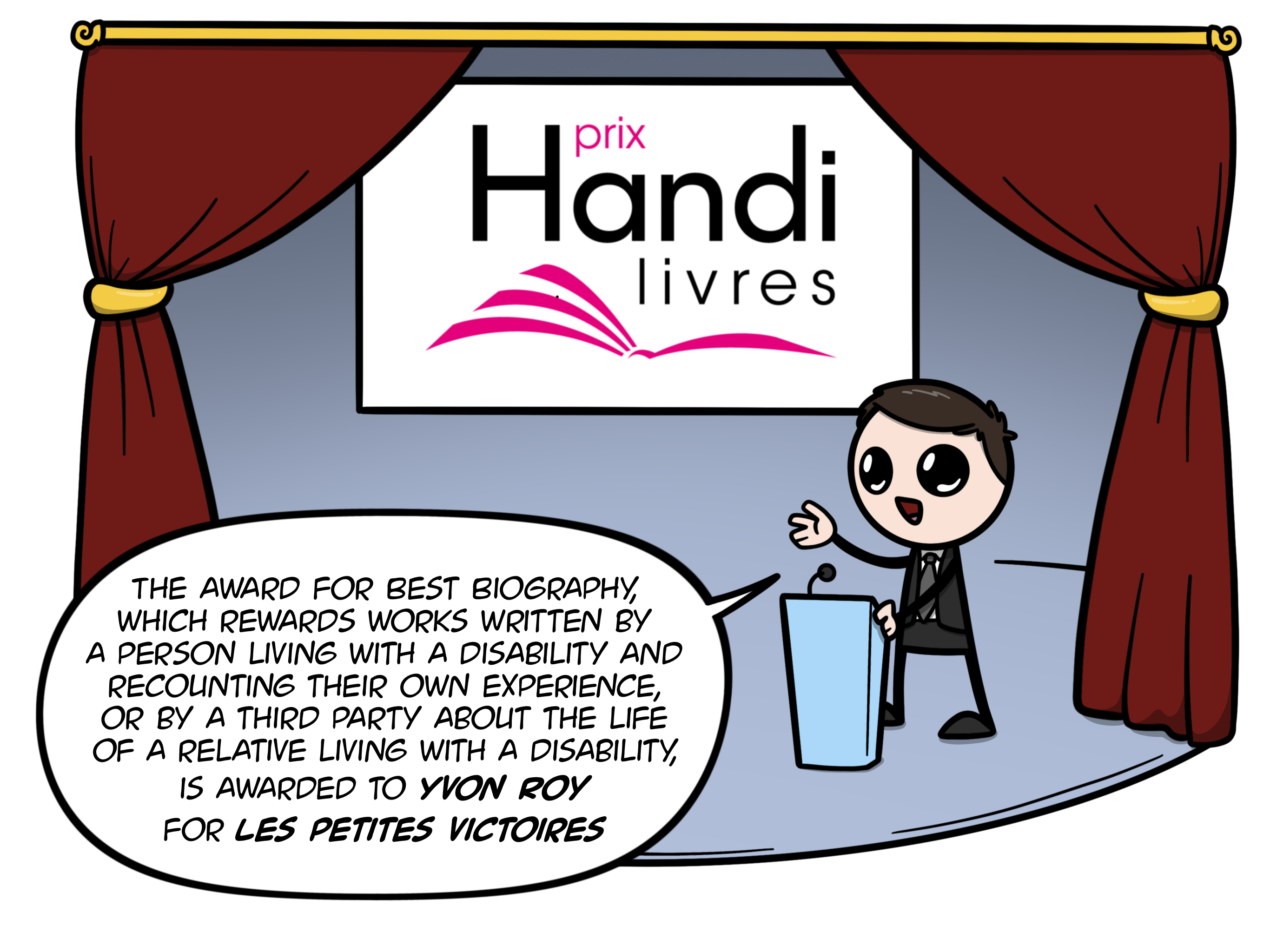
This comic book is an example of a creation that is easily accessible to the general public that has been awarded and highly publicized - even winning an award that recognizes works written by a person living with a disability and recounting their own experience, or by a third party about the life of a relative living with a disability. In 2018, the publisher Rue de Sèvres announced a contract for a film adaptation, which caused reactions and led to the hashtag :
#boycottlespetitesvictoires
As we will show, this is an example of the social representations of autism that perpetuate dominant understandings that do not fit the lived experience of those directly concerned to the point of being discriminatory. It is also difficult to identify moments when the child (the autistic character) shows agentivity. Instead, he’s passive in his father’s story. In a way, Olivier is only a supporting character. This is exaclty why representation doesn't mean autorepresentation and why "nothing about us whitout us" matters: although this comic is presented as a positive narrative from the allist perspective (3rd person), the story is completely different from the standpoint of the autistic community’s testimonies (1st person).
An allist person is a non-autistic person.
To understand the term "allist", we must go back to the origin of the word "autistic" which comes from the Greek word "autos" which means "self". So the word "autistic" initially referred to a person withdrawn on themself, who lives in their own world. The term "allist" appeared in a satirical article to refer to non-autistic people by swaping “autos” for "allos" which refers to others. So an allist is a person who is focused on others or, to flip the usual narrative, a person who lives in other people’s worlds.
In spite of the satire, the term “allist” has remained in use among others because it allows to distinguish between "neurotypicals" and "allists". There are people who are not autistic, but who are not neurotypical: a non-autistic dyslexic person, for example.
For a deconstruction
of the problematic propositions of the comic book:
But do you know the story from the autistic community’s perspective?
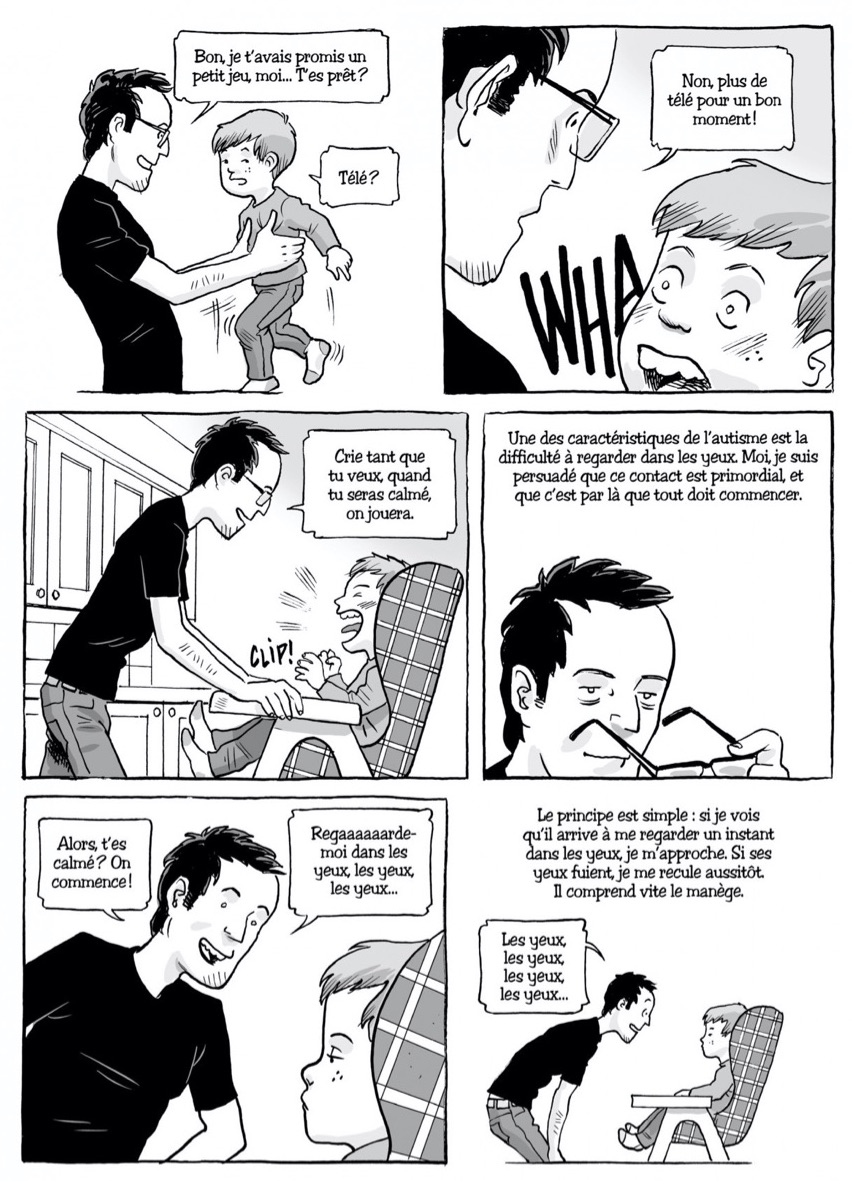
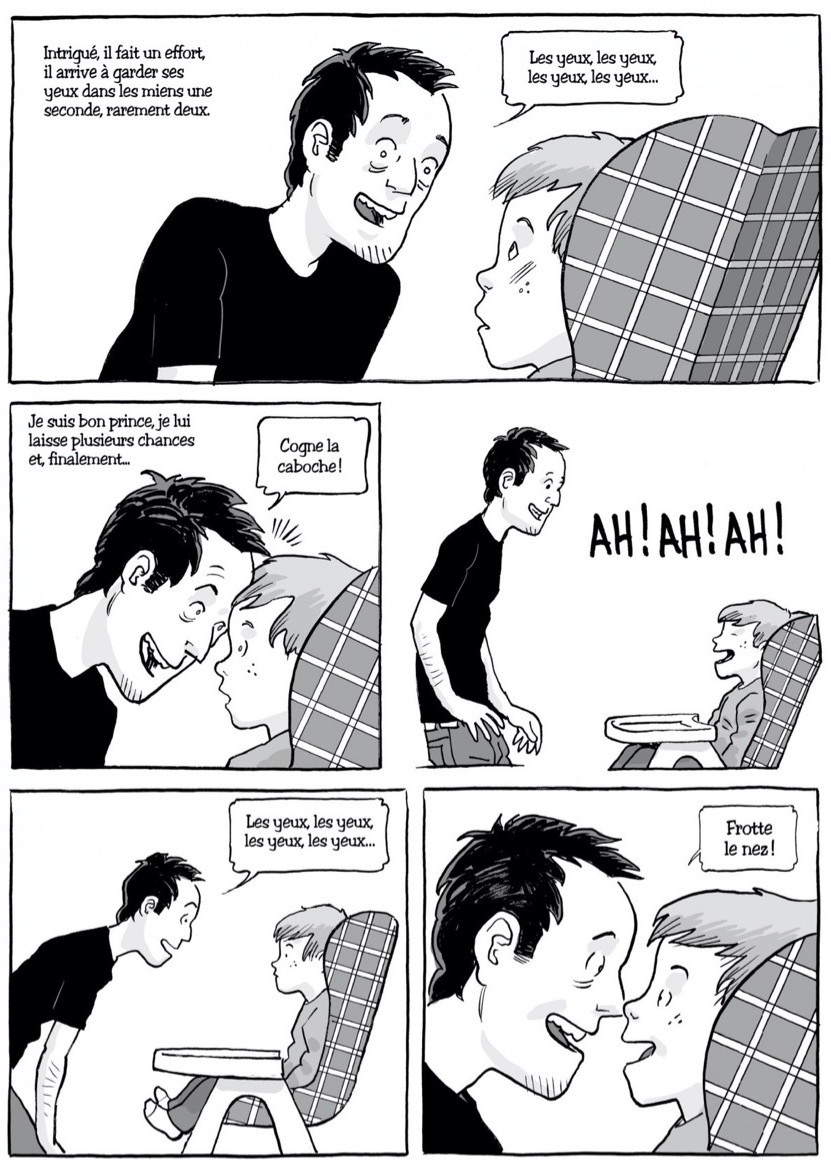
This is where webcomics can serve as an accessible tool that allows the reversal of dominant representations by opening the floor to self-representations directly grounded in marginalized communities. But before continuing with the topic of webcomics, we wish to feature an excerpt from Les Petites Victoires that addresses a frequent theme in autism: eye contact.
Excerpt on eye contact
English translation
English translation
Excerpt from Yvon Roy's interview
"I worked a bit like we can work to sometimes desensitize a substance. Sometimes certain people can have an allergy, we can try to desensitize them.
Several parents have contacted me regarding the trick to get the child to look in the eyes. This is the first thing we worked on together, that is to say, I considered that being able to look in the eyes - we know that autistic children have difficulty looking directly in the eyes - I said to myself, if we don't have eye contact, we have nothing. We need that, it's the beginning of human interaction." (our translation)
TW: The host uses the term “prison” in reference to autism:
"In your story that you shared with us in Les Petites Victoires, there is obviously the moment when you get up to face, to accompany your child in that reality: to learn to understand him too, inside what he lives and this prison, in a way, from which he is pressured which is basically this condition." (our translation)
Link to the interview (in French)
This scene is an example of neuronormativity
Recall that neuronormativity is the prevalent, neurotypical set of assumptions, norms, and practices that conceives of neurotypicality as the only acceptable or superior mode of cognition, and that stigmatizes attitudes, behaviors, or actions that reflect atypical modes of cognition as deviant or inferior.
This scene is told from the allist perspective and is presented with a positive outcome. In fact, as the author mentions, parents have applied this technique with their autistic children after being inspired by it.
But what if we ask autistic people how they feel about eye contact? That's exactly what we are going to do.
PART II
Why webcomics?
The medium of webcomic enables me to do something I don't know how to do otherwise: share how things feel on the inside.
Imagine. You come across a newspaper at the local coffee shop and recognize the face of a well-known personality. Yet you can't remember their name. It annoys you, you know you know it, it’s just not coming out, it stays there, on the tip of your tongue. You have time to come back to work, coffee in hand, and the name still hasn't come back to you, it still annoys you. You come across a colleague and you ask them, you describe the person, maybe clumsily at first (it would be so much easier with their name!), but you adjust to your interlocutor and, together, you can finally recall their name, it was so obvious!
It’s important to emphasize this feeling of annoyance. We rarely take the time to mention this annoyance when talking about epistemic injustices. Yet it is there, and it can even be painful: how do we make sense, to use Fricker's classic example, of our experience of sexual harassment when the concept does not yet exist? How can we share the feeling that something is wrong? This is where community comes into play and it is why the idea of "by and for" matters more than, say, a criterion of simplicity might. This is addressed by feminist epistemologies: for example, Longino argues for pragmatic values in science such as diffusion of power (as the importance of making research programs accessible to the actors involved in the research).
The impact of inadequate social representations on neurodiversity cannot be fully resolved by the traditional narrative of epistemic oppression and justice: adding new vocabulary to collective epistemic resources is not a panacea (we already have the word "autism" for example). So it is not only words that are missing, but rich and diverse lived experiences are also missing from the pool of shared resources.
The problem is that what is missing, the hermeneutical gaps, are not automatically apparent: social representations created by and for the dominant groups inadequately fill the hermeneutical gaps of marginalized groups. To that effect, let us recall here the Handi-Livre prize for the best biography which rewards works written by a person with a disability and telling his or her own experience, or by a third party on the life of a close relative with a disability: In the case of Les Petites Victoires, the award went to the biography of an allistic (non-autistic) person talking about autism. These inadequate social representations are difficult to resist: they are constantly and persistently reproduced. It is even harder when you don't have the words to replace theirs. But do we really have to wait for the right words to share our experiences? This is where illustration can become an attention grabbing action like shouting: an action that does not need words. This is what we propose here: a form of non-propositional epistemic resistance in response to hermeneutic injustice.
Webcomics are basically online comic books. They are mostly instantiated as short comics that take many forms and cover many topics. The most common form of webcomic is probably the blog (sometimes autobiographical, sometimes entirely fictional, sometimes both). Because they are mostly published independently by their artists, webcomics are an art form that is not limited by institutionalized power dynamics such as publishing houses or art galleries.
But the most important thing for us here is that webcomics are able to generate aesthetic experiences that allow viewers to better understand different aspects of the lived experience of neurodivergent people despite the inadequacy of mainstream epistemic resources.
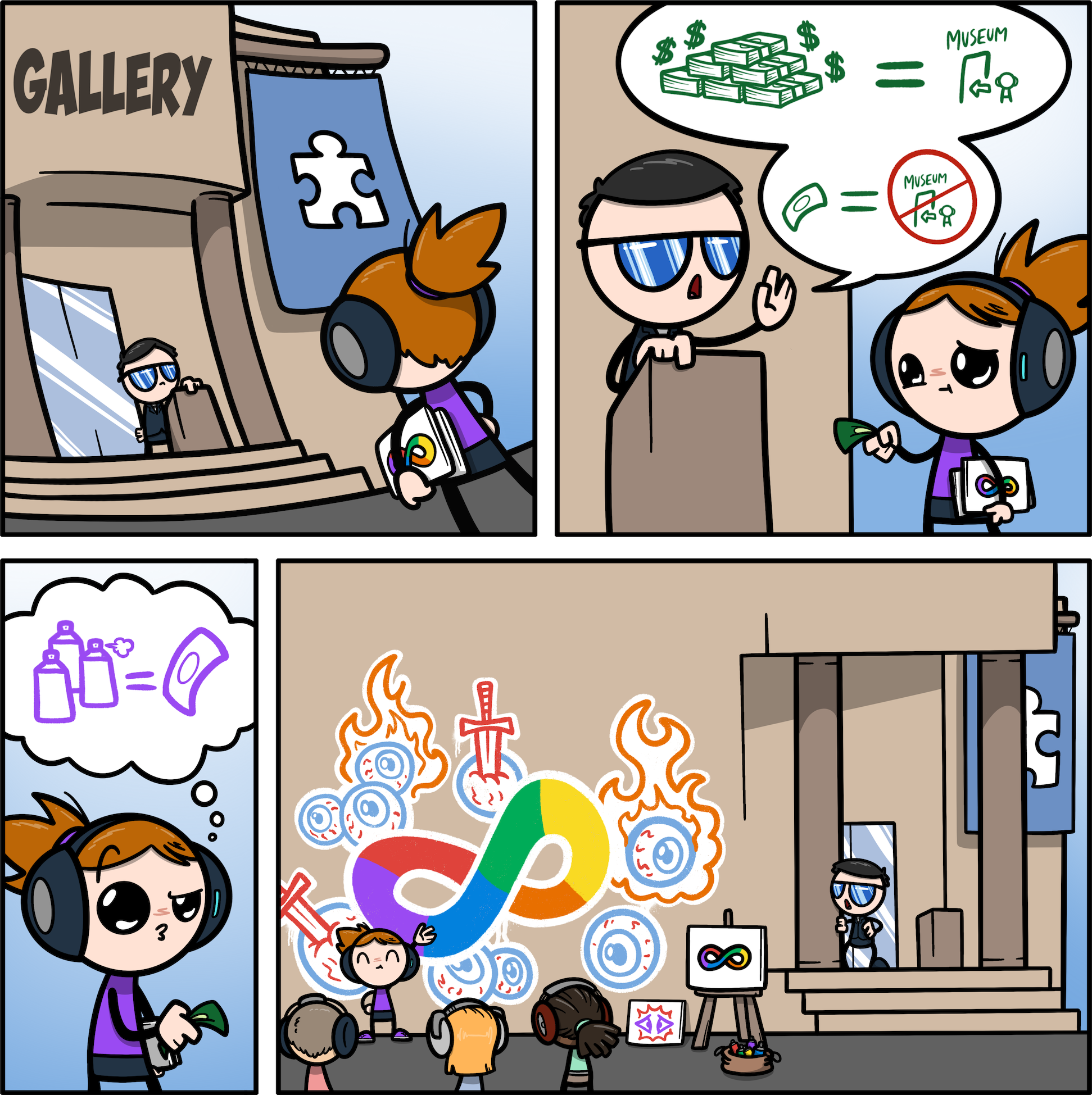
In some ways, webcomics are a digital version of street art.
Although limited to a given geographical space for street art and to a particular digital platform for webcomics, there is this common idea where it is not so much the public that goes to the creation as the creation that goes to the public. We are no longer in a reserved and predefined space like a museum, a bookstore, a gallery or even a library.
Although a recognized artist can make street art, it is more difficult for an artist who does not belong to a complex and influential network to access some places of diffusion such as an art gallery. Webcomic is thus added to the tools that allow the production, use and transmission of more accurate social representations, participating in the collective understandings of the oppressions suffered by epistemically marginalized groups. The public and interactional aspects of social media that support webcomics make them a catalyst for direct dialogue with (but also within and between) marginalized communities.
To put our epistemic resistance into action,
and to enhance our imaginative ressources, we chose to gather first-personal testimonies and descriptions of how eye contact can feel for autists.
After all, who better to provide insight into a given lived experience than those who live it? To do so, we used social media (instagram and facebook) to ask autistic followers of our webcomic (@lilyspectrum): How does eye contact feel to you? Although we are neurodivergent, it was important for us to go with the community beyond our individual experiences. For instance, we would never have thought of the sunburn idea on our own, but once we read those testimonies, it felt right.
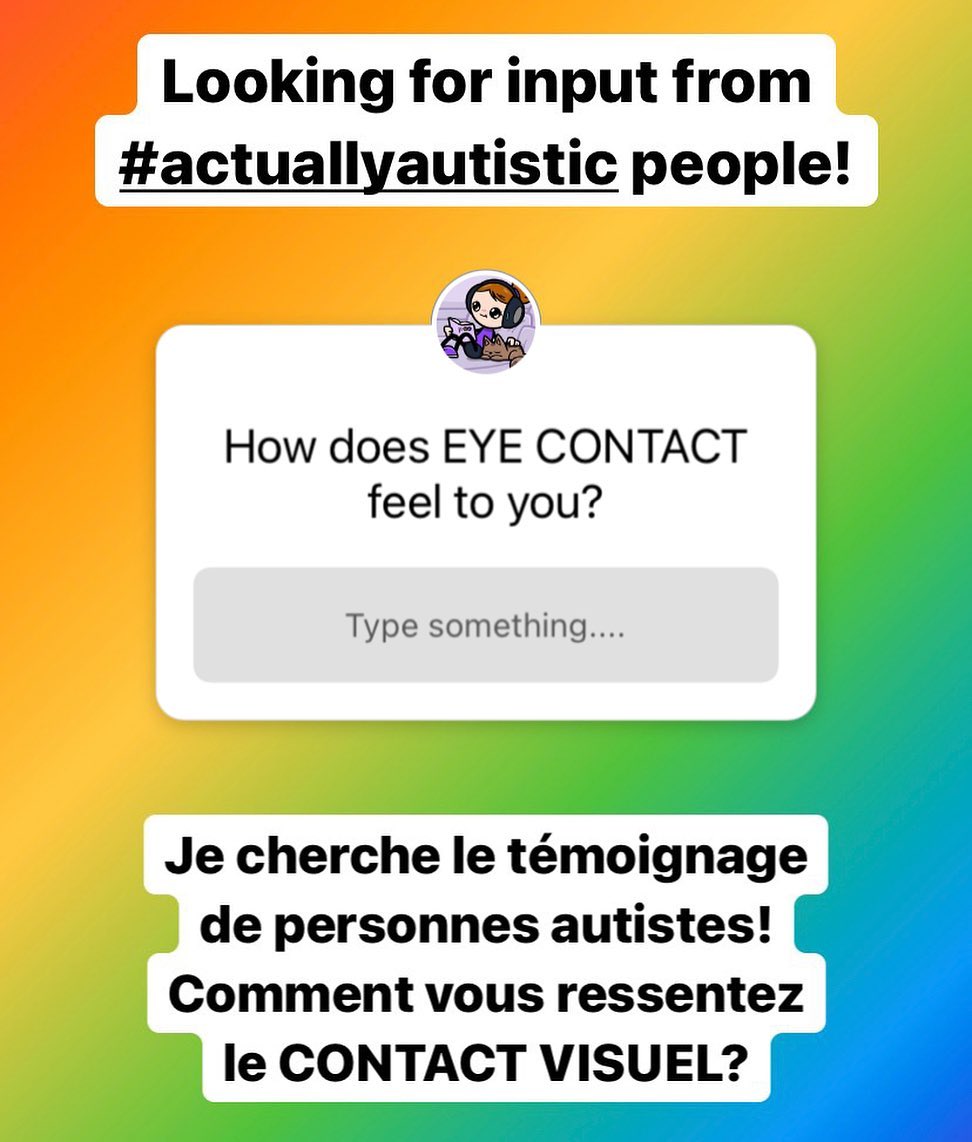
Both posts were made on November 8, and three days later, on November 11, we had received 175 testimonies. A few major themes emerged from these testimonies, which we used to base 7 webcomics or illustrations on. Keep in mind that, with this process, we do not claim to represent all there is to express about autists’ first-personal experience of eye contact. In fact, we suggest you visit these posts yourself to better understand the varied responses we got, and are still getting. And who knows, maybe this will allow you to add your own insight.
Publication
Since Monday, we have started to publish these comics on our social networks and we will continue to publish them in the following days
The interactions that take place around such webcomics are, we believe, an integral part of their complete aesthetic experience. These interactions often bring about clarifications, complementary details and descriptions or even added meaning. We thus invite you to visit these posts and interact with the community.
Webcomics
"I can do it but I can’t process anything else while doing it. My natural instinct and what feels the most right is to not look at someone’s face at all"
"It was drilled into me as a "rule" of politeness. I view it as just that, a rule. It's easy when there's multiple people because I can look around. But with one person, I have to look away or I end apparently end up staring"
"Everyone insisted on it, especially when they really wanted to correct a behavior or ensure I was paying attention. I honestly still don't love it, and prefer to look at noses or eyebrows to provide the impression I'm making eye contact"
"Eye contact was enforced during my childhood in mostly abusive ways and while it taught me to fake it, that made me hate it even more. Generally it just makes me uncomfortable and I find it quite distracting but it's also one of the most tiresome things to mask."
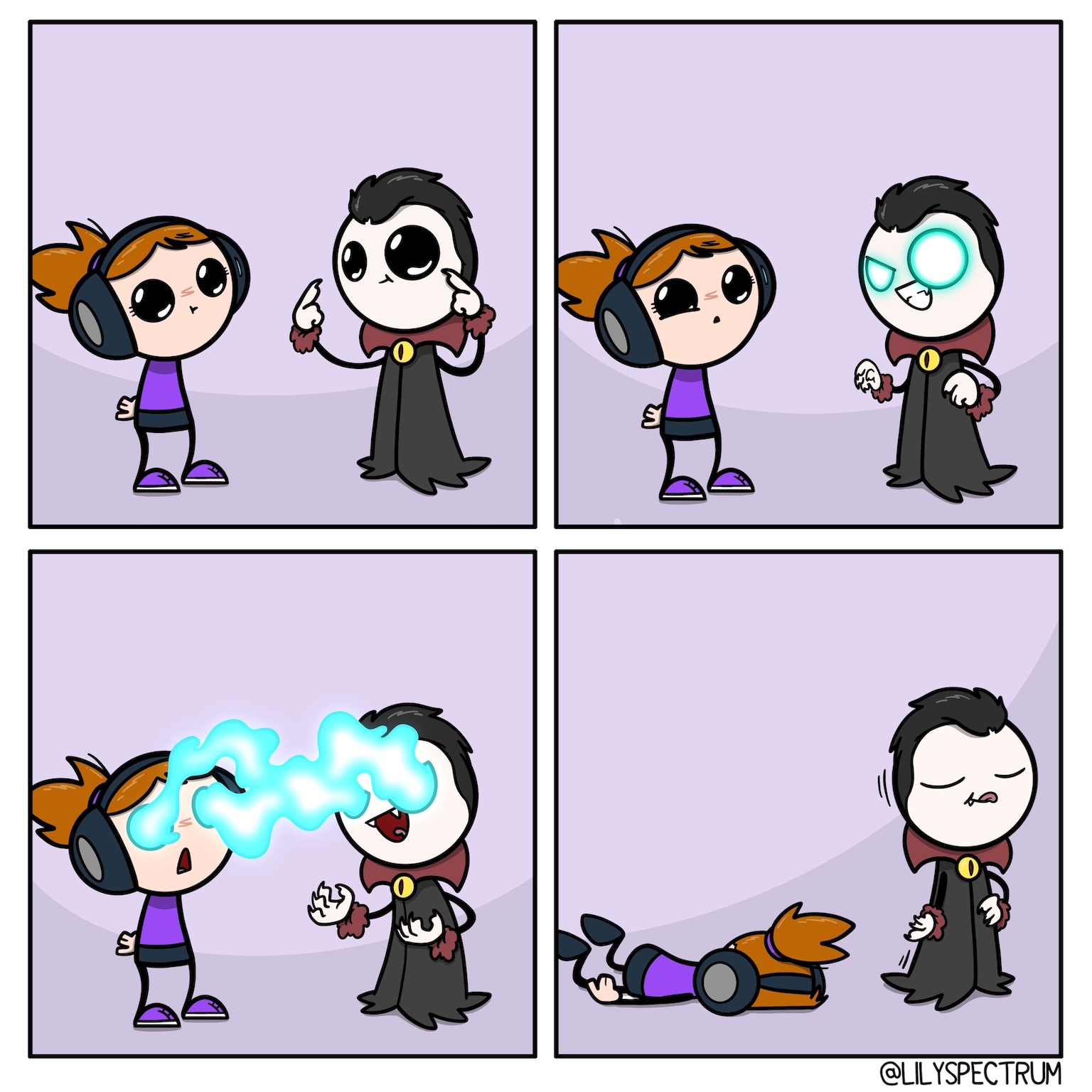
"Eye contact feels like they're staring into my soul, but with knives. I can make short eye contact before wanting to cry."
"It takes a concerted effort except for specific people."
"I’ve been so conditioned to make eye contact with people that when I met a lot of my friends for the first time they were kinda weirded out by me unblinkingly paying attention to them when they talked like 👁👄👁"
"It feels like someone is looking right past all my defenses and directly into my head. Not very pleasant."
"Terrifiant, j'ai vraiment l'impression qu'on me transperce à chaque fois …"
"Like I am being stabbed in the brain, itchy under the scalp, or suffocating. Anxiety is anxiety. I look at people's foreheads. They never know the difference but I am not forced to juggle the pain of eye contact and try to communicate. I am mostly non verbal and eye contact guarantees no words."
"Ça me met vraiment mal à l'aise et j'ai peur qu'on puisse mal interpréter si je regarde pas "correctement", je sais pas si je dois regarder quelqu'un dans les yeux ou combien de temps, il faut surtout pas que je regarde autre chose chez lui que ses yeux et du coup je sais pas quoi faire je préfère regarder le mur derrière mon interlocuteur 😂"
"Tout dépendra de la situation, de ma fatigue et de la personne. Certains contacts peuvent être transperçants (douloureux), d'autres envoutants (confusants), d'autres destabilisants (perturbants). En tous cas, si je regarde qqn dans les yeux, je suis sûr de perdre mon fil de pensée et/ou d'accorder mes réponses à ce que la personne ressent."
"Eye contact feels like burning discomfort, especially when I'm being told to do it."
"It’s extremely hard for me to maintain eye contact, and when people express to me that I should be looking at them when I’m talking to them, it puts me under more stress than just talking to them in the first place"
"somehow being told we should be making eye contact feels like being reprimanded as a child, at least to me.. I can't count the amount of times my mother would tell me to look her in the eyes as a child, and how humiliating/stressful it felt.. I legit forget to listen to people because I'm too busy trying to maintain eye contact."
"At best, awkward and uncomfortable. At worst, like someone's stabbed me in the eyes."
"It makes me uncomfortable but my mother forces me to look people in the eyes"
"Painful, but I feel like if I don't look ill be punished or called a liar. So I trained myself to look at something over their shoulder if not their foreheads to avoid harassment."
"Habituellement je regarde plutôt la bouche ou le nez des gens et ça semble passer crème pour donner l'illusion que je regarde dans les yeux (j'ai eu droit à l'expert en haute potentialité qui me disait que c'était impossible que je sois autiste car.. je le regardais dans les yeux ! Je regardais sa bouche depuis le début de l'entretien..). Je ne me force au contact visuel que de manière consciente et dans de rares cas précis : [suite]
(suite) par exemple si je suis attiré romantiquement par quelqu'un et désire que cette personne le perçoive (vu que le contact visuel accru est interprété de cette façon par beaucoup de neurotypiques). Mais cela reste un sacré effort et en général je détourne les yeux très rapidement, ça me met mal à l'aise, c'en est presque physique. Récemment un de nos profs en cours nous a fait faire une série d'exercices où on devait marcher vers quelqu'un/revenir à sa place à reculons en gardant le contact visuel constant avec cette personne.. je vous laisse deviner la torture que c'était"
"Transperçant!"
"J'ai l'impression que les yeux de la personne me percent à l'intérieur, je sais pas comment dire, c'est une sensation d'oppression aiguë."
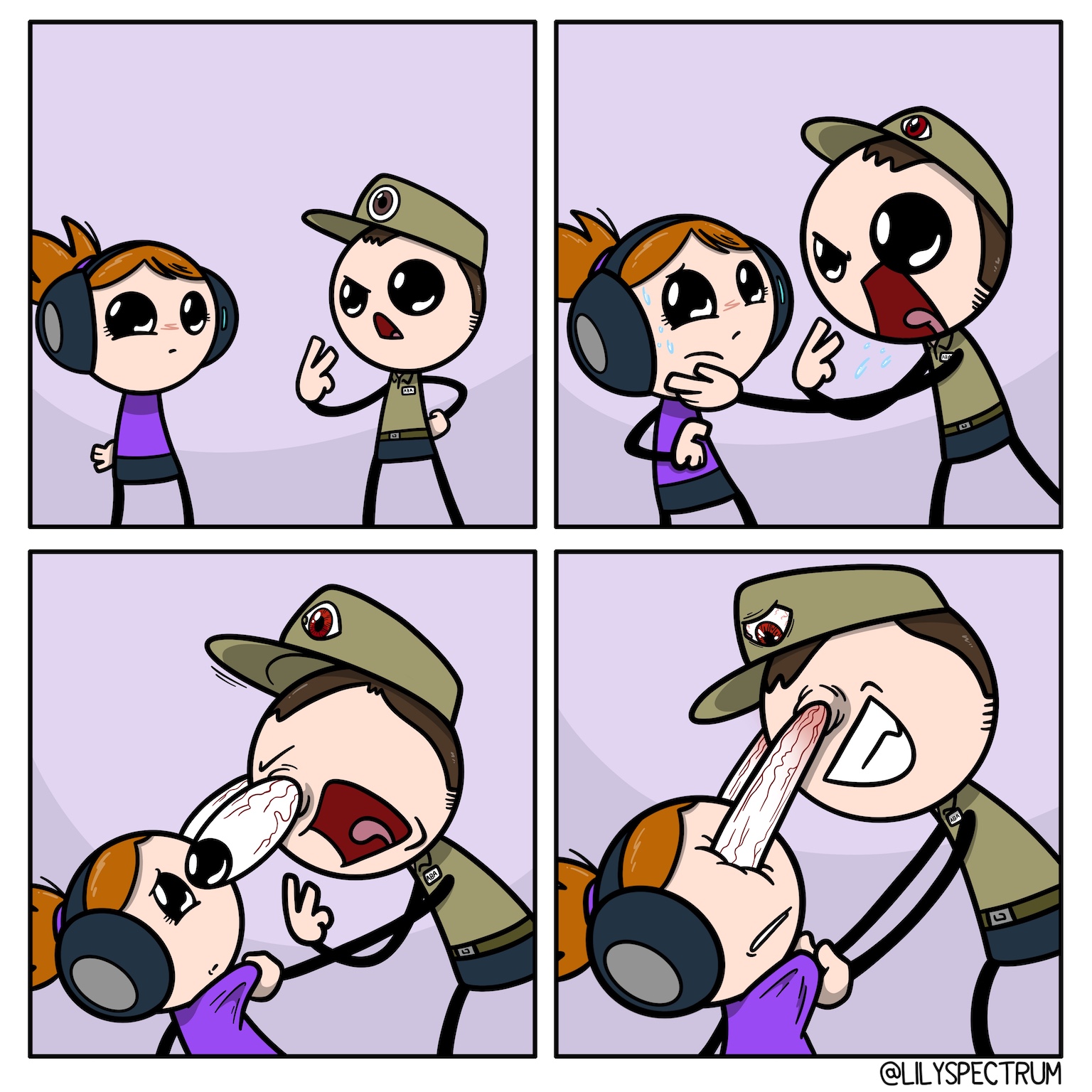
"For me, looking in the eyes feels too exposed and open. It makes me feel like I can't hide and protect myself from the people."
"Eye contact makes me uncomfortable most of the time, because of the feeling that I am being silently judged or getting talked about negatively."
"It's fine when I'm listening to someone but when I'm the one talking it makes me get stage fright like I'm being put on the spot to judge for performance lol"
"Too intimate, inappropriate… I become incredibly self conscious as well, like am I doing eye contact right? Should I be mirroring their behavior or a close approximation or complete opposite? How many times should I blink? Can they tell I’m faking this human interaction? It’s incredibly stressful."
"It feels like something is a required check box. It’s like a math problem. Look, one, two, three. Okay. Look away. Zone out if you need to. Okay, it’s been 10ish seconds. Look back. One, two, three.. okay, look away! Don’t share at them! Wait! You’ve looked away too long! Look back! …..it’s that on repeat quite often lol"
"I hate it I get so nervous and then I break down."
"I don't like it, makes me really uncomfortable. I'm "good at it", because I mask well (😬). I never know what to do, if I'm looking to much or not enough and always use a whole lot of energy just on eye contact. Generally, the more comfortable I feel the less I look someone in the eyes. (Also eyes as a body part make me feel really icky so that's that)."
"Intimidating and uncomfortable, I feel too vulnerable and keep thinking am I doing this right?"
"Ça me met vraiment mal à l'aise et j'ai peur qu'on puisse mal interpréter si je regarde pas "correctement", je sais pas si je dois regarder quelqu'un dans les yeux ou combien de temps, il faut surtout pas que je regarde autre chose chez lui que ses yeux et du coup je sais pas quoi faire je préfère regarder le mur derrière mon interlocuteur 😂"
"Eh bien, quand j’étais petit, je parlais et écoutais souvent le monde sans les regarder dans les yeux. Maintenant, ça me dérange pas de parler et écouter avec le contact visuel, mais j’peux très bien comprendre ce que le monde me dit sans obligatoirement les regarder dans les yeux. Aussi, c’est vrai que ça me rend un peu mal à l’aise quand des inconnus me fixe du regard. C’est comme s’ils me jugeaient et j’sais pas ce que j’ai fait de mal."
"Direct eye contact feels like I am being judged. It also makes me feel uncomfortable because I become unable to perceive and read the rest of their body language."
"Démunie, nue. Percée à jour. C’est très fort comme sensation, et rarement agréable. J’y arrive avec mes enfants ou mon mari, mais même dans ce cas, pas trop longtemps. Si je veux tenir une conversation, et me concentrer, alors je dois ruser. Je regarde entre les deux yeux ou le plus souvent la bouche."
"Feel nausea and anxiety, and extremely naked. Yet my mother was adamant that I learned it and therefore I am able to do it, despite the uncomfortable feelings. Absolutely love your work, for once I can tell that I am not alone"
"I feel instant stress and I have to force myself to do it and to look "natural"."
"Honestly, each time it happens to me, the most awkward feeling I have is « where should I look exactly » ? When you make eye contact, are you expected to focus one eye specifically (which one, then ?), between the eyes, not focus at all, or try a weird way of having each eye "looking" into the facing one (i.e. my left eye "looking at" their right one and vice-versa) ? I'm also never sure if/when eye contact is expected, and when it happens, is there/what is the hidden message behind this specific contact, and/or am I sending an incorrect hidden message myself ? Then, with all these questions actively consuming my brain "computing power", everything else totally miss the point (sometimes, though, I can hide this issue because I have this kind of ability to "replay" the last few words/sentence I unconsciously heard, to process it with a delay but potentially without the proper context- so it's not reliable at all !!). "
"Weird and artificial. I can actually read people's eyes now, but it took me years to learn it."
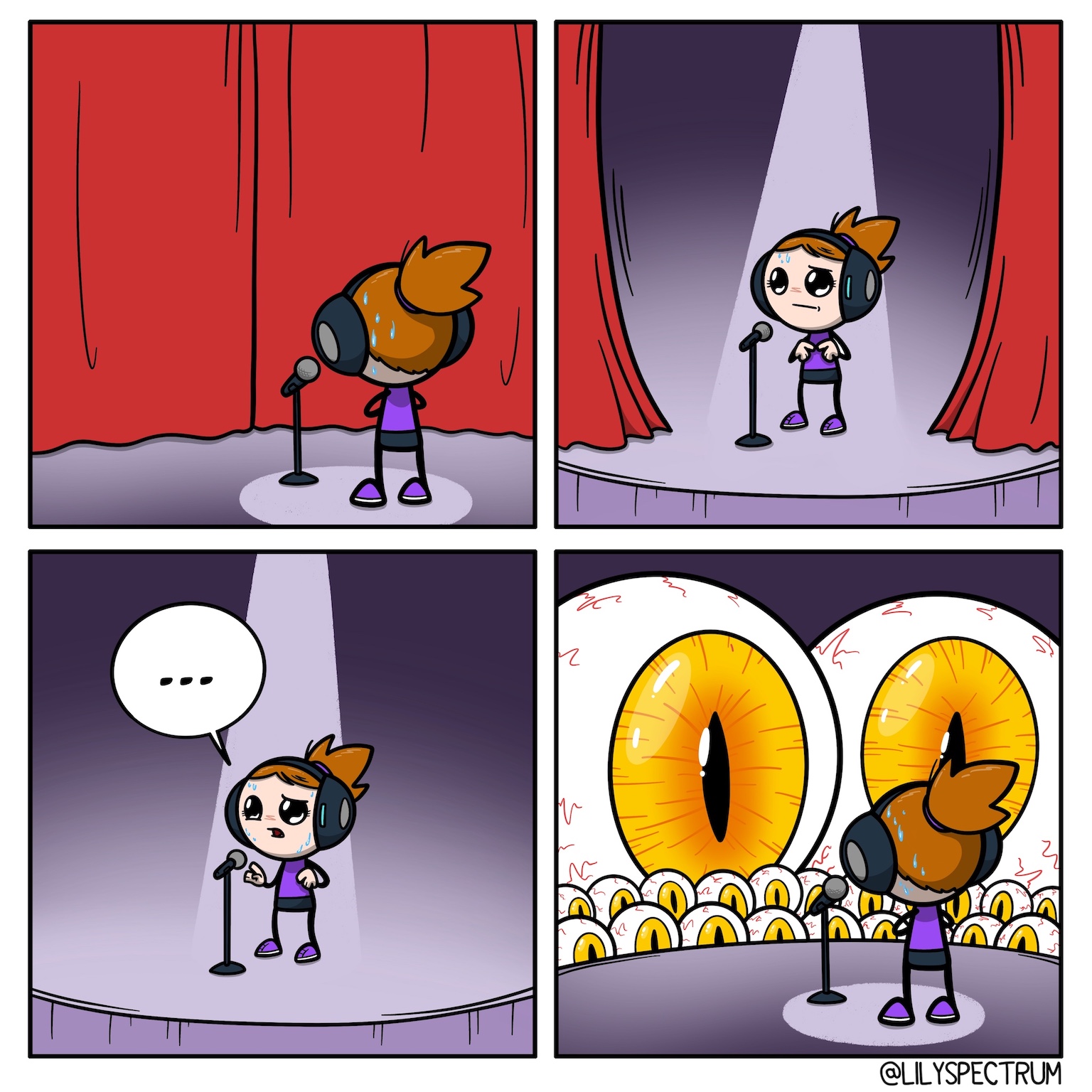
"My parents rasied me to always look into the eyes, still feels wrong. Like, I am invaiding a personal space and being rude. Like trying to stare down their soul and violating their privacy. I still try to look at people in the eyes but have learned to just looks in differents points in the face so I don't seem rude."
"Eye contact feels too intimate to me for most interactions. If I make eye contact with you, it’s because it’s important. "
"Eye contact feels very intimate. If I’m forced to hold it for too long, I feel violated, like I’ve been touched without consent."
"I really hate eye contact in almost all circumstances. About the only exception is with someone I'm very intimate with. Eye contact feels extremely intimate to me in general so it only feels natural when it's with someone I've got a suitably intimate emotional connection to. Otherwise it feels like I'm staring into someone's soul and I can see everything and they're staring into mine and seeing the same (even if I know they're not)."
"Invasive, extremely personal. I'm only comfortable looking my husband in the eyes"
"It feels like I’m standing too close to someone, I don’t know if that’s too vague of a comparison but it feels way too intimate. So I only do it when necessary or when I’m comfortable with that person."
"It feels creepy to me"
"I don't like it, makes me really uncomfortable. I'm "good at it", because I mask well (😬). I never know what to do, if I'm looking to much or not enough and always use a whole lot of energy just on eye contact. Generally, the more comfortable I feel the less I look someone in the eyes. (Also eyes as a body part make me feel really icky so that's that)."
"I hate eye contact. It almost hurts. But it’s nessesary to have a successful professional life, and my parents trained me well as a child. They would ask me people’s eye color after I met them to see if I made eye contact. Being trained like that at a very young age was incredibly difficult and felt unfair, but I’m very grateful that they pushed me now that I’m an adult."
"I can't do it, it makes me feel funny in a bad way and makes me feel kind of .. unsafe? and uncomfy I don't exactly know the word for the first one, I don't mind people looking at me but I won't look back"
"It's incredibly intimate and overwhelmingly so, particularly with strangers. And the more my emotions are revved up, the less I can tolerate it. It genuinely feels as though someone can see into my mind almost, even though I know that they can't. On the plus side, when I'm with someone I deeply, deeply love, sometimes that's okay because I want them to see how much I love them... but then that tends to make THEM feel awkward and uncomfortable too. LOL For me, it falls into the same category as standing too close, invading personal space, touching someone without consent etc. It's intimate, and can very easily become violating when you don't want it. And that;s so hard to explain to NT folk who expect you to look them in the eye all the time."
"It's okay with people I know, but I don't feel comfortable with eye contact with strangers, it almost feels like an invasion of privacy."
"eye contact feels so weird and creepy and if i have to make eye contact with someone, then ill quickly feel exhausted."
"It feels like a boundary rupture unless I completely and totally feel comfortable in a container of safety with another it probably won’t happen much."
"Well... I can't let anyone touch my eyeballs."
"Trop intrusif. Comme si l autre avait la perception de mes pensées. C est comme se montrer nue."
"Intense/ overwhelming/ fiery/ intrusive. Sometimes painful/ always difficult with strangers. Ok with intimate friends and family."
"Démunie, nue. Percée à jour. C’est très fort comme sensation, et rarement agréable. J’y arrive avec mes enfants ou mon mari, mais même dans ce cas, pas trop longtemps. Si je veux tenir une conversation, et me concentrer, alors je dois ruser. Je regarde entre les deux yeux ou le plus souvent la bouche."
"Feel nausea and anxiety, and extremely naked. Yet my mother was adamant that I learned it and therefore I am able to do it, despite the uncomfortable feelings. Absolutely love your work, for once I can tell that I am not alone"
"confronting and very intimate ..i feel naked"
"Quelque chose d'extrêmement intime, que je ne peux pas partager avec n'importe qui sinon je suis déstabilisée car je bloque sur cette sensation d'intimité forcée. Depuis le diagnostic, je me permets de ne plus regarder le visage des gens (je ne travaille pas). Quel soulagement!"
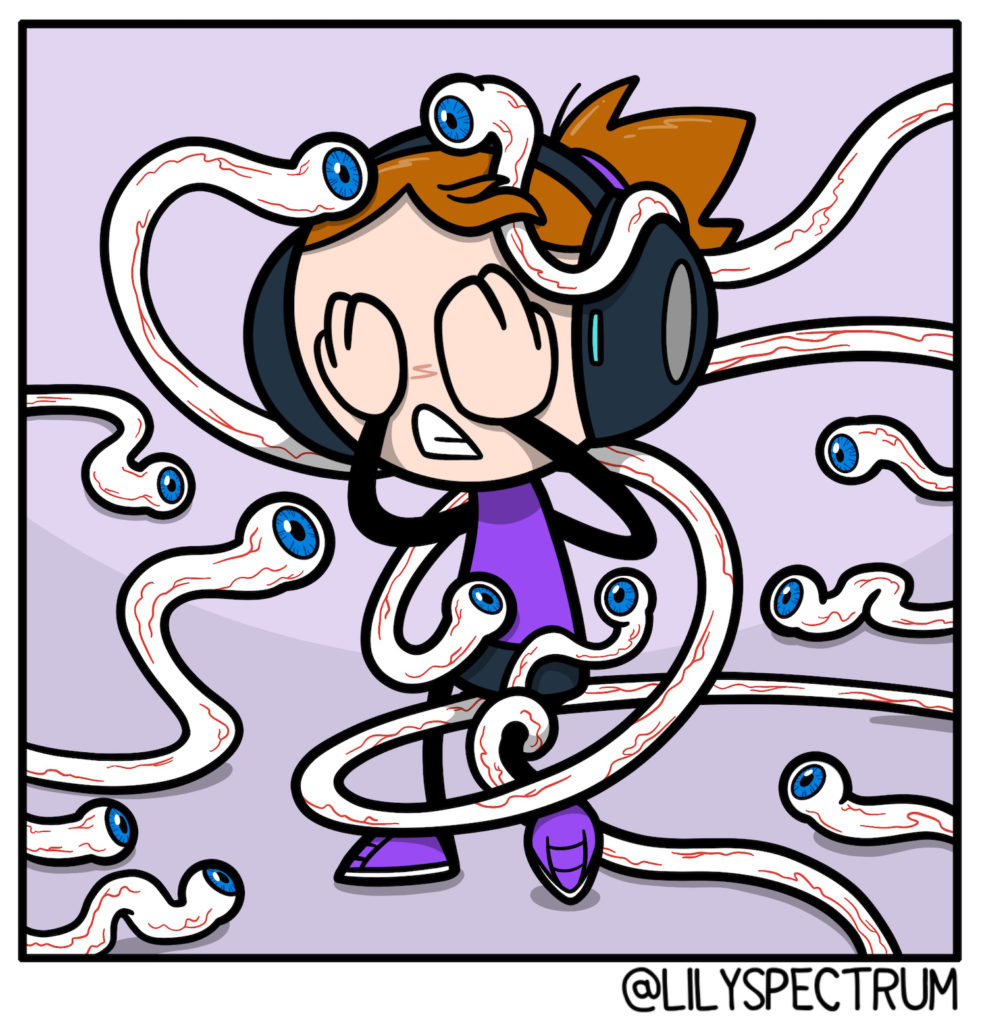
"Eye contact feels like they're staring into my soul, but with knives. I can make short eye contact before wanting to cry."
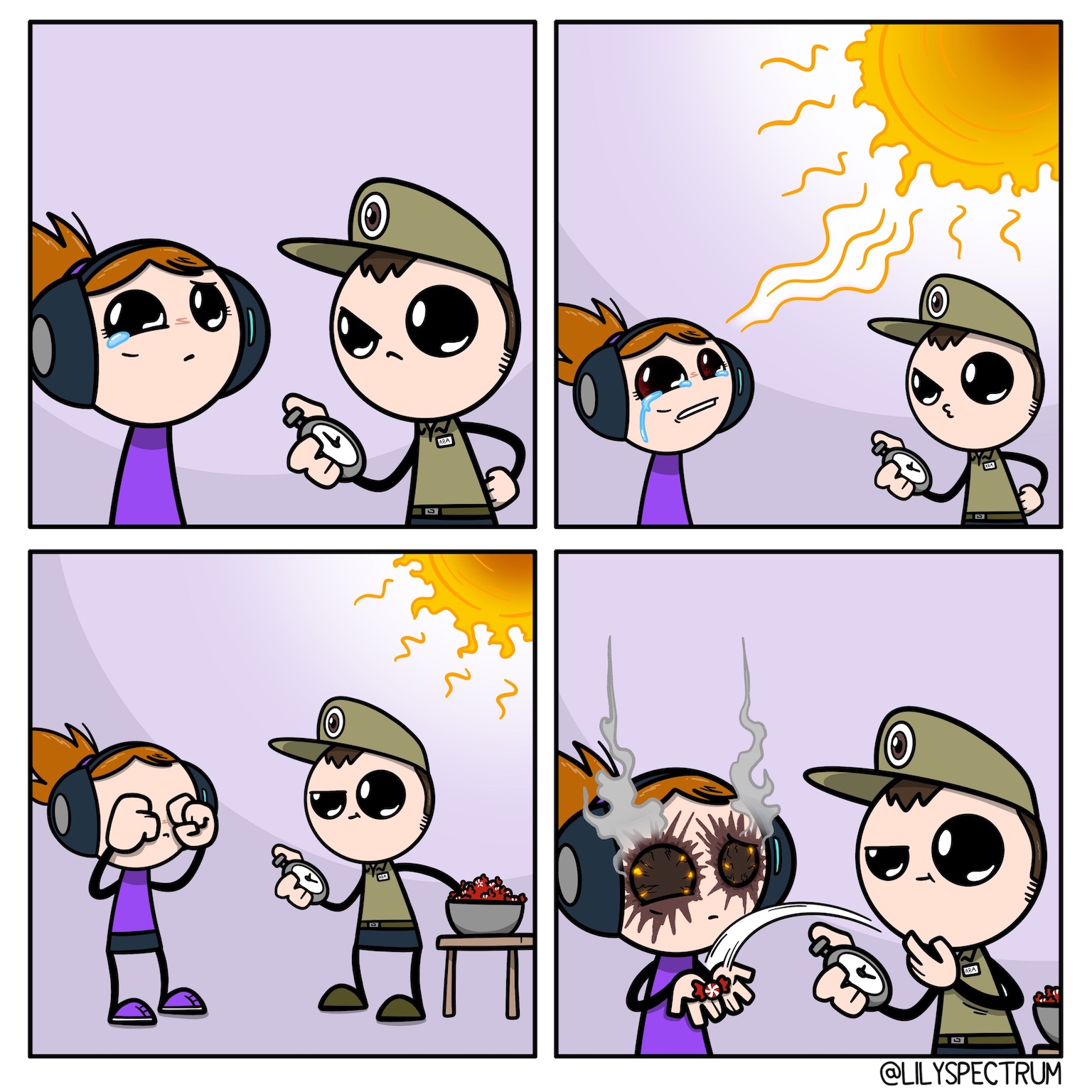
"It’s like being asked to look directly at the sun. I flinch, I can’t do it…"
"It feels like they gonna shoot me with laserbeams. Like Cyclops from X-Men. I van handle it for 10 seconds. I get panick attacks of it's to long. Even with my bf makes me on edge. I got a major panic attack during a being social etc exam (idk how it's in English is). It was so bad. They let me past because otherwise i needed to do the whole year over."
"Feels like I’m staring at the sun and I can only look a person in the eyes for 30 seconds or so before my eyes start to hurt a bit. I can only look animals in the eye."
"Like flames of intense awkwardness are scorching my retinas."
"When I was younger I always had trouble making eye contact. I’ve gotten better at it in recent years but its still painful to me."
"Eye contact feels like burning discomfort, especially when I'm being told to do it."
"Ça me demande beaucoup de concentration. J'ai l'impression que ça me fait mal aux yeux et quand j'étais plus jeune je pouvais même ne plus vraiment entendre ce que la personne me disait. Par contre ce n'est plus un problème quand je me mets vraiment en colère au point de vouloir me battre."
"Ca va de la gêne à la sensation de brûlure, ça dépend des personnes je suppose. On peut parfaitement regarder le nez, la bouche, entre les yeux sans que l'autre ne sen rende compte."
"I can’t think if I have to. Feels like pressure."
"Bad, I feel like my head is going to explode if I look at someone's eyes for too long. I suspect it's probably a blood pressure drop or adrenaline, but it feels awful. I honestly don't get why so many people require eye contact when speaking. I can make eye contact, but it's really difficult to understand what the person is saying because I'm too focused on how uncomfortable I feel and how incredibly awkward it is to stare at someone's eyes"
"It feels literally painful and I’m always afraid the other person can tell what I’m feeling/thinking. I’m comfortable with eye contact with very trusted folks in my life though."
"Painful"
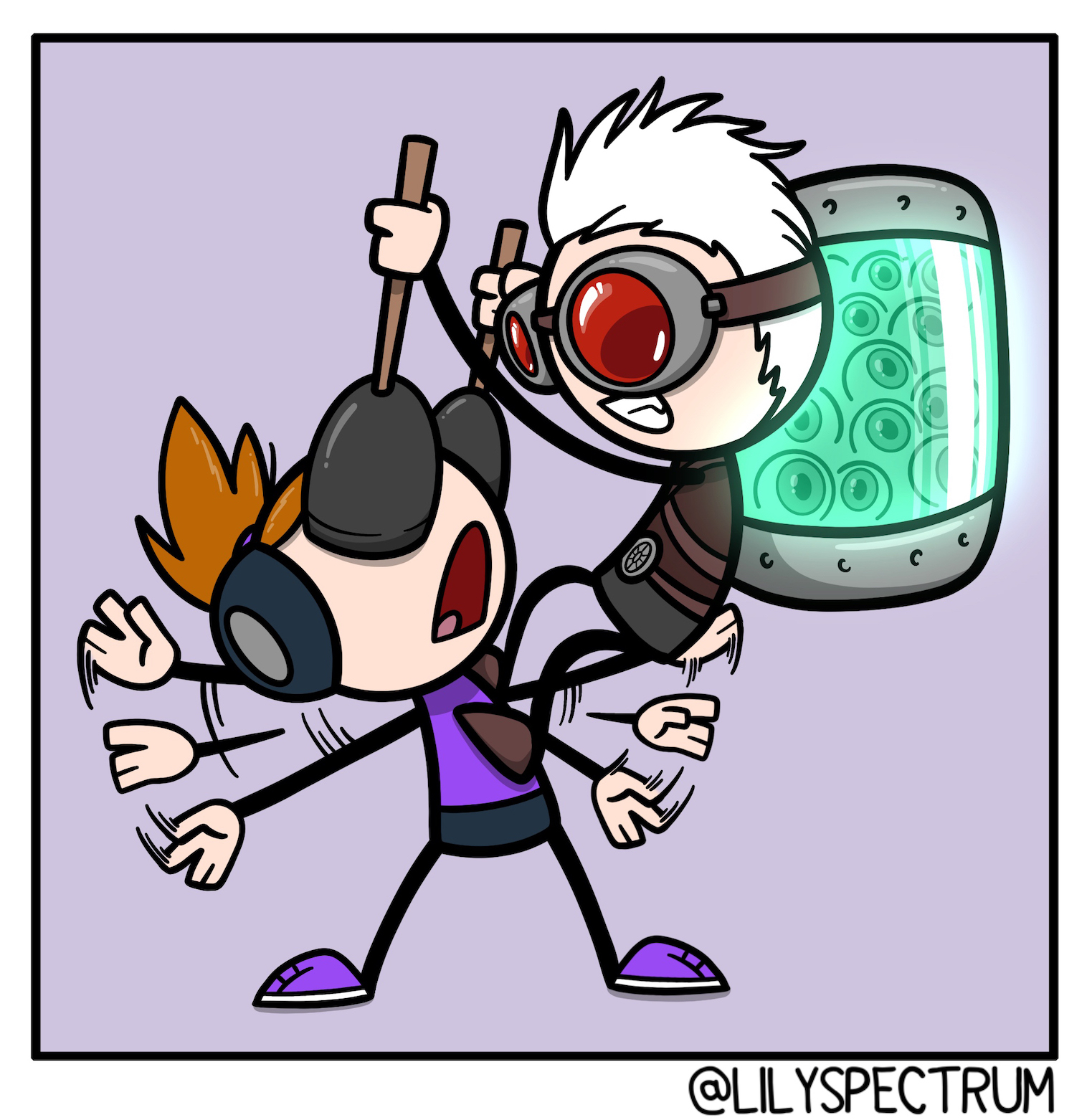
"I really hate eye contact in almost all circumstances. About the only exception is with someone I'm very intimate with. Eye contact feels extremely intimate to me in general so it only feels natural when it's with someone I've got a suitably intimate emotional connection to. Otherwise it feels like I'm staring into someone's soul and I can see everything and they're staring into mine and seeing the same (even if I know they're not)."
"I cant make eye contact with literally anyone. Its uncomfortable, and even when its not, i cant listen proberly to what people are saying when i focus on the eyes. I just cant do it at anytime with anyone, only for one second maximum. Its like staring into someone's soul, its too much."
"J’ai l’impression d’être absorbée par les yeux de la personne et en même temps comme si on pouvait voir ce qu’il y a à l’intérieur de moi."
"honestly it feels like i am being sucked into their soul… i can’t maintain it if i want a conversation because i just get lost"
"Like someone staring at my soul? I almost feel like that's the part of masking that exhausts me the most!"
"It's uncomfortable. But sometimes if I want to intimidate someone I stare deep into their eyes and make them feel unnerved like I'm looking into their soul."
"Tout dépendra de la situation, de ma fatigue et de la personne. Certains contacts peuvent être transperçants (douloureux), d'autres envoutants (confusants), d'autres destabilisants (perturbants). En tous cas, si je regarde qqn dans les yeux, je suis sûr de perdre mon fil de pensée et/ou d'accorder mes réponses à ce que la personne ressent."
"Trop intrusif. Comme si l autre avait la perception de mes pensées. C est comme se montrer nue."
"J’ai l’impression d’entrer dans l’âme de la personne. Je trouve ça trop privé. Alors je ne regarde que ceux dont j’ai vraiment envie de découvrir ce qu’il y a au plus profond d’eux même"
"I'm okay with it for small periods of time, but if it's more than a minute, I have to look away, it makes me super uncomfortable after that"
"It took me around 2 years to be able to do eye contact (kind of struggle still-) but normally if im uncomfortable looking at the eyes, ill just look at the nose instead"
"Awkward. The longest I can probably do it is for a few seconds, but sometimes it’s physically impossible for me to look someone in the eyes even for one second."
"Ça me met juste très mal à l’aise, et du coup je préfère regarder ailleurs et ne regarde les gens dans les yeux s’iels ne me regardent pas."
"Incapable de soutenir un eye contact sauf avec certaine personnes... Ma famille (ma mere, mon pere, ma soeur), ma nièce, mon beau frère et mon conjoint. Quelques amis specifique aussi... Mais sinon incapable. Je chercher tjrs a "évader" ses eye contact."
"Uncomfortable. I have trouble maintaining eye contact for long, especially in a conversation. However, I did figure out that talking with your hands is a great way to distract the other person's eyes from your and gives you a reason not to look at them."
"havent made eye contact with anyone (while i'm talking to them, that is) except my cats in years if that tells you anyone"
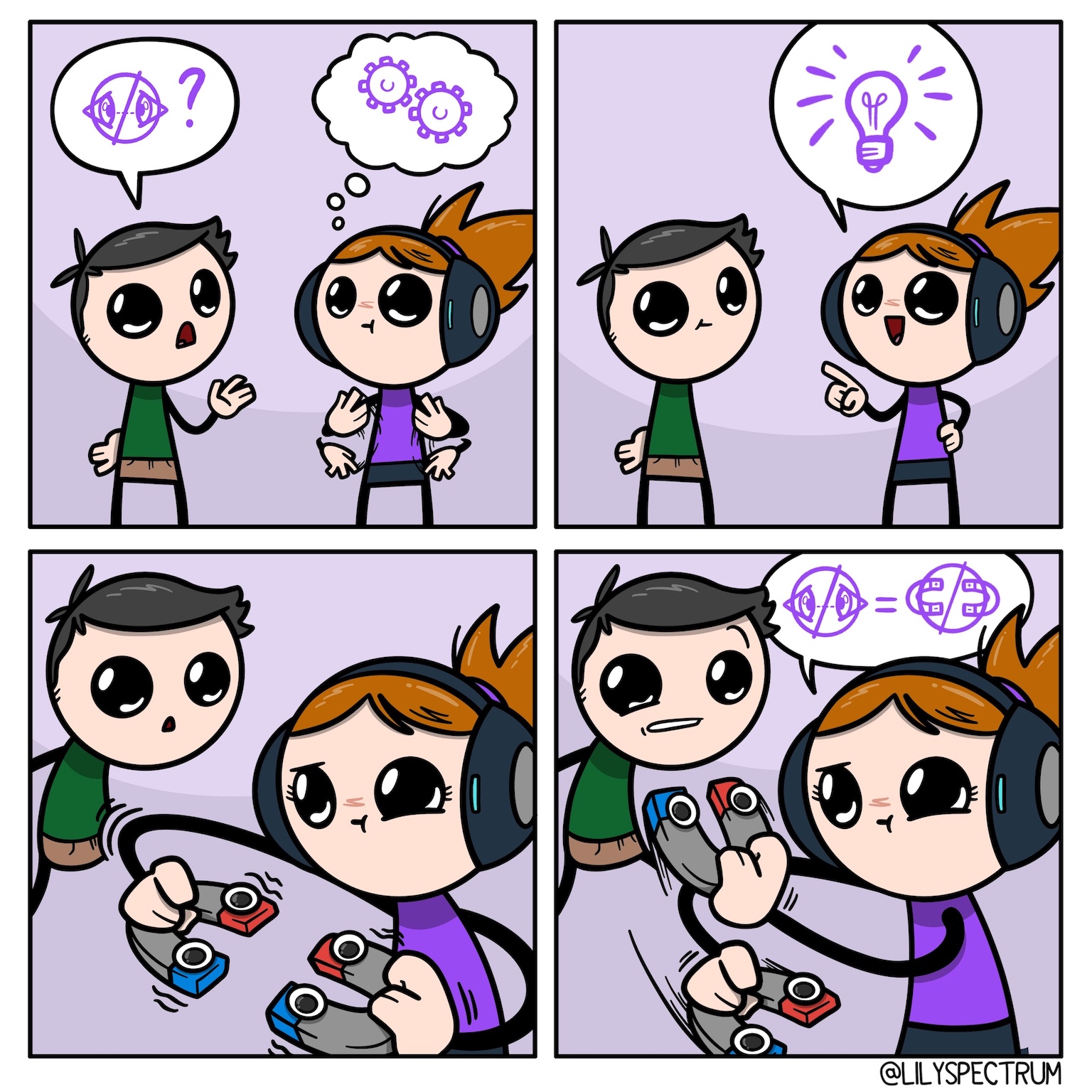
"When I was younger, it used to feel like when you held two magnets together both ends the same, it felt like no matter how hard you held them together, it would want to repel forcefully, my head wanted to repel and look past to the left or right or down or up like a magnet would, and when I managed to hold it against that feeling, my eyes would water up, not tears from sadness or anything, but they released tears, now I can manage it but it's still not comfortable to do, it depends on how comfortable I feel with the person or people or how stimulated I feel in an environment"
"It’s like when you hold two magnets with the same polarity against each other. Even if you want to put them together they won’t do it. The magnets are like my eyes. They just can’t center on the other persons eyes or it will cost a lot of energy. Like with holding magnets with the same polarity together. It’s just all in all very uncomfortable and draining. Btw I’m undiagnosed so I hope I can still answer here. Also I really really love your account and the stuff you do ^^ /g"
"Ça me met vraiment mal à l'aise et j'ai peur qu'on puisse mal interpréter si je regarde pas "correctement", je sais pas si je dois regarder quelqu'un dans les yeux ou combien de temps, il faut surtout pas que je regarde autre chose chez lui que ses yeux et du coup je sais pas quoi faire je préfère regarder le mur derrière mon interlocuteur 😂"
"Je me sens obligé de regarder chaque personne dans les yeux mais aussitôt que le contact est réciproque je baisse le regard aussi vite que mon ombre ainsi j'ai l'impression que j'ai fait ma part! haha! Par contre avec le monde avec qui je suis très, très à l'aise je vais quelque fois fixer les yeux, on dirait que j'essaie de comprendre pourquoi je fuis ceux des inconnus, alors je fixe en grand questionnement interne!"
"Awkward and physically painful , strong need to move my eyes away from it"
"Souvent trop intense… Et en plus il se passe tellement de choses autour des yeux qui m'intéressent plus et/ou me sécurisent plus! Je fixe puis je zappe, j'y reviens et je rezappe… Les sourcils, les lunettes, sont des bons compromis aussi, ou fixer mon regard dans le vague direction le visage ou le pourtour du visage… Ou fixer le visage avec une attitude très intéressée (posture corporelle de l'attention soutenue) quand la personne regarde AILLEURS, et quand son regard se tourne vers moi, fixer 1s seconde, sourire, et me tourner ailleurs vers qqn d'autre qui parle mais ne regarde pas vers moi à ce moment là, ou trouver à m'occuper avec un objet, et jongler comme ça."
"Je n'aime pas regarder sans les yeux, je ne sais pas, c'est plus fort que moi, je suis mal à l'aise, je ressens le besoin de regarder ailleurs. Du coup j'aime bien discuter quand je suis au resto ou quand on fait une activité, il y a l'excuse d'être occupée en même temps pour ne pas se regarder"
"Habituellement je regarde plutôt la bouche ou le nez des gens et ça semble passer crème pour donner l'illusion que je regarde dans les yeux (j'ai eu droit à l'expert en haute potentialité qui me disait que c'était impossible que je sois autiste car.. je le regardais dans les yeux ! Je regardais sa bouche depuis le début de l'entretien..). Je ne me force au contact visuel que de manière consciente et dans de rares cas précis : par exemple si je suis attiré romantiquement par quelqu'un et désire que cette personne le perçoive (vu que le contact visuel accru est interprété de cette façon par beaucoup de neurotypiques). Mais cela reste un sacré effort et en général je détourne les yeux très rapidement, ça me met mal à l'aise, c'en est presque physique. Récemment un de nos profs en cours nous a fait faire une série d'exercices où on devait marcher vers quelqu'un/revenir à sa place à reculons en gardant le contact visuel constant avec cette personne.. je vous laisse deviner la torture que c'était"
"Lorsque c'est quelqu'un avec qui je suis à l'aise ca va à une certaine distance mais de trop prêt je ressens un malaise assez vite. Si j'ai le malheur de croisé le regard avec un(e) inconnu(e) dans la rue ou dans un commerce, je regarde ailleurs aussitôt, gros malaise. C'est pour ça que j'évite de regarder les gens."
Thank you for joining us in this exploration!
We hope this experience was (and will be) as enriching for you as it was for us to come up with. We invite you to engage with us and the community through our posts or in the comments bellow!
This article covers what matters most. For solar providers in Chico, check out book solar energy consultation .
In case you are scouting for an invigorating modern approach to savor mobile gaming, the spingranny app has swiftly become a premier pick for aficionados everywhere spin granny download . Engineered to provide a seamless and user-friendly experience, this platform carries premium entertainment directly to your mobile. For players who appreciate diversity and ease, the spin granny app provides a robust dashboard that renders browsing effortless, if you are a leisurely player or a experienced pro.
To commence, the method is highly straightforward. Numerous folks look for the spingranny apk to verify they hold the most recent version of the application installed on their Android gadgets. Once you finish the spingranny download, you will gain instant entry to a vast catalog of games tailored for mobile play. The developers have perfected the utility so that the spin granny apk operates fluidly even on aged devices, making sure that no one loses out on the fun.
Selecting the ideal platform is vital for a safe gaming session. The spingranny casino app distinguishes itself by emphasizing player protection whilst offering absorbing features and regular updates. By choosing the official spin granny download, you are selecting a dependable provider that avoids the risks linked to untrusted external files. This devotion to quality is why the spin granny casino app has earned such a great reputation in the web circle.
Whether you happen to be at home or on the move, the platform secures that your active sessions are seamless and enjoyable. With its natural structure and rapid setup sequence, it has not ever been simpler to dive into your preferred titles. If you happen to be ready to improve your mobile gaming setup, it is time to explore the current iteration of this app. By getting your copy via the suggested paths, you are able to appreciate all the exclusive perks and bonuses that turn this application a favorite option among players nowadays. Try the difference for yourself by exploring what this mobile gaming app offers.
Thanks for the informative overview—this is exactly how I’d research solar providers in Antioch. solar contractors Antioch
Το πλατφόρμα slotsdj είναι ένα από τα πιο δημοφιλή συστήματα για ψηφιακά slots στην Ελλάδα και παγκοσμίως, προσφέροντας ποικιλία παχνιδιών με προηγμένης οπτική και ευχάριστη περίσταση παιχνιδιού slotsdj . Ο αξιόπιστος ιστότοπος slotsdj-casino έχει γίνει η αποδεκτή επιλογή χρηστών, κυρίως αυτών που αναζητούν ασφαλή και γρήγορη πρόσβαση σε διάφορα slots dj με ευνοϊκούς κανόνες και μεγάλες απολαβές. Σε την παρουσίαση αυτή θα αναλύσουμε συστηματικά τι προσφέρει η πλατφόρμα, πώς λειτουργεί και γιατί είναι απαραίτητο να την ερευνήσετε.
Το slotsdj casino ξεχωρίζει για την ποικιλία των παιχνιδιών που επιτρέπει, από παραδοσιακά slots μέχρι και μοντέρνα εκδόσεις με bonus features και jackpots. Οι αξιολογήσεις slotsdj είναι πολύ θετικές, με παίκτες να επισημαίνουν την ευκολία χρήσης, τα γρήγορα πληρωματικά συστήματα και την ασφάλεια των δεδομένων τους. Εάν ψάχνετε έναν αξιόπιστο σύνδεσμο slotsdj με γρήγορη πρόσβαση και αξιόπιστες λειτουργίες, η συσκευή αυτή αποτελεί εξαιρετική επιλογή.
Για όσους ενδιαφέρονται για slotsdj Ελλάδα, η συσκευή προσφέρει υποστήριξη σε ελληνική γλώσσα και ευνοϊκές προτάσεις για τους τοπικούς παίκτες. Οι όροι είναι διαφανείς, και οι όροι των βραβείων είναι προνομιακά ευνοϊκοί, κάτι που κάνει το slotsdj gr μια από τις καλύτερες επιλογές για online slots. Οι αξιολογήσεις slotsdj επιβεβαιώνουν ότι η πλατφόρμα είναι αξιόπιστη και προσφέρει μια απόλαυση χωρίς επιπλέον κόστους ή αόρατους όρους.
Εκτός από τα ψηφιακά slots, το casino slotsdj περιλαμβάνει και άλλα παιχνίδια τύχης, όπως poker, ρουλέτα και μπλάκτζακ, δυνατότητα στους παίκτες να επιλέξουν την αγαπημένη τους δραστηριότητα. Η συσκευή είναι προσβάσιμη σε όλους τους χρήστες με σύνδεση στο διαδίκτυο, επιτρέποντας μια ευχάριστη εμπειρία χωρίς εγκατάσταση λογισμικού. Αν ψάχνετε για μια αξιόπιστη και ευχάριστη εμπειρία στα slots, το casino slotsdj είναι η ιδεανική επιλογή για εσάς.
vecchie che si masturbano
Someone essentially help to make critically posts I might state.
That is the very first time I frequented your website page and to this
point? I amazed with the analysis you made to create this actual submit extraordinary.
Wonderful process!
The focus on customer reviews is spot-on when selecting solar providers in Davis. solar company in Davis
I appreciate the compassionate tone about drug detox in Albuquerque; learn more at Albuquerque detox centers .
The article is helpful for anyone searching for local support for drug detox in Palm Beach Gardens. 24/7 medical detox care
The article is helpful for anyone searching for local support for drug detox in Palm Beach Gardens. ##anyKeyword##
Great explanation of why medically supervised detox is often recommended in Charlotte. Charlotte addiction detox
Great explanation of why medically supervised detox is often recommended in Charlotte. ##anyKeyword##
I found the advice actionable. If you’re comparing solar providers in Chico, check out local solar power providers .
porno hratis
I found the advice actionable. If you’re comparing solar providers in Chico, check out ##anyKeyword##.
inout games chicken road 2, https://cirkles.online/2026/09/01/descubre-el-emocionante-mundo-de-chicken-road-2-una-aventura-unica-en-el-juego/ offers an exciting experience for players. Navigate through challenging terrains while avoiding obstacles. Work together with friends to achieve high scores and unlock fresh challenges.
I’m glad you mentioned local experience—solar providers in Grass Valley should know the area well. Learn more: solar companies in Grass Valley
I’m glad you mentioned local experience—solar providers in Grass Valley should know the area well. Learn more: ##anyKeyword##
مواد إباحية
Whenever you are hunting regarding the ideal way to begin your gaming experience, exploring the fresh promotions on the Spin Granny platform proves the total must spin granny bonus . The site offers a vast selection involving rewards tailored to boost your sessions alongside grow your chances of victories. Regardless of you could be some novice player or some repeat player, applying some spingranny bonus is the outstanding tactic to maximize your budget. Via navigating the main bonus page located at spingranny-review.com/bonus, you might remain informed on the highly latest promotions accessible for members currently.
To begin, it is essential to comprehend how to claim these prizes. Regularly, gamers look for some valid spingranny bonus code to access special packages. Using the correct spingranny promo code during your registration plus banking stage will offer you access to substantial advantages, including bonus prizes plus extra chips. Many gamers actively hunt towards some spingranny no deposit bonus code, which enables them to explore the gaming section without having to commit their own funds right away. This kind related to spingranny casino no deposit bonus is perfect towards sampling latest slots risk-free.
When you are set to play for real wins, making the spingranny casino deposit appears straightforward and safe. Each spin granny casino deposit will often get matched plus some starting offer, providing you a big spingranny casino bonus to enhance your time. Moreover, look towards frequent events which feature spingranny free spins in top slot titles, permitting you to turn the game more.
Always which each spin granny bonus includes defined rules alongside requirements, therefore always inspect the betting requirements prior to opting in. Through monitoring the fresh deals via trusted sources, you make certain which you never lose regarding extra benefits. Navigate to the specific incentive section to see which promos exist currently live plus begin your betting experience with some competitive edge that sustains the fun going. Using the right vouchers alongside offers at your fingertips, your stay at the portal will be much highly profitable.
Wer, sich fur unsere Sphare der Digital-Entertainment begeistert, landet zuvor bzw. spater bei Spino Gambino SpinoGambino . Damit das geschutztes und gerechtes Gaming-Erlebnis um gewahrleisten, bleibt dies entscheidend, jene vorhandenen Richtlinien plus Regeln auf der seriosen Webseite zukennen. Auf die Seite SpinoGambino-anmeldung.ch entdeckt jeder hierbei alle wichtigen Fakten, welche bezuglich zukunftige samt angemeldete Spieler von elementarer Bedeutung sind. Ehrlichkeit dominiert hierbei auf erster Stelle, weshalb einzelne Besucher prazise versteht, die Befugnisse sowie Lasten durch der Registrierung bei Spino Gambino verknupft existieren.
Jene Richtlinien behandeln verschiedene Sektoren auf, ausgehend einer Kreierung eines Spielerprofils bis hin bis Einhaltung jener bestehenden Altersbeschrankungen. Dies bleibt signifikant, zu begreifen, weshalb SpinoGambino gro?en Wert auf bedachtes Zocken legt. Die in dieser Website genannten Vorgaben helfen hierbei, ein serioses Setting zu etablieren, in welchem jener Vergnugen im Zentrum steht, wahrend zugleich Sicherheitsvorgaben eingehalten werden. Jeder, der individuell entscheidet, nahe Spino Gambino tatig zu agieren, musste hierfur weshalb die Mu?e nehmen, jene Regeln auf der besagten Infoseite sorgfaltig prufen.
Ein weiterer zentraler Faktor, welchen SpinoGambino in seinen Richtlinien thematisiert, wird die korrekte Verwaltung bezuglich Account-Daten und jener Verifizierung jener Personlichkeit. Dies schutzt keineswegs einzig das Betreiber, sondern vor allem die Zocker selbst gegen fremdem Zugriff. Wenn beim des Prozesses Unklarheiten entstehen, liefert jener Anforderungsprofil nahe Spino Gambino direkte Antworten sowie Vorgaben bezuglich ein reibungsloses Gaming-Erlebnis. Wer, jener Bedingungen von SpinoGambino begreift, handelt sicherer und gewinnt von einer klar strukturierten Plattform, die Anspruch auf Vertrauenswurdigkeit setzt.
Abschlie?end kann sich formulieren, weshalb die intensive Studie jener Regelwerke der Start- Punkt bezuglich jedweden bleibt, welcher individuell nahe Spino Gambino anmelden mochte. Jene Details formen das Fundament fur das transparentes sowie korrektes Zusammenspiel. Besuchen Sie die relevante Seite, damit optimal gewappnet um loszulegen und jegliche Vorteile, welche SpinoGambino an bieten besitzt, gema? Respektierung der definierte Vorgaben in ganzen Umfang zu auskosten. Seriositat sowie der verantwortungsvoller Verkehr bleiben dabei das Schlussel fur das dauerhaftes Spielspass an der Plattform.
bedste casino uden ROFUS, https://www.ststanislausathletics.org/2026/08/casino-uden-om-rofus-en-guide-til-spiloplevelser/ – Identifying the finest casino uden ROFUS is crucial for participants seeking unrestricted gaming experiences. Such casinos grant entry to diverse games minus the restrictions. Utilizing the ideal approach, players can take pleasure in exciting experiences as they gamble freely and comfortably. The best casino uden ROFUS provides a fantastic option to maximize winnings without additional limitations.
gioco book of dead, https://aimstormsolutions.com/wordpress/index.php/2026/08/31/scopri-i-segreti-del-gioco-slot-book-of-dead/ takes players on an exciting journey through ancient Egypt, in which they explore hidden treasures. Including stunning graphics and fascinating gameplay, it provides endless entertainment. Discover the legends of the pharaohs!
Thanks for sharing! If you’re researching solar providers in Antioch, this is worth a look: solar energy solutions company
This seems like a supportive starting point for Charlotte residents seeking detox. drug treatment Charlotte
This seems like a supportive starting point for Charlotte residents seeking detox. ##anyKeyword##
Το SlotsDJ είναι ένα από τα πιο δημοφιλή πλατφόρμες για φίλα των μασίνων σλότ, προσφέροντας μια μεγάλη επιλογή παχνιδιών με εξαιρετικές επιστροφές και ειδικές προσφορές slotsdj ελλάδα . Ο επίσημος ιστότοπος πλατφόρμα SlotsDJ έχει αποκτήσει την προσοχή πολλών παίκτων στην Ελλάδα και διεθνώς, κυρίως λόγω της ευκολίας χρήσης και της ποικιλίας των προσφερόμενων παχνιδιών.
Εάν ζητάτε για μια αξιόπιστη πηγή διασκέδασης με slot machine, αυτό το καζίνο μπορεί να είναι η καλύτερη προτάση.
Οι κριτικές για το SlotsDJ είναι γενικά θετικές, με πολλούς παίκτες να επιβεβαιώνουν την ποιότητα των παχνιδιών και την ασφάλεια της πλατφόρμας. Το casino προσφέρει πολύ μεγάλη γκάμα από κλασικά και και σύγχρονα σλότ, συμπεριλαμβανομένων παιχνιδιών με θεματικές όπως φαντασία ιστορικά γεγονότα όπως μοντέρνα blockbusters. Επιπλέον, η διαδικασία εντολής και συνδεσμολογίας είναι απλή και ταχύτατη, το οποίο επηρεάζει την προσέγγιση χρήστη ιδιαίτερα προτιμώμενη.
Εάν σας ενδιαφέρει να προσπαθήσετε το SlotsDJ στην Ελλάδα, ο αξιόπιστος ιστότοπος SlotsDJ είναι η πιο κατάλληλη επιλογή για να ξεκινήσετε. Η πλατφόρμα επιτρέπει διαφορές μορφές καταβολής και επιστροφών, συμπεριλαμβανομένων καρτών πιστωτικών και ηλεκτρονικών πορτοφολιών, καθιστώντας τις επιχειρήσεις ασφαλείς και ταχύτατες. Οι παίκτες μπορούν επίσης να χρησιμοποιήσουν ειδικές προσφορές και βραβεία, όπως δωρεάν γύροι και βόνους, που αυξάνουν τις πιθανότητες κέρδους.
Εάν ζητάτε μια αξιόπιστη συστήμα για μασίνες σλότ στην χώρα μας, το SlotsDJ είναι μια εξαιρετική προτάση. Οι κριτικές και τα αναφορές από άλλους χρήστες επιβεβαιώνουν την αξιοπιστία και την αξιοπιστία της πλατφόρμας, καθιστώντας την πιο κατάλληλη για όποιον θέλουν να απολαύσουν ψυχαγωγία με ασφάλεια και πρακτικότητα. Μην αποφύγετε την ευκαιρία να δοκιμάσετε αυτό το δημοφιλές casino και να απολαύσετε ένα μοναδικό εμπειρία με τα σλότ.
This post makes drug detox in Albuquerque feel less confusing; check drug detox near Albuquerque .
This post makes drug detox in Albuquerque feel less confusing; check ##anyKeyword##.
crypto casino without kyc, http://www.shitara-trail.jp/%e6%9c%aa%e5%88%86%e9%a1%9e/443744.html provides players with a unique chance to enjoy gaming without cumbersome verification. These platforms give users to play anonymously, promising privacy and security. Participants can discover various games while preserving their anonymity. In furthermore, getting involved in a crypto casino without kyc could boost your gaming experience significantly.
I appreciate your message about safety first and treatment continuity after detox. 24-hour drug detox Palm Beach Gardens
I appreciate your message about safety first and treatment continuity after detox. ##anyKeyword##
This post makes solar feel more approachable. For solar providers in Chico, start with solar companies in chico .
This post makes solar feel more approachable. For solar providers in Chico, start with ##anyKeyword##.
คลินิกสะอาด มาตรฐานเครื่องมือดี ดูใบรับรองที่ เมโสหน้าใส คือ
คลินิกสะอาด มาตรฐานเครื่องมือดี ดูใบรับรองที่ ##anyKeyword##
Unsere Cookie-Richtlinie von Spino Gambino spielt eine zentrale Rolle fur ein sicheres und offenes Spielerlebnis auf dieser Plattform SpinoGambino . Wenn Sie die Webseite SpinoGambino aufrufen, nutzen wir diverse Technologien an, um zu gewahrleisten, dass unsere Seite fehlerfrei lauft und genau auf Ihre personlichen Vorlieben angepasst ist. Transparenz ist uns dabei sehr wichtig, deswegen wir Sie in der Cookie-Richtlinie detailliert hieruber belehren, welche Daten erfasst sind und zu welchem Grund dies passiert.
Cookies reprasentieren kleine Textdateien, die beim Ihres Besuchs bei Spino Gambino auf Ihrem Endgerat hinterlegt werden. Jene Dateien unterstutzen uns dabei, Ihre Einstellungen zu speichern, wie beispielsweise Ihre favorisierte Sprachwahl oder Ihre Logindaten, sodass Sie nicht bei jedem Besuch wieder mit der Eingabe starten mussen. Zudem gebrauchen wir Cookies zur Analyse vom Nutzerverhaltens. Dies gestattet es dem Team von SpinoGambino, die Inhalte permanent zu optimieren und die Webseite zudem bedienungsfreundlicher zu gestalten. Ohne jene technischen Instrumente ware eine problemlose Navigation auf unserem Portal schwer moglich.
Selbstverstandlich besitzen Sie als Nutzer jederzeit volle Kontrolle uber die Verwendung von Cookies. Uber die Optionen Ihres Webbrowsers durfen Sie stets festlegen, welche Cookies Sie billigen oder abwahlen mochten. Vergessen Sie hingegen, dass die Deaktivierung gewisser technisch erforderlicher Cookies dazu animieren kann, dass etliche Funktionen von Spino Gambino nicht weiterhin wie erwartet zur Nutzung stehen. Wir empfehlen Ihnen somit, die Standardeinstellungen zu verwenden, um das perfekte Erlebnis zu gewahrleisten.
Sicherheit und Datenschutz befinden sich bei SpinoGambino an oberster Stelle. Unsere Cookie-Richtlinie basiert auf laufenden Uberprufungen, um sie permanent an die aktuellen rechtlichen Anforderungen in der Schweiz anzugleichen. Wir nutzen keine Tracking-Methoden, die Ihre Privatsphare unnotig gefahrden wurden. Wenn Sie Anfragen zu unserer Abwicklung von Daten oder besondere Anliegen wegen der hinterlegten Informationen haben, konnen Sie unsere Richtlinie stets auf unserer Webseite prufen. Wir bei Spino Gambino sind darauf ausgerichtet, Ihnen ein neutrales und sicheres Umfeld zu anbieten, in dem Sie sich jederzeit sicher wahnen konnen, wahrend Sie unser breites Angebot beanspruchen.
Great reminder that detox is the first step; learn more for Albuquerque at medically supervised detox .
Great reminder that detox is the first step; learn more for Albuquerque at ##anyKeyword##.
This is a great reminder that quitting isn’t always enough—drug detox in Palm Beach Gardens should be guided. outpatient medical drug detox
This is a great reminder that quitting isn’t always enough—drug detox in Palm Beach Gardens should be guided. ##anyKeyword##
cazzi enormi in culo
When exploring the digital sphere of web entertainment, ensuring your private data stays guarded is a major goal spin granny . Inside spingranny, we remain devoted to upholding complete clarity regarding how we manage your information. Our primary cookie policy outlines the particular methods we employ to boost your user session when accessing our site. Via accessing the spin granny site, you consent to our use of cookies, these are brief code packets saved on your system helping help us refine website speed and analyze visitor patterns.
These tracking units perform multiple vital functions. To start, they permit us to store your choices, making certain that your stay at spingranny is customized and smooth. Second, they provide our group using useful research information, helping us recognize where areas of spin granny are highly popular among our users, a factor subsequently enables us to improve our content and interface. Ultimately, some cookies are necessary so the primary operation of the platform to work accurately, including maintaining your session safety and confirming the site displays smoothly across distinct browsers.
We believe that our guests ought to possess absolute control over their online presence. Even though our portal counts on particular cookies to provide a high-quality experience, you have the power to control or block them through your software settings. Simply be mindful that choosing to restrict or deactivate some cookies could impact the operation of particular features within spingranny, possibly rendering it more hard to use or enjoy the platform to its maximum extent. We work to offer a protected, guarded, and welcoming environment to every visitor who interacts through spin granny. Regarding those eager in gathering more regarding how we guard your data or if you possess specific doubts concerning our information collection methods, we urge you to check our comprehensive policy frequently. Our aim is to maintain you aware and capable during the time you utilize the special amusement assets accessible via our site.
Great job explaining the next steps. More on solar providers in Antioch: best solar company Antioch
Great job explaining the next steps. More on solar providers in Antioch: ##anyKeyword##
I’m amazed at what properly-built fences can do – thank you for highlighting these talented # #ANYKEYWORD# http://seclub.org/main/goto/?url=https://zljf8.mssg.me/
I’m amazed at what properly-built fences can do – thank you for highlighting these talented # #ANYKEYWORD#
I appreciate the focus on comfort, monitoring, and safety in drug detox in charlotte. detox under medical supervision
I appreciate the focus on comfort, monitoring, and safety in drug detox in charlotte. ##anyKeyword##
uma plataforma online conhecida o site e uma opcao que os fas de casino de slots, notavelmente para busca entretenimento com azar slots dj .
Este link parece um ponto de acesso a selecao de slots, com versoes populares como casino DJ, que sao destacados por sua tematica de musica e sistemas de casino dinamicas. Ao acessar este endereco, os fas podem descobrir uma experiencia que junta praticidade com a excitacao de slots de jogo, perfeito quem os pretende divertir-se sem complicacoes.
Uma das maiores vantagens de optar por o casino e a simplicidade de acesso, uma vez que o endereco parece configurado ser ser diretamente atraves do browser, sem obrigatoriedade de downloads. Isso torna a sessao consideravelmente mais acessivel, notavelmente quem prefere divertir-se de modo rapida e sem burocracia. Alem disto, a plataforma parece oferecer uma ampla gama diversificada de slots, com versoes temas como slots DJ, que sao particularmente buscados por jogadores que adoram de casino que caracteristicas musicais e imagens apeteciveis.
Para quem esta buscando um slotsdj oficial site, e importante confirmar se a pagina atende os os requisitos de protecao e legislacao, garantindo uma sessao de jogo leal e confiavel. Uma boa opcao de checar a seguranca e acessar slotsdj review e slotsdj revisoes, onde outros utilizadores divulgam as suas opinioes e comentarios em relacao a a plataforma. Estes feedback podem facilitar a resolver duvidas sobre a excelencia dos jogos, a rapidez de transacoes e a credibilidade do site.
Em Portugal, o interesse por slotsdj casino online vem vindo, notavelmente entre os utilizadores que buscam escolhas protegidas e divertidas para passar o tempo. Ao escolher o casinos esta, os fas podem usufruir de uma sessao de jogo sem limitacoes, desde que respeitem as regulamentos locais em relacao aos casino. Se esta a um o casino virtual, ou de uma forma de jogar jogos de slot DJ de forma simples, este endereco pode uma otima opcao para comecar.
Em conclusao, slotsdj casino online apresenta uma resposta facil e eficiente quem deseja jogar casino sem problemas. Ao jogar esta plataforma, e sempre importante ler as avaliacoes e garantir que esta a jogar um casino seguro e seguro. Assim, podera apreciar de uma experiencia de casino agradavel e sem duvidas.